
In this work, I present a comprehensive method for transforming the spatial meshing problem of right-angle cylindrical worm gears into a simpler rack-and-pinion meshing problem. By leveraging the geometric specialities of orthogonal worm drives, I derive explicit conditions for the first-type limit points, second-type limit points, and the meshing axis. The analysis is supported by extensive tabular summaries and mathematical formulations, all aimed at simplifying the design and calculation of worm gears. Throughout this article, I emphasize the practical relevance of these transformations for improving the efficiency of worm gear systems.
1. Introduction
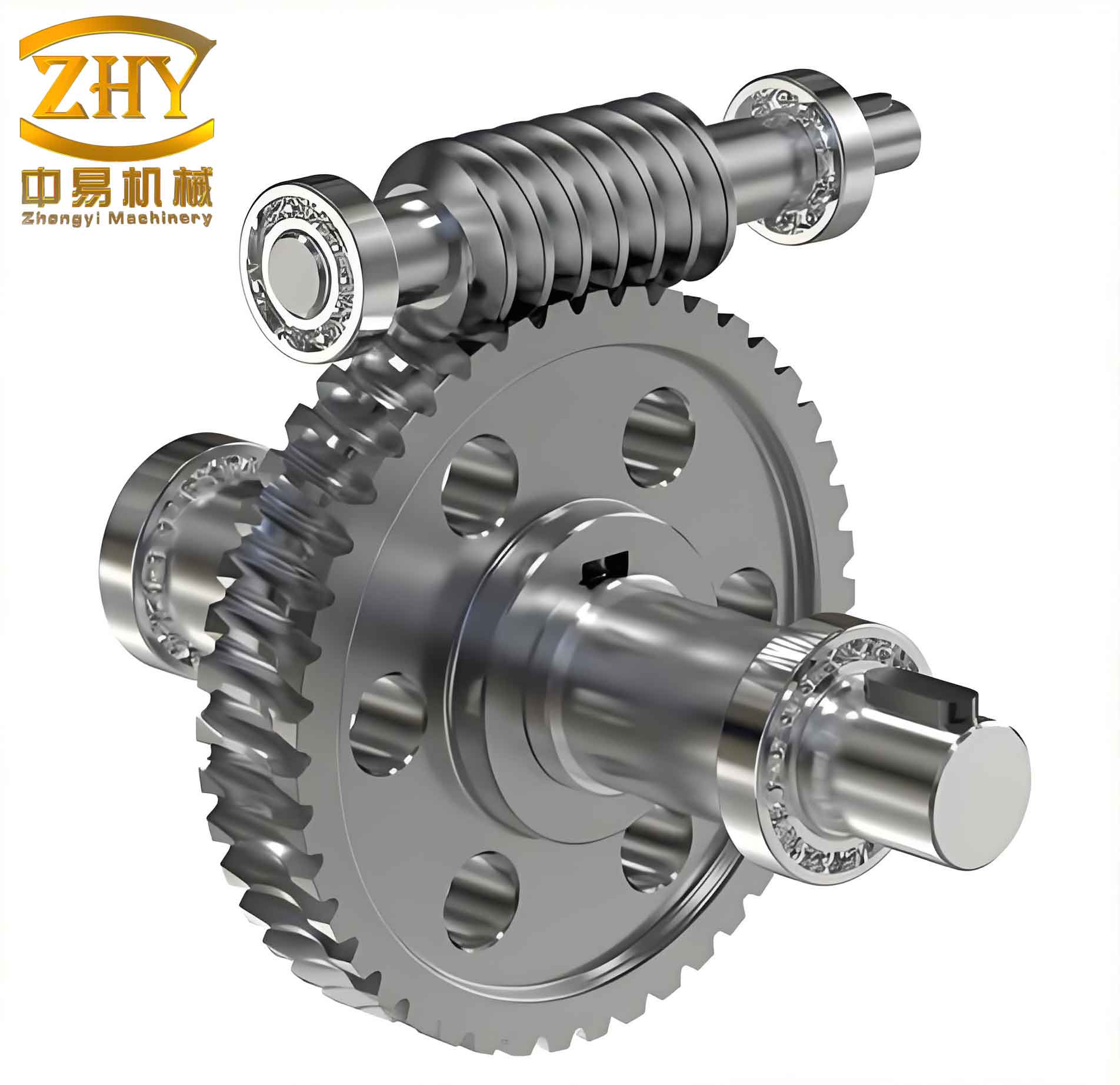
Worm gear pairs are widely used in power transmission due to their high reduction ratios and smooth operation. However, the spatial nature of their meshing often leads to complex analytical procedures. For the special case of right-angle cylindrical worm gears, I demonstrate that the relative motion between the worm and the worm wheel can be equivalently described by a rack (worm) and a gear (worm wheel) in planar motion. This conversion not only reduces the complexity of the governing equations but also provides clearer geometric insights into the meshing process. In the following sections, I systematically derive the transformed meshing conditions, limit points, and the existence of meshing axes, all while repeatedly highlighting their importance for the practical design of worm gears.
2. Coordinate Systems and Fundamental Relations
I establish two coordinate systems: the worm-fixed frame \( o_1-i_1j_1k_1 \) and the worm wheel-fixed frame \( o_2-i_2j_2k_2 \). The center distance is \( A \), and the angular velocity vectors are \( \boldsymbol{\omega}^{(1)} = k_1 \) (unit magnitude) and \( \boldsymbol{\omega}^{(2)} = I k_2 \) (with \( I = |\boldsymbol{\omega}^{(2)}|/|\boldsymbol{\omega}^{(1)}| \)). The orientation between the axes is defined by:
$$
i_2 = -i_1, \quad j_2 = -k_1, \quad k_2 = -j_1.
$$
The helical surface of the worm is given by:
$$
\boldsymbol{R}^{(1)} = \xi(u) \boldsymbol{e}(\lambda) + \eta(u) \boldsymbol{e}_1(\lambda) + (\zeta(u) + p\lambda) \boldsymbol{k}_1,
$$
where \( u, \lambda \) are surface parameters, \( p \) is the helix constant, and \( \boldsymbol{e}(\lambda), \boldsymbol{e}_1(\lambda) \) are circular vector functions. The family of surfaces generated by rotating the worm is:
$$
\boldsymbol{r}^{(1)} = B_1(\varphi_1) \boldsymbol{R}^{(1)} = \xi(u) \boldsymbol{e}(\lambda+\varphi_1) + \eta(u) \boldsymbol{e}_1(\lambda+\varphi_1) + (\zeta(u) + p\lambda) \boldsymbol{k}_1,
$$
where \( B_1(\varphi_1) \) is the rotation operator. Similarly, the worm wheel surface family is \( \boldsymbol{r}^{(2)} = B_2(\varphi_2) \boldsymbol{R}^{(2)} \). The general meshing condition is:
$$
f(u,\lambda,\varphi_1) = \left( \boldsymbol{\omega}^{(2)} \times \boldsymbol{r}^{(2)} – \boldsymbol{\omega}^{(1)} \times \boldsymbol{r}^{(1)} \right) \cdot \boldsymbol{n} = 0,
$$
with \( \boldsymbol{n} = \boldsymbol{r}^{(1)}_u \times \boldsymbol{r}^{(1)}_\lambda \). For helical surfaces, a key identity holds: \( (p \boldsymbol{\omega}^{(1)} + \boldsymbol{\omega}^{(1)} \times \boldsymbol{r}^{(1)}) \cdot \boldsymbol{n} = 0 \). Using this, the meshing condition simplifies to:
$$
f(u,\lambda,\varphi_1) = \left[ \boldsymbol{\omega}^{(2)} \times \boldsymbol{r}^{(2)} – (-p \boldsymbol{\omega}^{(1)}) \right] \cdot \boldsymbol{n} = 0.
$$
This equation interprets the relative motion as a rack (worm) translating with velocity \( -p \boldsymbol{\omega}^{(1)} \) and a gear (worm wheel) rotating. The derived pitch cylinder radius of the worm wheel becomes \( R_{2j} = p/I \).
| Symbol | Meaning | Mathematical expression |
|---|---|---|
| \( A \) | Center distance | – |
| \( p \) | Helix constant | – |
| \( I \) | Velocity ratio magnitude | \( I = |\boldsymbol{\omega}^{(2)}|/|\boldsymbol{\omega}^{(1)}| \) |
| \( R_{2j} \) | Derived pitch radius of worm wheel | \( R_{2j} = p/I \) |
| \( \boldsymbol{n} \) | Surface normal vector | \( \boldsymbol{r}^{(1)}_u \times \boldsymbol{r}^{(1)}_\lambda \) |
| \( \psi \) | Substituted parameter | \( \psi = \lambda + \varphi_1 \) |
The transformation from rotation to translation is evident by introducing \( \psi = \lambda + \varphi_1 \), which rewrites the worm surface family as a translating family along \( -k_1 \):
$$
\boldsymbol{r}^{(1)} = \xi \boldsymbol{e}(\psi) + \eta \boldsymbol{e}_1(\psi) + (\zeta + p\psi) \boldsymbol{k}_1 – p\varphi_1 \boldsymbol{k}_1.
$$
3. Conversion of Meshing Condition to Rack-and-Pinion Form
By defining the instantaneous axis (pitch line) as:
$$
\boldsymbol{r}_j = R_{1j} i_1 – Q j_1,
$$
where \( R_{1j} = A – R_{2j} \) and \( Q \) is a parameter, the fundamental theorem of gearing states that the common normal at the contact point must pass through this instantaneous axis. Hence:
$$
\boldsymbol{r}^{(1)} + S_0 \boldsymbol{n} = R_{1j} i_1 – Q_0 j_1,
$$
with:
$$
S_0 = -\frac{\boldsymbol{r}^{(1)} \cdot \boldsymbol{k}_1}{\boldsymbol{n} \cdot \boldsymbol{k}_1}, \quad Q_0 = -(\boldsymbol{r}^{(1)} + S_0 \boldsymbol{n}) \cdot \boldsymbol{j}_1.
$$
Cross-multiplying with \( \boldsymbol{j}_1 \times \boldsymbol{n} \) yields the simplified meshing condition:
$$
\left( \boldsymbol{r}^{(1)} \times \boldsymbol{j}_1 – R_{1j} \boldsymbol{k}_1 \right) \cdot \boldsymbol{n} = 0.
$$
This is equivalent to the earlier spatial condition and represents a planar meshing condition for the rack-and-pinion analogy. I can further verify this by substituting \( \boldsymbol{\omega}^{(2)} = -I j_1 \) and \( \boldsymbol{r}^{(2)} = \boldsymbol{r}^{(1)} – A i_1 \) into the original condition.
When intersecting the worm and wheel with a plane perpendicular to \( k_2 \), I obtain a pair of conjugate profiles: the worm section becomes a rack curve, and the wheel section becomes a gear tooth profile. The meshing condition in that plane is exactly the one given above. This is supported by the following proposition:
Proposition 1: For any non-singular point on a surface, the normal vector of the section curve, the normal vector of the surface, and the normal vector of the cutting plane are coplanar.
Thus, the system:
$$
\begin{cases}
\left( \boldsymbol{r}^{(1)} \times \boldsymbol{j}_1 – R_{1j} \boldsymbol{k}_1 \right) \cdot \boldsymbol{n} = 0, \\
\boldsymbol{r}^{(1)} \cdot \boldsymbol{j}_1 = C,
\end{cases}
$$
defines the meshing of the section profiles. The conjugate worm wheel tooth profile in that section is given by:
$$
\boldsymbol{R}^{(2)} = B_2^{-1}(\varphi_2) \left( \boldsymbol{r}^{(1)} – A i_1 \right).
$$
Consequently, the spatial meshing problem for worm gears reduces to a planar one. The intersection of the cutting plane with the instantaneous axis defines the pitch point; its intersection with the wheel axis gives the center of rotation; and its intersection with the meshing surface yields the meshing line.
| Feature | Spatial meshing | Converted planar (rack-and-pinion) |
|---|---|---|
| Worm representation | Helical surface, rotating | Rack curve, translating |
| Wheel representation | Gear tooth surface, rotating | Gear tooth profile, rotating |
| Meshing condition | \( (\boldsymbol{\omega}^{(2)} \times \boldsymbol{r}^{(2)} – \boldsymbol{\omega}^{(1)} \times \boldsymbol{r}^{(1)}) \cdot \boldsymbol{n} = 0 \) | \( (\boldsymbol{r}^{(1)} \times \boldsymbol{j}_1 – R_{1j} \boldsymbol{k}_1) \cdot \boldsymbol{n} = 0 \) |
| Relative motion | Two rotations around skew axes | Translation + rotation (rack and pinion) |
| Pitch element | Instantaneous screw axis | Instantaneous axis (pitch line) |
4. Equivalent Meshing Equation for Common Worm Gear Profiles
Three typical ruled-surface worm gears are considered: Archimedean, involute, and normal-rectilinear (with groove normal profile). For each, I examine the section at specific distances from the worm axis:
- Archimedean worm: section at \( \boldsymbol{r}^{(1)} \cdot \boldsymbol{j}_1 = 0 \) yields a rack with constant pressure angle.
- Involute worm: section at \( \boldsymbol{r}^{(1)} \cdot \boldsymbol{j}_1 = R_b \) (base circle radius).
- Normal-rectilinear worm: section at \( \boldsymbol{r}^{(1)} \cdot \boldsymbol{j}_1 = -R_h \) (reference cylinder radius).
In each case, the rack profile has a constant tooth angle, and from the meshing condition I derive that the conjugate worm wheel tooth profile in that plane is necessarily an involute curve. This is a powerful result that unifies the design of these common worm gears.
| Worm type | Section condition | Rack profile | Wheel profile |
|---|---|---|---|
| Archimedean | \( \boldsymbol{r}^{(1)} \cdot \boldsymbol{j}_1 = 0 \) | Straight line (constant angle) | Involute |
| Involute | \( \boldsymbol{r}^{(1)} \cdot \boldsymbol{j}_1 = R_b \) | Straight line (constant angle) | Involute |
| Normal-rectilinear | \( \boldsymbol{r}^{(1)} \cdot \boldsymbol{j}_1 = -R_h \) | Straight line (constant angle) | Involute |
5. First-Type Limit Points
In spatial meshing of worm gears, first-type limit points correspond to points on the conjugate surface where the meshing surface becomes singular or the envelope breaks down. I simplify the derivation using the following proposition:
Proposition 2: At a point on the conjugate surface corresponding to a first-type limit point on the meshing surface, the normal to the meshing surface intersects the axis of rotation of the conjugate surface.
Combining this with Proposition 1, I obtain a corollary for planar sections:
Corollary: At a first-type limit point on a conjugate curve, the normal to the meshing line passes through the center of rotation of the conjugate curve.
From the meshing condition \(\varphi_1 = \varphi_1(u,\lambda)\), the meshing surface in the wheel frame is:
$$
\boldsymbol{r}^{(2)} = \boldsymbol{r}^{(2)}(\varphi_1(u,\lambda), u, \lambda).
$$
Its normal vector is:
$$
\boldsymbol{n}_p = \boldsymbol{r}^{(2)}_u \times \boldsymbol{r}^{(2)}_\lambda.
$$
The first-type limit point condition is then:
$$
(\boldsymbol{r}^{(2)}, \boldsymbol{n}_p, \boldsymbol{k}_2) = 0.
$$
For the planar section case (cut by a plane perpendicular to \( k_2 \)), the condition reduces to:
$$
\begin{cases}
(\boldsymbol{r}^{(2)}, \boldsymbol{n}_p, \boldsymbol{k}_2) = 0, \\
\boldsymbol{r}^{(2)} \cdot \boldsymbol{k}_2 = C.
\end{cases}
$$
This provides a computational method to locate the first-type limit points without solving high-order differential equations.
| Context | Condition |
|---|---|
| Spatial meshing surface | \( (\boldsymbol{r}^{(2)}, \boldsymbol{n}_p, \boldsymbol{k}_2) = 0 \) |
| Planar section | \( (\boldsymbol{r}^{(2)}, \boldsymbol{n}_p, \boldsymbol{k}_2) = 0 \) and \( \boldsymbol{r}^{(2)} \cdot \boldsymbol{k}_2 = C \) |
6. Second-Type Limit Points
Second-type limit points in worm gears are associated with the envelope of contact lines and separate the conjugate region from the non-conjugate region. I consider the surface of normals (a ruled surface generated by the normal line of the worm surface as the worm rotates). Its equation is:
$$
\boldsymbol{r}_h(\lambda, u, \varphi_1, s) = \boldsymbol{r}^{(1)} + s \boldsymbol{n},
$$
where \( \varphi_1 \) and \( s \) are parameters. Within the conjugate region, the instantaneous axis (pitch line) must intersect this normal surface twice within a full rotation interval \( |\varphi_1| < 2\pi \). At the boundary (second-type limit point), the instantaneous axis becomes tangent to the normal surface. Hence, at \( s = S_0 \), the normal to the normal surface must be perpendicular to the instantaneous axis direction \( j_1 \):
$$
\begin{cases}
(\boldsymbol{r}_{h\varphi_1}, \boldsymbol{r}_{hs}, \boldsymbol{j}_1) = 0, \\
s = S_0.
\end{cases}
$$
This geometric condition is much more intuitive than the standard analytical approach. It directly relates to the visual concept of tangency between a line and a surface.
| Element | Mathematical expression |
|---|---|
| Normal surface | \( \boldsymbol{r}_h = \boldsymbol{r}^{(1)} + s \boldsymbol{n} \) |
| Tangency condition | \( (\boldsymbol{r}_{h\varphi_1}, \boldsymbol{r}_{hs}, \boldsymbol{j}_1) = 0 \) at \( s = S_0 \) |
| Interpretation | Instantaneous axis (\( j_1 \)-direction) is tangent to normal surface |
7. Meshing Axis
In skew-axis worm gears, there exist two fixed lines in space through which the common normals at all contact points of an instantaneous contact line pass. These are called meshing axes. For worm gears where one member is a helical surface, previous literature derived two meshing axes using complex mathematics. Using my rack-and-pinion analogy, I obtain the same result simply.
One meshing axis is precisely the instantaneous axis derived earlier:
$$
\boldsymbol{r}_{1f} = R_{1j} i_1 – Q j_1.
$$
To find the second meshing axis, I assume it has the form:
$$
\boldsymbol{r}_{2f} = R_{2f} i_1 + v (-\cos\alpha \, \boldsymbol{k}_1 + \sin\alpha \, \boldsymbol{j}_1),
$$
where \( R_{2f} \) is the intercept on \( i_1 \), \( \alpha \) is the angle with \( k_1 \), and \( v \) is a parameter. The two component angular velocities are chosen as \( \boldsymbol{\omega}_1 = \omega_1 j_1 \) and \( \boldsymbol{\omega}_2 = \omega_2 (-\cos\alpha \, \boldsymbol{k}_1 + \sin\alpha \, \boldsymbol{j}_1) \), satisfying:
$$
\boldsymbol{\omega}_1 + \boldsymbol{\omega}_2 = \boldsymbol{\omega}^{(2)} – \boldsymbol{\omega}^{(1)},
$$
$$
R_{1j} i_1 \times \boldsymbol{\omega}_1 + R_{2f} i_1 \times \boldsymbol{\omega}_2 – A i_1 \times \boldsymbol{\omega}^{(2)} = 0.
$$
Solving these yields:
$$
R_{2f} = 0, \quad \tan\alpha = \frac{p}{R_{1j}}.
$$
Thus, the second meshing axis passes through the origin and is inclined at the lead angle of the worm’s pitch cylinder. This elegant result confirms the existence of two meshing axes in worm gears and provides a direct geometric construction.
| Axis | Equation | Remarks |
|---|---|---|
| First meshing axis | \( \boldsymbol{r}_{1f} = R_{1j} i_1 – Q j_1 \) | Instantaneous axis (pitch line) |
| Second meshing axis | \( \boldsymbol{r}_{2f} = v (-\sin\alpha \, \boldsymbol{k}_1 + \cos\alpha \, \boldsymbol{j}_1) \) with \( \tan\alpha = p/R_{1j} \) | Passes through origin, angle = lead angle |
8. Conclusion
In this article, I have demonstrated a systematic framework for transforming the spatial meshing of right-angle cylindrical worm gears into an equivalent planar rack-and-pinion problem. The key contributions include:
- Derivation of a simplified meshing condition that directly yields the instantaneous axis and rack profiles.
- Application to common worm gear types (Archimedean, involute, normal-rectilinear), showing that the conjugate wheel profiles are involutes in the appropriate sections.
- Geometric conditions for first-type and second-type limit points based on intersection properties of normals and the instantaneous axis.
- Simple determination of the two meshing axes, confirming that one coincides with the pitch line and the other is inclined at the worm’s lead angle.
These results significantly reduce the analytical burden in designing worm gears and offer clear visual interpretations. Engineers working with worm gears can directly apply the rack-and-pinion analogy to quickly evaluate meshing performance, avoid undercutting, and optimize tooth forms. The method is valid for any cylindrical worm gear satisfying orthogonality and constant lead conditions, whether ruled or non-ruled surfaces.
| Property | Original spatial form | Converted planar form |
|---|---|---|
| Meshing condition | Vector triple product | Scalar product with instantaneous axis |
| First-type limit | Determinant condition on meshing surface | Sectional line normal through rotation center |
| Second-type limit | Envelope of contact lines | Tangency of instantaneous axis to normal surface |
| Meshing axes | Two skew lines in space | One pitch line, one inclined line |
The simplifications achieved here are particularly beneficial for computer-aided design and manufacturing of worm gears. By reducing the problem to two dimensions, I enable faster computation of conjugate surfaces and limit boundaries. Furthermore, the explicit formulas for limit point conditions allow designers to identify critical regions that may lead to edge contact or interference. Future work could extend this conversion method to non-orthogonal worm gears or to include tooth surface modifications for improved load distribution.