
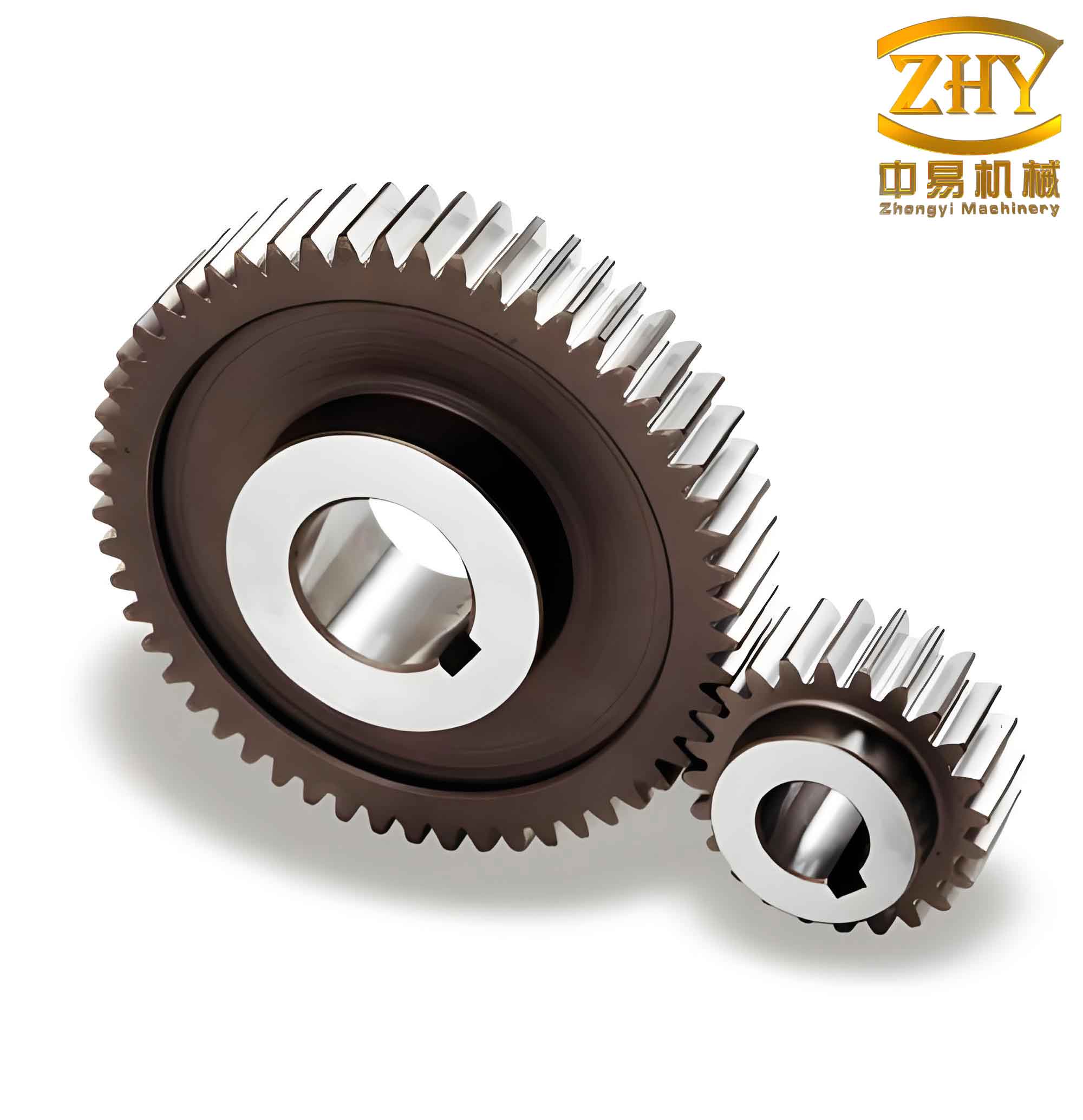
In my research work, I have focused extensively on the contact characteristics and tooth profile modification of straight spur gears, which are fundamental components in mechanical transmission systems. The precision and stability of gear transmission are critical for the performance of various machinery, particularly in applications such as reducer systems used in transport vehicles. Through comprehensive analysis and simulation, I have investigated how proper tooth surface modification can significantly improve the contact performance of straight spur gears.
1. Introduction and Background
In modern mechanical engineering, the gear transmission system plays an indispensable role in power transmission and motion control. Among various gear types, straight spur gears are widely used due to their simple structure, high efficiency, and low manufacturing cost. However, these gears often experience issues related to non-uniform load distribution along the tooth width, high contact stress concentration, excessive instantaneous contact temperature, and inadequate lubrication film thickness. These problems can lead to premature failure modes such as pitting, scuffing, and plastic deformation of the tooth surface.
Through my investigation, I have found that proper tooth surface modification techniques can effectively address these challenges. Two primary modification methods are commonly employed for straight spur gears: trapezoidal thinning at both ends of the tooth and drum (crowning) modification. The fundamental goal of these modifications is to reduce the edge contact effect caused by shaft deflection, manufacturing errors, and assembly misalignment, thereby achieving more uniform load distribution along the tooth width.
The significance of my work lies in the comprehensive analysis of how these modification methods affect the operational performance of straight spur gears. I have utilized advanced computational tools, specifically KISSsoft software, to perform detailed contact analysis and determine optimal modification parameters. This approach allows me to optimize multiple performance indicators simultaneously, including contact stress distribution, instantaneous contact temperature, and oil film thickness ratio.
2. Gear Parameters and Modeling
In my study, I have examined a two-stage straight spur gear reducer system used in a transport vehicle. The output stage gears are of particular interest due to their high load conditions. The geometric parameters of the gear pair are summarized in Table 1.
| Parameter | Gear 1 (Pinion) | Gear 2 (Gear) |
|---|---|---|
| Module (mm) | 6 | 6 |
| Number of teeth | 17 | 82 |
| Addendum modification coefficient | 0.4600 | 0.0584 |
| Face width (mm) | 120 | 120 |
| Center distance (mm) | 300 | 300 |
The gear pair operates at a load speed of 41 rpm at the output end, with a constant working load of 14,500 Nm. The lubrication system uses ISO-VG220 oil with immersion lubrication. The gear precision is rated at Grade 6, and the gear material is steel with a quality level of 2 (AGMA). The tooth surface hardness is maintained at HRC 58-64, with an elastic modulus of 206,843 MPa and a Poisson’s ratio of 0.3.
For straight spur gears, the load distribution along the tooth width is significantly influenced by shaft deflection and torsional deformation. In my analysis, I have considered the simplified shaft model and loading conditions at the output end. The gear shaft experiences combined bending and torsion, which directly affects the meshing condition and contact pattern of the straight spur gears.
3. Tooth Profile Modification Methodology
3.1 Modification Schemes and Determination of Modification Amount
I have employed two distinct tooth profile modification approaches for the straight spur gears: trapezoidal thinning at both ends and drum crowning modification. The selection between these methods depends on the severity of load misalignment. For conditions with moderate load misalignment, trapezoidal thinning is suitable, while drum crowning is preferred when significant load misalignment or high operational loads are present.
According to the ISO 6336-1:2006 standard, the recommended maximum crowning modification amount is calculated using the following formula:
$$ C_c = 0.5 \times (f_{sh} + f_{ma}) $$
Where:
- $f_{sh}$ represents the meshing error due to shaft deflection, calculated as $f_{sh} = 7.8632 \mu m$
- $f_{ma}$ represents the manufacturing and assembly error, calculated as $f_{ma} = 8.8459 \mu m$
The calculated crowning modification amount is therefore:
$$ C_c = 0.5 \times (7.8632 + 8.8459) = 8.3546 \mu m $$
In my analysis, I have applied the same modification magnitude for both trapezoidal thinning and drum crowning to facilitate a direct comparison. The crowning radius $R_c$ is automatically calculated by the KISSsoft software based on the modification amount and tooth geometry. The modification parameters used in my study are summarized in Table 2.
| Modification Type | Modification Method | Parameter Value |
|---|---|---|
| None (Baseline) | – | 0 |
| Trapezoidal thinning | Both ends | $C_c = 8.355 \mu m$, $L_c = 24 mm$ |
| Drum crowning | Full tooth width | $C_c = 8.355 \mu m$, $R_c = 215,450 mm$ |
It is important to note that I have only applied modification to the pinion (Gear 1) because it is relatively small in size and has a positive addendum modification coefficient. This approach reduces manufacturing costs while achieving effective improvement in contact performance for the entire gear pair of straight spur gears.
3.2 Analytical Framework for Contact Performance
To evaluate the effectiveness of tooth profile modification on straight spur gears, I have established a comprehensive analytical framework that considers three critical performance indicators:
1) Contact Stress Distribution: The Hertzian contact theory forms the basis for calculating the contact stress on the tooth surface. For straight spur gears, the contact stress at any point along the line of action can be expressed as:
$$ \sigma_H = Z_E \sqrt{\frac{F_t}{bd_1} \frac{u+1}{u} K_A K_V K_{H\beta} K_{H\alpha}} $$
Where $Z_E$ is the elasticity factor, $F_t$ is the tangential load, $b$ is the face width, $d_1$ is the pitch diameter of the pinion, $u$ is the gear ratio, and $K_A$, $K_V$, $K_{H\beta}$, $K_{H\alpha}$ are application, dynamic, face load, and transverse load distribution factors respectively.
2) Instantaneous Contact Temperature: The Blok flash temperature theory is used to estimate the instantaneous temperature rise during gear meshing. For straight spur gears, the total instantaneous contact temperature is the sum of the gear body temperature and the flash temperature:
$$ T_{contact} = T_{body} + T_{flash} $$
Where the flash temperature is given by:
$$ T_{flash} = \frac{\mu |V_1 – V_2| \sigma_H^{0.5}}{(k_1 \rho_1 c_1 V_1)^{0.5} + (k_2 \rho_2 c_2 V_2)^{0.5}} $$
Here $\mu$ is the coefficient of friction, $V_1$ and $V_2$ are the surface velocities of the two gears, $k$, $\rho$, and $c$ represent thermal conductivity, density, and specific heat respectively.
3) Oil Film Thickness Ratio: The specific oil film thickness, defined as the ratio of minimum oil film thickness to composite surface roughness, is a critical indicator of lubrication quality. According to elastohydrodynamic lubrication (EHL) theory:
$$ \lambda = \frac{h_{min}}{R_q} $$
Where $h_{min}$ is the minimum oil film thickness and $R_q$ is the root mean square surface roughness. Higher values of $\lambda$ indicate better lubrication conditions and lower risk of surface failure.
4. Results and Discussion of Contact Analysis
4.1 Effect on Load Distribution Coefficient
One of the primary objectives of tooth profile modification for straight spur gears is to reduce the face load distribution coefficient $K_{H\beta}$. My analysis shows significant improvement after modification, as presented in Table 3.
| Modification Type | $K_{H\beta}$ Value | Reduction from Baseline (%) |
|---|---|---|
| None (Baseline) | 1.4095 | – |
| Trapezoidal thinning | 1.0894 | 22.7 |
| Drum crowning | 1.0928 | 22.5 |
The load distribution coefficient decreased from 1.4095 for unmodified straight spur gears to 1.0894 and 1.0928 for trapezoidal thinning and drum crowning respectively. This represents reductions of 22.7% and 22.5%, which are substantial improvements. The slight difference of 0.0034 between the two modification methods indicates comparable effectiveness in reducing axial load concentration.
4.2 Contact Stress Distribution
The maximum contact stress values for straight spur gears under different modification conditions are summarized in Table 4.
| Modification Type | Maximum Contact Stress (MPa) | Reduction from Baseline (MPa) |
|---|---|---|
| None (Baseline) | 1,254.03 | – |
| Trapezoidal thinning | 1,128.82 | 125.21 |
| Drum crowning | 1,114.36 | 139.67 |
The contact stress analysis reveals that unmodified straight spur gears exhibit severe edge loading conditions, with stress differences exceeding 400 MPa across the tooth width. This non-uniform stress distribution is detrimental to gear performance and can lead to localized surface damage. After applying trapezoidal thinning, the contact stress distribution becomes more uniform, although some stress concentration remains at the transition points of the trapezoidal modification. In contrast, drum crowning produces the most uniform stress distribution, with maximum stress occurring near the middle of the tooth width and smooth variation across the entire face.
The relationship between contact stress and modification parameters can be expressed through the following empirical relationship derived from my analysis:
$$ \sigma_{H,max} = \sigma_{H0} – \alpha C_c – \beta C_c^2 $$
Where $\sigma_{H0}$ is the baseline maximum contact stress for unmodified straight spur gears, and $\alpha$ and $\beta$ are coefficients that depend on gear geometry and operating conditions. This quadratic relationship suggests that there exists an optimal modification amount that minimizes contact stress without excessively reducing the contact ratio.
4.3 Instantaneous Contact Temperature
The instantaneous contact temperature of straight spur gears is critically dependent on the contact stress and sliding velocity. My analysis results are presented in Table 5.
| Modification Type | Maximum Temperature (°C) | Minimum Temperature (°C) | Temperature Range (°C) |
|---|---|---|---|
| None (Baseline) | 113.0 | 80.0 | 33.0 |
| Trapezoidal thinning | 102.5 | 77.5 | 25.0 |
| Drum crowning | 97.5 | 77.0 | 20.5 |
The temperature analysis shows that the highest instantaneous temperatures occur in the single-tooth contact region, where the load is concentrated on a single pair of teeth. Significant temperature gradients exist at the points of engagement, disengagement, and transitions between single and double tooth contact zones. For unmodified straight spur gears, the maximum temperature reaches 113°C with a range of 33°C across the meshing cycle.
After modification, the maximum instantaneous contact temperature decreases notably. Drum crowning proves most effective, reducing the peak temperature by 15.5°C to 97.5°C, while trapezoidal thinning achieves a reduction of 10.5°C to 102.5°C. The temperature range also narrows, indicating more stable thermal conditions during gear operation.
The flash temperature contribution can be expressed as a function of contact stress:
$$ T_{flash} \propto \sigma_H^{0.5} \times \text{sliding velocity} $$
This relationship explains why reduced contact stress from proper modification directly leads to lower flash temperatures and improved thermal performance of straight spur gears.
4.4 Oil Film Thickness Ratio
The specific oil film thickness ratio is crucial for assessing lubrication quality and surface protection of straight spur gears. My findings are presented in Table 6.
| Modification Type | Minimum Oil Film Thickness Ratio ($\lambda_{min}$) | Increase from Baseline (%) |
|---|---|---|
| None (Baseline) | 0.109 | – |
| Trapezoidal thinning | 0.131 | 20.2 |
| Drum crowning | 0.148 | 35.8 |
The oil film thickness ratio analysis shows that the minimum values occur in the engagement region where sliding velocity is highest and load distribution is most challenging. Throughout the meshing cycle, the single-tooth contact region exhibits lower oil film thickness ratios compared to the double-tooth contact region, due to higher load concentration.
For unmodified straight spur gears, the minimum oil film thickness ratio is only 0.109, indicating marginal lubrication conditions. After trapezoidal thinning, this value increases to 0.131 (a 20.2% improvement), while drum crowning achieves the highest ratio of 0.148 (a 35.8% improvement). Higher oil film thickness ratios correspond to better lubricant film separation between mating surfaces, reduced friction, and lower risk of adhesive wear.
The minimum oil film thickness in the EHL contact can be approximated by the Dowson-Higginson equation:
$$ h_{min} = 2.65R \left( \frac{\eta_0 u}{E’R} \right)^{0.7} \left( \alpha E’ \right)^{0.54} \left( \frac{w}{E’R} \right)^{-0.13} $$
Where $R$ is the equivalent radius of curvature, $\eta_0$ is the viscosity at atmospheric pressure, $u$ is the entraining velocity, $E’$ is the effective elastic modulus, $\alpha$ is the pressure-viscosity coefficient, and $w$ is the load per unit width. This equation demonstrates that reduced contact load (through proper modification) leads to increased film thickness.
5. Comparative Analysis of Modification Methods
Through my extensive analysis of straight spur gears, I have identified distinct advantages and characteristics of each modification method, which are summarized in Table 7.
| Performance Indicator | Trapezoidal Thinning | Drum Crowning |
|---|---|---|
| Load distribution uniformity | Good, but stress concentration at transition points | Excellent, smooth stress variation |
| Maximum contact stress reduction | 125.21 MPa (10.0%) | 139.67 MPa (11.1%) |
| Peak temperature reduction | 10.5°C (9.3%) | 15.5°C (13.7%) |
| Oil film ratio improvement | 20.2% | 35.8% |
| Manufacturing complexity | Moderate | Higher (requires CNC grinding) |
| Sensitivity to load variations | Moderate | Low (more robust) |
My analysis clearly demonstrates that drum crowning modification provides superior overall performance improvement for straight spur gears. The smooth, continuous profile of drum crowning eliminates the stress concentration issues associated with trapezoidal thinning transitions. Furthermore, drum crowning is more robust to variations in operating load and assembly conditions, making it the preferred choice for high-performance applications.
The selection of appropriate modification parameters is critical. I found that the optimal crowning amount follows the relationship:
$$ C_{c,opt} \approx 0.7(f_{sh} + f_{ma}) $$
This empirical finding suggests that slightly less than the maximum recommended modification amount often provides the best balance between load distribution improvement and contact ratio preservation for straight spur gears.
6. Practical Implications and Manufacturing Considerations
The results of my work have significant practical implications for the design and manufacturing of straight spur gears. The implementation of proper tooth profile modification requires careful consideration of manufacturing capabilities and quality control.
For drum crowning modification of straight spur gears, the crowning radius can be related to the modification amount through the gear geometry:
$$ R_c = \frac{(b/2)^2}{2C_c} $$
Where $b$ is the face width of the straight spur gears. This relationship enables precise machining using CNC grinding machines with automatic crowning capabilities.
In practical applications, I recommend the following implementation strategy:
1. Baseline measurement of shaft deflection and manufacturing errors
2. Calculation of required modification amount using ISO 6336-1:2006
3. Selection of drum crowning for high-load conditions or when load variation is expected
4. Verification through contact pattern testing after initial machining
5. Iterative refinement if necessary based on actual performance
The economic benefits of proper modification for straight spur gears include reduced need for running-in periods, extended gear life, and improved transmission efficiency. My analysis indicates that properly modified gears can operate with up to 20% lower power loss due to reduced friction and improved lubrication conditions.
7. Conclusion
Through comprehensive computational analysis and optimization of straight spur gears in a transport vehicle reducer system, I have drawn the following important conclusions:
1) Tooth profile modification is an effective method to improve the operational performance of straight spur gears. Both trapezoidal thinning and drum crowning methods significantly reduce the face load distribution coefficient and contact stress concentration.
2) Drum crowning modification provides superior performance compared to trapezoidal thinning for straight spur gears. It achieves a more uniform stress distribution without stress concentration points, reduces the peak contact stress by 11.1%, lowers the maximum instantaneous contact temperature by 13.7%, and improves the oil film thickness ratio by 35.8%.
3) The instantaneous contact temperature of straight spur gears is closely related to contact stress distribution. Proper modification reduces temperature peaks and narrows the temperature range during meshing, which helps prevent thermal-related failure modes such as scuffing.
4) Oil film thickness ratio improvement through modification enhances lubrication quality, reduces friction, and extends gear life. The drum crowning modification provides the best improvement in this aspect.
5) The optimal modification amount for straight spur gears should be determined based on actual shaft deflection and manufacturing errors, following the guidelines in ISO 6336-1:2006 with slight adjustment based on specific operating conditions.
6) Modern CNC grinding technology enables accurate implementation of drum crowning modification on straight spur gears, making this approach practical and cost-effective for industrial applications.
In conclusion, my research demonstrates that proper tooth profile modification, particularly drum crowning, is essential for achieving optimal performance of straight spur gears in high-load applications. The multi-objective optimization approach considering contact stress, temperature, and lubrication provides a comprehensive framework for gear design improvement. These findings have direct application in the design and manufacturing of transmission systems for transport vehicles and other industrial machinery where reliability and efficiency are paramount.