
In our research, we investigate the influence of key design parameters on the contact performance and load-bearing capacity of the planar enveloping internal-meshing worm gear drive. Based on the gear meshing theory, we establish the spatial tooth contact line equations and numerically compute the contact lines, mapping them onto the worm wheel tooth surface. By analyzing the effects of center distance, transmission ratio, inclination angle of the generating plane, axial crossing angle, worm wheel rotation angle, pitch circle coefficient, and main base circle coefficient on the distribution of contact zones, we identify optimal design parameter ranges. A three-dimensional model is then generated using a set of reasonable parameters. This study provides a theoretical foundation for subsequent research on this novel worm gear drive.
The planar enveloping internal-meshing worm gear offers advantages such as high reduction ratio, compact structure, and multi-load output capability. However, the contact zone characteristics are highly sensitive to design parameters. Understanding these sensitivities is crucial for optimizing the worm gear performance.
Systematic Coordinate Setup and Meshing Theory
We define the coordinate systems as follows: S1 and S1′ are fixed and moving frames attached to the worm, while S2 and S2′ correspond to the worm wheel. The generating plane Σ is described by frame S0 with origin on the main base circle. The contact point is described in frame Sp. The transformation matrix from worm wheel moving frame S2′ to worm moving frame S1′ is given by:
$$
\mathbf{M}_{1’2′} = \mathbf{M}_{1’1}^{-1} \mathbf{M}_{12} \mathbf{M}_{22′}^{-1}
= \begin{pmatrix}
f_{11} & f_{12} & f_{13} & f_{14} \\
f_{21} & f_{22} & f_{23} & f_{24} \\
f_{31} & f_{32} & f_{33} & f_{34} \\
f_{41} & f_{42} & f_{43} & f_{44}
\end{pmatrix}
$$
where the elements include trigonometric functions of the worm rotation angle φ1, worm wheel rotation angle φ2, axial crossing angle δF, and center distance A. The meshing condition requires the relative velocity vector to be orthogonal to the common normal, leading to the meshing equation:
$$
\Phi = \mathbf{v}_{1’2′} \cdot \mathbf{i}_0 = 0
$$
The velocity components in the generating plane frame are derived as:
$$
\begin{aligned}
v_{x0} &= \beta \sin(\beta)\delta_F \dots \\
v_{y0} &= \dots \\
v_{z0} &= \dots
\end{aligned}
$$
Explicit expressions are lengthy and are omitted here for brevity. The worm tooth surface equation is obtained by combining the coordinate transformation and meshing condition:
$$
\mathbf{r}_{1′} = \mathbf{M}_{1’2′} \mathbf{r}_{2′} ,\quad \Phi(u,v,\varphi_2)=0
$$
Similarly, the worm wheel tooth surface coordinates are obtained by transforming the generating plane coordinates.
Mapping Contact Lines onto the Worm Wheel Tooth Surface
To visualize the contact zone, we map the spatial contact lines onto the worm wheel tooth profile using the following relationships:
$$
r = \sqrt{x_{2′}^2 + y_{2′}^2}, \quad z_{2′} = v \cos\beta
$$
The tooth width of the worm wheel is determined by:
$$
b = k_1 A – h_f – c, \quad h_f = 0.8m, \quad c = 0.2m
$$
where m is the module, and k1 is the pitch circle coefficient. The effective contact face width is:
$$
B = b \cos\beta
$$
We then numerically compute the contact lines for various parameter combinations using MATLAB.
Parametric Analysis of Contact Zone
We systematically vary each key parameter while keeping others constant, and evaluate the resulting contact line distribution on the worm wheel tooth surface. The following subsections summarize our findings.
Effect of Center Distance (A)
The center distance A is varied from 100 mm to 400 mm. The contact lines move from the tooth root near the entry side toward the tooth tip near the exit side, with the longest contact occurring near the middle of the tooth. The overall contact pattern remains similar, but the absolute size of the contact zone scales with A.
| Parameter | Value 1 | Value 2 | Value 3 | Value 4 |
|---|---|---|---|---|
| Center distance A (mm) | 100 | 200 | 300 | 400 |
| Transmission ratio i12 | 1/40 | 1/40 | 1/40 | 1/40 |
| Generating plane inclination β (°) | 24 | 24 | 24 | 24 |
| Worm wheel rotation φ2 (°) | 90 | 90 | 90 | 90 |
| Axial crossing angle δF (°) | 35 | 35 | 35 | 35 |
| Pitch circle coefficient k1 | 0.38 | 0.38 | 0.38 | 0.38 |
| Main base circle coefficient kb | 0.56 | 0.56 | 0.56 | 0.56 |
Effect of Transmission Ratio (i12)
We examine i12 = 1/10, 1/20, 1/30, and 1/40. A larger transmission ratio (smaller absolute value) results in longer and more uniform contact lines across the tooth surface. This indicates higher load capacity and better meshing performance for slower worm gear drives.
| Parameter | Value 1 | Value 2 | Value 3 | Value 4 |
|---|---|---|---|---|
| Center distance A (mm) | 100 | 100 | 100 | 100 |
| Transmission ratio i12 | 1/10 | 1/20 | 1/30 | 1/40 |
| Generating plane inclination β (°) | 24 | 24 | 24 | 24 |
| Worm wheel rotation φ2 (°) | 90 | 90 | 90 | 90 |
| Axial crossing angle δF (°) | 35 | 35 | 35 | 35 |
| Pitch circle coefficient k1 | 0.38 | 0.38 | 0.38 | 0.38 |
| Main base circle coefficient kb | 0.56 | 0.56 | 0.56 | 0.56 |
Effect of Generating Plane Inclination (β)
Inclination β is varied from 10° to 40°. When β exceeds 40°, the contact zone shifts to the upper-left corner of the tooth, resulting in poor stress distribution and reduced load capacity. Our previous studies suggested that β between 18° and 36° yields favorable meshing performance, and this is confirmed here.
| Parameter | Value 1 | Value 2 | Value 3 | Value 4 |
|---|---|---|---|---|
| Center distance A (mm) | 100 | 100 | 100 | 100 |
| Transmission ratio i12 | 1/40 | 1/40 | 1/40 | 1/40 |
| Generating plane inclination β (°) | 10 | 20 | 30 | 40 |
| Worm wheel rotation φ2 (°) | 90 | 90 | 90 | 90 |
| Axial crossing angle δF (°) | 35 | 35 | 35 | 35 |
| Pitch circle coefficient k1 | 0.38 | 0.38 | 0.38 | 0.38 |
| Main base circle coefficient kb | 0.56 | 0.56 | 0.56 | 0.56 |
Effect of Worm Wheel Rotation Angle (φ2)
This angle defines the starting position of the worm gear meshing segment. We tested φ2 values of 70°, 80°, 90°, and 100°. For φ2 less than 90°, the contact lines do not fully cover the tooth surface, indicating partial engagement. The ideal range for the internal meshing worm gear is between 90° and 138° (beyond 138° the gear degenerates into an end-face meshing type).
| Parameter | Value 1 | Value 2 | Value 3 | Value 4 |
|---|---|---|---|---|
| Center distance A (mm) | 100 | 100 | 100 | 100 |
| Transmission ratio i12 | 1/40 | 1/40 | 1/40 | 1/40 |
| Generating plane inclination β (°) | 24 | 24 | 24 | 24 |
| Worm wheel rotation φ2 (°) | 70 | 80 | 90 | 100 |
| Axial crossing angle δF (°) | 35 | 35 | 35 | 35 |
| Pitch circle coefficient k1 | 0.38 | 0.38 | 0.38 | 0.38 |
| Main base circle coefficient kb | 0.56 | 0.56 | 0.56 | 0.56 |
Effect of Axial Crossing Angle (δF)
The axial crossing angle δF is varied from 10° to 40°. When δF is below 30°, the contact lines concentrate on the upper-left region, reducing effective contact. When δF exceeds 54°, interference occurs between the worm wheel shaft and the worm tooth profile (unless the shaft is embedded). We recommend δF in the range of 30° to 54° for optimal performance.
| Parameter | Value 1 | Value 2 | Value 3 | Value 4 |
|---|---|---|---|---|
| Center distance A (mm) | 100 | 100 | 100 | 100 |
| Transmission ratio i12 | 1/40 | 1/40 | 1/40 | 1/40 |
| Generating plane inclination β (°) | 24 | 24 | 24 | 24 |
| Worm wheel rotation φ2 (°) | 90 | 90 | 90 | 90 |
| Axial crossing angle δF (°) | 10 | 20 | 30 | 40 |
| Pitch circle coefficient k1 | 0.38 | 0.38 | 0.38 | 0.38 |
| Main base circle coefficient kb | 0.56 | 0.56 | 0.56 | 0.56 |
Effect of Pitch Circle Coefficient (k1)
We vary k1 from 0.33 to 0.38. The contact zone distribution shows negligible sensitivity to this parameter. Therefore, when designing solely for load capacity, k1 can be selected based on standard guidelines without major concern for contact pattern.
| Parameter | Value 1 | Value 2 | Value 3 | Value 4 |
|---|---|---|---|---|
| Center distance A (mm) | 100 | 100 | 100 | 100 |
| Transmission ratio i12 | 1/40 | 1/40 | 1/40 | 1/40 |
| Generating plane inclination β (°) | 24 | 24 | 24 | 24 |
| Worm wheel rotation φ2 (°) | 90 | 90 | 90 | 90 |
| Axial crossing angle δF (°) | 35 | 35 | 35 | 35 |
| Pitch circle coefficient k1 | 0.33 | 0.3467 | 0.3634 | 0.38 |
| Main base circle coefficient kb | 0.56 | 0.56 | 0.56 | 0.56 |
Effect of Main Base Circle Coefficient (kb)
Similarly, kb is varied from 0.5 to 0.67. The contact line pattern remains almost unchanged, indicating that this parameter has minimal influence on the contact zone distribution for the planar enveloping internal-meshing worm gear.
| Parameter | Value 1 | Value 2 | Value 3 | Value 4 |
|---|---|---|---|---|
| Center distance A (mm) | 100 | 100 | 100 | 100 |
| Transmission ratio i12 | 1/40 | 1/40 | 1/40 | 1/40 |
| Generating plane inclination β (°) | 24 | 24 | 24 | 24 |
| Worm wheel rotation φ2 (°) | 90 | 90 | 90 | 90 |
| Axial crossing angle δF (°) | 35 | 35 | 35 | 35 |
| Pitch circle coefficient k1 | 0.38 | 0.38 | 0.38 | 0.38 |
| Main base circle coefficient kb | 0.5 | 0.56 | 0.62 | 0.67 |
Three-Dimensional Modeling and Simulation
Based on the parametric analysis, we selected a set of optimized parameters (e.g., A = 100 mm, i12 = 1/40, β = 24°, δF = 35°, φ2 = 90°, k1 = 0.38, kb = 0.56) to generate a three-dimensional solid model of the planar enveloping internal-meshing worm gear drive. The worm tooth surface is constructed by sweeping the contact lines along the tooth length. The worm wheel is designed with multiple output teeth to achieve backlash-free operation and power-splitting capability.
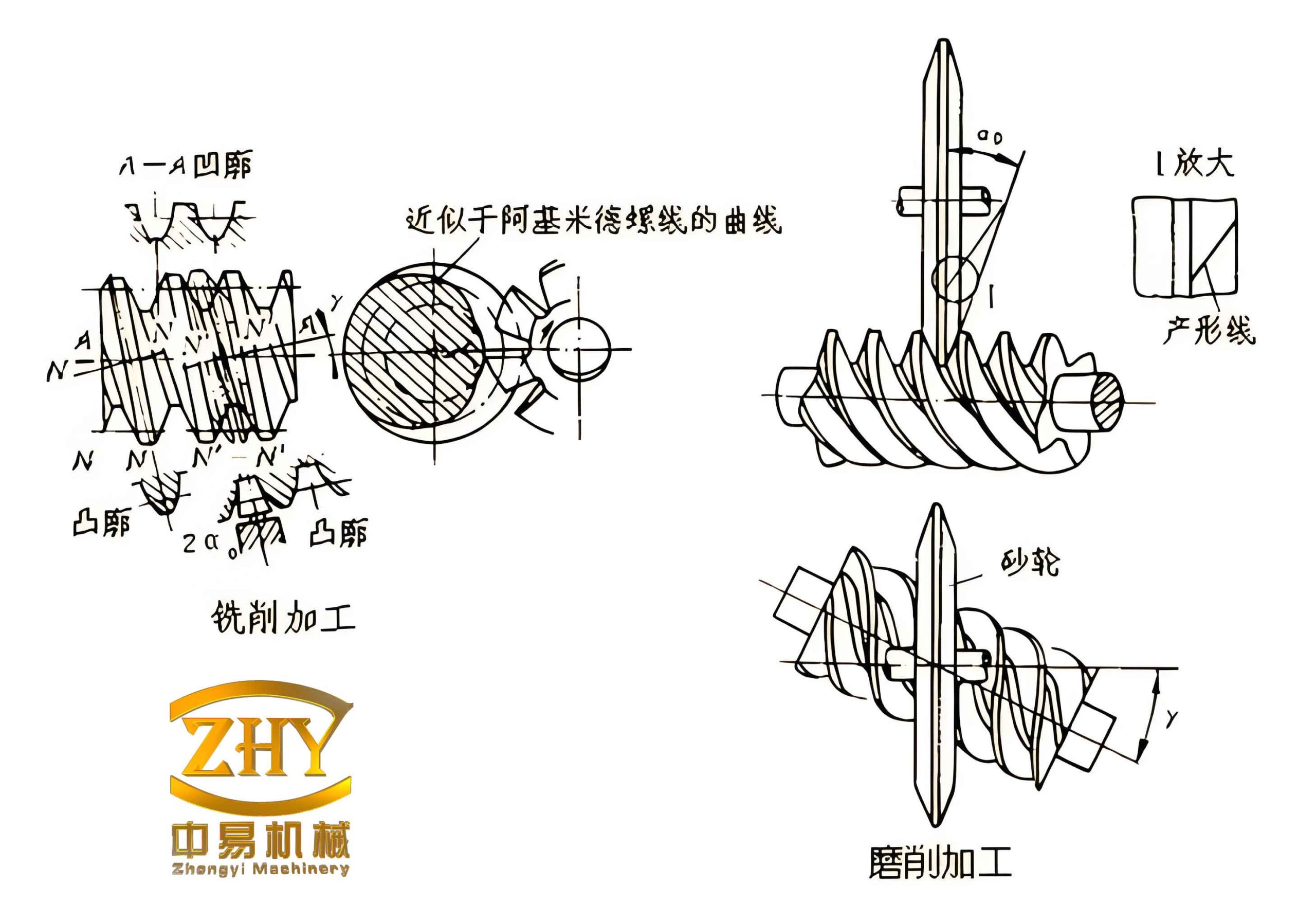
The three-dimensional model (shown above as an example of a typical worm gear assembly) closely matches the theoretical contact lines. When two or more worm wheels are used, they can be arranged to engage opposite flanks of the worm threads, thereby eliminating backlash and distributing loads evenly.
Conclusion
Through systematic numerical analysis of contact line distribution on the worm wheel tooth surface, we draw the following conclusions regarding the planar enveloping internal-meshing worm gear:
- Transmission ratio, worm wheel rotation angle, and axial crossing angle have significant effects on the contact zone. These parameters should be prioritized in optimization.
- The worm wheel rotation angle φ2 must be selected between 90° and 138° to ensure full tooth engagement and proper internal meshing characteristics.
- The axial crossing angle δF is best chosen between 30° and 54° when the worm wheel shaft is located outside the worm body. The generating plane inclination β should lie between 18° and 36° for optimal contact distribution.
- Center distance, pitch circle coefficient, and main base circle coefficient have minor or predictable influences on the contact pattern, allowing them to be determined based on standard design practices and space constraints.
These findings provide a valuable reference for the design and optimization of high-performance planar enveloping internal-meshing worm gear drives, particularly in applications requiring high load capacity, compactness, and multi-output capability.