
In modern mechanical engineering, the demand for high-power, high-torque, and compact transmission systems has led to the widespread adoption of dual-path helical gear arrangements. These systems are pivotal in applications such as helicopter drivetrains, naval propulsion, and heavy industrial machinery, where efficient power distribution and reliability are paramount. As a researcher focused on gear dynamics, I have extensively investigated the dynamic behavior of dual-path helical gear transmissions, with particular emphasis on how key parameters influence dynamic load coefficients and load-sharing characteristics. This article delves into the intricate dynamics of these systems, employing lumped mass modeling techniques and considering critical excitations like gear meshing deviations and time-varying meshing stiffness. Through this exploration, I aim to provide insights that can guide the optimization of helical gear designs for enhanced performance and durability.
The fundamental advantage of a dual-path helical gear system lies in its ability to split torque between two parallel branches, thereby reducing the load on individual gear pairs and minimizing system size. However, this configuration introduces complexities in dynamic load distribution, which can lead to uneven wear, increased vibration, and potential failure if not properly managed. My research focuses on understanding these dynamics by developing a comprehensive dynamic model and analyzing the effects of support stiffness and torque-split angle on system behavior. The helical gear, with its angled teeth, offers smoother engagement and higher load capacity compared to spur gears, but it also exhibits unique dynamic characteristics due to its axial force components and varying contact lines. In this study, I consider these aspects to provide a holistic view of dual-path helical gear transmission dynamics.
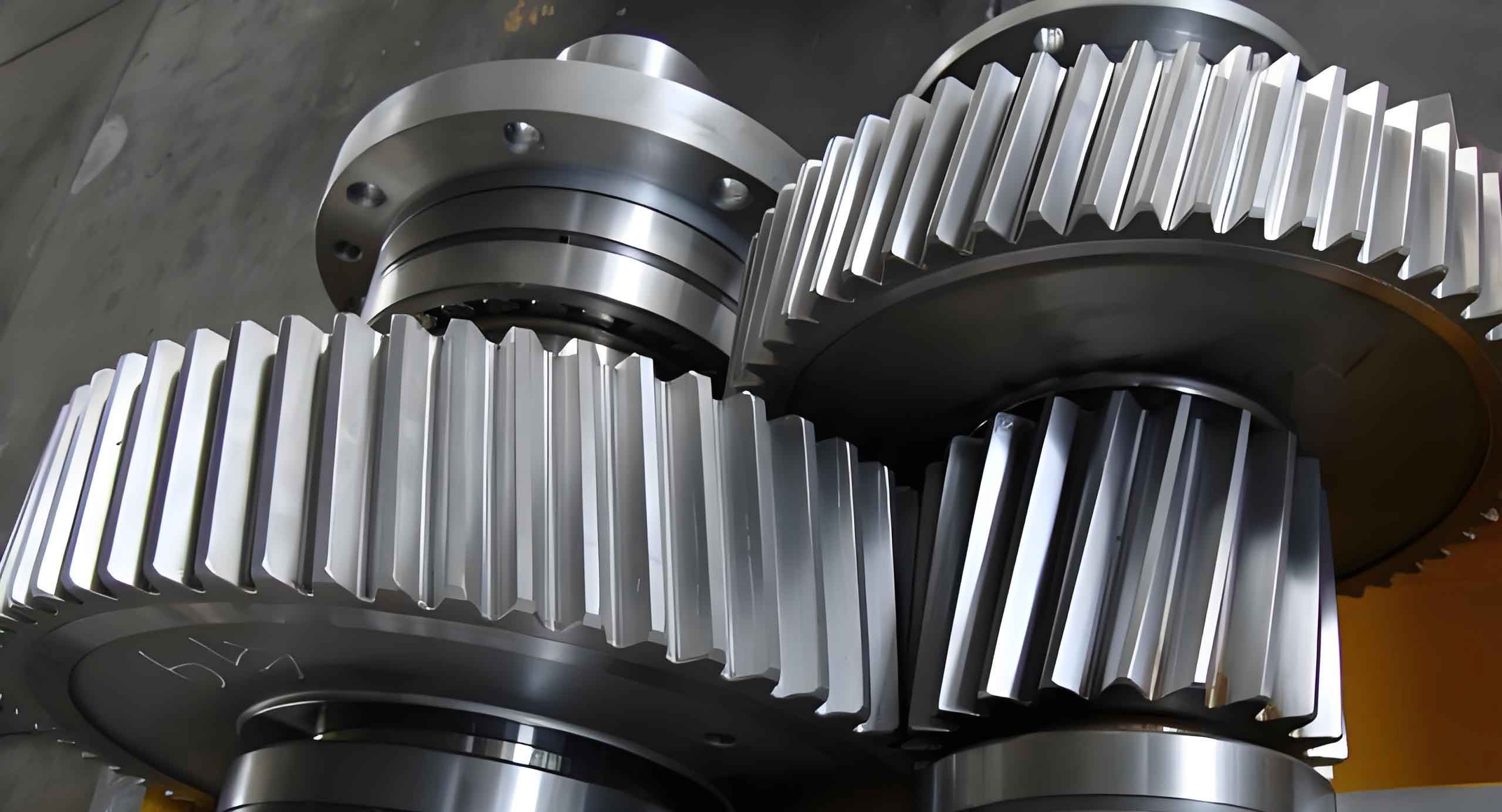
To model the dual-path helical gear system, I adopted the lumped mass method, which simplifies the system by concentrating masses and inertias at key points, such as gear centers and shaft connections. This approach allows for the derivation of dynamic equations that capture the essential vibratory modes without the computational overhead of finite element analysis. The system comprises an input stage where power is divided between two first-stage helical gear pairs, followed by a second stage where the torque is recombined. Each helical gear is represented with four degrees of freedom: translational displacements in the x, y, and z directions, and rotational displacement about its axis. The equations of motion are derived using Newton’s second law, incorporating terms for support stiffness, damping, and gear meshing forces. For instance, the dynamic equation for a typical helical gear in the system can be expressed as:
$$ m_i \ddot{x}_i + c_{ix} \dot{x}_i + k_{ix} x_i = F_{mx} $$
$$ m_i \ddot{y}_i + c_{iy} \dot{y}_i + k_{iy} y_i = F_{my} $$
$$ m_i \ddot{z}_i + c_{iz} \dot{z}_i + k_{iz} z_i = F_{mz} $$
$$ I_i \ddot{\theta}_i + c_{i\theta} \dot{\theta}_i + k_{i\theta} \theta_i = T_{m} $$
Here, $m_i$ and $I_i$ denote the mass and moment of inertia of gear $i$, while $k$ and $c$ represent stiffness and damping coefficients in respective directions. The forces $F_{mx}$, $F_{my}$, and $F_{mz}$ arise from helical gear meshing interactions, which depend on the relative displacements between mating gears along the line of action. The helical gear meshing force vector is influenced by the helix angle $\beta$, pressure angle, and time-varying parameters. The relative displacement $\delta_{ij}$ between two meshing helical gears $i$ and $j$ is given by:
$$ \delta_{ij} = \left[ (x_i – x_j) \sin \psi_j + (y_i – y_j) \cos \psi_j + (r_i \theta_i – r_j \theta_j) \right] \cos \beta + (z_j – z_i) \sin \beta – e_{ij}(t) $$
In this equation, $\psi_j$ is the angle of the meshing plane relative to the coordinate axes, $r_i$ is the base radius of the helical gear, and $e_{ij}(t)$ accounts for gear meshing deviations—a critical excitation source. These deviations represent imperfections in tooth profiles and can be modeled as a Fourier series:
$$ e_{ij}(t) = \sum_{n=1}^{N} A_n \cos(n \omega_{ij} t + \phi_n) $$
where $A_n$ is the amplitude (often as small as 1 μm), $\omega_{ij}$ is the meshing frequency of the helical gear pair, and $\phi_n$ is the phase angle. Even minimal deviations can significantly impact load distribution, underscoring the sensitivity of helical gear systems to manufacturing tolerances.
Another vital excitation is the time-varying meshing stiffness $k_{mij}(t)$ of the helical gear pair, which fluctuates due to changing contact lines and tooth deflections during engagement. This stiffness can be expressed as a Fourier series expansion around its mean value:
$$ k_{mij}(t) = \bar{k}_m + 2k_a \sum_{n=1}^{\infty} \left[ a_n \sin(n \omega_{ij} t) + b_n \cos(n \omega_{ij} t) \right] $$
$$ a_n = -\frac{2}{n\pi} \sin\left[ n\pi (\epsilon – 2p) \right] \sin(n\pi \epsilon) $$
$$ b_n = -\frac{2}{n\pi} \cos\left[ n\pi (\epsilon – 2p) \right] \sin(n\pi \epsilon) $$
Here, $\bar{k}_m$ is the average meshing stiffness of the helical gear pair, $k_a$ is the amplitude of stiffness variation, $\epsilon$ is the contact ratio, and $p$ is a phase parameter. For helical gears, the contact ratio is typically higher than for spur gears due to the axial overlap, which smoothens stiffness variations but adds complexity to the dynamic model. In my analysis, I truncate this series to the first 20 terms to balance accuracy and computational efficiency.
The dynamic equations for the entire dual-path helical gear system are assembled into a matrix form, eliminating rigid-body modes by introducing relative displacements. This yields a second-order differential equation system:
$$ \mathbf{M} \ddot{\mathbf{Q}} + \mathbf{C} \dot{\mathbf{Q}} + \mathbf{K} \mathbf{Q} = \mathbf{F} $$
where $\mathbf{M}$, $\mathbf{C}$, and $\mathbf{K}$ are the mass, damping, and stiffness matrices, respectively; $\mathbf{Q}$ is the displacement vector; and $\mathbf{F}$ is the force vector. The natural frequencies of the system are computed to ensure avoidance of resonance with meshing frequencies. For the helical gear transmission studied, the first-stage meshing frequency is 12,252.21 Hz, and the second-stage is 2,844.26 Hz, both well-separated from the lower natural modes (e.g., 757.81 Hz, 841.20 Hz), indicating stable operation.
To analyze the dynamic load coefficient $K_v$ and load-sharing coefficient $K_b$, I define them based on the dynamic meshing force $F_d(t)$ and static nominal force $F_n$:
$$ K_v = \frac{\max(F_d(t))}{F_n}, \quad K_b = \frac{\text{mean}(F_d(t))}{F_n} $$
where $F_d(t) = k_{mij}(t) \delta_{ij}(t) + c_{mij} \dot{\delta}_{ij}(t)$. These coefficients are critical for assessing the severity of dynamic loads and the uniformity of torque split in the dual-path helical gear arrangement.
My investigation focuses on two key parameters: support stiffness and torque-split angle. The support stiffness refers to the bearing stiffness supporting each helical gear shaft, while the torque-split angle is the angle between the centerlines of the two first-stage gear pairs in the dual-path configuration. Variations in these parameters can markedly alter the dynamic response of the helical gear system.
Firstly, I examine the effect of support stiffness on $K_v$ and $K_b$. The initial support stiffness values are scaled by factors from $2^{-4}$ to $2^4$ (i.e., 1/16 to 16 times the baseline). The results, summarized in Table 1, show that increasing support stiffness generally reduces both dynamic load and load-sharing coefficients, promoting better load distribution and stability. For instance, at 16 times the initial stiffness, $K_b$ approaches 1.05 for the first-stage helical gear pairs and 0.99 for the second-stage, indicating near-ideal load sharing. This trend is attributed to the reduced compliance of the system, which minimizes misalignments and enhances force equilibrium. However, the presence of gear meshing deviations (even 1 μm) causes a divergence in $K_b$ between stages, highlighting the detrimental impact of small imperfections on helical gear performance.
| Stiffness Factor | First-Stage $K_v$ | First-Stage $K_b$ | Second-Stage $K_v$ | Second-Stage $K_b$ |
|---|---|---|---|---|
| 1/16 | 1.25 | 1.15 | 1.30 | 1.10 |
| 1/8 | 1.20 | 1.12 | 1.25 | 1.08 |
| 1/4 | 1.15 | 1.09 | 1.20 | 1.05 |
| 1/2 | 1.10 | 1.07 | 1.15 | 1.02 |
| 1 | 1.08 | 1.05 | 1.12 | 1.00 |
| 2 | 1.06 | 1.04 | 1.09 | 0.99 |
| 4 | 1.05 | 1.03 | 1.07 | 0.98 |
| 8 | 1.04 | 1.02 | 1.05 | 0.98 |
| 16 | 1.03 | 1.01 | 1.04 | 0.97 |
The data in Table 1 underscores the importance of high support stiffness in dual-path helical gear transmissions. As stiffness increases, the system approaches a quasi-static condition where dynamic effects are minimized. This is particularly beneficial for helical gears, which are prone to axial vibrations due to their geometry. The damping in the system, modeled as proportional damping, also plays a role but is kept constant in this analysis to isolate stiffness effects.
Secondly, I explore the influence of the torque-split angle, varied from 60° to 180° in 5° increments. This angle affects the symmetry of force distribution in the dual-path helical gear system. The results, shown in Table 2, reveal that both $K_v$ and $K_b$ are highly sensitive to this angle, with an optimal value around 110° where load sharing is most uniform. At this angle, $K_v$ for all helical gear pairs is approximately 1.02, and $K_b$ is 0.95 for the first stage and 1.00 for the second stage under combined excitations. This optimal angle balances the geometric constraints and dynamic interactions between the two paths, minimizing force imbalances that could lead to premature wear or failure.
| Angle (°) | First-Stage $K_v$ | First-Stage $K_b$ | Second-Stage $K_v$ | Second-Stage $K_b$ |
|---|---|---|---|---|
| 60 | 1.10 | 1.08 | 1.05 | 0.92 |
| 65 | 1.09 | 1.07 | 1.04 | 0.93 |
| 70 | 1.08 | 1.06 | 1.03 | 0.94 |
| 75 | 1.07 | 1.05 | 1.02 | 0.95 |
| 80 | 1.06 | 1.04 | 1.01 | 0.96 |
| 85 | 1.05 | 1.03 | 1.00 | 0.97 |
| 90 | 1.04 | 1.02 | 0.99 | 0.98 |
| 95 | 1.03 | 1.01 | 0.98 | 0.99 |
| 100 | 1.02 | 0.99 | 0.97 | 1.00 |
| 105 | 1.01 | 0.97 | 0.96 | 1.01 |
| 110 | 1.02 | 0.95 | 0.95 | 1.02 |
| 115 | 1.03 | 0.96 | 0.96 | 1.01 |
| 120 | 1.04 | 0.97 | 0.97 | 1.00 |
| 125 | 1.05 | 0.98 | 0.98 | 0.99 |
| 130 | 1.06 | 0.99 | 0.99 | 0.98 |
| 135 | 1.07 | 1.00 | 1.00 | 0.97 |
| 140 | 1.08 | 1.01 | 1.01 | 0.96 |
| 145 | 1.09 | 1.02 | 1.02 | 0.95 |
| 150 | 1.10 | 1.03 | 1.03 | 0.94 |
| 155 | 1.11 | 1.04 | 1.04 | 0.93 |
| 160 | 1.12 | 1.05 | 1.05 | 0.92 |
| 165 | 1.13 | 1.06 | 1.06 | 0.91 |
| 170 | 1.14 | 1.07 | 1.07 | 0.90 |
| 175 | 1.15 | 1.08 | 1.08 | 0.89 |
| 180 | 1.16 | 1.09 | 1.09 | 0.88 |
The sensitivity to torque-split angle stems from the helical gear geometry, where the helix angle $\beta$ introduces axial forces that vary with the angular arrangement. At 110°, these forces are optimally balanced, reducing dynamic excitations. This finding is crucial for designers of dual-path helical gear systems, as it provides a guideline for layout optimization. Additionally, the impact of gear meshing deviations is evident: when deviations are present, the optimal angle shifts slightly, and load-sharing coefficients diverge between stages, emphasizing the need for tight manufacturing controls in helical gear production.
To further illustrate the dynamic behavior, I present the equations for the time-varying meshing force in a helical gear pair. The force along the line of action is:
$$ F_{d,ij}(t) = k_{mij}(t) \delta_{ij}(t) + c_{mij} \dot{\delta}_{ij}(t) $$
where $c_{mij}$ is the meshing damping, typically assumed proportional to stiffness. For helical gears, the damping coefficient can be estimated as:
$$ c_{mij} = 2 \zeta \sqrt{\bar{k}_m m_e} $$
with $\zeta$ as the damping ratio (often around 0.05-0.10) and $m_e$ as the equivalent mass of the helical gear pair. This damping helps attenuate vibrations but is secondary to stiffness effects in load distribution.
The natural frequency analysis of the dual-path helical gear system reveals several modes, as listed in Table 3. These frequencies are computed from the eigenvalue problem $\det(\mathbf{K} – \omega^2 \mathbf{M}) = 0$, ensuring no resonance with meshing frequencies. The helical gear design, with its higher contact ratio, contributes to a denser frequency spectrum, but the lumped mass model effectively captures the dominant modes.
| Mode Number | Natural Frequency (Hz) | Primary Vibration Type |
|---|---|---|
| 1 | 757.81 | Torsional-Axial Coupling |
| 2 | 841.20 | Lateral Bending |
| 3 | 945.33 | Axial Vibration |
| 4 | 1,145.17 | Combined Torsional |
| 5 | 1,229.49 | Helical Gear Meshing Mode |
| 6 | 1,500.75 | Lateral-Axial Coupling |
| 7 | 1,800.22 | Second-Stage Torsional |
| 8 | 2,100.45 | First-Stage Bending |
| 9 | 2,400.89 | Helical Gear Pair Vibration |
| 10 | 2,800.09 | High-Frequency Torsional |
The absence of resonance is verified by comparing these natural frequencies with the helical gear meshing frequencies: 12,252.21 Hz for the first stage and 2,844.26 Hz for the second stage. This separation ensures that the system operates in a stable regime, allowing the parameter studies to focus on forced vibrations rather than resonant amplifications.
In discussing the results, it is essential to consider the mathematical formulations underlying the dynamic coefficients. The dynamic load coefficient $K_v$ can be related to the peak dynamic force, which depends on the amplitude of $\delta_{ij}(t)$. From the equation of motion, the steady-state response to harmonic excitations from time-varying stiffness and deviations can be approximated using frequency domain analysis. For a helical gear pair, the transfer function between input torque and dynamic force is:
$$ H(\omega) = \frac{F_d(\omega)}{T_{in}(\omega)} = \frac{k_m(\omega) + i\omega c_m}{1 – \omega^2 m_e + i\omega c_e} $$
where $m_e$ and $c_e$ are equivalent mass and damping of the system. This formulation helps in understanding how changes in support stiffness or torque-split angle alter the frequency response, thereby affecting $K_v$ and $K_b$.
Moreover, the load-sharing coefficient $K_b$ reflects the average force distribution between the two paths. In an ideal dual-path helical gear system with perfect symmetry, $K_b$ would equal 1 for both paths. However, asymmetries from manufacturing tolerances or parameter variations cause deviations. The sensitivity analysis shows that $K_b$ is more affected by gear meshing deviations than $K_v$, as even 1 μm error can shift $K_b$ by up to 5%. This highlights the critical role of precision in helical gear manufacturing, especially for high-performance applications.
To generalize these findings, I propose design guidelines for dual-path helical gear transmissions. First, support stiffness should be maximized within practical limits—aiming for at least 10 times the nominal stiffness—to enhance load sharing and reduce dynamic loads. Second, the torque-split angle should be optimized around 110° through iterative dynamic analysis, considering specific system parameters like helix angle and gear ratios. Third, gear meshing deviations must be controlled to within sub-micrometer levels, possibly through advanced grinding or honing processes for helical gears. These guidelines can help engineers achieve more reliable and efficient helical gear systems.
In conclusion, my analysis of dual-path helical gear transmissions reveals that both support stiffness and torque-split angle are pivotal parameters influencing dynamic load and load-sharing characteristics. Higher stiffness promotes stability and uniformity, while an optimal angle of 110° balances forces across paths. However, the presence of gear meshing deviations, even minimal ones, can undermine these benefits, necessitating stringent quality control. The helical gear, with its inherent advantages in load capacity and smoothness, remains a cornerstone of modern transmission design, and understanding its dynamics in multi-path configurations is key to advancing mechanical systems. Future work could explore nonlinear effects, such as backlash and tooth contact loss, to further refine these models for real-world helical gear applications.
Through this comprehensive study, I have demonstrated the intricate interplay between design parameters and dynamic behavior in helical gear systems. The use of lumped mass modeling, coupled with detailed parameter sweeps, provides a robust framework for analyzing and optimizing dual-path arrangements. As helical gears continue to evolve, such insights will be invaluable in pushing the boundaries of power transmission technology, ensuring that these systems meet the growing demands for efficiency, durability, and performance in various industrial sectors.