
In this paper, I present a comprehensive meshing theory analysis of a novel worm gear transmission—the roller enveloping end face engagement worm drive. This innovative design integrates the advantages of roller enveloping worm gears and end face engagement worm gears, aiming to achieve rolling contact, reduced friction and wear, lower heat generation, and prolonged service life. I begin by describing the working principle and tooth surface formation, establish a mathematical model, derive key meshing equations, and discuss meshing characteristics. Throughout this study, I emphasize the term worm gear to highlight the core subject of this analysis.
1. Introduction and Motivation
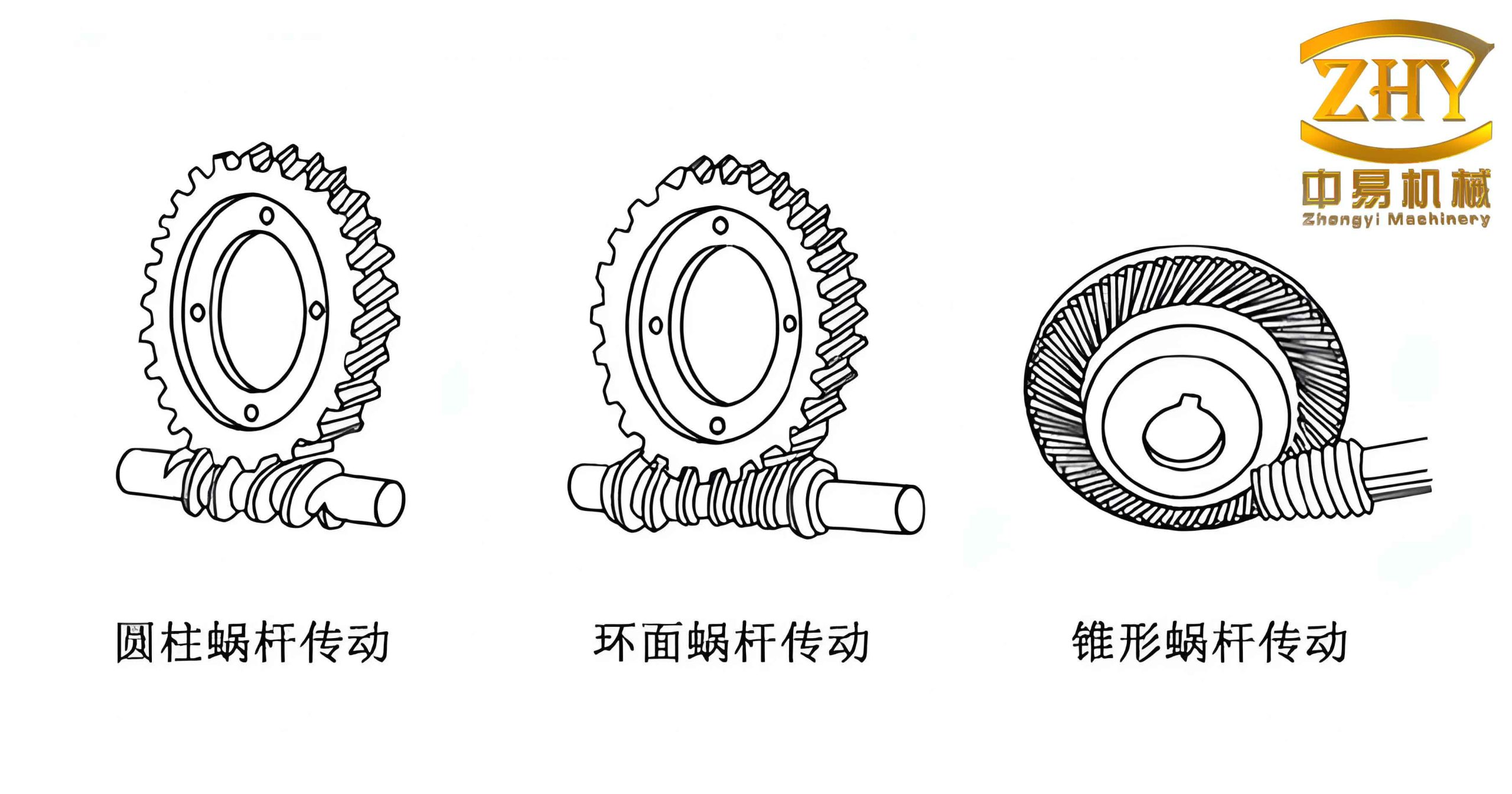
The worm gear is a fundamental mechanical component widely used in power transmission applications. Traditional worm gears suffer from high sliding friction, leading to efficiency loss, heat generation, and wear. To overcome these drawbacks, researchers have proposed various improvements. The roller enveloping worm gear replaces sliding contact with rolling contact by incorporating rollers as worm wheel teeth. Meanwhile, the end face engagement worm gear allows simultaneous engagement of multiple tooth pairs, enhancing load capacity and eliminating backlash. Combining both concepts, I propose the roller enveloping end face engagement worm drive, which offers superior performance. This study focuses on the meshing theory of this new worm gear configuration.
2. Working Principle and Tooth Surface Formation
The proposed worm gear consists of a worm shaft with two worm sections (left and right) and a worm wheel equipped with rollers that can rotate about their own axes. The left worm section engages the upper tooth flanks of the worm wheel, while the right worm section engages the lower tooth flanks, creating a symmetric engagement that eliminates backlash in both directions of rotation. This configuration increases the number of simultaneously meshing teeth and reduces axial forces.
The tooth surface of the worm is formed as the envelope of the roller surfaces during relative motion. The roller is a cylindrical element mounted on the worm wheel via needle bearings, allowing it to rotate freely. This design converts sliding friction into rolling friction at the contact interface. The formation principle is illustrated by the coordinate systems and transformation matrices described in the following sections.
3. Mathematical Model
3.1 Coordinate Systems
I establish coordinate systems to describe the relative motion between the worm and worm wheel. The fixed and moving coordinate systems are defined as follows:
- σ1(i1, j1, k1): fixed coordinate system of the worm.
- σ2(i2, j2, k2): fixed coordinate system of the worm wheel.
- σ1′(i1′, j1′, k1′): moving coordinate system attached to the worm.
- σ2′(i2′, j2′, k2′): moving coordinate system attached to the worm wheel.
- σ0(i0, j0, k0): coordinate system at the center of the roller top circle.
- σp(e1, e2, n): moving frame at the contact point.
The rotation angles are φ1 for the worm and φ2 for the worm wheel, with the transmission ratio i12 = ω1/ω2 = Z2/Z1, where Z1 is the number of worm threads and Z2 is the number of worm wheel teeth. The center distance is denoted by A.
3.2 Roller Surface Equation
The roller is a cylindrical surface. In coordinate system σ0, the position vector is:
$$ r_0 = \begin{bmatrix} x_0 \\ y_0 \\ z_0 \end{bmatrix} = \begin{bmatrix} R\cos\theta \\ R\sin\theta \\ u \end{bmatrix} $$
where u and θ are surface parameters, and R is the roller radius.
3.3 Coordinate Transformations
The transformation from moving worm coordinate system σ1′ to fixed worm coordinate system σ1 is:
$$
\begin{bmatrix} i_1 \\ j_1 \\ k_1 \\ 1 \end{bmatrix} =
\begin{bmatrix} \cos\varphi_1 & -\sin\varphi_1 & 0 & 0 \\
\sin\varphi_1 & \cos\varphi_1 & 0 & 0 \\
0 & 0 & 1 & 0 \\
0 & 0 & 0 & 1 \end{bmatrix}
\begin{bmatrix} i_{1′} \\ j_{1′} \\ k_{1′} \\ 1 \end{bmatrix}
$$
Similarly, for the worm wheel:
$$
\begin{bmatrix} i_2 \\ j_2 \\ k_2 \\ 1 \end{bmatrix} =
\begin{bmatrix} \cos\varphi_2 & -\sin\varphi_2 & 0 & 0 \\
\sin\varphi_2 & \cos\varphi_2 & 0 & 0 \\
0 & 0 & 1 & 0 \\
0 & 0 & 0 & 1 \end{bmatrix}
\begin{bmatrix} i_{2′} \\ j_{2′} \\ k_{2′} \\ 1 \end{bmatrix}
$$
The transformation from worm moving σ1′ to worm wheel moving σ2′ is derived by combining the above with the constant offset due to center distance. The result is a 4×4 transformation matrix. I summarize key transformation matrices in Table 1.
| Transformation | Matrix (3×3 rotation + translation) |
|---|---|
| σ1′ → σ2′ |
$$ \begin{bmatrix} -\cos\varphi_1\cos\varphi_2 & \sin\varphi_1\cos\varphi_2 & -\sin\varphi_2 & A\cos\varphi_2 \\ \cos\varphi_1\sin\varphi_2 & -\sin\varphi_1\sin\varphi_2 & -\cos\varphi_2 & -A\sin\varphi_2 \\ -\sin\varphi_1 & -\cos\varphi_1 & 0 & 0 \\ 0 & 0 & 0 & 1 \end{bmatrix} $$ |
| σ2′ → σp |
$$ \begin{bmatrix} 0 & -\sin\theta & \cos\theta \\ -1 & 0 & 0 \\ 0 & \cos\theta & \sin\theta \end{bmatrix} $$ |
3.4 Relative Velocity and Angular Velocity
The relative velocity vector between the worm and the worm wheel at the contact point is derived using vector relationships. In the moving frame σp, the components are:
$$
V^{(1’2′)} = V_1 e_1 + V_2 e_2 + V_n n
$$
with
$$
\begin{aligned}
V_1 &= -B_2 \sin\theta + B_3 \cos\theta, \\
V_2 &= -B_1, \\
V_n &= B_2 \cos\theta + B_3 \sin\theta.
\end{aligned}
$$
The relative angular velocity vector in σp is:
$$
\omega^{(1’2′)} = \omega_1 e_1 + \omega_2 e_2 + \omega_n n
$$
where
$$
\begin{aligned}
\omega_1 &= \cos\varphi_2 \sin\theta – i_{21} \cos\theta, \\
\omega_2 &= \sin\varphi_2, \\
\omega_n &= -\cos\theta \cos\varphi_2 – i_{21} \sin\theta.
\end{aligned}
$$
4. Meshing Analysis
4.1 Meshing Function and Meshing Equation
Based on gear meshing theory, the meshing condition is given by:
$$ \Phi = n \cdot V^{(1’2′)} = 0 $$
Substituting the expressions, I obtain the meshing function:
$$ \Phi = M_1 \cos\varphi_2 + M_2 \sin\varphi_2 + M_3 $$
where
$$
\begin{aligned}
M_1 &= \sin\theta (a_2 – u), \\
M_2 &= 0, \\
M_3 &= -i_{21} \cos\theta (a_2 – u) – A \sin\theta.
\end{aligned}
$$
The meshing equation is therefore:
$$ \Phi = \sin\theta (a_2 – u) \cos\varphi_2 – i_{21} \cos\theta (a_2 – u) – A \sin\theta = 0 $$
4.2 Contact Lines on the Worm Wheel Tooth Surface
For a fixed value of φ2, the instantaneous contact line on the worm wheel tooth is obtained by combining the roller surface equation and the meshing equation:
$$
\begin{cases}
x_0 = R\cos\theta \\
y_0 = R\sin\theta \\
z_0 = u \\
u = f(\theta, \varphi_2) = \frac{P_1}{P_2} \\
\varphi_2 = \text{constant}
\end{cases}
$$
The contact lines are nearly straight, and the worm gear engages five tooth pairs simultaneously in each worm section. This indicates high load capacity.
4.3 Worm Tooth Surface Equation
The worm tooth surface is the envelope of the family of roller surfaces as φ2 varies. Using the transformation matrices and meshing condition, the surface equation in the worm moving coordinate system is:
$$
\begin{aligned}
x_{1′} &= -\cos\varphi_1\cos\varphi_2 (a_2 – z_0) + \cos\varphi_1\sin\varphi_2 x_0 – y_0\sin\varphi_1 + A\cos\varphi_1, \\
y_{1′} &= \sin\varphi_1\cos\varphi_2 (a_2 – z_0) – \sin\varphi_1\sin\varphi_2 x_0 – y_0\cos\varphi_1 – A\sin\varphi_1, \\
z_{1′} &= -\sin\varphi_2 (a_2 – z_0) – \cos\varphi_2 x_0.
\end{aligned}
$$
together with the relations from the roller surface and meshing condition.
4.4 Induced Normal Curvature
Using the method of moving frames, the induced normal curvature along the contact line normal direction is:
$$ k^{(1’2′)} = -k^{(2’1′)} = -\frac{ (\omega_2 + V_1 / R)^2 + \omega_1^2 }{ \Psi } $$
Figure 8 in the original study shows that as the worm wheel rotates from 0 to 2π, the induced normal curvature remains between 0.079 mm-1 and 0.17 mm-1, indicating good conformity of the conjugate surfaces. This value is 0.03–0.121 mm-1 lower than that of a comparable toroidal worm gear without rollers.
4.5 Lubrication Angle
The lubrication angle μ is defined as the angle between the instantaneous contact line tangent and the relative velocity direction. A value close to 90° indicates excellent lubrication conditions. The formula is:
$$ \mu = \arcsin\left( \frac{ -V_1(V_1/R – \omega_2) + V_2\omega_1 }{ \sqrt{V_1^2+V_2^2} \sqrt{(V_1/R-\omega_2)^2+\omega_1^2} } \right) $$
For the roller enveloping end face engagement worm gear, the lubrication angle stays between 89° and 90° throughout the meshing cycle, which is superior to the 80°–88° range of conventional toroidal worm gears.
4.6 Relative Entrainment Velocity
The relative entrainment velocity Vjx is half the sum of the velocities of the two surfaces along the contact line normal. It influences the formation of a hydrodynamic oil film. I compute it as:
$$ V_{jx} = 0.5 \left( V_{1’\sigma} + V_{2’\sigma} \right) $$
where the components are derived from the surface velocities. The range of Vjx for this worm gear is 10 mm/s to 23 mm/s, indicating good oil film formation.
4.7 Roller Rotation Angle
The self-rotation angle μz0 is the angle between the relative velocity V(12) and the roller axis k0. For effective rolling, μz0 should be close to 90°. It is given by:
$$ \mu_{z0} = \arccos\left( \frac{ V_2 }{ \sqrt{V_1^2+V_2^2} } \right) $$
Analysis shows that for the proposed worm gear, μz0 ranges from 84.5° to 90°, which is 8.5°–14° higher than that of a comparable toroidal worm gear, confirming excellent rolling behavior.
5. Summary of Key Meshing Parameters
For clarity, I compile the major meshing performance parameters of the roller enveloping end face engagement worm drive in Table 2, comparing with a conventional toroidal worm gear where applicable.
| Parameter | Roller enveloping end face worm gear | Conventional toroidal worm gear (no rollers) |
|---|---|---|
| Induced normal curvature (mm-1) | 0.079 – 0.17 | ~0.2 |
| Lubrication angle (degrees) | 89 – 90 | 80 – 88 |
| Relative entrainment velocity (mm/s) | 10 – 23 | — |
| Roller self-rotation angle (degrees) | 84.5 – 90 | ~76 |
| Number of simultaneously meshing tooth pairs | ≥5 | — |
6. Conclusion
I have presented a detailed meshing theory analysis of the roller enveloping end face engagement worm drive. The mathematical model, meshing equations, contact lines, tooth surface equations, and performance parameters such as induced curvature, lubrication angle, entrainment velocity, and roller rotation angle were derived and discussed. The results demonstrate that this novel worm gear exhibits excellent meshing characteristics: high conformity, near-optimal lubrication angle, favorable oil film formation, and rolling contact behavior that significantly reduces friction and wear compared to traditional worm gears. The design also offers high load capacity due to multiple simultaneous engagements. This worm gear concept holds great promise for applications requiring high efficiency, low heat generation, and long life.
Key words: worm gear, roller enveloping, end face engagement, meshing theory, induced curvature, lubrication angle, rolling contact.