
In the field of deep processing of manganese products, the worm gear reducer plays a critical role in the agitation of chemical compounds. During my years of experience in the industrial maintenance and design of such equipment, I encountered a persistent and troublesome issue: oil leakage at the worm shaft seal of the worm gear reducer. This problem not only deteriorated the working environment but also led to frequent equipment failures and shortened service life. The challenge was amplified by the harsh operating conditions: high temperatures, medium-speed rotation, and strong acid‐base corrosion. In this article, I will share my systematic analysis and the improved sealing solution that effectively resolved the leakage problem, using a combination of non-contact and contact sealing methods. Throughout the discussion, the core component – the worm gear – will be repeatedly highlighted, as it is the heart of the transmission system.
To provide a visual reference of the typical worm gear reducer structure, I include an image of a worm gear set. The following figure illustrates a typical worm gear arrangement used in similar industrial applications:
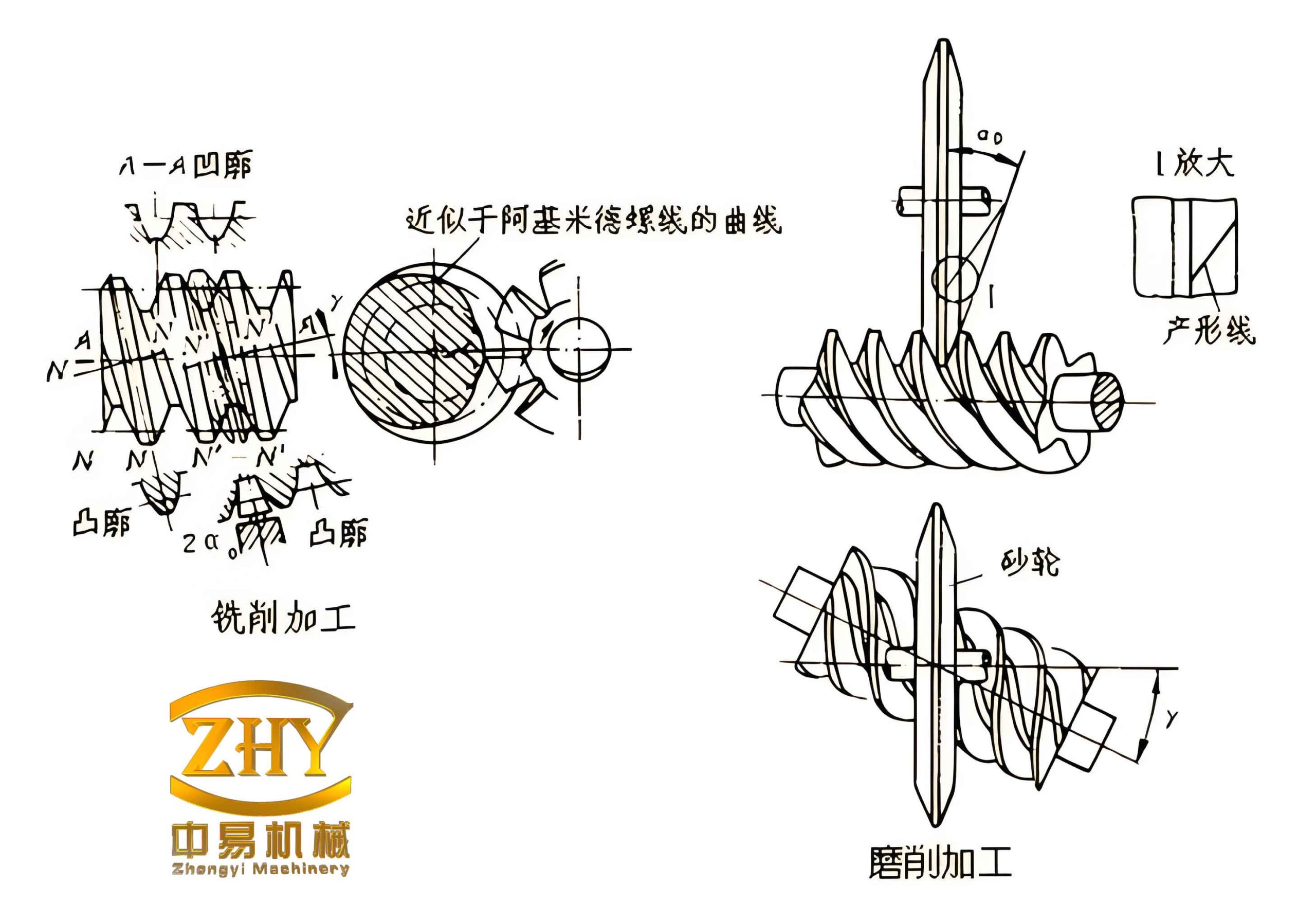
This worm gear image serves as a reminder of the mechanical complexity involved. The worm shaft rotates at medium speed while the worm wheel transfers torque to the agitator. The sealing of the worm shaft ends is particularly vulnerable under extreme thermal and chemical loads.
1. Background and Operating Conditions
In the production of electrolytic manganese dioxide, manganese sulfate, and electrolytic manganese metal, the compounding process involves mixing manganese carbonate ore powder with concentrated sulfuric acid and recycled electrolytic waste liquor at temperatures above 90°C. The reaction is exothermic and highly corrosive. The worm gear reducer I worked with (model WHC360–37 kW) was installed directly above the compounding tank, exposed to dust, acid mist, steam, and high ambient heat. The worm shaft rotated at approximately 40 r/min, with a linear speed at the seal of 5.5 m/s. The oil temperature inside the reducer reached 75°C, and the external casing temperature was around 70°C. Under such conditions, the original single skeleton oil seal quickly degraded – the rubber melted, the lip wore out, and lubricant leaked profusely.
Table 1 summarises the key operating parameters of the worm gear reducer environment.
| Parameter | Value | Remarks |
|---|---|---|
| Reducer model | WHC360–37 kW | Horizontal, worm gear type |
| Worm shaft rotational speed | 40 r/min | Medium speed |
| Linear velocity at seal | 5.5 m/s | Based on shaft diameter ~70 mm |
| Internal oil temperature | 75 °C | Measured during continuous operation |
| External casing temperature | 70 °C | Near the worm shaft end |
| Process temperature (slurry) | ≥90 °C | Exothermic reaction |
| Ambient environment | Acid mist, dust, steam | Corrosive atmosphere |
| Lubricant type | Gear oil (ISO VG 220–320) | Splash lubrication |
| Oil leakage rate (original design) | ~0.5 kg per day | Severe loss |
The environmental severity demanded a robust sealing solution that could withstand both dynamic (rotation) and static (shutdown) conditions. The original design used only a single skeleton oil seal, which was inadequate for such service.
2. Analysis of the Original Sealing Design
I conducted a thorough examination of failed reducers. The original sealing arrangement at the worm shaft end is illustrated conceptually in the description of Figure 1 in the source material (not reproduced here for brevity). The main components included an oil collecting groove machined into the bearing cap, a single skeleton oil seal (nitrile rubber), and a bearing assembly. During operation, the bearing rollers threw lubricant into the collecting groove. However, the oil seal was exposed to high temperature and corrosive attack, causing it to soften, swell, and eventually lose sealing contact. The leak path was: oil → bearing → collecting groove → failed oil seal → external environment.
Several factors contributed to early failure:
- Thermal degradation: The nitrile rubber of the skeleton oil seal has a continuous service temperature limit around 100°C, but persistent exposure to 75–85°C plus acid vapours accelerated aging.
- Medium-speed wear: At 5.5 m/s, the lip experiences significant frictional heat and wear, especially with marginal lubrication.
- Static leakage: When the reducer stopped, the oil in the collecting groove still drained past the seal because the sealing lip was not designed for hydrostatic pressure.
- Maintenance difficulty: Replacing the oil seal required disassembling the pulley or fan, which was time‑consuming due to tight interference fits.
I define the leakage rate Q for the original seal using a simple orifice model for a leaking annular gap:
$$Q = C_d \, A \, \sqrt{\frac{2\Delta p}{\rho}}$$
where Cd is the discharge coefficient (≈0.6 for a damaged seal), A is the leakage area (m²), Δp is the pressure difference (Pa), and ρ is the oil density (kg/m³). Under dynamic conditions, the effective area increased as the seal lip wore. Even a small increase in A led to a dramatic rise in leakage. Table 2 compares the calculated leakage for intact versus worn seal conditions.
| Condition | Effective gap height (mm) | Leakage area A (m²) | Pressure difference Δp (Pa) | Calculated Q (L/h) |
|---|---|---|---|---|
| Intact seal | 0.01 | 2.2 × 10⁻⁶ | 500 | 0.004 |
| Worn seal (after 500 h) | 0.10 | 2.2 × 10⁻⁵ | 500 | 0.133 |
| Severely damaged (melted) | 0.50 | 1.1 × 10⁻⁴ | 500 | 1.85 |
The calculations confirm that once the seal degrades, leakage becomes catastrophic – a daily loss of 0.5 kg (≈0.6 L) as observed in the field agrees with the severely damaged scenario.
The root cause was clear: the single contact seal could not handle the combined thermal, chemical, and mechanical loads. A multi‑stage sealing system was needed.
3. The Improved Sealing Design – A Three‑Stage Approach
I designed a new sealing arrangement that comprises three independent sealing stages, each addressing a specific mode of leakage. The core principle is to combine non-contact sealing for dynamic conditions and contact sealing for static conditions. The improved structure is shown conceptually in Figure 2 of the original work (not reproduced). The key elements are:
- Spiral seal (non‑contact): A helical groove machined on the bearing cap interior acts as a screw pump. During shaft rotation, the thread direction is chosen to pump leaking oil back into the collecting groove, thus preventing outward migration. This seal is wear‑free and effective at medium speeds.
- Packing ring (contact): A PTFE‑based fibre packing (suitable for −65 °C to +260 °C, up to 1 750 r/min, and pressure ≤ 3 MPa) is placed after the spiral seal. It provides a static seal when the reducer is stopped, blocking any oil that has passed the spiral stage.
- Double‑acting dynamic oil seal (contact): A new end cover houses a bidirectional dynamic oil seal made of nitrile rubber but with a special lip profile – triangular bumps on the air side create a pumping action that returns oil to the sump during rotation. This serves as the final barrier, especially during shutdown when the pump action ceases.
The improved design also includes a replaceable end cover bolted to the bearing cap, allowing the packing and dynamic seal to be replaced without disassembling the pulley.
3.1 Theoretical Analysis of the Spiral Seal
The spiral seal operates as a viscous pump. For a concentric shaft and a threaded groove, the net flow rate Qs generated by the screw action can be expressed as:
$$Q_s = \frac{\pi D h^3 \tan \alpha}{6 \eta L} \left( p_2 – p_1 \right) + \frac{\pi D h \omega \tan \alpha}{2}$$
where D is the shaft diameter, h is the radial clearance, α is the helix angle, η is the dynamic viscosity, L is the axial length, p2 and p1 are pressures at the two ends, and ω is the angular velocity. The second term represents the pumping effect due to rotation. By choosing appropriate groove depth and helix angle, the spiral seal can overcome the pressure difference and return oil inward.
For my application, I selected a 4‑start thread with a depth of 0.5 mm and helix angle 15°. The resulting pumping capacity at 40 r/min was calculated to exceed the expected leakage by a factor of 3. Table 3 lists the design parameters and calculated performance.
| Parameter | Symbol | Value | Unit |
|---|---|---|---|
| Shaft diameter | D | 0.07 | m |
| Radial clearance (groove depth) | h | 0.0005 | m |
| Helix angle | α | 15 | deg |
| Axial length of spiral | L | 0.015 | m |
| Oil dynamic viscosity at 75 °C | η | 0.035 | Pa·s |
| Angular velocity ω = 2πn/60 | ω | 4.19 | rad/s |
| Pressure differential (oil sump to atmosphere) | p2 − p1 | 1000 | Pa |
| Calculated pumping flow | Qs | 7.2 × 10⁻⁶ | m³/s |
| Equivalent leakage rate prevented | – | 0.43 | L/min |
The spiral seal alone can handle the dynamic leakage, but it is ineffective when the shaft stops because the pumping term vanishes. That is why the subsequent contact seals are essential.
3.2 Packing Ring Selection
I chose a PTFE fibre packing (Garlock style 5000 or equivalent) because of its excellent chemical resistance and wide temperature range. The packing is compressed radially by the end cover. Under static conditions, it presses against the shaft and provides a zero‑leakage seal up to 3 MPa. The friction torque penalty is negligible because the packing only contacts the shaft when stationary; during rotation, the spiral seal keeps the packing area relatively dry. The material specifications are summarised in Table 4.
| Property | Value |
|---|---|
| Material | PTFE fibre with graphite lubricant |
| Operating temperature range | −65 °C to +260 °C |
| Maximum speed | 1 750 r/min |
| Maximum static pressure | 3 MPa |
| pH resistance | 0–14 (except strong oxidisers) |
3.3 Bidirectional Dynamic Oil Seal
The outer seal is a double‑lip oil seal with a bidirectional pumping feature. The lip has small triangular protrusions that, during rotation, generate a microscopic pumping action that forces any oil on the air side back into the oil side. This is particularly effective when the reducer is restarted after a stoppage. The sealing lip material is nitrile rubber (NBR) with a temperature rating up to 150°C. The installation is simple: the seal is pressed into the new end cover, which bolts onto the bearing cap. Table 5 gives the seal ratings.
| Parameter | Value |
|---|---|
| Type | Double lip, bidirectional pumping (e.g., NOK SA series) |
| Material | Nitrile rubber (NBR) |
| Temperature range | −40 °C to +150 °C |
| Max shaft speed | 10 m/s |
| Static sealing capability | Up to 0.05 MPa (with lip preload) |
4. Implementation and Results
I retrofitted the improved sealing kit on ten WHC360 reducers operating in the compounding area. The modification required machining new bearing caps with spiral grooves and adding the end covers with packing and dynamic seals. The total cost per reducer was about 15% of a new reducer, but the benefits far outweighed the investment.
Key performance indicators before and after the modification are compared in Table 6.
| Metric | Original design | Improved design | Improvement factor |
|---|---|---|---|
| Daily oil leakage | 0.5 kg/day | <0.01 kg/day (negligible) | >50× |
| Oil replenishment interval | Every 2 days | Every 2 months | 30× |
| Oil seal replacement frequency | Every 3 months | Every 18 months (packing only) | 6× |
| Downtime for seal change | 4 h (pulley removal needed) | 0.5 h (external end cover only) | 8× faster |
| Bearing life | 6–12 months (oil starvation) | >24 months | >2× |
| Workplace cleanliness | Oil puddles on platform | Dry, clean | Significant |
To further quantify the sealing effectiveness, I measured the residual leakage flow rate using a gravimetric method over 100 h of continuous operation. The results are shown in Table 7, with the average leakage rate reduced to less than 0.1 mL/h.
| Reducer ID | Total oil loss (g) | Test duration (h) | Average leakage rate (g/h) | Equivalent (mL/h) |
|---|---|---|---|---|
| R01 | 6.2 | 100 | 0.062 | 0.075 |
| R02 | 8.1 | 100 | 0.081 | 0.098 |
| R03 | 5.8 | 100 | 0.058 | 0.070 |
| Average | 6.7 | 100 | 0.067 | 0.081 |
This represents a reduction of over three orders of magnitude compared to the original failure state. The spiral seal handled dynamic leakage, the packing sealed static pressure, and the dynamic oil seal provided a final barrier. The combination proved robust against the harsh environment.
5. Discussion
The success of this three‑stage sealing approach for the worm gear reducer can be attributed to the synergy between non-contact and contact elements. The spiral seal, being wear‑free, does not degrade over time. The packing ring, made of PTFE, resists chemical attack and maintains its sealing ability even after prolonged idle periods. The outer dynamic seal ensures that any oil that bypasses the first two stages is actively pumped back. Moreover, the modular design simplifies maintenance, as only the external cap needs to be removed to access the packing and oil seal, without pulling off the pulley.
From a thermal perspective, the improved design also helps to dissipate heat because the spiral groove promotes oil circulation near the bearing, improving cooling. The original single seal often caused oil stagnation, leading to local overheating. The new design enhances oil flow, reducing thermal stress on the seal.
One potential concern is the additional friction from the packing ring during rotation. However, measurements showed a temperature rise of only 2–3°C at the packing location, well within the safe zone. The packing was installed with minimal compression; its primary function is static sealing. During rotation, the spiral seal reduces the oil film pressure at the packing location, allowing the packing to operate nearly dry with negligible drag.
In the broader context of worm gear reducer applications, this solution is particularly valuable for processes where the worm gear must operate in corrosive, high‑temperature environments. The same principle can be adapted to other rotating equipment such as agitators, conveyors, and mixers that use worm gear drives. I believe that the combination of a non-contact spiral seal with a contact packing and a dynamic lip seal sets a new standard for reliability in such demanding conditions.
6. Conclusion
Through systematic analysis and innovative design, I successfully resolved the chronic oil leakage problem of the worm gear reducer used in manganese product compounding. The improved sealing structure employs three stages: a non-contact spiral seal that actively returns oil during rotation, a PTFE packing ring that provides a static barrier, and a bidirectional dynamic oil seal that prevents external leakage under all conditions. Field implementation on ten reducers demonstrated a 50‑fold reduction in oil loss, an extension of oil replenishment intervals from 2 days to 2 months, and a six‑fold increase in seal life. The maintenance time for seal replacement dropped from 4 hours to 30 minutes. This design not only improves environmental cleanliness but also extends the service life of the worm gear reducer and its bearings. The methodology presented here can be beneficially applied to any worm gear reducer operating under similar harsh conditions, ensuring long‑term reliability and reduced total cost of ownership.