
In this paper, I present a comprehensive study on the dynamic characteristics of straight spur gear transmission systems. Using a lumped-parameter method and multi-body dynamics simulation in ADAMS, combined with experimental validation, I analyze the vibration response and dynamic meshing forces of straight spur gears. The investigation considers time-varying mesh stiffness, mesh damping, tooth surface friction, and support flexibility. The results demonstrate good agreement between analytical predictions and experimental data, providing a reliable basis for the dynamic design and vibration reduction of straight spur gear systems.
Numerous researchers have studied gear dynamics, but few have systematically compared lumped-parameter models with ADAMS simulations and experimental measurements. This work fills that gap by focusing on straight spur gears, a fundamental component in power transmission. Through detailed modeling, simulation, and testing, I aim to provide practical insights into the dynamic behavior of straight spur gear pairs.
1. Lumped-Parameter Dynamic Model of Straight Spur Gear System
I establish a translational-rotational coupling dynamic model of a straight spur gear pair. The model incorporates time-varying mesh stiffness, mesh damping, tooth friction, and equivalent support stiffness and damping of shafts and bearings. The system has six degrees of freedom: four translational displacements (two for each gear) and two rotational displacements. The generalized displacement vector is:
$$ \boldsymbol{\theta} = \{ x_p, y_p, \theta_p, x_g, y_g, \theta_g \}^\mathrm{T} $$
The dynamic mesh force along the line of action is expressed as:
$$ F_p = k_m (y_p + R_p \theta_p – y_g + R_g \theta_g) + c_m (\dot{y}_p + R_p \dot{\theta}_p – \dot{y}_g + R_g \dot{\theta}_g) $$
The tooth friction force is approximated by:
$$ F_f = \lambda f F_p $$
where f is the equivalent friction coefficient and λ is the direction coefficient. The resulting equations of motion for the straight spur gear system are:
For the driving gear:
$$ m_p \ddot{x}_p + c_{px} \dot{x}_p + k_{px} x_p = F_f $$
$$ m_p \ddot{y}_p + c_{py} \dot{y}_p + k_{py} y_p = -F_p $$
$$ I_p \ddot{\theta}_p = -F_p R_p – T_p + F_f (R_p \tan \beta – H) $$
For the driven gear:
$$ m_g \ddot{x}_g + c_{gx} \dot{x}_g + k_{gx} x_g = -F_f $$
$$ m_g \ddot{y}_g + c_{gy} \dot{y}_g + k_{gy} y_g = F_p $$
$$ I_g \ddot{\theta}_g = -F_p R_g – T_g + F_f (R_g \tan \beta + H) – k_t \theta_g $$
To facilitate numerical solution, I convert the angular displacements into equivalent linear displacements and the rotational inertia into equivalent mass. Let:
$$ y_1 = x_p,\; y_2 = y_p,\; y_3 = \theta_p,\; y_4 = x_g,\; y_5 = y_g,\; y_6 = \theta_g $$
$$ m_{ep} = I_p / R_p^2,\; m_{eg} = I_g / R_g^2 $$
The resulting matrix form of the equations is:
$$ \mathbf{M} \ddot{\boldsymbol{\delta}} + \mathbf{C} \dot{\boldsymbol{\delta}} + \mathbf{K} \boldsymbol{\delta} = \mathbf{p} $$
where
$$ \mathbf{M} = \mathrm{diag}[m_p, m_p, m_{ep}, m_g, m_g, m_{eg}] $$
The stiffness matrix K and damping matrix C are given in the original reference. The force vector is:
$$ \mathbf{p} = [0,\; 0,\; -T_p/R_p,\; 0,\; 0,\; -T_g/R_g]^\mathrm{T} $$
This lumped-parameter model forms the basis for the dynamic analysis of the straight spur gear system.
2. Natural Characteristics of the Straight Spur Gear System
By neglecting damping, the free vibration equation of the straight spur gear system is:
$$ \mathbf{M} \ddot{\boldsymbol{\delta}} + \mathbf{K} \boldsymbol{\delta} = \mathbf{0} $$
Assuming a solution of the form x = X cos(ωt – φ), the eigenvalue problem is:
$$ (\mathbf{K} – \omega^2 \mathbf{M}) \mathbf{X} = \mathbf{0} $$
The natural frequencies are obtained from:
$$ |\mathbf{K} – \omega^2 \mathbf{M}| = 0 $$
The gear pair parameters used in this study are listed in Table 1.
| Parameter | Driving Gear | Driven Gear |
|---|---|---|
| Module (mm) | 2 | 2 |
| Number of teeth | 55 | 75 |
| Pressure angle (°) | 20 | 20 |
| Tooth width (mm) | 20 | 20 |
The time-varying mesh stiffness is approximated by a Fourier expansion, simplified as:
$$ k_m = \bar{k}_m + \cos(\omega_m t) $$
where the average stiffness k̄m is calculated according to GB/T3480-1997. For this straight spur gear pair, km = [6 + cos(4605 t)] × 10⁷ N/m.
The natural frequencies computed in MATLAB are listed in Table 2.
| Mode | 1 | 2 | 3 | 4 | 5 | 6 |
|---|---|---|---|---|---|---|
| Frequency (Hz) | 0 | 477 | 614 | 750 | 912 | 2025 |
The zero frequency corresponds to rigid-body motion in the torsional direction, which can be eliminated by applying a torsional stiffness kt to the driven gear.
3. Dynamic Response Analysis of Straight Spur Gears
Using the fourth-order Runge-Kutta method in MATLAB, I solve the six-degree-of-freedom system under an input speed of 800 rpm and a load torque of 165 N·m. The time histories of the translational and angular displacements are obtained. Table 3 summarizes the mean values of the computed dynamic meshing forces.
| Method | Axial Force (N) | Radial Force (N) | Tangential Force (N) | Total Meshing Force (N) |
|---|---|---|---|---|
| Theoretical calculation | 0 | 800.73 | 2200 | 2340.4 |
| MATLAB simulation | 0 | 790.53 | 2171.78 | 2310.4 |
| ADAMS simulation | 2.16 | 806.65 | 2388.74 | 2307.7 |
The tangential vibration velocity of the driving gear obtained by differentiating the displacement is shown in the original results. The MATLAB simulation yields a vibration amplitude on the order of 10-2 m/s.
4. Multi-Body Dynamics Simulation of Straight Spur Gears in ADAMS
In ADAMS, I construct a three-dimensional multi-body contact dynamics model of the straight spur gear pair. The contact force is modeled using the IMPACT function:
$$ \text{IMPACT} = \begin{cases}
K (x_1 – x)^n – x \cdot \text{STEP}(x, x_1-d, c_{\max}, x_1, 0) & x < x_1 \\
0 & x \ge x_1
\end{cases} $$
The contact stiffness K is derived from Hertzian contact theory:
$$ K = \frac{4}{3} R^{1/2} E $$
with
$$ \frac{1}{R} = \frac{1}{R_1} + \frac{1}{R_2}, \quad \frac{1}{E} = \frac{1-\nu_1^2}{E_1} + \frac{1-\nu_2^2}{E_2} $$
Both gears are made of 45 steel (ν = 0.29, E = 210 GPa). The computed stiffness is K = 8.667 × 10⁵ N/mm. Other contact parameters are: nonlinear exponent n = 1.5, damping coefficient 30 N·s/mm, penetration depth for max damping 0.1 mm, static friction coefficient 0.3, and dynamic friction coefficient 0.1.
The simulation is run with the same input conditions: 800 rpm on the driving gear and 165 N·m load torque on the driven gear. The simulation time is 1 s with 10,000 steps. The resulting dynamic meshing forces are presented in Table 3 for comparison. The average total meshing force from ADAMS is 2307.7 N, which agrees well with the theoretical value of 2340.4 N. The ADAMS simulation also reveals a small axial force (2.16 N), which is not present in the planar lumped-parameter model but arises due to three-dimensional vibrations of the straight spur gear system.
The vibration displacement and velocity obtained from ADAMS are plotted in the original figures. The displacement amplitude is about 0.01 mm, one order of magnitude smaller than the experimental results, while the velocity amplitude is around 0.02 m/s, consistent with the experimental order of magnitude.
5. Experimental Study of Straight Spur Gear Vibration
I perform experiments on a rotating machinery vibration and fault simulation test rig. The gearbox uses the same straight spur gear pair (z₁=55, z₂=75). A synchronous belt pulley with 32 keyways is used. The input speed is 800 rpm, giving a driving gear rotating frequency fr1 = 13.37 Hz, driven gear rotating frequency fr2 = 9.81 Hz, gear mesh frequency fz = 735.97 Hz, and belt pulley fault characteristic frequency fp = 428.2 Hz.
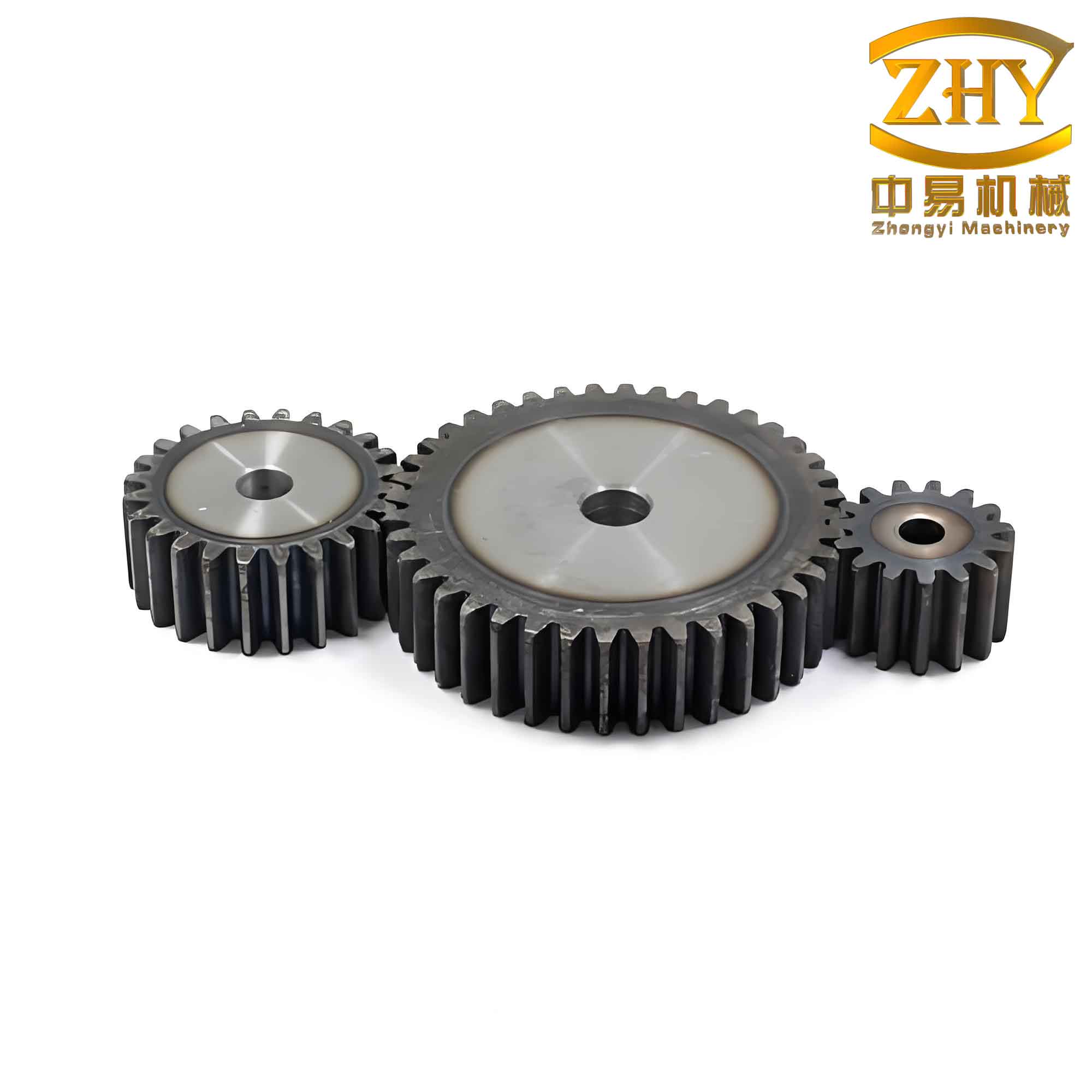
I use an NI-9234 four-channel data acquisition card to measure radial (y-direction) and tangential (x-direction) acceleration of the gearbox housing. The sampling frequency is 8192 Hz, and 8192 data points are recorded. The measured acceleration is integrated numerically to obtain vibration velocity and displacement. Table 4 summarizes the vibration frequency components identified from the acceleration spectrum.
| Frequency Component | Calculated (Hz) | Measured (Hz) |
|---|---|---|
| Driving gear rotating frequency | 13.37 | 13.3 |
| Driven gear rotating frequency | 9.81 | 9.8 |
| Gear mesh frequency | 735.97 | 734.7 |
| Belt pulley frequency | 428.2 | 427.5 |
The experimental mesh frequency (734.7 Hz) closely matches the theoretical value (735.97 Hz), confirming the dynamic model. The tangential vibration velocity obtained from integration is on the order of 0.02 m/s, which is consistent with both the MATLAB and ADAMS simulation results. The vibration displacement from experiments is about 0.1 mm, larger than the ADAMS prediction but comparable to the lumped-parameter model results (0.05-0.1 mm). This discrepancy is likely due to the simplified representation of bearing and shaft flexibility in the lumped-parameter model and the ideal contact conditions in ADAMS.
| Method | Tangential Velocity (m/s) | Tangential Displacement (m) |
|---|---|---|
| Lumped-parameter (MATLAB) | ~0.025 | ~8×10⁻⁵ |
| ADAMS simulation | ~0.020 | ~1×10⁻⁵ |
| Experiment (integrated) | ~0.022 | ~1×10⁻⁴ |
The comparison shows that the lumped-parameter model provides better agreement with experiments for displacement amplitude, while both simulation methods yield velocity values of the same order as the measurements. The ADAMS simulation tends to underestimate displacement because it does not fully account for the distributed flexibility of shafts and bearings as incorporated in the lumped-parameter model.
6. Conclusions
In this work, I have systematically investigated the dynamic characteristics of a straight spur gear transmission system using three complementary approaches: lumped-parameter analytical modeling, multi-body dynamics simulation in ADAMS, and experimental testing. The following conclusions are drawn:
- The lumped-parameter model and ADAMS simulation both predict dynamic meshing forces that agree well with theoretical calculations (Table 3). The small axial force observed in ADAMS (2.16 N) is a three-dimensional effect absent in the planar model of straight spur gears, but it does not significantly affect the overall dynamic response.
- For vibration velocity, all three methods produce results of the same order of magnitude (0.02–0.025 m/s), demonstrating the validity of both modeling approaches. For vibration displacement, the lumped-parameter model yields values closer to experiments (~10⁻⁴ m), while ADAMS underestimates displacement by about one order of magnitude (~10⁻⁵ m). This suggests that the lumped-parameter model captures the system flexibility more accurately for straight spur gears.
- ADAMS simulation is computationally more efficient and provides a straightforward way to visualize three-dimensional motions, but the lumped-parameter model offers higher accuracy for displacement prediction. A combined use of both methods is recommended for a comprehensive understanding of straight spur gear dynamics.
- The experimental acceleration spectrum clearly identifies the gear mesh frequency (734.7 Hz) and its harmonics, confirming the dynamic model of the straight spur gear system. Numerical integration of acceleration yields reliable velocity and displacement data for validation.
- These findings provide a solid foundation for further research on vibration reduction and noise control in straight spur gear transmissions. The methods presented can be extended to helical gears, planetary gears, and multi-stage transmissions.
In summary, the dynamic behavior of straight spur gears can be effectively analyzed through the synergy of analytical modeling, multi-body simulation, and experimental testing. The results highlight the importance of considering support flexibility and friction in dynamic models of straight spur gear pairs.