
In this study, I investigated the particle interaction behavior on the tooth surfaces of a straight spur gear during spindle barrel finishing using the discrete element method (DEM). The objective was to understand how processing parameters influence the relative motion and contact forces between abrasive particles and the gear teeth, and how these factors affect the uniformity of surface finishing. I conducted simulations and experimental validations to analyze the effects of gear immersion depth and rotational speeds of both the gear and drum. The results reveal periodic particle flow patterns and significant differences in contact forces between the upper and lower tooth flanks. Increasing immersion depth primarily enhances contact forces, while increasing rotational speeds predominantly increases relative particle velocities. Moreover, deeper immersion improves axial finishing uniformity. This work provides a mechanistic understanding for optimizing the finishing process of straight spur gears.
1. Introduction
The demand for high-performance straight spur gears with long fatigue life and reliable service has driven the development of surface finishing techniques. Spindle barrel finishing is widely adopted for its ability to reduce surface roughness, remove burrs, and improve residual stress distribution on complex geometries like gear teeth. Previous studies have shown that the contact force and impact velocity between particles and workpiece surfaces are crucial for material removal and surface integrity. However, direct observation of the particle-tooth interface is challenging. Therefore, I employed DEM simulation to analyze the particle flow field and contact mechanics on a straight spur gear tooth surface. This approach allows detailed investigation of how gear immersion depth and rotational speeds affect particle behavior, and I validated the simulation results through experimental strain and roughness measurements.
2. Principle of Spindle Finishing
Spindle finishing involves a rotating drum filled with abrasive particles, into which a workpiece (straight spur gear) is immersed and rotated about its own axis. The relative motion between the particles and the gear surfaces generates forces and velocities that lead to material removal. The key parameters include the immersion depth of the gear (h₁), the rotational speed of the drum (n₁), and the rotational speed of the gear (n₂). In my experiments and simulations, the speed ratio n₁:n₂ was fixed at 5:4, consistent with the experimental setup. The particle flow field is modified by the presence of the gear, creating a pile-up region in front of the gear and a wake behind it. The relative velocity between a particle and a gear tooth can be expressed by the following formula:
$$ V = 2\pi n_1 \left[ r^2 \left(1 – \frac{n_2}{n_1}\right)^2 + R^2 + 2Rr \left(1 – \frac{n_2}{n_1}\right) \cos\theta \right]^{1/2} $$
where V is the relative velocity, r is the distance from the tooth surface point to the gear axis, R is the center distance between gear and drum, and θ is the angle between the radial line and the line connecting the two centers.
3. Discrete Element Simulation
3.1 Model Setup
I built a DEM model using EDEM software with the Hertz-Mindlin (no slip) contact model based on Archard’s wear theory. The abrasive particles were spherical brown corundum with a diameter of 3 mm. The straight spur gear had module m = 5 mm, number of teeth z = 23, face width b = 40 mm, and pressure angle 20°. The material properties and contact parameters are summarized in the tables below. The simulation time step was set at 20% of the Rayleigh time step, and the total simulation duration covered three gear rotation periods.
| Material | Density ρ (kg/m³) | Poisson’s ratio ε | Shear modulus E (MPa) |
|---|---|---|---|
| Drum (steel) | 7850 | 0.300 | 7940 |
| Particle (brown corundum) | 2675 | 0.360 | 1260 |
| Gear (40Cr) | 7870 | 0.277 | 8080 |
| Interaction | Restitution coefficient | Static friction coefficient | Rolling friction coefficient |
|---|---|---|---|
| Particle–drum | 0.50 | 0.35 | 0.10 |
| Particle–gear | 0.43 | 0.36 | 0.10 |
| Particle–particle | 0.46 | 0.39 | 0.10 |
3.2 Simulation Design
According to Archard’s wear model, the wear depth Δh on the gear surface is proportional to the normal contact pressure P and the relative sliding velocity v:
$$ \Delta h = \frac{K P v}{H} \Delta t $$
where K is the wear coefficient, H is the material hardness, and Δt is the time interval. Thus, I focused on two key factors: immersion depth (h₁) and rotational speeds (n₁, n₂). The simulation parameters are listed in the following table:
| Gear immersion depth h₁ (mm) | Drum rotational speed n₁ (r/min) |
|---|---|
| 80 | 12, 21, 30 |
| 110 | 12, 21, 30 |
| 140 | 12, 21, 30 |
In all cases, the gear rotational speed n₂ was kept at 4/5 of n₁.
4. Results and Analysis
4.1 Particle Flow Field around the Straight Spur Gear
When the drum rotates, the free surface of the particle bed forms a parabolic shape. Upon inserting the straight spur gear, the flow is disrupted, creating a pile-up region ahead of the gear and a void region behind it. The maximum pile-up height reaches 192.23 mm, while the void depth is about 70 mm lower than the static level. The particle velocity field shows that particles decelerate when hitting the gear front, then accelerate as they slide down the wake. I examined three orthogonal cutting planes through the gear center: the xz plane shows low velocity near the tooth flanks; the yz plane reveals upward flow on the front side and downward flow on the rear; the xy plane indicates lateral flow around the gear, with the highest velocities exceeding 0.6 m/s near the drum wall. The flow pattern strongly influences the particle–tooth contact conditions.
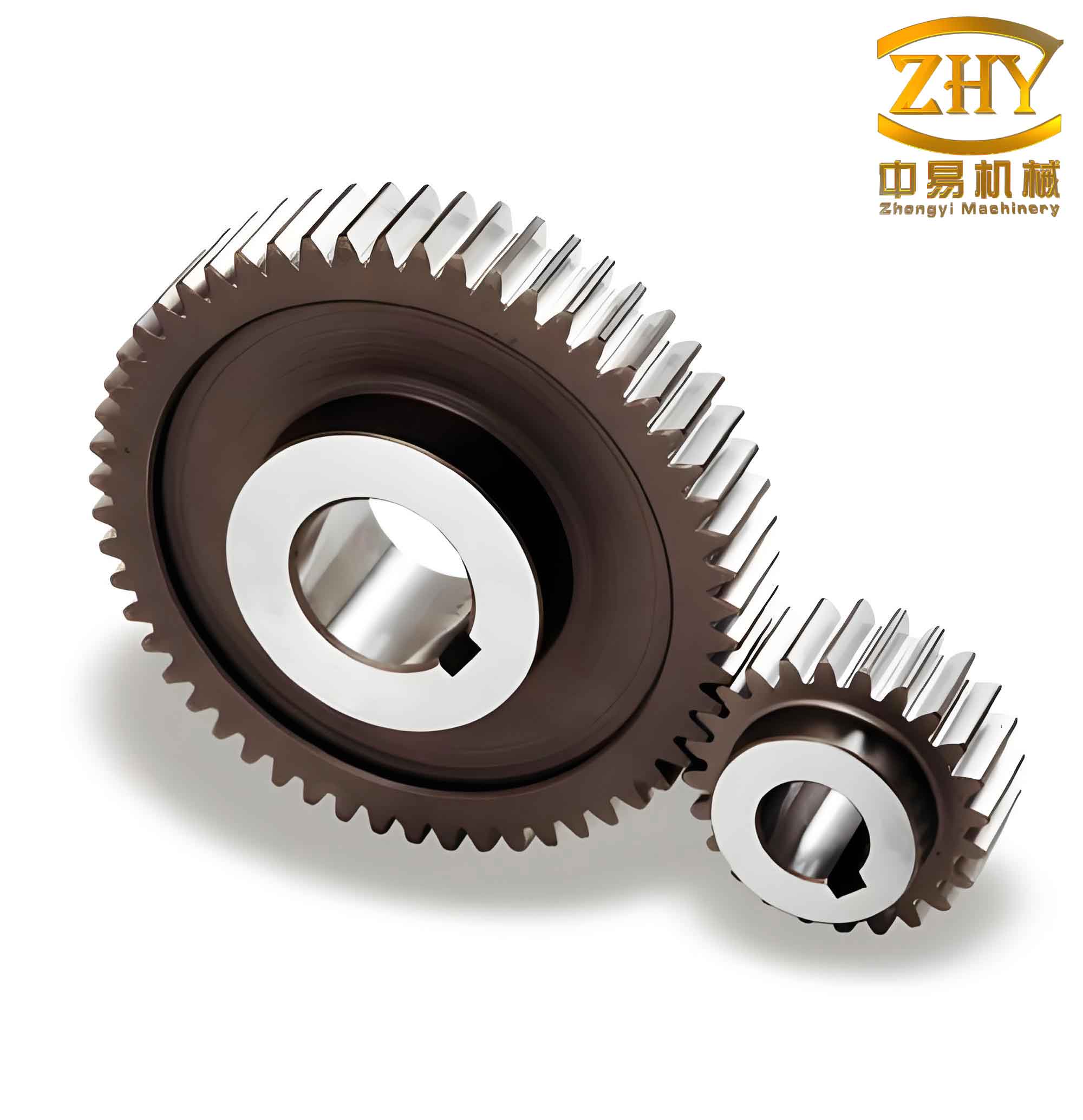
To visualize the straight spur gear used in this study, the following image illustrates a typical gear geometry:
4.2 Contact Particle Velocity on Tooth Surfaces
During one gear revolution, the particle flow inside the tooth space undergoes three phases: filling, stable filling, and outflow. In the stable filling phase, particles move upward along the tooth surface with velocities between 0.01 and 0.05 m/s, and the number of contacting particles remains constant (30–40 particles per tooth surface). I extracted the relative velocity of particles contacting the tooth surface during the stable phase. For a given immersion depth (h₁ = 80 mm), increasing the drum speed from 12 to 30 r/min increases the average relative particle velocity by 148%. For a fixed speed (n₁ = 30 r/min), increasing immersion depth from 80 to 140 mm only increases the velocity by 4%. Therefore, rotational speed is the dominant factor controlling particle velocity on the straight spur gear tooth surface.
| Parameter variation | Condition | Relative velocity increase |
|---|---|---|
| Speed (n₁) from 12 to 30 r/min, h₁=80 mm | All tooth surface | 148% |
| Depth (h₁) from 80 to 140 mm, n₁=30 r/min | All tooth surface | 4% |
Notably, the upper tooth flank always exhibits higher relative velocities than the lower flank, with the ratio ranging from 1.35 to 1.45, regardless of parameters.
4.3 Contact Force Distribution on Tooth Surfaces
The normal contact force on the tooth surface also varies periodically. In the stable filling phase, the average contact force is 22.45 times that in the filling phase and 26.24 times that in the outflow phase. When increasing immersion depth from 80 to 140 mm (75% increase), the contact force increases by 76%. In contrast, increasing speed from 12 to 30 r/min (150% increase) only raises the contact force by 18%. Hence, immersion depth is the primary factor affecting contact forces.
The spatial distribution of contact forces on the straight spur gear tooth surface is inhomogeneous. The upper tooth flank experiences 1.52 to 1.88 times the force of the lower flank. Additionally, the axial distribution shows that the lower part of the tooth (near the gear end face) experiences slightly higher forces than the upper part, but this difference diminishes as immersion depth increases. When h₁ = 140 mm, the axial force distribution becomes nearly uniform. This suggests that deeper immersion promotes axial uniformity of finishing.
| Parameter change | Contact force change | Relative velocity change |
|---|---|---|
| h₁: 80 → 140 mm (↑75%) | ↑76% | ↑4% |
| n₁: 12 → 30 r/min (↑150%) | ↑18% | ↑148% |
5. Experimental Validation
I conducted experiments on an X1400 spindle finishing machine using the same parameters as simulations. Resistance strain gauges were attached to the gear tooth flank, upper end face, and lower end face to measure stress. The strain signals were low-pass filtered at 200 Hz, and only compressive stresses (negative) were retained. The stress at the tooth flank showed periodic variations corresponding to gear rotation, confirming the cyclic particle contact pattern observed in DEM. The average stress at the lower end face was significantly higher than at the upper end face, consistent with the simulated force non-uniformity.
I also measured surface roughness Ra before and after 2-hour finishing for different parameters. The roughness reduction rate increased with both speed and depth. For the lower end face, the reduction rate reached 58.36% at n₁=30 r/min, h₁=80 mm, and 56.89% at h₁=140 mm, n₁=30 r/min. More importantly, the axial uniformity improved with deeper immersion: at h₁=80 mm, the roughness reduction rates at three axial positions (top, middle, bottom of tooth flank) were 17%, 26%, 36%; at h₁=140 mm, they became 62%, 58%, 55%, indicating a nearly uniform axial finish. This corroborates the simulation finding that deeper immersion reduces axial variability.
| Immersion depth h₁ (mm) | Top of flank (%) | Middle of flank (%) | Bottom of flank (%) |
|---|---|---|---|
| 80 | 17 | 26 | 36 |
| 140 | 62 | 58 | 55 |
The experimental results follow the same trends as the simulations: increasing depth mainly enhances contact forces, while increasing speed mainly enhances particle velocities. The difference between upper and lower tooth surfaces persists in both experimental stress and roughness data, validating the simulation model.
6. Conclusions
Based on the discrete element simulation and experimental investigation of spindle finishing of a straight spur gear, I draw the following conclusions:
- The particle flow and contact on the tooth surface of a straight spur gear exhibit periodic phases: filling, stable filling, and outflow. The stable filling phase is the most active, with contact forces 22 times higher than the filling phase and 26 times higher than the outflow phase.
- Increasing the gear immersion depth significantly increases the contact force on the tooth surface: a 75% depth increase results in a 76% force increase, while the relative particle velocity only rises by 4%.
- Increasing the drum and gear rotational speeds predominantly increases the relative particle velocity: a 150% speed increase yields a 148% velocity increase, while the contact force rises by only 18%.
- The upper tooth flank experiences 1.5–1.8 times higher contact forces and 1.35–1.45 times higher relative velocities than the lower flank. This inhomogeneity is not significantly affected by changes in depth or speed.
- Deep immersion (140 mm) reduces the axial finishing variability of the straight spur gear: the roughness reduction rate along the tooth flank becomes nearly uniform (around 60%), compared to a large spread when immersion is shallow (80 mm). Changing speeds or depths does not significantly alter the non-uniformity along the tooth profile direction.
These findings provide a quantitative basis for selecting processing parameters to achieve uniform surface finishing on straight spur gears in spindle barrel finishing operations.