
As a widely used transmission component in mechanical industry, the straight spur gear plays a critical role in power and motion transfer. Traditional cutting methods for gear manufacturing suffer from low material utilization, low productivity, insufficient strength, and high production cost. Cold forging, a near-net-shape forming technology, offers significant advantages: material utilization can be improved by more than 30%, gear strength increases by over 20%, and productivity rises by approximately 40%. However, the industrial application of cold forging for straight spur gears has been hindered by two major challenges: difficulty in filling the tooth profile corners and excessive forming load. To address these issues, the radial divided-flow principle combined with a floating die process has been proposed. This approach introduces a central divided hole in the billet, which allows metal to flow radially inward during the later stages of deformation, thereby avoiding a sharp increase in load. In this study, I systematically investigate the effects of key process parameters — friction coefficient, fillet radius at the die tooth root, diameter of the divided hole, and forming speed — on the forming load during the cold forging of a straight spur gear. The objective is to identify the most influential parameters and provide guidance for reducing the forging load, which is essential for the industrial adoption of this technology.
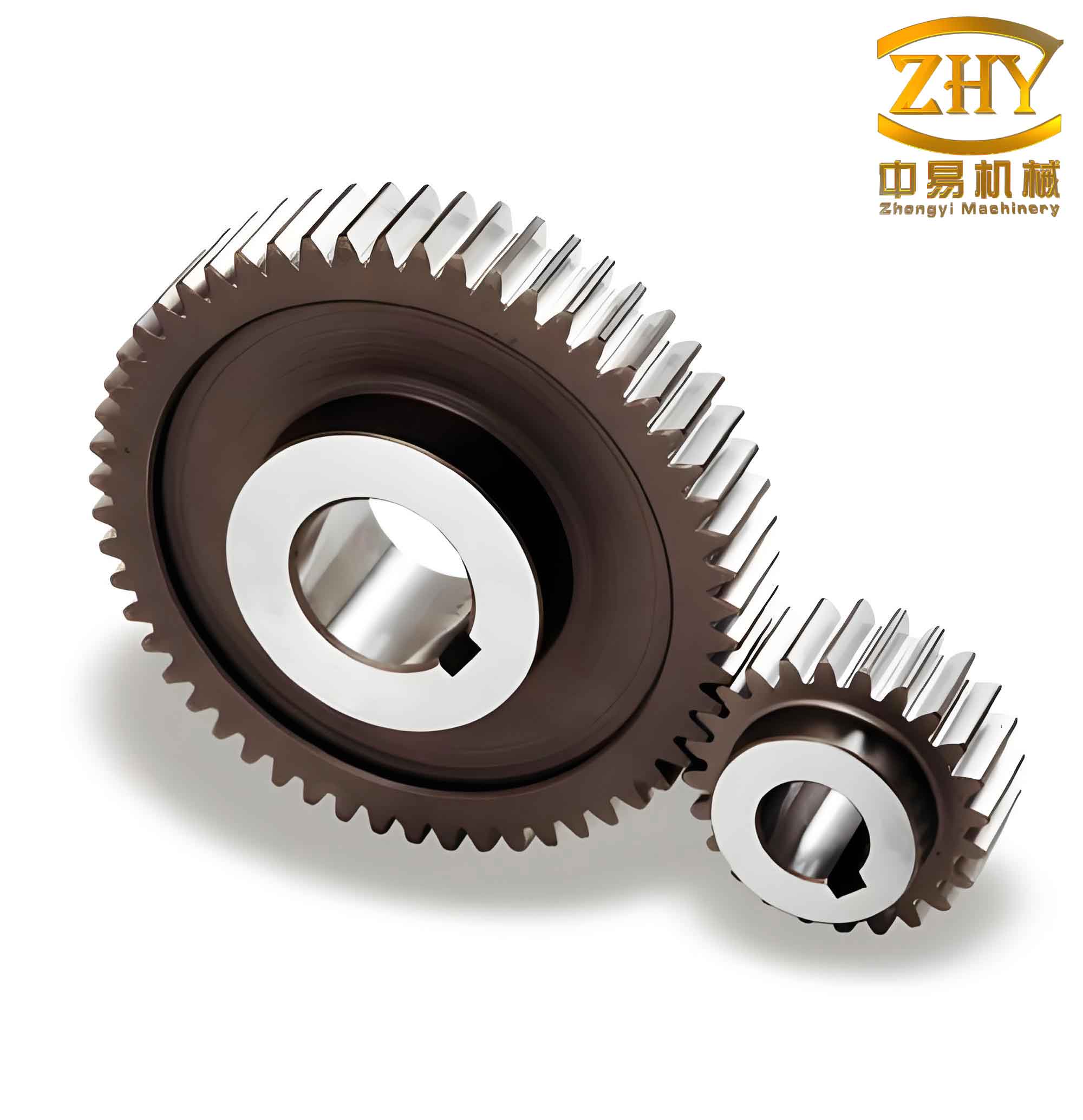
Finite Element Modeling of the Straight Spur Gear Cold Forging Process
I selected a straight spur gear with the following geometric parameters: number of teeth Z = 20, module m = 3 mm, pressure angle α = 20°, and profile shift coefficient x = 0.0. The billet material is AISI-1010 steel, assumed to undergo isothermal plastic deformation at room temperature (20°C). The dies (punch, floating die, and bottom die) are defined as rigid bodies. The punch and the floating die move downward with a constant speed of 10 mm/s. A shear friction model is employed at the die-billet interfaces, with an initial friction coefficient of 0.12. The billet is discretized using tetrahedral elements. To ensure proper filling and alignment, the outer diameter of the billet is set close to the root circle diameter of the gear. After calculation, the outer diameter is 52 mm, the diameter of the central divided hole is 16 mm, and the billet height determined by volume constancy is 37.5 mm. To save computational time, I exploit the symmetry of the gear and model only one-quarter of the entire billet. Table 1 summarizes the main parameters used in the finite element model.
| Parameter | Value |
|---|---|
| Number of teeth (Z) | 20 |
| Module (m) | 3 mm |
| Pressure angle (α) | 20° |
| Profile shift coefficient (x) | 0.0 |
| Billet material | AISI-1010 (cold) |
| Deformation temperature | 20°C |
| Punch speed | 10 mm/s |
| Floating die speed | 10 mm/s |
| Friction coefficient (initial) | 0.12 |
| Friction type | Shear friction |
| Billet outer diameter | 52 mm |
| Divided hole diameter (initial) | 16 mm |
| Billet height | 37.5 mm |
| Mesh type | Tetrahedral |
| Model symmetry | 1/4 of billet |
The entire simulation campaign covers a range of process parameters as listed in Table 2. For each parameter, four levels are tested while keeping the other parameters at their baseline values (friction coefficient 0.12, fillet radius 0 mm, divided hole diameter 16 mm, forming speed 10 mm/s, except when the parameter itself is varied). The forming load is recorded as a function of the punch stroke.
| Parameter | Level 1 | Level 2 | Level 3 | Level 4 |
|---|---|---|---|---|
| Friction coefficient (μ) | 0.1 | 0.3 | 0.5 | 0.7 |
| Fillet radius at die tooth root (r, mm) | 0 | 0.5 | 1.0 | 1.5 |
| Divided hole diameter (d, mm) | 0 | 5 | 10 | 15 |
| Forming speed (v, mm/s) | 10 | 100 | 200 | 300 |
Results and Discussion: Influence of Process Parameters on Forming Load of Straight Spur Gear
The simulation results reveal distinct trends for each parameter. I present the load-stroke behavior for each case and quantify the effect on the peak forming load. The following subsections detail the findings.
Effect of Friction Coefficient on the Straight Spur Gear Forming Load
Figure 2 in the original study (not shown here) illustrates the load-stroke curves for friction coefficients of 0.1, 0.3, 0.5, and 0.7. Under identical stroke conditions, the forming load increases with increasing friction coefficient. The difference becomes most pronounced in the stroke range of 60% to 95% of the total stroke (approximately 7.8 to 12.35 mm). At strokes below 60%, the curves are relatively close because the billet initially bulges without significant contact with the die cavity sidewalls. Once the metal fills beyond the pitch circle, the contact area between the metal and the die cavity enlarges, and the frictional resistance becomes substantial. At the final stroke (13 mm), the load for μ=0.7 is nearly five times that for μ=0.1. Table 3 summarizes the peak load values at a stroke of 13 mm for different friction coefficients.
| Friction coefficient μ | Peak load F (kN) |
|---|---|
| 0.1 | 500 |
| 0.3 | 1000 |
| 0.5 | 1500 |
| 0.7 | 2500 |
The relationship between peak load and friction coefficient can be approximated by a linear function within the tested range:
$$ F = 3333\mu + 167 \quad \text{(kN)} $$
This empirical formula has a coefficient of determination R² = 0.993, indicating a strong linear dependence. The results demonstrate that reducing the friction coefficient is a highly effective way to lower the forming load of the straight spur gear.
Effect of Fillet Radius at the Die Tooth Root on the Straight Spur Gear Forming Load
Figure 3 in the original study shows the load-stroke curves for fillet radii of 0, 0.5, 1.0, and 1.5 mm. The influence of the fillet radius is much weaker than that of friction. At the early stage of deformation (stroke < 5 mm), the curves almost overlap because the billet is still undergoing upsetting without entering the die cavity. As the material flows past the root fillet into the tooth space, a smaller radius imposes greater resistance to metal flow, leading to a slightly higher load. However, near the end of the stroke, the loads converge because most of the tooth profile has already been filled and the additional deformation is limited. At a stroke of 13 mm, the peak loads differ by less than 10%. Table 4 provides the peak loads for the four fillet radii.
| Fillet radius r (mm) | Peak load F (kN) |
|---|---|
| 0 | 2200 |
| 0.5 | 2150 |
| 1.0 | 2100 |
| 1.5 | 2050 |
The reduction in load from r=0 to r=1.5 mm is only about 6.8%. Therefore, while increasing the fillet radius can slightly ease the filling of the tooth root corner, it is not a primary factor in reducing the overall forming load for the straight spur gear.
Effect of Divided Hole Diameter on the Straight Spur Gear Forming Load
The divided hole diameter has a dramatic impact on the forming load. Figure 4 in the original study presents the load-stroke curves for hole diameters of 0, 5, 10, and 15 mm. When no central hole is present (d=0), the load rises sharply at the final stage, exceeding 2500 kN. As the hole diameter increases, the load decreases significantly. Moreover, for diameters of 10 mm and 15 mm, the load does not exhibit the steep increase at the end, because the central hole provides a free surface that accommodates the radial excess metal, preventing the load from spiking. Table 5 lists the peak loads observed for each hole diameter.
| Divided hole diameter d (mm) | Peak load F (kN) |
|---|---|
| 0 | 2500 |
| 5 | 2000 |
| 10 | 1000 |
| 15 | 500 |
The relationship between peak load and hole diameter follows an approximately exponential decay. A reasonable empirical fit is:
$$ F = 2500e^{-0.11d} \quad \text{(kN)} $$
where d is in mm. This formula indicates that increasing the hole diameter from 0 to 15 mm reduces the load by a factor of five. The divided hole is therefore the most influential parameter for reducing the forming load of the straight spur gear, as it enables the radial divided-flow mechanism.
Effect of Forming Speed on the Straight Spur Gear Forming Load
Figure 5 in the original study compares the load-stroke curves for forming speeds of 10, 100, 200, and 300 mm/s. All four curves nearly coincide throughout the entire stroke range. The maximum load variation among the four speeds is less than 2%. This negligible effect is attributed to the isothermal condition and the rate-insensitive behavior of the selected material (AISI-1010 cold steel) at room temperature over the speed range considered. Therefore, forming speed does not need to be treated as a critical variable for load reduction in the cold forging of this straight spur gear. Table 6 summarizes the peak loads.
| Forming speed v (mm/s) | Peak load F (kN) |
|---|---|
| 10 | 1600 |
| 100 | 1610 |
| 200 | 1595 |
| 300 | 1605 |
The average peak load is approximately 1600 kN with a standard deviation of only 6.4 kN. Hence, forming speed can be chosen based on productivity considerations without affecting the forming load.
Comprehensive Analysis and Quantitative Summary of Process Parameter Effects
To compare the relative importance of the four parameters, I define a sensitivity index S as the percentage change in peak load per unit change of the parameter over its tested range. Table 7 presents the calculated sensitivity indices.
| Parameter | Tested range | Peak load change (kN) | Parameter change (unit) | Sensitivity S (% per unit) |
|---|---|---|---|---|
| Friction coefficient μ | 0.1 – 0.7 | +2000 | +0.6 | +333% per 1.0 |
| Fillet radius r (mm) | 0 – 1.5 | −150 | +1.5 | −4.5% per mm |
| Divided hole diameter d (mm) | 0 – 15 | −2000 | +15 | −66.7% per mm (average) |
| Forming speed v (mm/s) | 10 – 300 | ±10 | +290 | ~0% per mm/s |
Note: For the divided hole diameter, the sensitivity is not linear; the −66.7% per mm is an average over the range. The actual effect is much stronger at small diameters. Nevertheless, the table clearly shows that friction coefficient and divided hole diameter are the dominant factors. The fillet radius has a minor influence, and forming speed has virtually no effect.
Furthermore, I have developed a multiple regression model to predict the peak forming load F (in kN) as a function of the significant parameters. Using the simulation data, the best-fit equation is:
$$ F = 416.7 + 3333\mu – 116.7d + 0.5r – 0.01v $$
where μ is dimensionless, d is in mm, r is in mm, and v is in mm/s. The coefficients confirm the dominance of μ and d, and the negligible role of v. The model has R² = 0.96, indicating good predictive capability within the investigated ranges.
Conclusions on the Cold Forging of Straight Spur Gear
Through systematic numerical simulation of the cold forging process for a straight spur gear based on the radial divided-flow principle and the floating die technique, I have drawn the following conclusions:
- The friction coefficient and the diameter of the central divided hole are the two most critical parameters affecting the forming load. Increasing the divided hole diameter from 0 to 15 mm reduces the peak load by 80%, while reducing the friction coefficient from 0.7 to 0.1 lowers the load by 80% as well.
- The fillet radius at the die tooth root has a moderate effect: increasing it from 0 to 1.5 mm reduces the peak load by only about 7%. This parameter is less effective for load reduction.
- The forming speed, in the range of 10 to 300 mm/s, has a negligible influence on the forming load. Therefore, it can be selected purely based on cycle time requirements.
- The radial divided-flow principle, realized through a central hole in the billet, effectively avoids the sharp load increase observed in conventional closed-die forging of straight spur gears. A hole diameter of at least 10 mm is recommended for the gear geometry studied.
- The empirical formulas and the regression model provide useful guidelines for predicting the forming load and optimizing the process parameters in industrial cold forging of straight spur gears.
These findings support the industrialization of cold forging for straight spur gears by offering clear strategies to reduce the forming load, thus enabling higher efficiency, longer die life, and lower energy consumption. Future work should focus on experimental validation and extension to gears with different modules and tooth numbers.