
We present a comprehensive numerical study on the non-steady-state elastohydrodynamic lubrication (EHL) of involute straight spur gears lubricated by different carrier fluid ferrofluids under impact load. The aim is to understand how the choice of ferrofluid carrier liquid affects the pressure distribution and film thickness in the gear contact zone during dynamic loading conditions. Our analysis incorporates the meshing geometry, time-varying load, and rheological properties of ferrofluids, providing insights for optimizing gear lubrication in practical applications.
The lubrication of straight spur gears is inherently transient due to varying contact geometry, entrainment velocity, and load along the line of action. Impact loads, which often occur during gear engagement, further complicate the lubrication regime. Ferrofluids, consisting of magnetic nanoparticles suspended in a carrier liquid, offer unique advantages such as self-sealing and enhanced film formation under external magnetic fields. However, the carrier liquid plays a critical role in determining the lubricant’s viscosity, density, and overall performance. We investigate three types of ferrofluids: ester-based H02, hydrocarbon-based E02, and diester-based D01, under impact loading applied at the meshing point.
Geometric Model of Straight Spur Gears
We adopt a Cartesian coordinate system to describe the meshing geometry of straight spur gears. A fixed coordinate system XPY defines the global positions, while a moving coordinate system xKy is attached to the instantaneous meshing point. The meshing point moves along the line of action with velocities v₁(t) = ω₁Rb1(t) and v₂(t) = ω₂Rb2(t), where ω₁ and ω₂ are the angular velocities of the driving and driven gears, respectively. The instantaneous radii R₁(t) and R₂(t) are given by:
$$ R_1(t) = R_{b1} \tan \varphi – s(t) $$
$$ R_2(t) = R_{b2} \tan \varphi + s(t) $$
where φ is the pressure angle, s(t) is the distance along the line of action from the pitch point, and Rb1, Rb2 are the base radii. The composite radius of curvature R(t) is:
$$ R(t) = \frac{R_1(t) R_2(t)}{R_1(t) + R_2(t)} $$
The entrainment velocity u(t) is the average of the tangential velocities u₁(t) and u₂(t) along the involute profiles:
$$ u(t) = \frac{u_1(t) + u_2(t)}{2} $$
$$ u_1(t) = \omega_1 (R_{b1} \tan \varphi + s) $$
$$ u_2(t) = \omega_2 (R_{b2} \tan \varphi – s) $$
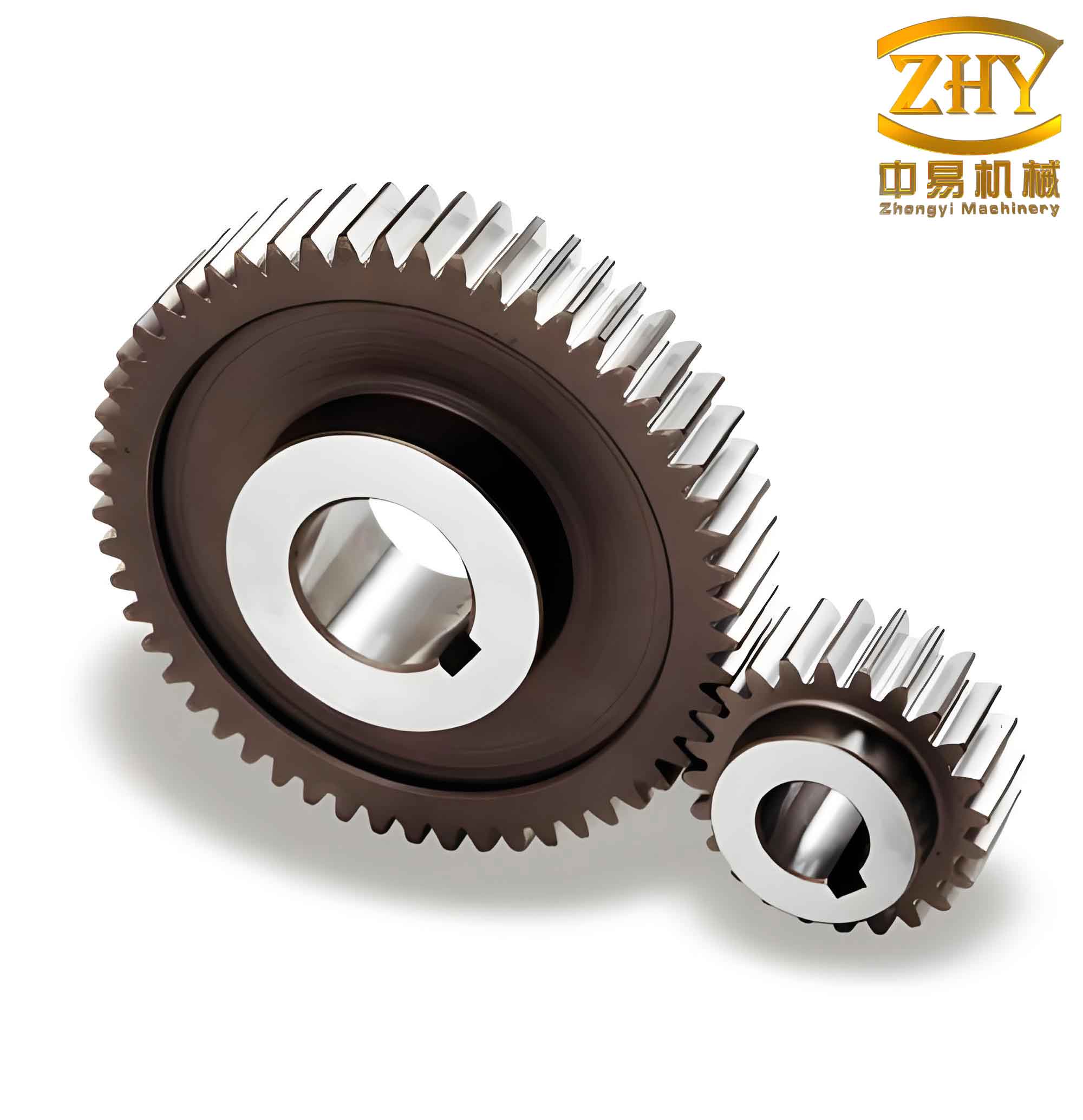
Governing Equations for EHL of Straight Spur Gears
Reynolds Equation
For isothermal, line-contact, time-dependent lubrication, the pressure p(x,t) satisfies the Reynolds equation:
$$ \frac{\partial}{\partial x} \left( \frac{\rho h^3}{\eta} \frac{\partial p}{\partial x} \right) = 12 \frac{\partial (\rho u h)}{\partial x} + 12 \frac{\partial (\rho h)}{\partial t} $$
where ρ is the lubricant density, η is the viscosity, h is the film thickness, and u is the entrainment speed. The boundary conditions are p(xin) = 0, p(xout) = 0, and p(x) ≥ 0 within the computational domain.
Film Thickness Equation
The film thickness includes the undeformed geometry, the elastic deformation of the gear surfaces, and a rigid body separation h₀(t):
$$ h(x,t) = h_0(t) + \frac{x^2}{2R(t)} – \frac{2}{\pi E’} \int_{x_{in}}^{x_{out}} p(\zeta,t) \ln (x-\zeta)^2 \, d\zeta $$
where E’ is the effective elastic modulus of the gear material.
Viscosity-Pressure Relationship
We employ the Roelands viscosity model:
$$ \eta = \eta_0 \exp\left\{ (\ln \eta_0 + 9.67) \left[ (1 + 5.1 \times 10^{-9} p)^{z_0} – 1 \right] \right\} $$
where η₀ is the ambient viscosity, and z₀ is the viscosity-pressure index.
Density-Pressure Relationship
The Dowson-Higginson density model is used:
$$ \rho = \rho_0 \frac{1 + 0.6 \times 10^{-9} p}{1 + 1.7 \times 10^{-9} p} $$
where ρ₀ is the ambient density.
Impact Load Model
The impact load during gear meshing is modeled as a decaying sinusoidal function:
$$ w_i(t) = w_0 e^{-0.2 t} \sin\left( \frac{\pi t}{4} \right) $$
where w₀ is the amplitude of the impact load, and t is the dimensionless time. The total load on a pair of teeth varies along the mesh cycle, with single and double tooth contact regions as shown in Figure 3 of the original study.
Numerical Solution Method
We nondimensionalize all equations using the following scaling parameters:
| Parameter | Dimensionless Form |
|---|---|
| Coordinate | X = x / b |
| Load | W₀ = w₀ / (E’ R₀) |
| Speed | U₀ = η₀ u₀ / (E’ R₀) |
| Film thickness | H = h R₀ / b² |
| Pressure | P = p / pH |
| Viscosity | η* = η / η₀ |
| Density | ρ* = ρ / ρ₀ |
| Curvature | CRt = R / R₀ |
| Velocity | Cut = u / u₀ |
| Load variation | Cwtt = w / w₀ |
| Time | t* = t u₀ / b |
We discretize the equations using finite differences. The pressure field is solved using the multigrid method with 6 grid levels; the finest level contains 961 nodes. Elastic deformation is computed with the multigrid integration technique. Gauss-Seidel iterations are employed on each grid. The convergence criterion is that the relative error between two successive iterations is less than 10⁻³ for both pressure and load. A full mesh cycle is divided into 120 time instants. The steady-state solution just before impact is used as initial condition.
Results and Discussion
The gear and lubricant parameters used in the numerical simulation are listed in Table 1.
| Parameter | Value |
|---|---|
| Ambient viscosity η₀ (Pa·s) | 0.075 |
| Viscosity-pressure coefficient α (Pa⁻¹) | 2.19 × 10⁻⁸ |
| Viscosity-temperature coefficient β (K⁻¹) | 0.042 |
| Ambient density ρ₀ (kg/m³) | 870 |
| Specific heat of lubricant C (J/kg·K) | 2000 |
| Thermal conductivity of lubricant K (W/m·K) | 0.14 |
| Gear density ρ1,2 (kg/m³) | 7850 |
| Gear specific heat C1,2 (J/kg·K) | 470 |
| Gear thermal conductivity K1,2 (W/m·K) | 46 |
| Gear elastic modulus E1,2 (Pa) | 2.6 × 10¹¹ |
| Poisson’s ratio γ1,2 | 0.3 |
| Number of teeth z₁, z₂ | 35, 140 |
| Module m (mm) | 2.5 |
| Gear speed n₁ (r/min) | 600 |
| Tooth width B (mm) | 20 |
| Pressure angle θ (°) | 20 |
| Transmitted power P (kW) | 20 |
| Addendum coefficient h* | 1.0 |
| Clearance coefficient c* | 0.25 |
| Ambient temperature T₀ (K) | 313 |
Table 2 lists the physical properties of the three ferrofluids studied.
| Carrier liquid | Code | Viscosity η (Pa·s) | Density ρ (kg/m³) |
|---|---|---|---|
| Ester-based | H02 | 0.006 | 1250 |
| Hydrocarbon-based | E02 | 0.030 | 1300 |
| Diester-based | D01 | 0.075 | 1185 |
Effect of Ferrofluid Carrier Liquid under Impact Load
Figure 4 in the original article shows the pressure and film thickness distributions for the three ferrofluids at the pitch point under impact load. We summarize the key findings in Table 3.
| Ferrofluid | Peak Pressure (GPa) | Minimum Film Thickness (μm) |
|---|---|---|
| Ester H02 | 1.05 | 0.18 |
| Hydrocarbon E02 | 0.97 | 0.32 |
| Diester D01 | 0.89 | 0.48 |
The diester-based D01 ferrofluid, having the highest viscosity (0.075 Pa·s), produces the thickest lubricating film and the lowest contact pressure. In contrast, the ester-based H02 with the lowest viscosity (0.006 Pa·s) yields the thinnest film and highest pressure. This confirms that viscosity plays a dominant role in EHL of straight spur gears. Higher viscosity improves film formation and reduces asperity contact, thereby lowering pressure spikes.
Effect of Transmission Ratio on Diester D01 Lubricated Straight Spur Gears
We investigated the influence of the gear transmission ratio (i = z₂/z₁) on the lubrication performance of diester D01 ferrofluid under impact load at the pitch point. The results are summarized in Table 4.
| Transmission Ratio i | Peak Pressure (GPa) | Minimum Film Thickness (μm) |
|---|---|---|
| 2 | 0.95 | 0.38 |
| 4 | 0.89 | 0.48 |
| 6 | 0.84 | 0.55 |
As the transmission ratio increases, the composite radius of curvature and entrainment velocity also increase, promoting a thicker oil film and reducing contact pressure. Therefore, within allowable design limits, increasing the transmission ratio is beneficial for improving the lubrication condition of straight spur gears under impact load.
Effect of Transmitted Power on Diester D01 Lubricated Straight Spur Gears
Different transmitted power levels correspond to different tooth loads. Table 5 shows the effect of power on the EHL response at the pitch point.
| Transmitted Power (kW) | Peak Pressure (GPa) | Minimum Film Thickness (μm) |
|---|---|---|
| 10 | 0.82 | 0.55 |
| 20 | 0.89 | 0.48 |
| 30 | 0.98 | 0.40 |
Higher transmitted power increases the tooth load, leading to higher contact pressure and thinner oil film. This indicates that the diester D01 ferrofluid, while performing well under moderate loads, may require thicker films or higher viscosity grades for very high-power transmissions to avoid direct metal-to-metal contact in straight spur gears.
Conclusions
Based on our numerical analysis of non-steady-state EHL in straight spur gears under impact load and lubricated by different carrier fluid ferrofluids, we draw the following conclusions:
- Among the three ferrofluids studied, the diester-based D01 exhibits the largest film thickness and the smallest contact pressure due to its highest viscosity. The ester-based H02, with the lowest viscosity, results in the thinnest film and highest pressure. Carrier liquid viscosity is the key property affecting EHL performance in straight spur gears.
- For the diester D01 ferrofluid, increasing the transmission ratio reduces contact pressure and increases film thickness. Thus, higher gear ratios are advantageous for improving lubrication under impact loading.
- Higher transmitted power increases the tooth load, causing elevated pressure and reduced film thickness in straight spur gears lubricated with diester D01. This suggests that careful selection of ferrofluid viscosity is necessary for high-power applications.
Our findings provide valuable guidance for selecting appropriate ferrofluid carrier liquids in the design of reliable lubrication systems for straight spur gears subjected to impact loads.