
Spur gears represent one of the most widely used transmission components in the automotive industry, with enormous market demand. Traditional manufacturing processes, such as “hobbing + shaving” or “broaching + shaving,” are characterized by high precision and stable quality. However, these methods suffer from significant drawbacks including low material utilization, interrupted metal flow lines, high production costs, and relatively low efficiency. With the rapid advancement of precision plastic forming technology and mold manufacturing, cold extrusion forming has been successfully developed and gradually promoted for manufacturing spur gears of different modules and tooth counts. This process yields gears with high tooth accuracy, excellent surface quality, and enhanced load-bearing capacity, presenting a promising application prospect.
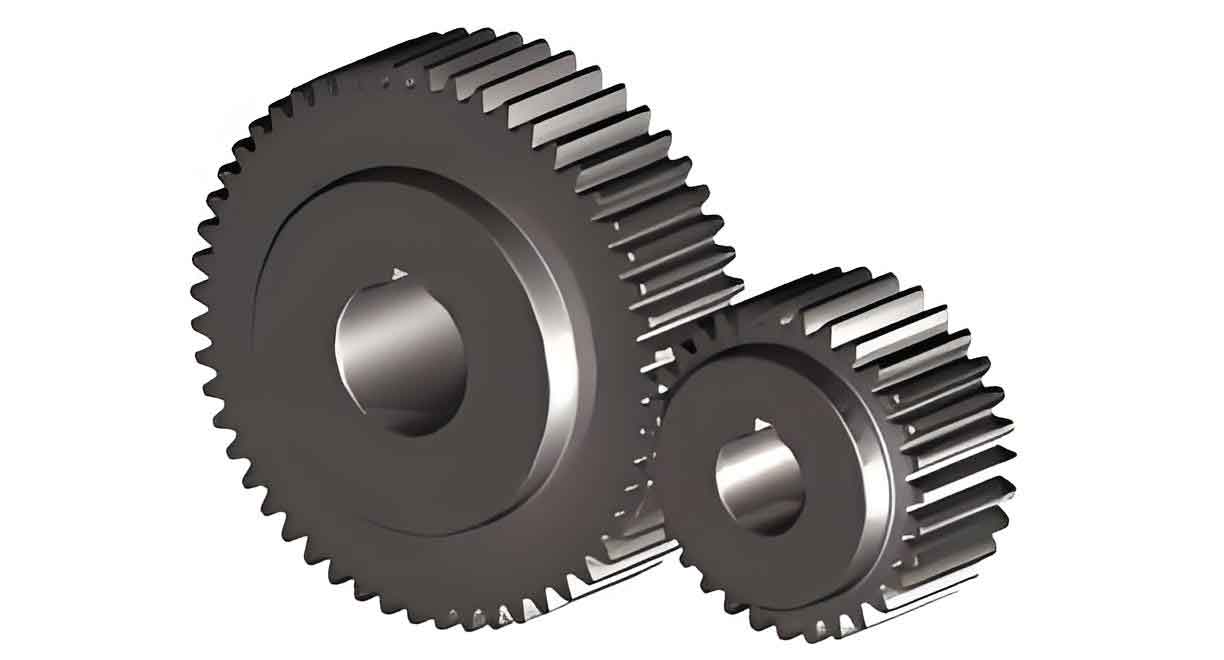
Extensive research has been conducted to improve the quality and prevent defects in the cold extrusion of spur gears. While previous studies offer valuable insights, many focus on process improvement or single-objective optimization. Few adopt a systematic multi-objective optimization approach to comprehensively address common forming defects. This study focuses on a through-type cold extrusion process for spur gears. In this process, the billet is pressed through a shaped die by a punch to plastically form the gear teeth. Although efficient, preliminary simulations and experiments identified critical quality issues: significant collapse (undercut) at the tooth tips on the exit side (bottom) and excessive outward protrusion (convexity) of the bottom end face. These defects directly lead to increased machining allowance, lower material utilization, and higher scrap rates. Therefore, optimizing the process parameters to minimize both the tooth tip collapse angle and the bottom face protrusion, while also considering the forming load, is essential. This constitutes a typical multi-objective optimization problem.
Problem Description and Process Analysis
The target component is a spur gear with a module m = 4, number of teeth Z = 16, pressure angle α = 20°, and is made of 20CrMnTi steel. The manufacturing sequence involves: hot forging to produce a ring blank, annealing, shot blasting, machining to a precise preform, application of polymer lubricant, and finally, cold extrusion. The through-type cold extrusion process is employed to enhance material utilization and production rate. The finite element model for this process was developed using FORGE software. The billet was defined as a plastic body. To save computational time, a sector model representing a single tooth was utilized. The simulation parameters were set with a constant extrusion speed, Coulomb friction model, and room temperature conditions.
The simulation revealed the metal flow pattern during forming. The process can be divided into three stages. In the initial stage, as the billet is forced into the tooth die cavity, the flow velocity of the outer layer metal is slower than that of the inner layer due to friction and constraint from the die. This velocity differential causes the inner layer to pull the outer layer, resulting in the outward protrusion of the bottom end face and insufficient filling at the bottom tooth tips, manifesting as a collapse angle. In the middle stage, as the metal enters the sizing land of the die, the flow velocity becomes more uniform, primarily in the axial direction. In the final stage, after exiting the sizing land, the metal is no longer in contact with the die and moves as a rigid body. Comparison between simulation results and actual formed parts showed good agreement, validating the reliability of the finite element model for analyzing this process.
Multi-Objective Optimization Methodology Based on Grey Relational Analysis
To address the multi-objective nature of the problem, an integrated methodology combining Design of Experiments (DOE), Grey Relational Analysis (GRA), Principal Component Analysis (PCA), and Response Surface Methodology (RSM) was employed. The goal is to transform the multiple objectives into a single comprehensive performance measure for optimization.
Experimental Design and Objective Definition
Four key geometrical parameters of the tooth die were selected as design variables (factors): tooth tip radius (R), entrance angle (μ), split angle thickness (T), and sizing land length (L). Their influence on three critical response objectives was investigated: the bottom tooth tip collapse amount (δ), the bottom face protrusion height (h), and the maximum forming load (F). A Central Composite Design (CCD) with four factors and five levels was used, resulting in 31 experimental runs for numerical simulation. The factor levels and the experimental design matrix with corresponding simulation results for δ, h, and F are presented below.
| Run | R (mm) | μ (°) | T (mm) | L (mm) | δ (mm) | h (mm) | F (kN) |
|---|---|---|---|---|---|---|---|
| 1 | 1.2 | 40 | 2 | 10 | 0.281 | 1.985 | 2141.7 |
| 2 | 1.6 | 40 | 2 | 10 | 0.278 | 1.928 | 2136.1 |
| 3 | 1.2 | 50 | 2 | 10 | 0.296 | 2.636 | 2195.4 |
| … | … | … | … | … | … | … | … |
| 31 | 1.4 | 45 | 3 | 15 | 0.331 | 2.409 | 2238.0 |
Data Preprocessing and Grey Relational Coefficient Calculation
In GRA, the first step is data preprocessing to normalize the raw data sequences, making them comparable. Since the objectives are to minimize δ, h, and F, the “smaller-the-better” characteristic is used. The reference sequence X0 is defined as the ideal optimal values, typically the minimum observed value for each objective: X0 = {min(δ), min(h), min(F)} = {0.278, 1.911, 2126.718}. Each experimental result forms a comparison sequence Xi(k), where i=1…31 and k=1,2,3 for the three objectives.
The grey relational coefficient ξi(k), which expresses the relationship between the reference and comparison sequences, is calculated for each response in each experiment using the following formula:
$$
\xi_i(k) = \frac{\min_i \min_k |x_0(k) – x_i(k)| + \rho \max_i \max_k |x_0(k) – x_i(k)|}{|x_0(k) – x_i(k)| + \rho \max_i \max_k |x_0(k) – x_i(k)|}
$$
where ρ is the distinguishing coefficient, usually set to 0.5. A larger grey relational coefficient indicates that the corresponding response is closer to the ideal value.
Determination of Weights via Principal Component Analysis
The overall performance, or Grey Relational Grade (GRG) γi, is a weighted sum of the grey relational coefficients. To objectively determine the weights βk for the three objectives (δ, h, F), Principal Component Analysis (PCA) was applied to the matrix of grey relational coefficients. PCA transforms correlated variables into a set of uncorrelated principal components. The weights are derived from the contribution rates of the first principal component associated with each original variable.
The covariance matrix Rjl of the grey relational coefficients is computed first:
$$
R_{jl} = \frac{\text{cov}[x_i(j), x_i(l)]}{\sigma_{x_i(j)} \sigma_{x_i(l)}}
$$
Solving the characteristic equation |λI – R| = 0 yields the eigenvalues λk and eigenvectors. The contribution rate αk of each principal component is given by λk / Σλi. The results of the PCA are summarized below.
| Principal Component | Associated Original Objective | Eigenvalue | Contribution Rate (%) |
|---|---|---|---|
| PC1 | Tooth Tip Collapse (δ) | 2.5185 | 84.0 |
| PC2 | Face Protrusion (h) | 0.3217 | 10.7 |
| PC3 | Forming Load (F) | 0.1598 | 5.3 |
The contribution rates are used as the weights: β_δ = 0.84, β_h = 0.107, β_F = 0.053. This indicates that improving the tooth tip fill (reducing δ) is the primary concern in optimizing the cold extrusion of spur gears, followed by reducing end face protrusion, with forming load being a secondary consideration.
Calculation of Grey Relational Grade
The Grey Relational Grade (GRG) for each experimental run, representing its overall multi-objective performance, is then calculated as:
$$
\gamma_i = \sum_{k=1}^{3} \beta_k \cdot \xi_i(k) = 0.84 \cdot \xi_i(\delta) + 0.107 \cdot \xi_i(h) + 0.053 \cdot \xi_i(F)
$$
A higher GRG value signifies that the corresponding combination of process parameters yields results closer to the ideal optimal values across all three objectives. The calculated GRG for all 31 runs allows for an initial assessment. The average GRG for each level of the four factors can be computed, and the factor with the largest range (difference between max and min average GRG) has the greatest influence on the multi-objective response. Analysis of the initial data indicated that split angle thickness (T) had the most significant effect, followed by entrance angle (μ), with tooth tip radius (R) and sizing land length (L) having comparatively lesser influence.
Development and Validation of the Predictive Response Model
To establish a precise quantitative relationship between the input process parameters and the output GRG, and to find the optimal parameter set within the design space, Response Surface Methodology (RSM) was employed. A second-order polynomial regression model was fitted to the data (GRG vs. R, μ, T, L). The general form of the model is:
$$
\gamma = \beta_0 + \sum \beta_i x_i + \sum \beta_{ii} x_i^2 + \sum \sum_{i<j} $$
Where β0 is the constant, βi are linear coefficients, βii are quadratic coefficients, βij are interaction coefficients, and ε is the error. The specific fitted model obtained was:
$$
\begin{aligned}
\gamma = & 0.22156 + 0.01395R – 0.02498\mu – 0.05797T – 0.01595L \\
& -0.00197R^2 + 0.00380\mu^2 – 0.00248T^2 + 0.00692L^2 \\
& +0.00384R\mu – 0.00273\mu T + 0.00722TL
\end{aligned}
$$
The adequacy of the model was rigorously checked. The predicted GRG values from the model were plotted against the actual calculated GRG values from the experiments, showing a strong linear correlation with an average relative error of only 3.12%. The Analysis of Variance (ANOVA) for the regression model yielded a highly significant p-value (< 0.0001). Key goodness-of-fit statistics are shown below:
| R² | Adjusted R² | Predicted R² | S (Residual Std. Dev.) |
|---|---|---|---|
| 0.9834 | 0.9738 | 0.9393 | 0.00987 |
The high R² and Adjusted R² values (both > 0.97) confirm the model’s excellent fit. The close agreement between Adjusted R² and Predicted R² (difference < 0.04) indicates good predictive capability for new observations. The normal probability plot of residuals showed points closely following a straight line, confirming the normality assumption. These diagnostics collectively validate the fitted response surface model as reliable for optimization.
Optimization and Experimental Verification
With a valid predictive model, the optimization problem simplifies to finding the combination of R, μ, T, and L within their feasible ranges that maximizes the Grey Relational Grade γ. Using the optimization module in statistical software, the response surface was navigated to find the maximum point. The optimal process parameters predicted by the model were: Tooth Tip Radius R = 1.6 mm, Entrance Angle μ = 40°, Split Angle Thickness T = 1.5 mm, Sizing Land Length L = 10 mm. The corresponding predicted maximum GRG was 0.374.
To verify the optimization results, a physical experiment was conducted using the optimal parameter set. A die was manufactured accordingly. The billets (20CrMnTi) underwent spheroidizing annealing and phosphating-soaping treatment for lubrication. The extrusion was performed on a 4 MN hydraulic press. The resulting spur gear formed via cold extrusion showed a marked improvement in quality. Compared to the initial unoptimized forming condition, the bottom tooth tip collapse was reduced by 51.7%, and the bottom face protrusion was decreased by 36.3%. This significant enhancement in the filling of the spur gear teeth and the reduction of the end defect clearly demonstrates the effectiveness of the proposed multi-objective optimization approach.
Conclusion
This study presented a systematic methodology for the multi-objective optimization of process parameters in the through-type cold extrusion forming of spur gears. The primary defects of tooth tip collapse and bottom face protrusion were successfully addressed. The integrated approach using Grey Relational Analysis combined with Principal Component Analysis effectively transformed the multi-response problem into a single-objective optimization of the Grey Relational Grade, objectively weighting the importance of each forming quality indicator. The Response Surface Model established a accurate quantitative relationship between the key die geometry parameters and the overall performance index. The optimization results yielded a specific parameter set that was validated through physical experiments, proving its capability to substantially improve the forming quality of spur gears. This methodology provides a robust and effective framework for optimizing complex multi-response metal forming processes, offering valuable guidance for the precision manufacturing of spur gears and similar axisymmetric parts via cold extrusion.