
In the field of mechanical engineering, the design and manufacturing of straight spur gears are fundamental to power transmission systems. The accuracy of gear models directly influences the performance of subsequent simulations, finite element analyses, virtual assembly, and numerical control machining. This work aims to establish a robust and efficient method for creating precise three-dimensional models of straight spur gears using the parametric modeling capabilities of Pro/E (now known as Creo). Additionally, a dynamic generation simulation of the gear cutting process is implemented in MATLAB to visually demonstrate the involute tooth profile formation. By leveraging parameterization, we can rapidly adapt the gear geometry to different design requirements, thereby reducing development cycles and improving engineering productivity.
Throughout this article, the term straight spur gears is repeatedly highlighted because the methodology focuses exclusively on this common gear type. The modeling approach is based on the involute curve, which is the theoretical tooth profile for most straight spur gears. The steps include defining basic parameters, generating the involute profile, mirroring and arraying teeth, and finally creating the solid model. The generation simulation uses a rack cutter principle, where the relative motion between the cutter and the gear blank produces the involute shape through envelope theory. All mathematical derivations are presented with clear formulas, and key design parameters are summarized in tables for quick reference.
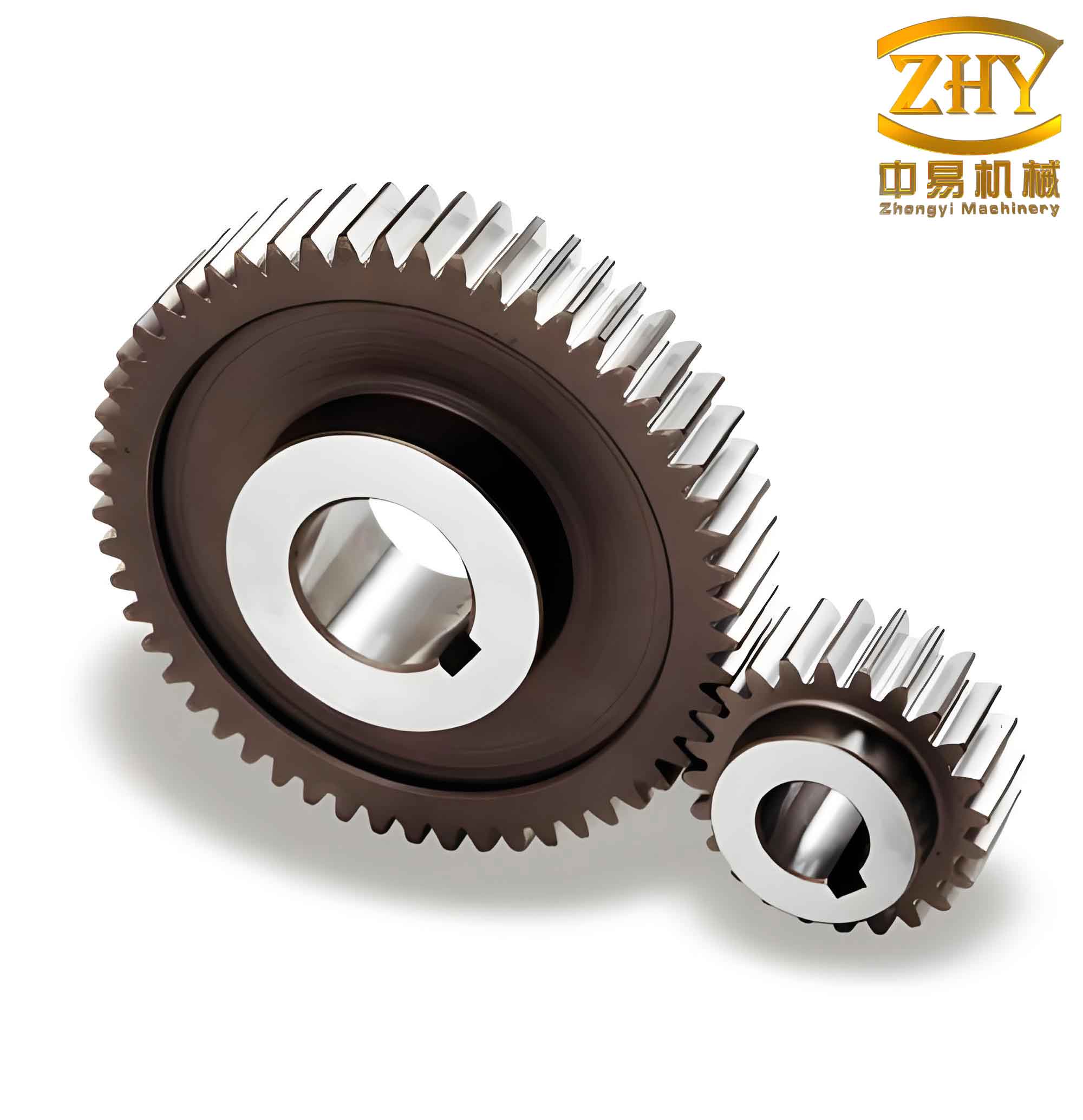
Parametric Design Principles of Straight Spur Gears
The foundation of any straight spur gear model lies in its basic parameters: number of teeth, module, pressure angle, addendum coefficient, and clearance coefficient. These variables completely determine all geometric dimensions such as pitch circle diameter, base circle diameter, addendum circle diameter, and dedendum circle diameter. The relationships are governed by standard gear formulas, which are implemented in Pro/E using the relation tool. Table 1 lists the input parameters and the derived dimensions used in this study.
| Parameter | Symbol | Expression / Value | Remarks |
|---|---|---|---|
| Number of teeth | Z | User input (e.g., 25) | |
| Module | m | User input (e.g., 3 mm) | |
| Face width | B | User input (e.g., 10 mm) | |
| Pressure angle | α | 20° (standard) | |
| Addendum coefficient | ha* | 1 | Standard for spur gears |
| Clearance coefficient | c* | 0.25 | |
| Addendum height | ha | ha = (ha* + x) ⋅ m | x is profile shift (x=0 for standard gear) |
| Dedendum height | hf | hf = (ha* + c* – x) ⋅ m | |
| Pitch circle diameter | d | d = m ⋅ Z | |
| Addendum circle diameter | da | da = d + 2 ⋅ ha | |
| Base circle diameter | db | db = d ⋅ cos α | |
| Dedendum circle diameter | df | df = d – 2 ⋅ hf |
These formulas are entered into Pro/E’s relationship editor. For example, the pitch circle diameter is defined by d = m * Z, and the base circle by db = d * cos(alpha). The software automatically computes all dependent values whenever a base parameter changes, ensuring a fully parametric model of straight spur gears.
Generating the Involute Curve for Straight Spur Gears
The involute profile is the heart of a straight spur gear’s tooth shape. According to the generation principle, an involute is the locus of a point on a straight line that rolls without slipping along the base circle. Mathematically, we derive the parametric equations of the involute in terms of a variable angle. In Pro/E, we use the curve-from-equation option with the following standard formulas (written in Cartesian coordinates):
$$
\begin{aligned}
\text{ang} &= 90 \cdot t \\
r_b &= \frac{d_b}{2} = \frac{m \cdot Z \cdot \cos \alpha}{2} \\
s &= \pi \cdot r_b \cdot \frac{t}{2} \\
x_c &= r_b \cdot \cos(\text{ang}) \\
y_c &= r_b \cdot \sin(\text{ang}) \\
x &= x_c + s \cdot \sin(\text{ang}) \\
y &= y_c – s \cdot \cos(\text{ang}) \\
z &= 0
\end{aligned}
$$
Here, $t$ is an internal parameter ranging from 0 to 1, corresponding to the point moving along the generating line. The resulting curve is the involute from the base circle outward. For straight spur gears, this involute defines the active tooth flank.
After generating one involute curve, we need to mirror it about the tooth symmetry plane to obtain the other side of the tooth. The symmetry plane is defined by the axis of the gear and a reference point (the intersection of the involute with the pitch circle). The angular offset from the centerline is computed as:
$$
\theta = \frac{360^\circ}{4 \cdot Z}
$$
This ensures that the two involute curves are correctly positioned to form a single tooth. The mirror operation is performed using a datum plane that rotates by $\theta$ from the initial plane through the reference point. The relation d20 = 360/(4*z) is added to the model so that the mirror plane updates automatically when the number of teeth changes.
Constructing the Solid Model of Straight Spur Gears in Pro/E
With the involute curves prepared, the next step is to create a single tooth solid feature using the extrude command. The tooth profile is a closed sketch consisting of the two mirrored involutes, the addendum arc, and the dedendum arc (or trochoid fillet). For straight spur gears with standard cutters, the dedendum circle may be smaller than the base circle; in such cases, the involute must be trimmed or extended to meet the dedendum circle. A small fillet radius (e.g., $0.38 \cdot m$) is often added at the root to reduce stress concentration.
The extrusion depth is set equal to the face width $B$. After creating the first tooth, we use the pattern (array) feature to generate the remaining teeth around the gear axis. The pattern is a rotational copy with an angular increment of $360^\circ / Z$. The relation for the rotation angle of the first copy is added to the model so that the array regenerates correctly when $Z$ changes. Figure 2 (conceptually) shows the final solid model of a straight spur gear after arraying all teeth and performing the necessary Boolean operations to subtract the material.
Table 2 summarizes the key steps in the Pro/E parametric modeling workflow for straight spur gears.
| Step | Action | Key Relations / Equations |
|---|---|---|
| 1 | Define base parameters (Z, m, B, α, ha*, c*) | User input via “Parameters” dialog |
| 2 | Sketch four concentric circles (addendum, pitch, base, dedendum) | Assign diameters using relations: d = m*Z, da = d+2*ha, db = d*cos(α), df = d-2*hf |
| 3 | Create involute curve via equation | Parametric equations as shown above; use base circle radius rb = db/2 |
| 4 | Create datum plane for mirroring | Angle offset θ = 360/(4*Z) from plane through reference point |
| 5 | Mirror involute curve | Mirror about the datum plane |
| 6 | Extrude first tooth profile | Sketch includes involutes, addendum arc, dedendum arc + fillet; depth = B |
| 7 | Rotational pattern of teeth | Array angle increment = 360/Z, number of instances = Z |
| 8 | Final solid model | Complete straight spur gear ready for further analysis |
Generation (Hobbing) Simulation of Straight Spur Gears Using MATLAB
Beyond static modeling, understanding how straight spur gears are actually cut in manufacturing is valuable. Generation (or hobbing) is the most common method: a tool shaped like a rack or hob moves tangentially relative to the gear blank while both rotate at a fixed gear ratio. The envelope of the successive tool positions forms the involute tooth profile. We developed a MATLAB script to animate this process for educational and verification purposes.
The simulation treats the rack cutter as a straight-edged tool with a pressure angle equal to the gear’s pressure angle. The gear blank is represented by a circle (the pitch circle). At each time step, the rack is translated by a distance equal to the arc length traveled on the pitch circle, and simultaneously the blank rotates by the corresponding angle. The cutting edges of the rack are plotted as lines, and the intersection (envelope) gradually reveals the tooth spaces. The program loops through multiple rotations to generate the full gear profile.
The key mathematical relationships in the simulation are:
Let the rack move horizontally at a constant speed $v$. The rotation angle of the gear blank is $\phi = \frac{v \cdot t}{r_p}$, where $r_p = d/2$ is the pitch circle radius and $t$ is time. For a standard rack with pressure angle $\alpha$, the cutting edge is a straight line inclined at $\alpha$ to the vertical. By plotting the family of lines at successive positions, we observe the formation of the involute flanks. The animation clearly shows how the tooth spaces are cut and how the root fillet is created.
A sample frame from the MATLAB simulation is presented in the figure inserted earlier. The dynamic nature of the simulation helps students and engineers visualize the generation principle underlying the manufacturing of straight spur gears.
Conclusion
This article presented a complete workflow for the parametric design and generation simulation of straight spur gears. In Pro/E, we utilized the relation-driven environment to build a fully adjustable gear model where changing any base parameter (e.g., number of teeth, module) automatically updates all dimensions and the final solid. The involute curve was generated from its parametric equation, and the tooth array was made rotational through pattern commands. The entire process is summarized in Table 2, ensuring repeatability for different gear specifications.
Additionally, the MATLAB generation simulation provided an intuitive visualization of how straight spur gears are produced by the rack cutter. This simulation reinforces the theoretical concept of the involute envelope and aids in verifying the correctness of the Pro/E model. By combining parametric modeling with dynamic simulation, engineers can rapidly prototype straight spur gears for further CAE and CAM applications, such as stress analysis, noise vibration harshness studies, and tool path generation.
In summary, the methods described here offer a practical and efficient approach for designing straight spur gears in modern CAD/CAE environments. Future work could extend this methodology to helical gears, bevel gears, or internal gears, while maintaining the same parametric philosophy. The use of tables and formulas throughout ensures clarity and ease of implementation for engineers working with straight spur gears.