
In this study, we delve into the intricate world of hyperboloid gear systems, focusing specifically on the Oerlikon cycloidal hypoid gear design. Hyperboloid gears, often referred to as hypoid gears, are critical components in automotive drivetrains, enabling efficient power transmission between non-parallel and non-intersecting axes. The unique geometry of hyperboloid gears offers advantages such as reduced noise and improved strength, but it also introduces complexities in manufacturing and analysis. Our primary objective is to develop a comprehensive mathematical model for the entire tooth surface generation of these gears, including both the working flanks and the root transition surfaces, and to propose an enhanced tooth contact analysis (TCA) methodology that circumvents the need for cumbersome curvature calculations. This work aims to provide a foundation for subsequent loaded tooth contact analysis and stress evaluation, ultimately contributing to the optimization of hyperboloid gear performance in practical applications.
The manufacturing process of Oerlikon cycloidal hypoid gears involves continuous indexing face hobbing, a method that utilizes a cutter head with multiple tool groups to simultaneously generate both sides of a tooth space. This approach enhances production efficiency compared to traditional methods. To accurately model the tooth surface, we begin by considering the cutter geometry, which includes circular blade edges for profile modification and tip radii for generating the root fillet. The cutter is mounted on a virtual generating gear, simulating the relative motion between the tool and the workpiece. Through a series of coordinate transformations, we derive the parametric equations for the tooth surface. Let us define the coordinate systems: let \( S_t(x_t, y_t, z_t) \) be fixed to the cutter head, and \( S_l(x_l, y_l, z_l) \) be attached to the blade. For a left-hand inner blade cutting the convex side of a pinion, the position vector of a point on the circular blade edge can be expressed as:
$$ \mathbf{r}_l(u) = \begin{bmatrix} 2R_{BH} \sin\left(\frac{u}{2R_{BH}}\right) \cos\left(\alpha_0 – \frac{u}{2R_{BH}}\right) \\ 0 \\ 2R_{BH} \sin\left(\frac{u}{2R_{BH}}\right) \sin\left(\alpha_0 – \frac{u}{2R_{BH}}\right) \end{bmatrix} $$
Here, \( R_{BH} \) is the radius of the circular blade edge, \( u \) is a parameter along the blade, and \( \alpha_0 \) is the tool pressure angle. For the tip fillet section, parameterized by \( \theta \), the vector equation is:
$$ \mathbf{r}_l(\theta) = \begin{bmatrix} X_M \\ 0 \\ Z_M \end{bmatrix} + r_e \begin{bmatrix} \cos \alpha_1 – \cos(\theta + \alpha_1) \\ 0 \\ \sin(\theta + \alpha_1) – \sin \alpha_1 \end{bmatrix} $$
where \( r_e \) is the tip radius, \( \alpha_1 = \arcsin(1 – H_P / r_e) \), and \( (X_M, 0, Z_M) \) are the coordinates of the transition point between the blade edge and the fillet. By applying transformation matrices, we map these vectors to the cutter head coordinate system \( S_t \):
$$ \mathbf{r}_t(u) = \mathbf{M}_{tl} \mathbf{r}_l(u) $$
The matrix \( \mathbf{M}_{tl} \) encapsulates the orientation of the blade relative to the cutter head, incorporating parameters such as the blade direction angle \( \delta_0 \) and initial tool angle \( \beta_i \). Next, we introduce the virtual generating gear, represented by coordinate system \( S_d(x_d, y_d, z_d) \). The cutter motion relative to the generating gear involves rotations described by the cradle angle \( \phi_{c1} \) and the cutter rotation angle \( \beta \). The relationship \( \phi_{c1} = (z_0 / z_p) \beta \) holds, where \( z_0 \) is the number of tool groups on the cutter head and \( z_p \) is the number of teeth on the generating gear. Thus, the blade surface in the generating gear system is:
$$ \mathbf{r}_d(u, \beta) = \mathbf{M}_{dt}(\beta) \mathbf{r}_t(u) $$
Finally, the tooth surface on the workpiece (e.g., a pinion) is obtained by considering the relative motion between the generating gear and the workpiece. Let \( S_1(x_1, y_1, z_1) \) be fixed to the pinion. The transformation involves the workpiece rotation angle \( \phi_1 \) and the generating gear rotation angle \( \phi_{c2} \), with \( \phi_{c2} = (z / z_p) \phi_1 \), where \( z \) is the number of teeth on the workpiece. The tooth surface equation becomes:
$$ \mathbf{r}_1(u, \beta, \phi_1) = \mathbf{M}_{1d}(\phi_1) \mathbf{r}_d(u, \beta) $$
For the root transition surface generated by the tip fillet, a similar equation applies with parameter \( \theta \). The normal vector \( \mathbf{n}_1 \) and tangent vector \( \mathbf{t}_1 \) at any point on the surface are derived through partial derivatives:
$$ \mathbf{n}_1(u, \beta, \phi_1) = \frac{\frac{\partial \mathbf{r}_1}{\partial u} \times \frac{\partial \mathbf{r}_1}{\partial \beta}}{\left\| \frac{\partial \mathbf{r}_1}{\partial u} \times \frac{\partial \mathbf{r}_1}{\partial \beta} \right\|}, \quad \mathbf{t}_1(u, \beta, \phi_1) = \frac{\frac{\partial \mathbf{r}_1}{\partial \beta}}{\left\| \frac{\partial \mathbf{r}_1}{\partial \beta} \right\|} \times \mathbf{n}_1(u, \beta, \phi_1) $$
The generation of the tooth surface for a gear pair typically involves two methods: Spirac (formate for the gear and generate for the pinion) and Spiroflex (generate for both). The meshing condition during cutting is given by \( f_1(u, \beta, \phi_1) = \mathbf{n}_1 \cdot \mathbf{v}_1^{(l1)} = 0 \), where \( \mathbf{v}_1^{(l1)} \) is the relative velocity between the blade and the workpiece. This equation ensures that the surface is enveloped by the tool path. A similar process is applied to derive the mating gear tooth surface. The complete tooth model, encompassing both working flanks and root transitions, is essential for accurate analysis, as it forms the basis for evaluating contact patterns and stress distributions under load.
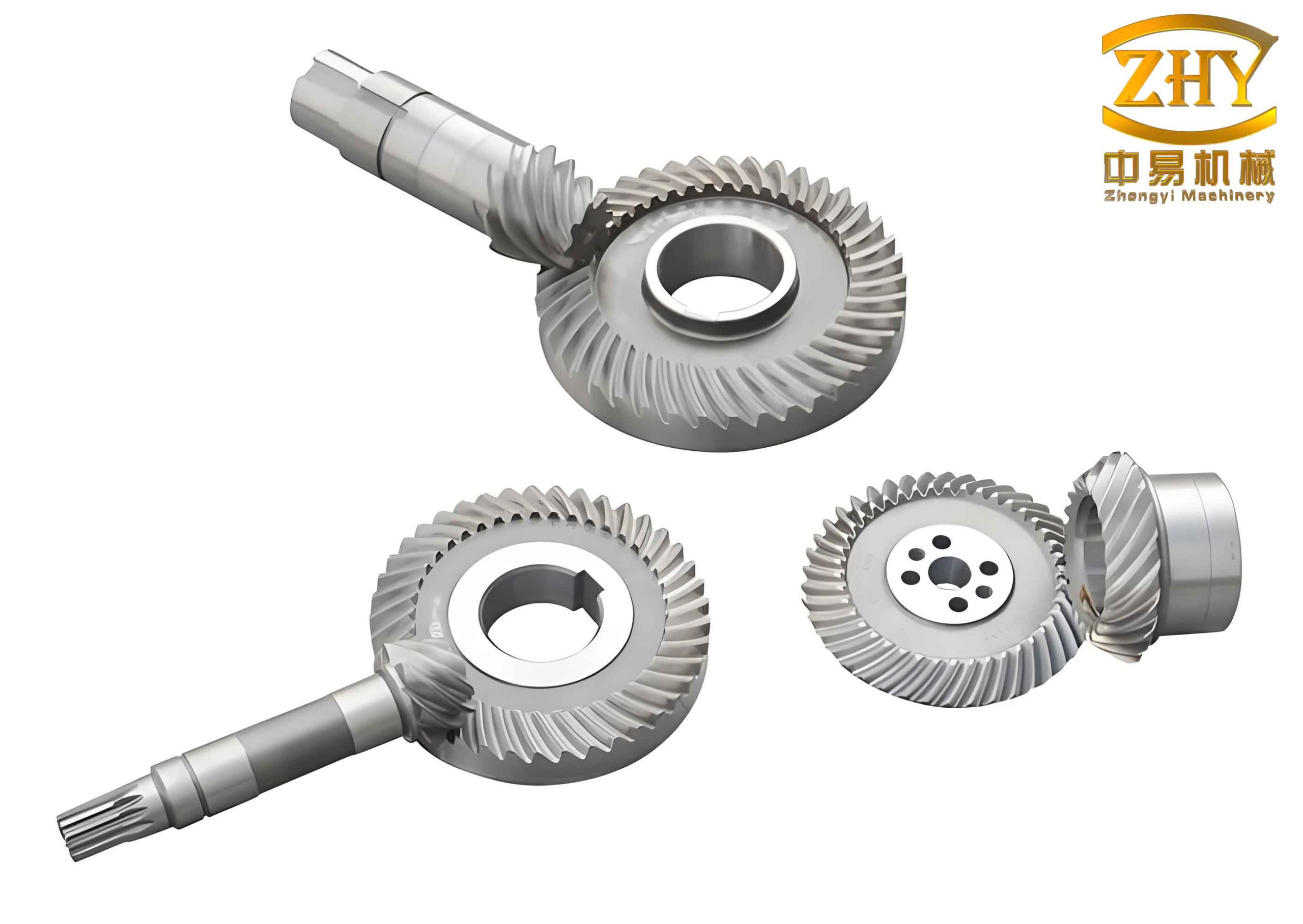
With the tooth surface model established, we proceed to tooth contact analysis (TCA), which simulates the meshing of a hyperboloid gear pair under no-load conditions. Traditional TCA methods rely on quadratic approximations of the tooth surfaces near a reference point, requiring complex calculations of principal curvatures and relative curvatures to determine contact ellipses. This approach can be inaccurate for areas distant from the reference point and does not provide the full boundary of the instantaneous contact area. To address these limitations, we propose a modified TCA model that directly utilizes the parametric equations of the mating surfaces without secondary approximation. Consider a gear pair consisting of a pinion (surface Σ1) and a gear (surface Σ2). Their position vectors, normal vectors, and tangent vectors are transformed into a fixed machine coordinate system \( S_s \) as follows:
$$ \mathbf{r}_{s1} = \mathbf{M}_{s1}(\phi_1) \mathbf{r}_1(\mu, \beta, \phi_1), \quad \mathbf{n}_{s1} = \mathbf{L}_{s1}(\phi_1) \mathbf{n}_1(\mu, \beta, \phi_1), \quad \mathbf{t}_{s1} = \mathbf{L}_{s1}(\phi_1) \mathbf{t}_1(\mu, \beta, \phi_1) $$
$$ \mathbf{r}_{s2} = \mathbf{M}_{s2}(\phi_2) \mathbf{r}_2(\mu, \beta, \phi_2), \quad \mathbf{n}_{s2} = \mathbf{L}_{s2}(\phi_2) \mathbf{n}_2(\mu, \beta, \phi_2), \quad \mathbf{t}_{s2} = \mathbf{L}_{s2}(\phi_2) \mathbf{t}_2(\mu, \beta, \phi_2) $$
Here, \( \phi_1 \) and \( \phi_2 \) are the rotation angles of the pinion and gear, respectively, and \( \mathbf{L}_{s1} \) and \( \mathbf{L}_{s2} \) are the rotational submatrices of \( \mathbf{M}_{s1} \) and \( \mathbf{M}_{s2} \). The TCA equations are based on the conditions that the position vectors and normal vectors coincide at the contact point. However, to avoid redundancy due to the unit magnitude of normal vectors, we reformulate these conditions using orthogonal vectors in the tangent plane:
$$ \mathbf{r}_{s1} = \mathbf{r}_{s2} $$
$$ (\mathbf{n}_{s2} \times \mathbf{t}_{s2}) \cdot \mathbf{n}_{s1} = 0 $$
$$ \mathbf{t}_{s2} \cdot \mathbf{n}_{s1} = 0 $$
The vectors \( \mathbf{n}_{s2} \times \mathbf{t}_{s2} \) and \( \mathbf{t}_{s2} \) are perpendicular within the tangent plane of surface Σ2. These equations, combined with the meshing conditions from the cutting process (e.g., two equations for Spirac method or three for Spiroflex), form a system of nonlinear equations. By specifying the pinion rotation angle \( \phi_1 \) as input, we can solve for the remaining parameters iteratively, identifying the contact points across the tooth surface. The transmission error, a key indicator of meshing quality, is computed as:
$$ \Delta e = (\phi_2 – \phi_{20}) – \frac{z_1}{z_2} (\phi_1 – \phi_{10}) $$
where \( \phi_{10} \) and \( \phi_{20} \) are the initial angles at the reference contact point, and \( z_1 \) and \( z_2 \) are the tooth numbers of the pinion and gear, respectively. This transmission error reflects deviations from perfect conjugate motion and influences noise and vibration characteristics in hyperboloid gear applications.
A novel aspect of our TCA approach is the method for calculating the contact ellipse, which represents the instantaneous area of contact between tooth surfaces under slight load. Instead of relying on surface curvature data, we directly exploit the tooth surface equations. The procedure is as follows: first, consider a plane Q that contains the normal vector \( \mathbf{u}_3 \) at the current contact point. As illustrated conceptually, this plane intersects the tooth surfaces Σ1 and Σ2. We define a surface separation distance δ (typically set to 0.0064 mm, equivalent to the diameter of marking compound particles used in roll testing) along the normal direction. By iteratively finding points on both surfaces where the separation equals δ within plane Q, we obtain two points, say \( c_1 \) and \( c_2 \), such that the total distance \( c = c_1 + c_2 \) corresponds to the boundary of the contact ellipse in that sectional plane. Second, we rotate plane Q around the normal vector axis in incremental steps over 180°, repeating the process to capture a complete set of boundary points. The major axis of the contact ellipse is then the maximum value of c encountered during this rotation, and its orientation is determined by the corresponding angular position of plane Q. This technique eliminates the need for complicated curvature derivations and provides a more authentic representation of the contact area, as it accounts for the actual surface geometries without approximation. The contact lines, which trace the path of contact over the tooth surface, can also be derived by assembling contact points from successive TCA solutions.
To validate our methodology, we apply it to a hypoid gear pair designed for a high-speed vehicle axle, manufactured using the Spirac method. The geometric parameters, cutter data, and machine settings are summarized in the tables below. These parameters are critical for generating accurate tooth surfaces and performing TCA simulations. The hyperboloid gear pair consists of a right-hand spiral gear (convex side) and a left-hand spiral pinion (concave side), with a shaft angle of 90° and an offset of 22 mm. The modeling involves detailed cutter specifications, including blade radii, pressure angles, and tip radii, as well as machine adjustment parameters like tool inclination angle, cutter rotation, and offset corrections.
| Parameter | Gear (Convex Side) | Pinion (Concave Side) |
|---|---|---|
| Shaft Angle (°) | 90 | |
| Offset (mm) | 22 | |
| Normal Module at Reference Point (mm) | 3.251 | |
| Number of Teeth | 39 | 9 |
| Face Width (mm) | 28 | 31.53 |
| Pitch Angle (°) | 72.026 | 17.325 |
| Spiral Angle at Reference Point (°) | 49.997 | 34.046 |
| Pitch Radius at Reference Point (mm) | 76.5 | 22.756 |
| Parameter | Gear (Concave/Convex) | Pinion (Concave/Convex) |
|---|---|---|
| Number of Tool Groups | 17 | |
| Cutter Radius (mm) | 88.024 / 87.578 | 87.697 / 87.951 |
| Tool Pressure Angle (°) | -23.61 / 17.516 | -23.007 / 18.059 |
| Blade Direction Angle (°) | 19.822 / 19.927 | -19.839 / -19.899 |
| Initial Setup Angle (°) | -13.76 / -0.233 | -62.695 / -55.263 |
| Tip Radius (mm) | 0.981 / 0.981 | 0.761 / 0.763 |
| Blade Edge Radius (mm) | 443.88 / 445.93 | 98,441.3 / 99,342.6 |
| Generating Gear Tooth Number | 40.999 | |
| Setting | Gear | Pinion |
|---|---|---|
| Tool Inclination Angle (°) | 0 | 20.787 |
| Tool Rotation Angle (°) | 0 | -162.669 |
| Cutter Position (mm) | 101.196 | 100.468 |
| Initial Cradle Angle (°) | -56.541 | 74.368 |
| Vertical Workpiece Offset (mm) | 0 | 21.709 |
| Workpiece Correction (mm) | 0.0024 | 0.903 |
| Machine Center Correction (mm) | 0 | 9.182 |
| Machine Root Angle (°) | 72.026 | -0.531 |
Using these parameters, we generate the full tooth surface models for both the gear and pinion, incorporating the working flanks and root transitions. The three-dimensional representations reveal the complex curvature of hyperboloid gear teeth, which is essential for accurate contact simulation. We then perform TCA simulations with our modified method. The results include contact patterns on the tooth surfaces, transmission error curves, and contact ellipse dimensions. For comparison, we also analyze the same gear pair using a commercial software package, Klingelnberg KIMoS5, which is widely used in the industry for hypoid gear design. The contact patterns obtained from our method show close agreement with those from KIMoS5, exhibiting similar orientation and extent on both the convex and concave sides. The transmission error values are nearly identical; for the working side (gear convex, pinion concave), our method yields 63.4 μrad, while KIMoS5 gives 64.5 μrad, a difference of only 1.71%. For the non-working side, the values are 59.7 μrad versus 60.9 μrad, a 1.97% discrepancy. This consistency validates the accuracy of our tooth surface modeling and TCA approach.
Further validation is achieved through physical roll testing. The hyperboloid gear pair is manufactured on a Gleason Phoenix 600HC machine and then subjected to a roll test on a dedicated testing apparatus. During the test, a marking compound is applied to the tooth surfaces, and the gears are rotated under light load to imprint contact patterns. The experimental contact patterns on the gear convex and concave sides align well with the simulated patterns from our TCA method, confirming the practical relevance of our model. The contact ellipses calculated using our direct method provide a detailed view of the instantaneous contact area, which is crucial for assessing load distribution and predicting wear in hyperboloid gear applications. The avoidance of curvature-based approximations allows for a more realistic depiction, especially near the edges of the tooth surface where traditional methods might deviate.
In conclusion, this study presents a comprehensive framework for modeling and analyzing Oerlikon cycloidal hypoid gears, a specific type of hyperboloid gear. By developing a full tooth surface model that includes both working flanks and root transition surfaces, we establish a solid basis for advanced analyses such as loaded tooth contact analysis and stress evaluation. The proposed modified TCA method eliminates the need for complex curvature calculations, relying instead on direct use of surface equations to determine contact ellipses and lines. This approach not only simplifies the analysis process but also enhances accuracy by avoiding quadratic approximations. Validation through comparison with commercial software and physical roll tests demonstrates the feasibility and effectiveness of our methodology. The insights gained can be extended to other types of gear transmissions, contributing to improved design and manufacturing practices for hyperboloid gears in automotive and industrial applications. Future work may involve incorporating elastic deformations under load, thermal effects, and dynamic behaviors to further refine the analysis of hyperboloid gear systems.
The mathematical rigor employed in this study underscores the importance of precise geometry in hyperboloid gear performance. For instance, the transformation matrices used in surface generation can be generalized. Consider the transformation from coordinate system \( S_j \) to \( S_i \), represented by a homogeneous transformation matrix \( \mathbf{M}_{ij} \) that includes rotation and translation components. If \( \mathbf{R}_{ij} \) is a 3×3 rotation matrix and \( \mathbf{d}_{ij} \) is a translation vector, then:
$$ \mathbf{M}_{ij} = \begin{bmatrix} \mathbf{R}_{ij} & \mathbf{d}_{ij} \\ \mathbf{0} & 1 \end{bmatrix} $$
In the context of hyperboloid gear generation, these matrices account for machine settings such as tool inclination, cradle rotation, and workpiece offsets. The cumulative effect of these transformations accurately captures the relative motions between the cutter and the workpiece, which is essential for generating the correct tooth geometry. Additionally, the meshing condition during cutting can be expressed in differential form. For a surface generated by a family of tool positions parameterized by \( \phi \), the equation \( \mathbf{n} \cdot \mathbf{v} = 0 \) must hold, where \( \mathbf{v} = \frac{\partial \mathbf{r}}{\partial \phi} \). This condition ensures that the tool envelope forms a smooth surface. For hyperboloid gears, this leads to nonlinear equations that are solved numerically to define the tooth surface points.
The TCA equations can also be expressed in terms of minimization. Instead of solving the system directly, one can define an error function \( E = \| \mathbf{r}_{s1} – \mathbf{r}_{s2} \|^2 + \lambda_1 [(\mathbf{n}_{s2} \times \mathbf{t}_{s2}) \cdot \mathbf{n}_{s1}]^2 + \lambda_2 (\mathbf{t}_{s2} \cdot \mathbf{n}_{s1})^2 \), where \( \lambda_1 \) and \( \lambda_2 \) are weighting factors. By minimizing E with respect to the parameters, we can find contact points efficiently using optimization algorithms. This alternative formulation is particularly useful for handling multiple contact points or slight misalignments in hyperboloid gear assemblies.
Regarding the contact ellipse calculation, the iterative process for finding boundary points can be formalized. Let \( \mathbf{p}_0 \) be the contact point with normal \( \mathbf{n} \). For a given rotation angle \( \psi \) of plane Q around \( \mathbf{n} \), we define two orthonormal vectors \( \mathbf{u}_1(\psi) \) and \( \mathbf{u}_2(\psi) \) spanning Q. The intersection of the tooth surfaces with Q can be approximated by solving for parameters that satisfy \( \mathbf{r}_1 – \mathbf{r}_2 = \delta \mathbf{n} \) projected onto Q. In practice, we discretize \( \psi \) from 0 to π and for each value, solve the following system for surface parameters and a scalar s:
$$ \mathbf{r}_1(u_1, \beta_1, \phi_1) – \mathbf{r}_2(u_2, \beta_2, \phi_2) = \delta \mathbf{n} + s \mathbf{u}_1(\psi) $$
$$ (\mathbf{r}_1 – \mathbf{r}_2) \cdot \mathbf{u}_2(\psi) = 0 $$
This yields points on the boundary relative to \( \mathbf{p}_0 \). The distance c is then \( \| s \mathbf{u}_1(\psi) \| \). The major axis length is \( \max(c) \) and the minor axis length is \( \min(c) \) over ψ, providing a complete ellipse description. This method is computationally efficient and directly uses the surface equations, aligning with our goal of simplifying hyperboloid gear analysis.
In summary, the advancements presented here enhance the toolkit for hyperboloid gear design and evaluation. By integrating detailed surface modeling with an innovative TCA technique, we offer a pathway to optimize gear performance, reduce development time, and ensure reliability in demanding applications. The repeated focus on hyperboloid gears throughout this discussion highlights their significance in modern machinery, and our contributions aim to address the challenges associated with their complex geometry.