
In the design, manufacturing, and quality control of **straight spur gears**, the control of backlash is critically dependent on the specified tooth thickness deviations. Among the various parameters used to describe tooth thickness, three are most commonly encountered: the constant chord tooth thickness (Sx), the base tangent length (Wk), and the span measurement over rods (M value). Each of these parameters has distinct characteristics, measurement methods, and ranges of applicability. For engineers working with **straight spur gears**, the ability to convert the increment (or deviation) of one parameter into the corresponding increments of the others is essential for tolerance coordination and process planning. This article systematically derives the increment relationships among these three parameters, presents comprehensive tables for common pressure angles, and provides practical application examples. Throughout the discussion, the focus remains on **straight spur gears** with standard involute profiles.
1. Three Methods for Measuring Tooth Thickness in Straight Spur Gears
1.1 Constant Chord Tooth Thickness
The constant chord tooth thickness Sx is defined as the chord length measured between the points of contact when a standard rack engages with the gear tooth symmetrically. The distance from this chord to the tooth tip is the constant chord height hx. For **straight spur gears**, Sx depends only on the module m and the pressure angle αf, and is independent of the number of teeth. The theoretical formulas are:
$$ S_x = \frac{\pi m}{2} \cos^2 \alpha_f $$
$$ h_x = h_e – \frac{\pi m}{8} \sin 2\alpha_f – (R_e – R_e’) $$
where he is the addendum height, Re is the theoretical tip radius, and Re’ is the measured tip radius. Simplified expressions for common pressure angles are given in the table below.
| αf (°) | Addendum Coefficient | Sx | hx |
|---|---|---|---|
| 20 | 1 | 1.3871 m | 0.7476 m – (Re – Re’) |
| 20 | 0.8 | 1.3871 m | 0.5476 m – (Re – Re’) |
| 15 | 1 | 1.4656 m | 0.8037 m – (Re – Re’) |
| 14.5 | 1 | 1.4723 m | 0.8096 m – (Re – Re’) |
Constant chord measurement is simple and independent of tooth count, making it convenient for workshop inspection of **straight spur gears**. However, it is sensitive to radial runout of the gear blank and errors in the tip diameter. Therefore, it is generally recommended for gears of grade 7 or lower (ISO 1328-1:2013) with module greater than 1 mm.
1.2 Base Tangent Length
The base tangent length Wk is measured between two parallel planes that are tangent to two involute flanks across a number of teeth k. For an involute **straight spur gear**, the theoretical formula is:
$$ W_k = m \cos\alpha_f \left[ (k-0.5)\pi + z\,\text{inv}\,\alpha_f \right] $$
$$ k = \text{round}\left(0.5 + \frac{\alpha_f}{180^\circ}z\right) $$
The base tangent method is widely used because it is unaffected by errors in the tip circle diameter and provides a direct measurement of tooth thickness. Using a base tangent micrometer with a resolution of 0.05 mm, it is suitable for **straight spur gears** with module ≥ 0.5 mm and accuracy grade 7 or higher.
1.3 Span Measurement over Rods (M Value)
The M value is an indirect measurement of tooth thickness obtained by placing two precision cylindrical rods (or balls) in diametrically opposite tooth spaces and measuring the distance over the rods. For **straight spur gears**, the theoretical rod diameter is dp = (πm)/(2 cosαf), but in practice, rods with diameters in the range (1.68~1.9)m are often used to locate the contact points near the pitch circle. The calculation formulas depend on whether the number of teeth z is even or odd:
$$ M = D_x + d_p \quad \text{(z even)} $$
$$ M = D_x \cos\frac{90^\circ}{z} + d_p \quad \text{(z odd)} $$
where Dx is the diameter over the centers of the rods, related to the gear geometry. The M-value method offers several advantages for **straight spur gears**: it works well for small modules (m < 1 mm), it is insensitive to both radial runout and tip diameter errors, and its sensitivity to tooth thickness variations is higher than the other two methods (for αf = 20°, ΔM ≈ 2.75 ΔSx).
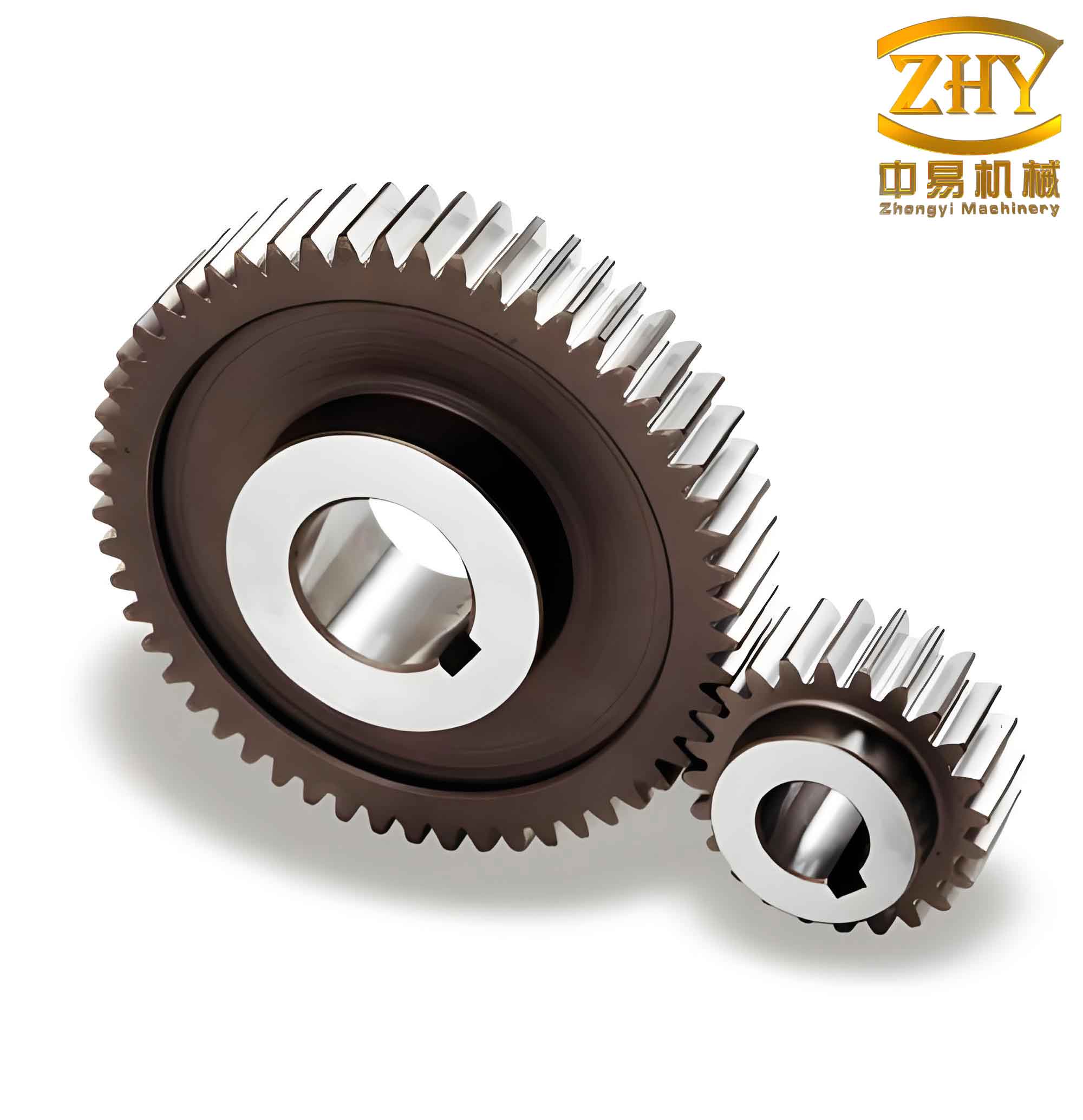
This image illustrates a typical **straight spur gear** that might be subject to the measurement techniques discussed. The three tooth thickness parameters are essential for evaluating such gears.
2. Increment Relationships Among the Three Parameters
In practice, we often need to convert a known deviation (increment) of one tooth thickness parameter into the corresponding deviations of the other two. This is essential for tolerance chain analysis and for setting measurement limits during manufacturing. The derivations below assume small increments and standard involute geometry. All relationships are derived for **straight spur gears** with no profile shift.
2.1 Relationship Between Base Tangent Length Increment and Constant Chord Increment
Consider a small increase ΔSx in the constant chord tooth thickness. The corresponding normal displacement of the tooth flank is ΔSx cosαf, which directly equals the increment in base tangent length ΔWk. Therefore:
$$ \Delta W_k = \Delta S_x \cos\alpha_f \tag{1} $$
This is an approximate formula valid when the measurement is taken near the pitch circle, which is typical for **straight spur gears**. The ratio ΔWk/ΔSx for common pressure angles is:
| αf (°) | ΔWk / ΔSx | ΔSx / ΔWk |
|---|---|---|
| 20 | 0.940 | 1.06 |
| 15 | 0.966 | 1.04 |
| 14.5 | 0.968 | 1.03 |
2.2 Relationship Between M-Value Increment and Base Tangent Increment
For even-numbered teeth in **straight spur gears**, the geometry of the rods and flanks leads to the following relation. When each flank moves outward by ΔWk/2, the rod center shifts by ΔM/2. The geometric relation in the triangle formed by the contact point gives:
$$ \Delta M = \frac{\Delta W_k}{\sin\alpha_x} \quad \text{(even z)} \tag{2} $$
For odd-numbered teeth, the angular offset of the measurement axis introduces a factor cos(90°/z):
$$ \Delta M = \frac{\Delta W_k}{\sin\alpha_x} \cos\frac{90^\circ}{z} \quad \text{(odd z)} \tag{3} $$
In the expression, αx ≈ αf + 90°/z is the pressure angle at the contact point when using the standard rod diameter near the pitch circle. Tables below give the ratio ΔM/ΔWk for various tooth numbers and pressure angles commonly used in **straight spur gears**.
| αf (°) | z=8 | 10 | 12 | 16 | 20 | 30 | 46 | 90 | 180 | 360 | 720 | ∞ |
|---|---|---|---|---|---|---|---|---|---|---|---|---|
| 20 | 1.93 | 2.06 | 2.17 | 2.31 | 2.41 | 2.56 | 2.67 | 2.79 | 2.86 | 2.89 | 2.91 | 2.92 |
| 15 | 2.26 | 2.46 | 2.61 | 2.84 | 3.00 | 3.24 | 3.43 | 3.63 | 3.80 | 3.80 | 3.83 | 3.86 |
| 14.5 | 2.30 | 2.51 | 2.67 | 2.91 | 3.07 | 3.33 | 3.53 | 3.74 | 3.86 | 3.93 | 3.96 | 3.99 |
| αf (°) | z=7 | 9 | 11 | 15 | 19 | 29 | 45 | 89 | 179 | 359 | 719 | ∞ |
|---|---|---|---|---|---|---|---|---|---|---|---|---|
| 20 | 1.79 | 1.97 | 2.10 | 2.27 | 2.38 | 2.54 | 2.67 | 2.79 | 2.85 | 2.89 | 2.91 | 2.92 |
| 15 | 2.09 | 2.33 | 2.51 | 2.78 | 2.95 | 3.21 | 3.42 | 3.62 | 3.74 | 3.80 | 3.83 | 3.86 |
| 14.5 | 2.12 | 2.37 | 2.57 | 2.84 | 3.02 | 3.30 | 3.52 | 3.74 | 3.86 | 3.93 | 3.96 | 3.99 |
As can be seen, for small tooth numbers the odd-tooth ratios are slightly lower than the even-tooth ones due to the cos(90°/z) factor. For z ≥ 30 the difference becomes negligible for most engineering applications involving **straight spur gears**.
2.3 Relationship Between M-Value Increment and Constant Chord Increment
Combining equations (1) and (2) (or (3)) yields the direct relationship between ΔM and ΔSx. For even-tooth **straight spur gears**:
$$ \Delta M = \frac{\Delta S_x \cos\alpha_f}{\sin\alpha_x} \quad \text{(even z)} \tag{4} $$
For odd-tooth **straight spur gears**:
$$ \Delta M = \frac{\Delta S_x \cos\alpha_f}{\sin\alpha_x} \cos\frac{90^\circ}{z} \quad \text{(odd z)} \tag{5} $$
An approximate simplified formula often used in practice is ΔM ≈ ΔSx cotαf, which is reasonably accurate for larger tooth numbers. The following tables provide the exact ratios for common pressure angles and tooth counts in **straight spur gears**.
| αf (°) | z=8 | 10 | 12 | 16 | 20 | 30 | 46 | 90 | 180 | 360 | 720 | ∞ |
|---|---|---|---|---|---|---|---|---|---|---|---|---|
| 20 | 1.81 | 1.94 | 2.04 | 2.17 | 2.26 | 2.41 | 2.51 | 2.62 | 2.69 | 2.72 | 2.73 | 2.74 |
| 15 | 2.18 | 2.38 | 2.52 | 2.74 | 2.89 | 3.13 | 3.31 | 3.51 | 3.61 | 3.67 | 3.70 | 3.73 |
| 14.5 | 2.23 | 2.43 | 2.58 | 2.82 | 2.97 | 3.22 | 3.42 | 3.62 | 3.74 | 3.80 | 3.83 | 3.86 |
| αf (°) | z=7 | 9 | 11 | 15 | 19 | 29 | 45 | 89 | 179 | 359 | 719 | ∞ |
|---|---|---|---|---|---|---|---|---|---|---|---|---|
| 20 | 1.68 | 1.85 | 1.97 | 2.13 | 2.24 | 2.39 | 2.51 | 2.62 | 2.68 | 2.72 | 2.73 | 2.74 |
| 15 | 2.02 | 2.25 | 2.42 | 2.69 | 2.85 | 3.10 | 3.30 | 3.50 | 3.61 | 3.67 | 3.70 | 3.73 |
| 14.5 | 2.05 | 2.29 | 2.49 | 2.75 | 2.92 | 3.19 | 3.41 | 3.62 | 3.74 | 3.80 | 3.83 | 3.86 |
These tables are indispensable for rapid conversion between the three tooth thickness parameters in **straight spur gears**. For example, if the constant chord thickness deviation is specified, the corresponding M-value deviation can be read directly from the table for the given pressure angle and tooth number.
3. Practical Application Examples for Straight Spur Gears
3.1 Tolerance Conversion
Consider a **straight spur gear** with αf = 20°, z = 30 teeth. The drawing specifies the constant chord tooth thickness tolerance as:
$$ S_x \, \text{upper deviation} = -0.020\ \text{mm}, \quad \text{lower deviation} = -0.065\ \text{mm} $$
We need to determine the corresponding tolerances for the base tangent length and the M-value.
From the ratio tables for even teeth (z=30 is even, αf=20°), we have:
- ΔWk/ΔSx = 0.940 (from Table 2). Thus:
- Upper deviation ΔWk = 0.940 × (-0.020) = -0.0188 mm ≈ -0.019 mm
- Lower deviation ΔWk = 0.940 × (-0.065) = -0.0611 mm ≈ -0.061 mm
- ΔM/ΔSx = 2.41 (from Table 5 for even z=30, αf=20°). Thus:
- Upper deviation ΔM = 2.41 × (-0.020) = -0.0482 mm ≈ -0.048 mm
- Lower deviation ΔM = 2.41 × (-0.065) = -0.1567 mm ≈ -0.157 mm
So the base tangent length tolerance would be -0.019 / -0.061 mm and the M-value tolerance would be -0.048 / -0.157 mm. This conversion ensures that the three measurement methods are consistent for the same **straight spur gear**.
3.2 Allowance Conversion in Grinding
During the grinding of a **straight spur gear** with parameters αf = 14.5°, z = 25 teeth (odd), the grinding wheel is dressed to a certain depth. The operator measures the M value and finds that the remaining stock (the amount still to be removed) is ΔM = 31 μm. We need to find the corresponding stock in the tooth thickness direction, i.e., the constant chord increment ΔSx.
From the odd-tooth table for αf = 14.5° and z=25 (interpolating between z=19 and z=29 in Table 6: at z=19, ΔM/ΔSx = 2.92; at z=29, ΔM/ΔSx = 3.19; for z=25 we can linearly interpolate ≈ 3.06). Alternatively, using the infinite-tooth limit is not accurate for odd z=25. Using the exact formula (5) with αx = 14.5° + 90/25 = 18.1°, sin(18.1°) ≈ 0.310, cosαf = cos14.5° ≈ 0.968, cos(90/25)=cos3.6°≈0.998, then:
$$ \frac{\Delta M}{\Delta S_x} = \frac{0.968}{0.310} \times 0.998 \approx 3.12 $$
Thus ΔSx = ΔM / 3.12 = 31 / 3.12 ≈ 9.94 μm. So the remaining stock in the constant chord tooth thickness is about 10 μm. This means the grinding wheel needs to remove approximately 10 μm from each tooth flank (normal direction) to reach the final dimension. Such calculations are vital for process control of **straight spur gears**.
4. Graphical Representation of Increment Relationships
To further facilitate quick conversions, we can construct a combined diagram (which we describe here in words, referencing the data tables) that shows the three parameters on a common scale for each pressure angle. For the three standard pressure angles (20°, 15°, 14.5°) of **straight spur gears**, one can plot ΔWk, ΔSx, and ΔM on logarithmic or linear axes as functions of tooth number. The tables provided above essentially give the numerical values for such plots. In practice, these graphs are printed on reference sheets or embedded in digital calculators for rapid use by gear engineers.
5. Conclusions
The three tooth thickness parameters—constant chord, base tangent length, and M value—form the backbone of quality assurance for **straight spur gears**. Through the derived increment relationships and the comprehensive tables presented for common pressure angles, we have demonstrated that converting between these parameters is straightforward and accurate. The formulas and tables account for both even and odd tooth numbers, ensuring that the conversions are valid for all standard **straight spur gears**. The practical examples illustrate how these relationships are applied in tolerance conversion and stock removal estimation during grinding. By using the provided tables and equations, engineers can save time and avoid inconsistencies when specifying or inspecting tooth thickness in **straight spur gears**. The inclusion of the graphical concept further enhances usability. These tools are essential for anyone involved in the design, manufacture, or metrology of **straight spur gears**.