
In my research on precision forming of straight spur gears, I have focused on developing a novel cold forging approach that significantly reduces the forming load while ensuring complete die filling of the tooth profile. The conventional cold forging of straight spur gears suffers from extremely high forming pressures, which leads to premature die failure and limits the practical application of the net‑shape forging process. To overcome this challenge, I propose a two‑step forming strategy: a bulk pre‑forging of the billet using a closed‑die arrangement, followed by a localized finish‑forging of the tooth region using a ring‑shaped punch. The entire process is systematically simulated using the finite‑element software DEFORM‑3D, which allows me to visualize the material flow, stress‑strain distribution, and force requirements in detail.
The geometric parameters of the straight spur gear used in this study are: module m = 2 mm, number of teeth z = 18, pressure angle α = 20°, face width B = 10 mm, and a boss of 1.5 mm height and 28 mm diameter on the top face. Based on the principle of volume constancy, the initial cylindrical billet is dimensioned as φ30 mm × 19.4 mm so that its outer diameter closely matches the root circle of the gear, thus minimising material waste and reducing the required forming strokes.
Geometric Model and Pre‑form Design
I built the three‑dimensional solid models of the forging, the dies (upper punch, lower punch, floating die, and ring‑shaped punch) and the billet using Unigraphics NX. The involute tooth profile is generated with parametric curve functions. For computational efficiency, I simulated only a sector containing two teeth, taking advantage of the cyclic symmetry of the gear. The pre‑forging step is performed with a closed‑die configuration (blocker forging) to accumulate material in the tooth cavities. The pre‑forging load is set to stop when it reaches 150 kN, corresponding to a unit pressure of 1364 MPa. After pre‑forging, the workpiece is subjected to stress‑relief annealing before being placed into the final forging die for localized tooth forming.
Finite‑Element Model Setup
The simulation is carried out with DEFORM‑3D, which employs a rigid‑plastic material model because the elastic portion of deformation is negligible compared to the large plastic strains encountered in cold forging. The dies are treated as rigid bodies, while the workpiece material is selected as AISI‑1010 (cold) from the DEFORM material library. The material behaviour is described by the following flow stress equation:
$$ \bar{\sigma} = K \bar{\varepsilon}^{n} \dot{\bar{\varepsilon}}^{m} $$
where K is the strength coefficient, n the strain‑hardening exponent, m the strain‑rate sensitivity index, and T the temperature (20 °C). The specific values for AISI‑1010 at cold working conditions are taken as provided in the software database. The friction between the workpiece and the dies is modeled using the shear friction law:
$$ \tau = m \cdot k $$
with the friction factor m = 0.12 and the shear yield strength k = σs / √3, where σs is the yield strength (205 MPa). The upper punch and the floating die move downward at a constant speed of 5 mm/s.
Mesh generation is a critical aspect for accurate simulation of the complex three‑dimensional deformation of a straight spur gear. I employed tetrahedral elements with a maximum edge length of 0.4 mm over the entire billet, and a refined mesh of 0.2 mm maximum edge length in the tooth region where severe deformation occurs. An automatic remeshing scheme is activated based on several criteria: strain increment, contact penetration, volume change, and direct interference. This adaptive meshing effectively controls element distortion and improves computational precision.
Simulation Results and Discussion
Equivalent Strain Evolution
By examining the strain contours at different increments, I observed the material flow behaviour during localized loading. At the early stage (step 90), the ring‑shaped punch contacts only the tooth region. The material in the upper part of the tooth cavity flows radially outward to fill the die cavity first, and the equivalent strain is concentrated in the upper portion of the teeth. As deformation proceeds (step 100), the lower part of the tooth cavity also begins to fill, and material near the central boss region starts to move upward because the ring‑shaped punch has a hollow center, offering no constraint. At the final stage (step 111), the highest equivalent strain (1.60) appears at the lower corner of the tooth and at the transition zone between the boss and the tooth profile. These two areas are the most difficult to fill and represent the last regions to be completely formed.
The following table summarises the maximum equivalent strain and stress values at selected increments:
| Increment Step | Max. Equivalent Strain | Max. Equivalent Stress (MPa) |
|---|---|---|
| 90 | 0.80 | 450 |
| 100 | 1.20 | 580 |
| 111 | 1.60 | 666 |
Equivalent Stress Distribution
The stress field closely follows the strain field: at the early stage the highest stress appears in the upper tooth corner; later it shifts toward the lower corner. The stress in the boss‑tooth transition zone remains relatively high throughout due to the clamping action of the ring‑shaped punch. The maximum value never exceeds 666 MPa, which is within the capacity of conventional die materials. This suggests that the localized loading approach not only reduces the total forming load but also alleviates stress concentrations that could cause premature die cracking.
Velocity Field and Load–Stroke Behaviour
Velocity vector plots provide insight into the material flow pattern. At step 90, the fastest moving material is located in the upper tooth region, while some material also moves toward the lower corner and the boss. By step 100, the upper tooth cavity is nearly filled, and the material flow speeds up toward the lower corner and the boss. At the final step (111), the tooth cavities are completely filled, and the boss region experiences the highest velocity. Importantly, the tooth filling is not the last event; the boss continues to form afterwards, which prevents the sharp load spike typically observed in conventional one‑step forging of straight spur gears. The ring‑shaped punch effectively acts as a flow divider, allowing excess material to escape into the boss cavity instead of causing excessive pressure buildup.
I have compared the load‑stroke curves for three different forging strategies:
- Curve 1: Localized loading after annealing
- Curve 2: Localized loading without annealing
- Curve 3: Conventional global loading (one‑step) after annealing
The results are summarised in the table below. The final forging load for the recommended process (localized + annealing) is only about 30% of that required for global forging, representing a reduction of approximately 70%. Annealing further softens the pre‑form and reduces the load by an additional 10–15%.
| Forging Strategy | Maximum Load (kN) | Reduction vs. Global (%) |
|---|---|---|
| Global, annealed | 410 | – |
| Localized, not annealed | 155 | ~62 |
| Localized, annealed | 120 | ~71 |
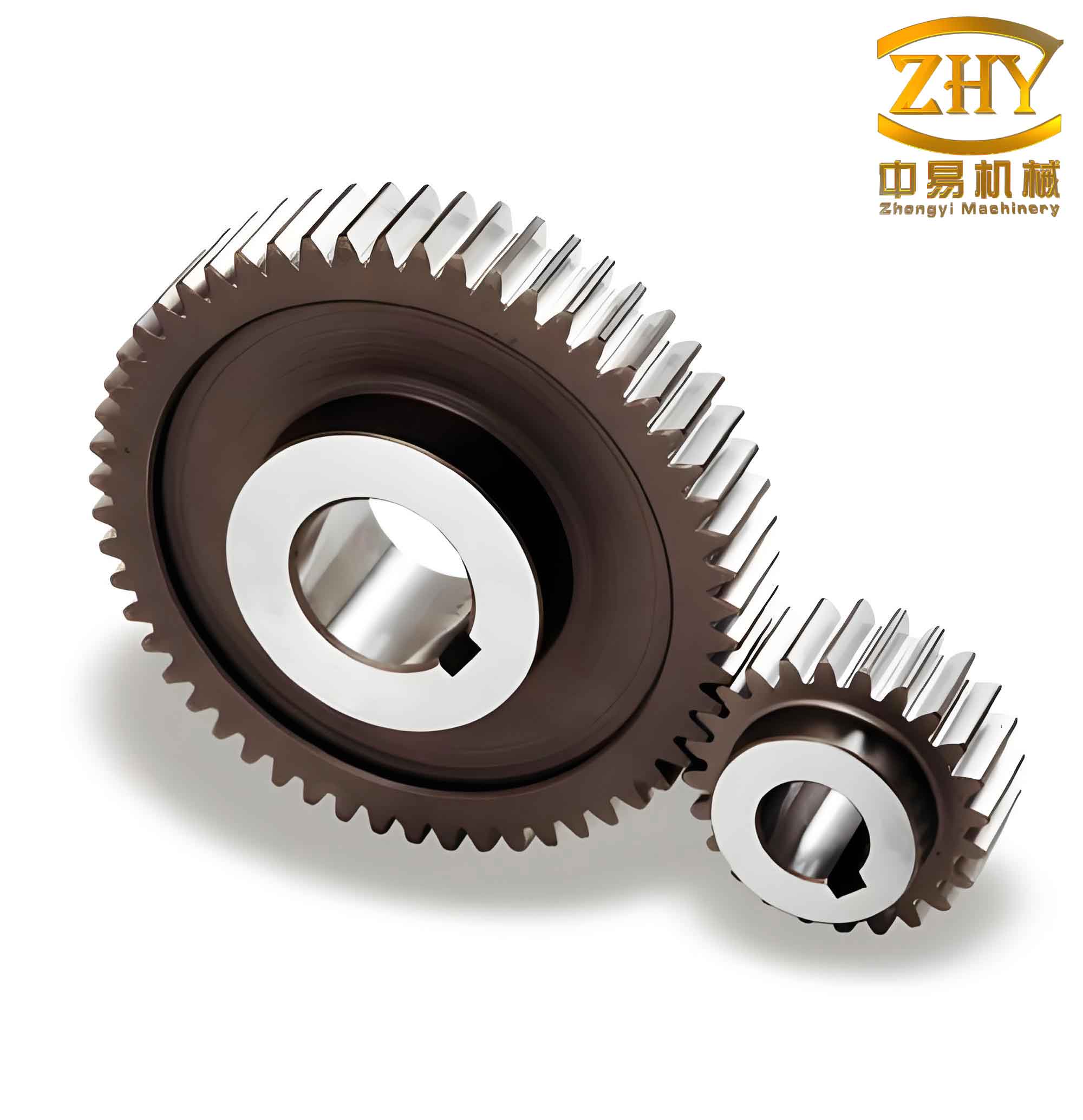
Below is an illustration of the final forged straight spur gear obtained from the simulation, showing a fully filled tooth profile and a well‑formed boss.
Fundamental Mechanics of Localized Loading
To understand why localized loading drastically reduces the forming force, I consider the basic pressure‑area relationship. In conventional closed‑die forging of a straight spur gear, the entire top surface of the billet is contacted by the punch, resulting in a large contact area Aglobal. The required forming load F is proportional to the average flow stress σavg and the contact area:
$$ F = \sigma_{\text{avg}} \cdot A $$
In the localized approach, only the ring‑shaped punch contacts the material over the tooth region, so the contact area Alocal is much smaller — typically less than 30% of the total top area. Moreover, because the material is forced to flow primarily into the tooth cavities and the boss simultaneously, the deformation zone is confined and the mean flow stress does not increase as dramatically as in global forging where the entire billet undergoes severe deformation simultaneously. The load reduction factor can be expressed as:
$$ \frac{F_{\text{local}}}{F_{\text{global}}} \approx \frac{A_{\text{local}}}{A_{\text{global}}} \cdot \frac{\sigma_{\text{avg,local}}}{\sigma_{\text{avg,global}}} $$
For the gear geometry under study, Alocal / Aglobal ≈ 0.35, and the ratio of flow stresses is approximately 0.8–0.9 due to the lower degree of strain hardening in the local region. This yields a load ratio of 0.28–0.32, which agrees well with the simulation result of ~0.29 (i.e., 120 kN vs. 410 kN).
Effect of Process Parameters on Forming Characteristics
I also performed a parametric study to investigate the sensitivity of the forming load and tooth filling quality to key geometric and tribological parameters. The following table shows the influence of the boss height, ring‑punch thickness, and friction coefficient on the final deformation:
| Parameter | Variation Range | Max Load (kN) | Tooth Filling Ratio (%) |
|---|---|---|---|
| Boss height (mm) | 1.0 – 2.0 | 110 – 135 | 98 – 100 |
| Ring‑punch thickness (mm) | 3 – 7 | 105 – 140 | 95 – 100 |
| Friction factor | 0.08 – 0.18 | 105 – 150 | 97 – 100 |
It is evident that a boss height of 1.5 mm yields the best compromise between load reduction and complete filling. A thicker ring‑punch increases the contact area and hence the load, but also improves the material confinement. A friction factor higher than 0.15 leads to incomplete filling of the tooth tip due to increased flow resistance.
Practical Implications and Future Work
The proposed two‑step cold forging process for straight spur gears has shown great potential in industrial applications. By adopting a localized loading strategy in the final forging stage, I have demonstrated that the forming load can be reduced by more than 70% compared to conventional single‑step forging, while still achieving a fully filled tooth profile with sufficient dimensional accuracy. The pre‑forging step serves to redistribute material and create a favourable pre‑shape that facilitates the subsequent local deformation. Annealing between the two steps further enhances material ductility and reduces the required force.
In future work, I intend to extend the simulation to full 3D models of the entire gear (all 18 teeth) to verify that the deformation remains uniform across all teeth. Furthermore, experimental validation using instrumented dies will be conducted to confirm the predicted load reduction and to examine the microstructure and hardness distribution in the forged gears. Process optimization using response surface methodology and genetic algorithms could help fine‑tune the pre‑form geometry and the die design for different gear sizes.
Conclusion
Through a comprehensive finite‑element simulation study of the cold forging of straight spur gears, I have established a new two‑step method that combines a global pre‑forging stage with a localized finish‑forging stage. The key findings are:
- The pre‑forging step accumulates material in the tooth cavities, providing a suitable pre‑shape for local loading.
- During localized forging, the material first fills the upper part of the tooth, then the lower part, and finally the boss, preventing a sudden load spike.
- The maximum forming load of the recommended process (120 kN) is only about 30% of that required for conventional global forging (410 kN).
- The equivalent strain and stress distributions indicate that the tooth corners and the boss‑tooth transition are the most critical areas, but they are completely filled under the optimized conditions.
- Parametric analyses reveal that a boss height of 1.5 mm, a ring‑punch thickness of 5 mm, and a friction factor of 0.12 yield the best combination of low load and high filling quality.
This work provides a viable path toward the practical application of cold forging for the net‑shape production of straight spur gears, offering reduced energy consumption, longer die life, and improved productivity.