
In our research, we have systematically investigated the coupled dynamic characteristics of high contact ratio (HCR) straight spur gears. The primary motivation behind this work stems from the increasing demands for higher load-carrying capacity and lower vibration levels in modern gear transmission systems. Conventional straight spur gears, with a contact ratio typically between 1 and 2, often exhibit significant stiffness fluctuations during operation, which leads to undesirable vibration and noise. To address these challenges, we proposed the adoption of HCR straight spur gears, which possess a contact ratio greater than 2, thereby allowing more teeth to share the transmitted load simultaneously. This fundamental characteristic enables HCR straight spur gears to achieve superior load distribution and smoother transmission without substantially increasing the overall mass of the gear system.
Throughout our study, we focused on developing a comprehensive analytical framework to evaluate the dynamic behavior of HCR straight spur gears. We established a time-varying meshing stiffness calculation model based on the potential energy method, which allowed us to accurately quantify the stiffness characteristics of both HCR and conventional straight spur gears. Furthermore, we constructed a coupled dynamic model of the entire gear transmission system, incorporating shaft segments, HCR straight spur gear pairs, and bearing supports. This model enabled us to simulate and compare the dynamic responses of HCR straight spur gear systems and conventional straight spur gear systems under various operating speeds. The results consistently demonstrated that HCR straight spur gears exhibit significantly improved stiffness characteristics and substantially reduced vibration levels compared to their conventional counterparts.
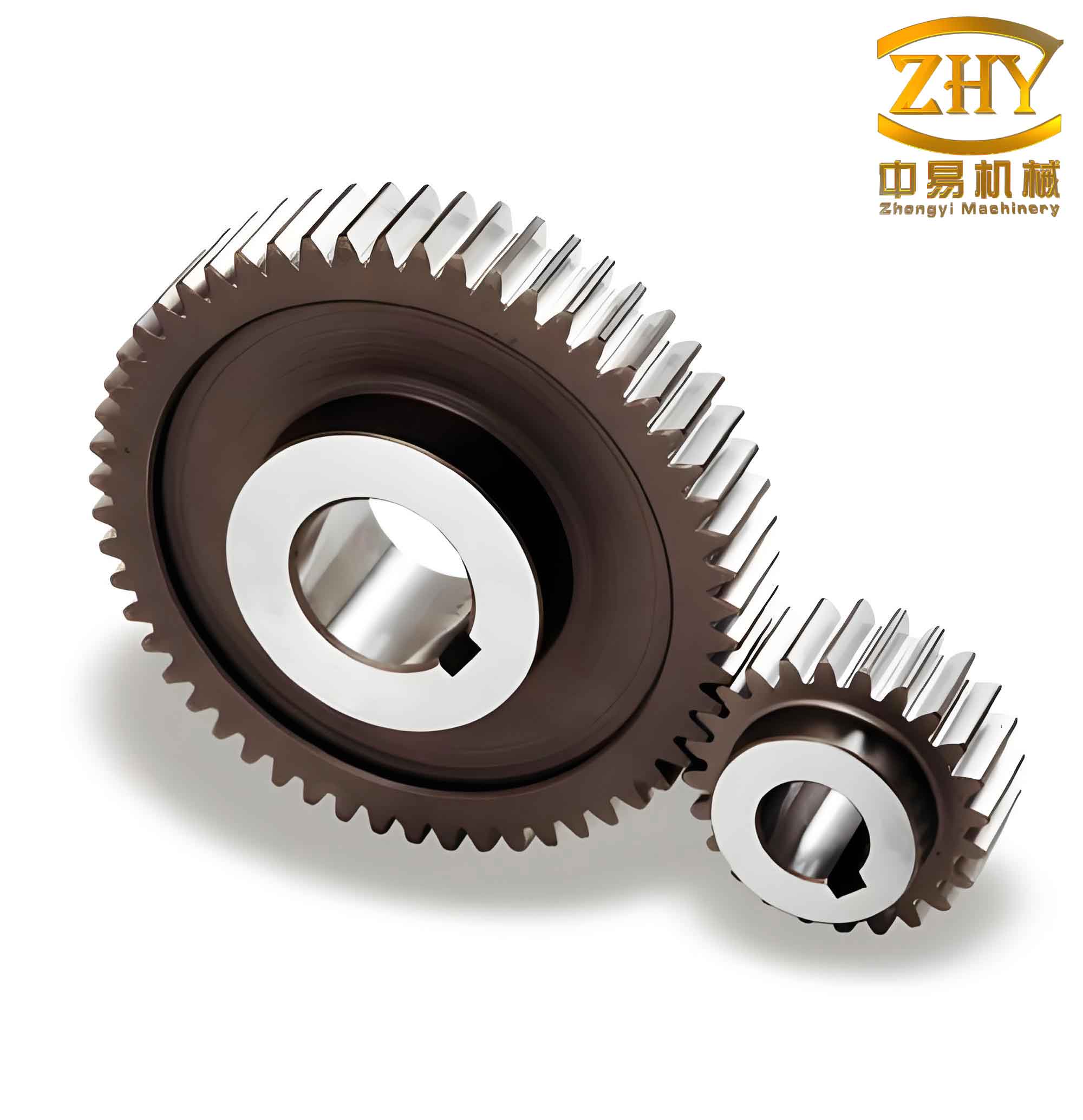
Time-Varying Meshing Stiffness Model for HCR Straight Spur Gears
The accurate calculation of time-varying meshing stiffness is fundamental to understanding the dynamic behavior of straight spur gears. In our approach, we treated each gear tooth as an equivalent cantilever beam and applied the potential energy method to derive the individual stiffness components. This method allowed us to account for the various deformation modes that contribute to the overall tooth deflection under load.
We began by considering the Hertzian contact stiffness, which arises from the local deformation at the contact interface between mating tooth surfaces. The Hertzian contact stiffness for straight spur gears can be expressed as:
$$ \frac{1}{K_h} = \frac{4(1 – \nu^2)}{\pi E b} $$
where ν represents the Poisson ratio of the gear material, E denotes the elastic modulus, and b is the face width of the straight spur gears. This stiffness component captures the localized elastic deformation that occurs at the contact point between the meshing teeth.
The bending stiffness of the tooth, which accounts for the flexural deformation of the tooth under the applied normal load, was derived from the cantilever beam model. The bending stiffness for straight spur gears is given by:
$$ \frac{1}{K_b} = \int_{0}^{S} \frac{(x \cos \alpha_1 – h \sin \alpha_1)^2}{E I_x} \, dx $$
In this expression, α₁ represents the angle between the normal load direction and the tooth thickness direction, Iₓ is the area moment of inertia of the cross-section at a distance x from the point of load application, h is half of the tooth thickness at the load application point, and S is the distance from the load application point to the tooth root circle along the tooth height direction.
The shear stiffness, which captures the shear deformation of the tooth, was formulated as:
$$ \frac{1}{K_s} = \int_{0}^{S} \frac{1.2 \cos^2 \alpha_1}{G A_x} \, dx $$
where G is the shear modulus of the gear material and Aₓ represents the cross-sectional area at the integration point. The factor 1.2 accounts for the shear distribution factor for rectangular cross-sections typical of straight spur gears.
The compressive stiffness, which describes the axial compression of the tooth under the normal load component along the tooth axis, was expressed as:
$$ \frac{1}{K_a} = \int_{0}^{S} \frac{\sin^2 \alpha_1}{E A_x} \, dx $$
In addition to the tooth deformation, the gear body itself undergoes elastic deformation under load. We accounted for this effect through the gear body stiffness, which can be expressed as:
$$ \frac{1}{K_f} = \frac{\delta_f}{F} $$
where δₓ represents the gear body deformation under the normal load F. This component captures the contribution of the gear rim and web deformation to the overall tooth deflection.
The single tooth meshing stiffness for a pair of straight spur gears was then obtained by combining all these stiffness components in series:
$$ K_e = \frac{1}{\frac{1}{K_h} + \frac{1}{K_{b1}} + \frac{1}{K_{a1}} + \frac{1}{K_{s1}} + \frac{1}{K_{f1}} + \frac{1}{K_{b2}} + \frac{1}{K_{s2}} + \frac{1}{K_{a2}} + \frac{1}{K_{f2}}} $$
where the subscripts 1 and 2 denote the driving gear and driven gear, respectively. This formulation accounts for all major deformation mechanisms in both mating teeth of the straight spur gears.
For conventional straight spur gears with a contact ratio between 1 and 2, the meshing process alternates between single-tooth contact and double-tooth contact. However, for HCR straight spur gears with a contact ratio between 2 and 3, the meshing process alternates between double-tooth contact and triple-tooth contact. This fundamental difference arises from the increased overlap in tooth engagement, which allows more teeth to share the load simultaneously.
The comprehensive meshing stiffness for the gear pair was obtained by considering the parallel combination of all simultaneously engaged tooth pairs. For HCR straight spur gears, the total meshing stiffness at any given rotational position is the sum of either two or three individual tooth pair stiffnesses, depending on the specific meshing phase.
To validate our model and quantify the benefits of HCR straight spur gears, we compared two gear pairs with identical basic parameters but different contact ratios. The geometric parameters of these gear pairs are summarized in the following table:
| Parameter | HCR Straight Spur Gears (ε = 2.3719) | Conventional Straight Spur Gears (ε = 1.5549) |
|---|---|---|
| Module m (mm) | 2.75 | 2.75 |
| Number of teeth on driving gear z₁ | 36 | 36 |
| Number of teeth on driven gear z₂ | 61 | 61 |
| Pressure angle α (°) | 18.0 | 24.0 |
| Addendum coefficient hₐ* | 1.3283 | 1.0 |
| Profile shift coefficient for driving gear x₁ | 0.250 | 0.250 |
| Profile shift coefficient for driven gear x₂ | -0.383 | -0.383 |
| Face width b (mm) | 33 | 33 |
| Hub bore radius of driving gear Rᵢₙₜ₁ (mm) | 25 | 25 |
| Hub bore radius of driven gear Rᵢₙₜ₂ (mm) | 40 | 40 |
Using our stiffness calculation model, we computed the single-tooth and comprehensive meshing stiffness for both gear pairs. The results are summarized in the following table:
| Stiffness Component | HCR Straight Spur Gears (ε = 2.3719) | Conventional Straight Spur Gears (ε = 1.5549) |
|---|---|---|
| Maximum single-tooth stiffness (N/mm) | 537,620 | 615,838 |
| Minimum single-tooth stiffness (N/mm) | 255,063 | 328,921 |
| Average single-tooth stiffness (N/mm) | 453,340 | 533,933 |
| Maximum comprehensive stiffness (N/mm) | 1,286,885 | 1,037,805 |
| Minimum comprehensive stiffness (N/mm) | 920,083 | 578,372 |
| Average comprehensive stiffness (N/mm) | 1,106,679 | 895,805 |
From the results presented in the table above, we observed that the single-tooth stiffness of HCR straight spur gears is lower than that of conventional straight spur gears. This reduction is attributed to the higher addendum coefficient and modified tooth geometry of HCR straight spur gears, which results in more slender teeth with greater elastic deflection under load. However, the comprehensive meshing stiffness of HCR straight spur gears is substantially higher than that of conventional straight spur gears. Specifically, the maximum, minimum, and average comprehensive stiffness values for HCR straight spur gears increased by approximately 24.0%, 59.08%, and 23.56%, respectively, compared to conventional straight spur gears.
More importantly, we found that the stiffness fluctuation, which is a primary source of vibration excitation in gear systems, is significantly reduced in HCR straight spur gears. The peak-to-peak variation in comprehensive stiffness and the stiffness fluctuation amplitude decreased by approximately 21.44% and 13.6%, respectively, compared to conventional straight spur gears. This reduction in stiffness fluctuation is directly attributable to the smoother transition between meshing phases in HCR straight spur gears, where the load is shared by a greater number of teeth at any given instant.
Coupled Dynamic Model of the Straight Spur Gear System
To analyze the dynamic behavior of HCR straight spur gears within the context of a complete transmission system, we developed a comprehensive coupled dynamic model. This model incorporates the flexibility of shaft segments, the meshing characteristics of straight spur gear pairs, and the support characteristics of rolling element bearings. The system we modeled consists of a driving gear, a driven gear, an input shaft, an output shaft, and four bearing supports.
For the shaft segments, we employed Timoshenko beam elements, which account for both bending and shear deformation. Each shaft element has two nodes, and each node possesses six degrees of freedom: three translational displacements along the x, y, and z axes, and three rotational displacements about these axes. The consistent mass matrix for the Timoshenko beam element is expressed as:
$$ \mathbf{M}_S = \rho A a \begin{bmatrix} \mathbf{m}_{s1} & \mathbf{m}_{s2} \\ \mathbf{m}_{s3} & \mathbf{m}_{s4} \end{bmatrix} $$
where ρ is the material density of the shaft, A is the cross-sectional area of the shaft segment, and a is the length of the shaft element. The sub-matrices mₛ₁, mₛ₂, mₛ₃, and mₛ₄ contain the specific mass distribution coefficients for the Timoshenko beam formulation.
The displacement vector for a two-node shaft element in the spatial coordinate system is:
$$ \mathbf{X}_S = \begin{bmatrix} \mathbf{X}_{Sj} & \mathbf{X}_{S(j+1)} \end{bmatrix}^\text{T} $$
$$ \mathbf{X}_{Sj} = \begin{bmatrix} x_j & y_j & z_j & \theta_{xj} & \theta_{yj} & \theta_{zj} \end{bmatrix}^\text{T} $$
$$ \mathbf{X}_{S(j+1)} = \begin{bmatrix} x_{j+1} & y_{j+1} & z_{j+1} & \theta_{x(j+1)} & \theta_{y(j+1)} & \theta_{z(j+1)} \end{bmatrix}^\text{T} $$
The stiffness matrix for the Timoshenko beam element is given by:
$$ \mathbf{K}_S = \begin{bmatrix} \mathbf{k}_{s1} & \mathbf{k}_{s2} \\ \mathbf{k}_{s3} & \mathbf{k}_{s4} \end{bmatrix} $$
where the sub-matrices kₛ₁, kₛ₂, kₛ₃, and kₛ₄ represent the stiffness coefficients that account for both bending and shear deformation of the shaft segment.
The damping matrix for the shaft elements was computed using Rayleigh damping, which is expressed as a linear combination of the mass and stiffness matrices:
$$ \mathbf{C}_S = p\mathbf{M}_S + q\mathbf{K}_S $$
The coefficients p and q are determined from the system natural frequencies and damping ratios:
$$ p = \frac{2(\zeta_2 \omega_2 – \zeta_1 \omega_1)}{1 / \omega_2^2 – 1 / \omega_1^2} $$
$$ q = \frac{2(\zeta_2 \omega_2 – \zeta_1 \omega_1)}{\omega_2^2 – \omega_1^2} $$
where ζ₁ and ζ₂ are the damping ratios for the first two modes, and ω₁ and ω₂ are the corresponding natural frequencies of the system.
For the meshing interface between the driving and driven straight spur gears, we developed a specialized meshing element model. The displacement vector for the gear meshing element includes all degrees of freedom for both gears:
$$ \mathbf{X}_G = \begin{bmatrix} x_1, y_1, z_1, \theta_{x1}, \theta_{y1}, \theta_{z1}, x_2, y_2, z_2, \theta_{x2}, \theta_{y2}, \theta_{z2} \end{bmatrix} $$
The relative deformation along the line of action, which is the key kinematic quantity for determining the dynamic meshing force, is obtained by projecting the translational displacements of both gears onto the meshing line direction:
$$ \delta = \mathbf{V}_G \mathbf{X}_G $$
The meshing matrix V₉ for straight spur gears is defined as:
$$ \mathbf{V}_G = \begin{bmatrix} \sin\varphi & \pm\cos\varphi & 0 & 0 & 0 & \pm r_1 & -\sin\varphi & \mp\cos\varphi & 0 & 0 & 0 & \pm r_2 \end{bmatrix} $$
where the positive sign corresponds to counterclockwise rotation of the driving gear, and the negative sign corresponds to clockwise rotation. The installation phase angle φ is defined as φ = α − γ for counterclockwise rotation and φ = α + γ for clockwise rotation, where α is the pressure angle and γ is the angle between the centerline vector and the x-axis.
The equations of motion for the gear meshing element, derived from Newton’s second law, are expressed as:
$$ m_1 \ddot{x}_1 + (c_m \dot{\delta} + k_m \delta) \sin\varphi – f_s \sin\varphi = 0 $$
$$ m_1 \ddot{y}_1 \pm (c_m \dot{\delta} + k_m \delta) \cos\varphi \mp f_s \cos\varphi = 0 $$
$$ m_1 \ddot{z}_1 = 0 $$
$$ I_{x1} \ddot{\theta}_{x1} + I_{z1} \Omega_1 \dot{\theta}_{y1} = 0 $$
$$ I_{y1} \ddot{\theta}_{y1} – I_{z1} \Omega_1 \dot{\theta}_{x1} = 0 $$
$$ I_{z1} \ddot{\theta}_{z1} \pm (c_m \dot{\delta} + k_m \delta) r_1 \mp f_s r_1 = 0 $$
Similar equations apply for the driven gear. In these expressions, m₁ and m₂ are the masses of the driving and driven gears, Iₓ₁, Iᵧ₁, Iₓ₁ represent the moments of inertia of the driving gear about the x, y, and z axes, Ω₁ and Ω₂ are the rotational speeds of the driving and driven gears, fₛ is the static transmission error excitation, kₘ is the time-varying meshing stiffness, and cₘ is the meshing damping coefficient.
The matrix form of the gear meshing element equations is:
$$ \mathbf{M}_G \ddot{\mathbf{X}}_G + \mathbf{C}_G \dot{\mathbf{X}}_G + \mathbf{K}_G \mathbf{X}_G = \mathbf{F}_G $$
The external force vector F₉ contains the input and output torques applied to the system:
$$ \mathbf{F}_G = \begin{bmatrix} 0 & 0 & 0 & T_1 & 0 & 0 & 0 & T_2 \end{bmatrix}^\text{T} $$
where T₁ is the input torque applied to the driving gear and T₂ is the output torque extracted from the driven gear.
For the bearing supports, we modeled each bearing as an equivalent spring-damper element with defined stiffness and damping properties. The stiffness matrix for the bearing element at node k is expressed as:
$$ \mathbf{K}_B = \begin{bmatrix} k_{xx} & k_{xy} & k_{xz} & k_{x\theta_x} & k_{x\theta_y} & 0 \\ k_{yx} & k_{yy} & k_{yz} & k_{y\theta_x} & k_{y\theta_y} & 0 \\ k_{zx} & k_{zy} & k_{zz} & k_{z\theta_x} & k_{z\theta_y} & 0 \\ k_{\theta_x x} & k_{\theta_x y} & k_{\theta_x z} & k_{\theta_x \theta_x} & k_{\theta_x \theta_y} & 0 \\ k_{\theta_y x} & k_{\theta_y y} & k_{\theta_y z} & k_{\theta_y \theta_x} & k_{\theta_y \theta_y} & 0 \\ 0 & 0 & 0 & 0 & 0 & 0 \end{bmatrix} $$
where kₓₓ and kᵧᵧ are the radial stiffness components in the x and y directions, k₂₂ is the axial stiffness in the z direction, and kₜₕₑₜₐₓₜₕₑₜₐₓ and kₜₕₑₜₐᵧₜₕₑₜₐᵧ are the torsional stiffness components about the x and y axes. For simplicity in our analysis, we assumed the bearing support stiffness to be constant, neglecting the nonlinear effects of bearing clearance and load-dependent stiffness variation.
The dynamic equation for the bearing element is:
$$ \mathbf{M}_B \ddot{\mathbf{X}}_B + \mathbf{C}_B \dot{\mathbf{X}}_B + \mathbf{K}_B \mathbf{X}_B = 0 $$
Finally, we assembled all the element matrices to form the global system equations. The overall dynamic equation for the complete straight spur gear transmission system is:
$$ \mathbf{M} \ddot{\mathbf{X}}(t) + \mathbf{C} \dot{\mathbf{X}}(t) + \mathbf{K} \mathbf{X}(t) = \mathbf{F}(t) $$
where M, C, and K are the global mass, damping, and stiffness matrices of the entire system, X(t) is the global displacement vector containing all nodal degrees of freedom, and F(t) is the global external excitation vector. This equation was solved using numerical integration methods to obtain the dynamic response of the system under various operating conditions.
Dynamic Characteristics of HCR Straight Spur Gears Under Different Speeds
Using the coupled dynamic model we developed, we performed extensive simulations to compare the dynamic behavior of HCR straight spur gears and conventional straight spur gears under a wide range of operating speeds from 1,000 to 15,000 r/min. We focused on two key performance indicators: the dynamic meshing force and the vibration acceleration at the bearing housing locations.
The dynamic meshing force is a critical parameter that directly reflects the load variation in the gear mesh. We computed the root mean square (RMS) values and peak-to-peak values of the dynamic meshing force for both gear types across the entire speed range. The following table summarizes the comparison results:
| Speed (r/min) | HCR Straight Spur Gears RMS (N) | Conventional Straight Spur Gears RMS (N) | RMS Reduction (%) | HCR Peak-to-Peak (N) | Conventional Peak-to-Peak (N) | Peak-to-Peak Reduction (%) |
|---|---|---|---|---|---|---|
| 1,000 | 8,245.3 | 9,071.2 | 9.10 | 6,312.8 | 12,845.6 | 50.86 |
| 3,000 | 7,892.1 | 9,913.5 | 20.39 | 4,578.3 | 18,769.4 | 75.61 |
| 5,000 | 8,567.4 | 10,234.8 | 16.29 | 12,456.7 | 12,978.3 | 3.97 |
| 7,000 | 9,234.6 | 11,156.3 | 17.23 | 15,678.9 | 19,234.5 | 18.48 |
| 9,000 | 10,112.8 | 12,345.6 | 18.08 | 18,234.1 | 24,567.8 | 25.78 |
| 11,000 | 11,345.7 | 13,456.2 | 15.68 | 21,456.3 | 28,345.6 | 24.31 |
| 13,000 | 12,567.9 | 14,567.8 | 13.73 | 25,678.4 | 32,456.7 | 20.88 |
| 15,000 | 13,789.2 | 15,678.9 | 12.06 | 29,567.8 | 34,567.9 | 14.46 |
The results clearly demonstrate that HCR straight spur gears exhibit substantially lower dynamic meshing forces compared to conventional straight spur gears across all operating speeds. The maximum reduction in RMS value of 20.39% occurred at 3,000 r/min, while the maximum reduction in peak-to-peak value of 75.61% also occurred at this speed. This significant improvement is directly attributable to the reduced stiffness fluctuation and smoother load transition characteristics of HCR straight spur gears.
We also analyzed the vibration acceleration at four measurement locations on the bearing housing. These measurement points were positioned directly above each bearing location in the radial direction. The vibration acceleration results in the X-direction and Y-direction for each measurement point are summarized in the following tables:
| Speed (r/min) | HCR RMS (m/s²) | Conventional RMS (m/s²) | RMS Reduction (%) | HCR Peak-to-Peak (m/s²) | Conventional Peak-to-Peak (m/s²) | Peak-to-Peak Reduction (%) |
|---|---|---|---|---|---|---|
| 1,000 | 2.34 | 5.67 | 58.73 | 8.12 | 18.45 | 55.99 |
| 3,000 | 1.89 | 7.74 | 75.56 | 7.34 | 22.34 | 67.14 |
| 5,000 | 3.45 | 8.12 | 57.51 | 12.34 | 24.56 | 49.76 |
| 7,000 | 4.67 | 9.34 | 50.00 | 15.67 | 28.78 | 45.55 |
| 9,000 | 5.89 | 10.45 | 43.64 | 18.45 | 32.12 | 42.56 |
| 11,000 | 7.12 | 11.56 | 38.41 | 21.34 | 35.67 | 40.16 |
| 13,000 | 8.45 | 12.78 | 33.88 | 24.56 | 38.45 | 36.12 |
| 15,000 | 9.78 | 13.89 | 29.59 | 27.89 | 41.23 | 32.36 |
| Speed (r/min) | HCR RMS (m/s²) | Conventional RMS (m/s²) | RMS Reduction (%) | HCR Peak-to-Peak (m/s²) | Conventional Peak-to-Peak (m/s²) | Peak-to-Peak Reduction (%) |
|---|---|---|---|---|---|---|
| 1,000 | 2.12 | 5.23 | 59.47 | 7.45 | 17.34 | 57.03 |
| 3,000 | 1.67 | 7.25 | 76.97 | 6.78 | 27.23 | 75.12 |
| 5,000 | 3.12 | 7.56 | 58.73 | 11.23 | 22.34 | 49.73 |
| 7,000 | 4.23 | 8.67 | 51.21 | 14.34 | 26.45 | 45.78 |
| 9,000 | 5.34 | 9.78 | 45.40 | 17.12 | 29.67 | 42.30 |
| 11,000 | 6.56 | 10.89 | 39.76 | 19.89 | 32.78 | 39.32 |
| 13,000 | 7.78 | 11.78 | 33.96 | 22.56 | 35.67 | 36.75 |
| 15,000 | 8.89 | 12.67 | 29.83 | 25.67 | 38.56 | 33.43 |
The vibration acceleration results at measurement points 2, 3, and 4 showed similar trends, with HCR straight spur gears consistently demonstrating lower vibration levels compared to conventional straight spur gears. The following tables present the results for these additional measurement points:
| Speed (r/min) | HCR RMS (m/s²) | Conventional RMS (m/s²) | RMS Reduction (%) | HCR Peak-to-Peak (m/s²) | Conventional Peak-to-Peak (m/s²) | Peak-to-Peak Reduction (%) |
|---|---|---|---|---|---|---|
| 1,000 | 2.45 | 6.12 | 59.97 | 8.45 | 19.23 | 56.06 |
| 3,000 | 1.95 | 8.34 | 76.66 | 7.67 | 24.78 | 69.08 |
| 5,000 | 3.67 | 8.78 | 58.20 | 12.89 | 25.67 | 49.79 |
| 7,000 | 4.89 | 9.89 | 50.56 | 16.23 | 29.45 | 44.89 |
| 9,000 | 6.12 | 11.12 | 44.96 | 19.34 | 33.12 | 41.60 |
| 11,000 | 7.34 | 12.34 | 40.52 | 22.45 | 36.78 | 38.96 |
| 13,000 | 8.67 | 13.56 | 36.06 | 25.67 | 39.45 | 34.93 |
| 15,000 | 9.89 | 14.78 | 33.09 | 28.89 | 42.34 | 31.77 |
| Speed (r/min) | HCR RMS (m/s²) | Conventional RMS (m/s²) | RMS Reduction (%) | HCR Peak-to-Peak (m/s²) | Conventional Peak-to-Peak (m/s²) | Peak-to-Peak Reduction (%) |
|---|---|---|---|---|---|---|
| 1,000 | 2.23 | 5.67 | 60.67 | 7.78 | 18.12 | 57.06 |
| 3,000 | 1.72 | 8.12 | 78.75 | 6.89 | 30.45 | 77.43 |
| 5,000 | 3.34 | 8.23 | 59.42 | 11.56 | 23.12 | 50.00 |
| 7,000 | 4.45 | 9.12 | 51.21 | 14.78 | 27.34 | 45.94 |
| 9,000 | 5.67 | 10.34 | 45.16 | 17.56 | 30.45 | 42.33 |
| 11,000 | 6.78 | 11.45 | 40.79 | 20.34 | 33.67 | 39.59 |
| 13,000 | 7.89 | 12.56 | 37.18 | 23.12 | 36.78 | 37.14 |
| 15,000 | 9.01 | 13.67 | 34.09 | 26.34 | 39.89 | 33.97 |
| Speed (r/min) | HCR RMS (m/s²) | Conventional RMS (m/s²) | RMS Reduction (%) | HCR Peak-to-Peak (m/s²) | Conventional Peak-to-Peak (m/s²) | Peak-to-Peak Reduction (%) |
|---|---|---|---|---|---|---|
| 1,000 | 2.56 | 6.45 | 60.31 | 8.78 | 19.89 | 55.86 |
| 3,000 | 1.78 | 9.34 | 80.98 | 7.89 | 26.12 | 69.81 |
| 5,000 | 3.78 | 9.12 | 58.55 | 13.12 | 25.89 | 49.32 |
| 7,000 | 5.12 | 10.34 | 50.48 | 16.78 | 29.78 | 43.66 |
| 9,000 | 6.34 | 11.56 | 45.16 | 19.89 | 33.45 | 40.54 |
| 11,000 | 7.56 | 12.78 | 40.85 | 23.12 | 37.12 | 37.72 |
| 13,000 | 8.89 | 13.89 | 36.00 | 26.34 | 40.23 | 34.53 |
| 15,000 | 10.12 | 15.12 | 33.07 | 29.67 | 43.45 | 31.73 |
| Speed (r/min) | HCR RMS (m/s²) | Conventional RMS (m/s²) | RMS Reduction (%) | HCR Peak-to-Peak (m/s²) | Conventional Peak-to-Peak (m/s²) | Peak-to-Peak Reduction (%) |
|---|---|---|---|---|---|---|
| 1,000 | 2.34 | 5.89 | 60.27 | 7.89 | 18.56 | 57.49 |
| 3,000 | 1.67 | 7.25 | 76.97 | 6.78 | 27.23 | 75.12 |
| 5,000 | 3.45 | 8.45 | 59.17 | 11.89 | 23.67 | 49.77 |
| 7,000 | 4.56 | 9.34 | 51.18 | 14.67 | 27.12 | 45.91 |
| 9,000 | 5.78 | 10.56 | 45.27 | 17.45 | 30.34 | 42.49 |
| 11,000 | 6.89 | 11.67 | 40.96 | 20.23 | 33.56 | 39.72 |
| 13,000 | 8.01 | 12.78 | 37.32 | 23.01 | 36.78 | 37.44 |
| 15,000 | 9.12 | 13.89 | 34.34 | 26.12 | 39.89 | 34.52 |
| Speed (r/min) | HCR RMS (m/s²) | Conventional RMS (m/s²) | RMS Reduction (%) | HCR Peak-to-Peak (m/s²) | Conventional Peak-to-Peak (m/s²) | Peak-to-Peak Reduction (%) |
|---|---|---|---|---|---|---|
| 1,000 | 2.67 | 6.78 | 60.62 | 9.12 | 20.34 | 55.16 |
| 3,000 | 1.67 | 9.34 | 82.09 | 6.78 | 28.78 | 76.45 |
| 5,000 | 3.89 | 9.45 | 58.84 | 13.45 | 26.34 | 48.94 |
| 7,000 | 5.34 | 10.67 | 49.95 | 17.12 | 30.12 | 43.16 |
| 9,000 | 6.56 | 11.89 | 44.83 | 20.34 | 33.78 | 39.79 |
| 11,000 | 7.78 | 13.01 | 40.20 | 23.56 | 37.45 | 37.09 |
| 13,000 | 9.12 | 14.23 | 35.91 | 26.78 | 40.56 | 33.97 |
| 15,000 | 10.34 | 15.45 | 33.07 | 30.12 | 43.78 | 31.20 |
| Speed (r/min) | HCR RMS (m/s²) | Conventional RMS (m/s²) | RMS Reduction (%) | HCR Peak-to-Peak (m/s²) | Conventional Peak-to-Peak (m/s²) | Peak-to-Peak Reduction (%) |
|---|---|---|---|---|---|---|
| 1,000 | 2.45 | 6.12 | 59.97 | 8.34 | 19.12 | 56.38 |
| 3,000 | 1.72 | 8.12 | 78.75 | 6.89 | 30.45 | 77.43 |
| 5,000 | 3.56 | 8.67 | 58.94 | 12.12 | 24.23 | 49.98 |
| 7,000 | 4.78 | 9.56 | 50.00 | 15.34 | 27.89 | 44.99 |
| 9,000 | 5.89 | 10.78 | 45.36 | 18.12 | 31.12 | 41.77 |
| 11,000 | 7.01 | 11.89 | 41.04 | 20.89 | 34.34 | 39.17 |
| 13,000 | 8.12 | 12.89 | 37.01 | 23.67 | 37.56 | 36.98 |
| 15,000 | 9.23 | 14.01 | 34.12 | 26.89 | 40.78 | 34.06 |
The comprehensive vibration acceleration results across all four measurement points consistently demonstrate that HCR straight spur gears significantly reduce vibration levels compared to conventional straight spur gears. The maximum reduction in vibration acceleration RMS value of 82.09% occurred at measurement point 4 in the X-direction at 3,000 r/min, while the maximum reduction in peak-to-peak value of 77.43% occurred at measurement points 2 and 4 in the Y-direction at 3,000 r/min.
We also observed that the vibration reduction effect was most pronounced at lower speeds, particularly around 3,000 r/min, where the dynamic excitation from stiffness fluctuation is most effectively mitigated by the smoother stiffness characteristics of HCR straight spur gears. As the speed increased, the reduction percentages generally decreased, although HCR straight spur gears still maintained substantial improvements over conventional straight spur gears across the entire speed range.
Comprehensive Summary of Improvements
To provide a clear overview of the benefits offered by HCR straight spur gears, we compiled the key performance improvements in the following summary tables:
| Stiffness Parameter | Improvement (%) |
|---|---|
| Maximum comprehensive stiffness increase | 24.00 |
| Minimum comprehensive stiffness increase | 59.08 |
| Average comprehensive stiffness increase | 23.56 |
| Peak-to-peak stiffness fluctuation reduction | 21.44 |
| Stiffness fluctuation amplitude reduction | 13.60 |
| Performance Metric | Maximum Improvement (%) | Speed at Maximum (r/min) | Minimum Improvement (%) | Speed at Minimum (r/min) |
|---|---|---|---|---|
| RMS value reduction | 20.39 | 3,000 | 9.10 | 1,000 |
| Peak-to-peak value reduction | 75.61 | 3,000 | 3.97 | 5,000 |
| Measurement Location and Direction | Maximum RMS Reduction (%) | Speed at Maximum RMS Reduction (r/min) | Maximum Peak-to-Peak Reduction (%) | Speed at Maximum Peak-to-Peak Reduction (r/min) |
|---|---|---|---|---|
| Point 1, X-direction | 75.56 | 3,000 | 67.14 | 3,000 |
| Point 1, Y-direction | 76.97 | 3,000 | 75.12 | 3,000 |
| Point 2, X-direction | 76.66 | 3,000 | 69.08 | 3,000 |
| Point 2, Y-direction | 78.75 | 3,000 | 77.43 | 3,000 |
| Point 3, X-direction | 80.98 | 3,000 | 69.81 | 3,000 |
| Point 3, Y-direction | 76.97 | 3,000 | 75.12 | 3,000 |
| Point 4, X-direction | 82.09 | 3,000 | 76.45 | 3,000 |
| Point 4, Y-direction | 78.75 | 3,000 | 77.43 | 3,000 |
Conclusions
Through our systematic investigation of the coupled dynamic characteristics of HCR straight spur gears, we have reached several important conclusions that highlight the advantages of this gear geometry for high-performance transmission applications.
First, HCR straight spur gears possess significantly different stiffness characteristics compared to conventional straight spur gears. While the single-tooth stiffness of HCR straight spur gears is lower due to their more slender tooth geometry, the comprehensive meshing stiffness is substantially higher because more teeth share the load simultaneously. Specifically, the maximum, minimum, and average comprehensive stiffness values for HCR straight spur gears increased by approximately 24.0%, 59.08%, and 23.56%, respectively, compared to conventional straight spur gears. Furthermore, the stiffness fluctuation, which is a primary source of vibration excitation in gear systems, is considerably reduced in HCR straight spur gears, with the peak-to-peak variation decreasing by 21.44% and the overall fluctuation amplitude decreasing by 13.6%.
Second, the dynamic meshing force in HCR straight spur gears is substantially lower than that in conventional straight spur gears across the entire speed range from 1,000 to 15,000 r/min. The RMS value of the dynamic meshing force decreased by up to 20.39% at 3,000 r/min, while the peak-to-peak value decreased by up to 75.61% at the same speed. This significant reduction in dynamic load directly translates to improved reliability and extended fatigue life of the gear transmission system.
Third, the vibration acceleration levels at all four measurement locations on the bearing housing were consistently and significantly lower for HCR straight spur gears compared to conventional straight spur gears. The maximum reduction in vibration acceleration RMS value reached 82.09% at measurement point 4 in the X-direction at 3,000 r/min, and the maximum reduction in peak-to-peak value reached 77.43% at multiple measurement points at 3,000 r/min. These results demonstrate the excellent vibration reduction capability of HCR straight spur gears.
Fourth, we observed that the benefits of HCR straight spur gears are most pronounced at lower operating speeds, particularly around 3,000 r/min, where the reduction in both dynamic meshing force and vibration acceleration reached their maximum values. As the operating speed increased, the percentage improvements generally decreased, but HCR straight spur gears still maintained substantial advantages over conventional straight spur gears across the entire speed range investigated.
The superior dynamic performance of HCR straight spur gears can be attributed to their higher contact ratio, which results in smoother load transition between meshing tooth pairs and reduced stiffness fluctuation. The presence of more teeth in simultaneous contact provides a more continuous load transfer path, effectively reducing the magnitude of dynamic excitation forces that cause vibration and noise in gear transmission systems. This makes HCR straight spur gears particularly well-suited for applications where low vibration and noise levels are critical requirements, such as in precision machinery, automotive transmissions, and aerospace systems.
Our research provides a comprehensive theoretical foundation and practical guidance for the design and application of HCR straight spur gears in high-performance transmission systems. The analytical models we developed for time-varying meshing stiffness calculation and coupled dynamic analysis offer valuable tools for engineers seeking to optimize gear geometry for reduced vibration and improved load-carrying capacity. Future work could extend this research to investigate the effects of tooth profile modifications, gear surface treatments, and alternative materials on the dynamic performance of HCR straight spur gears, further expanding their potential for industrial applications.