
In modern mechanical transmissions, spiral gears play a pivotal role due to their ability to transmit power between non-parallel and non-intersecting shafts with high efficiency and smooth operation. Among these, involute helical gears, a type of spiral gear, are widely used because of their favorable meshing properties, ease of manufacturing, and interchangeability. However, achieving high precision in spiral gears often requires grinding processes to meet stringent technical specifications. In this paper, I will delve into the research on the profile of grinding wheels used for processing involute helical gears, focusing on the mathematical modeling of the gear surface, the contact conditions between the wheel and the workpiece, and the numerical derivation of the wheel profile. This study aims to provide a comprehensive method for form grinding of spiral gears, addressing challenges such as wheel wear compensation through advanced computational techniques.
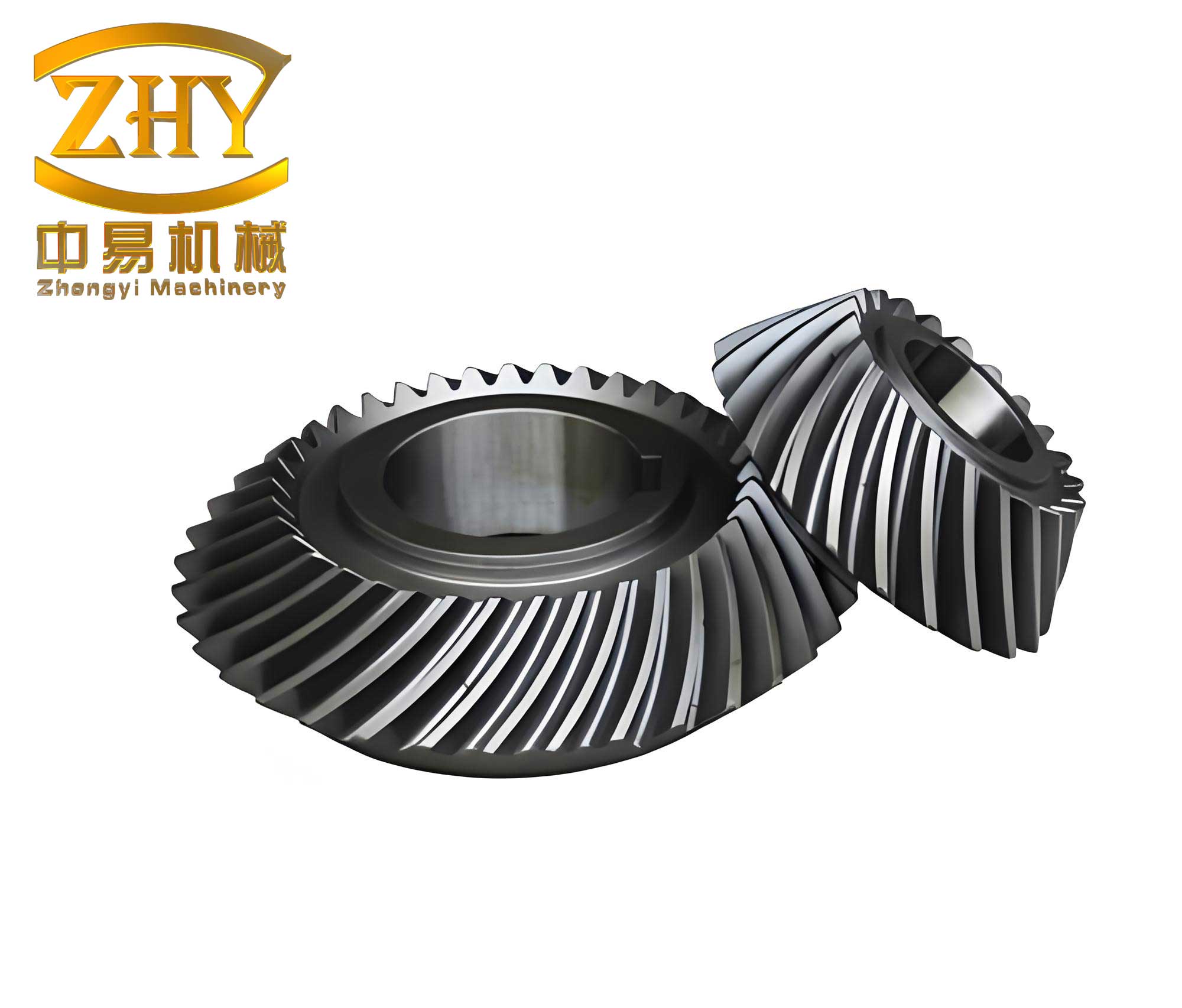
The foundation of this research lies in understanding the geometry of involute helical surfaces, which are essential for spiral gears. An involute helical surface can be generated by a straight line tangent to a base cylinder with radius $$r_b$$, while simultaneously following a helical path with spiral parameter $$P$$. This motion creates a surface whose cross-section is an involute curve. To formulate this mathematically, I start with the parametric equations of an involute curve in the transverse plane. Let $$u$$ be the parameter representing the angle from the starting point of the involute, and $$\sigma$$ be the initial angle offset. The coordinates of a point on the involute are given by:
$$x_0 = r_b \cos(\sigma + u) + r_b u \sin(\sigma + u)$$
$$y_0 = r_b \sin(\sigma + u) – r_b u \cos(\sigma + u)$$
These equations describe the left-side involute of a gear tooth slot, symmetric about the x-axis. For spiral gears, this involute undergoes a helical motion around the z-axis, which can be decomposed into a rotation by angle $$\theta$$ and a translation along the z-axis by distance $$P\theta$$. The spiral parameter $$P$$ is related to the gear’s geometry: $$P = \frac{r}{\cos\beta}$$, where $$r$$ is the pitch radius and $$\beta$$ is the helix angle. Using coordinate transformations, the equations of the right-handed helical surface become:
$$x_1 = r_b \cos(\sigma + \theta + u) + r_b u \sin(\sigma + \theta + u)$$
$$y_1 = r_b \sin(\sigma + \theta + u) – r_b u \cos(\sigma + \theta + u)$$
$$z_1 = P \theta$$
Here, $$(x_1, y_1, z_1)$$ represent a point on the involute helical surface of the spiral gear. The normal vector to this surface at any point is crucial for analyzing contact conditions. The components of the normal vector are derived from the partial derivatives of the surface equations, yielding:
$$n_x = P r_b u \sin(\sigma + \theta + u)$$
$$n_y = -P r_b u \cos(\sigma + \theta + u)$$
$$n_z = r_b^2 u$$
This formulation sets the stage for investigating the interaction between the grinding wheel and the spiral gear workpiece during form grinding.
When using a disk-shaped grinding wheel to machine spiral gears, the wheel’s rotary surface must precisely contact the gear’s helical surface along a continuous line. This contact line is fundamental to ensuring accurate tooth profile generation. The relative motion between the wheel and the workpiece is characterized by their axes being set at a center distance $$a$$ and an angle $$\Sigma$$, where $$\Sigma = 90^\circ – \beta$$ for spiral gears. According to the principles of gear machining, at any instant, the wheel and gear surfaces share a common tangent along the contact line, and the relative velocity vector is perpendicular to the common normal. From this, I derive the contact condition equation. Let $$\omega$$ and $$\omega’$$ be the angular velocities of the workpiece and wheel, respectively, and $$\mathbf{v}^{(12)}$$ be the relative velocity. The condition is:
$$\mathbf{v}^{(12)} \cdot \mathbf{n} = 0$$
Expanding this for the helical surface and simplifying, the contact condition reduces to:
$$(\mathbf{k}’ \times \mathbf{R}) \cdot \mathbf{n} = 0$$
where $$\mathbf{k}’$$ is the unit vector along the wheel axis, and $$\mathbf{R}$$ is the position vector from the wheel center to a point on the surface. After coordinate transformations and algebraic manipulations, the specific equation for the contact line on the involute helical surface is obtained as:
$$(P^2 \theta – r_b^2 u) \sin\Sigma \sin(\sigma + \theta + u) – (P a \cos\Sigma + r_b^2 \sin\Sigma) \cos(\sigma + \theta + u) + r_b (P \cos\Sigma + a \sin\Sigma) = 0$$
This equation involves the parameters $$u$$ and $$\theta$$, which define the contact line. For a given spiral gear with specified parameters, solving this equation yields discrete points along the contact line. It is important to note that the contact line varies with the grinding wheel diameter; larger wheels result in longer and smoother contact lines, as illustrated in computational analyses. Moreover, all contact lines for a given gear intersect at a fixed point known as the “fixed chordal space point,” a characteristic property of spiral gears.
To determine the exact profile of the grinding wheel, I need to compute the wheel’s rotary surface based on the contact line. The wheel profile in its axial cross-section can be derived by revolving the contact line around the wheel axis. Using coordinate systems, the transformation from the gear coordinates to the wheel coordinates is given by:
$$X = a – x_1$$
$$Y = -y_1 \cos\Sigma – z_1 \sin\Sigma$$
$$Z = -y_1 \sin\Sigma + z_1 \cos\Sigma$$
The axial profile of the wheel is then described by the radial distance $$R$$ and axial coordinate $$Z$$:
$$R = \sqrt{X^2 + Y^2}$$
$$Z = Z$$
Since the contact condition equation is implicit in $$u$$ and $$\theta$$, numerical methods are employed to solve it. By iterating over a range of $$\theta$$ values with small increments, corresponding $$u$$ values are computed, resulting in discrete points on the contact line. These points are then transformed to the wheel coordinate system to obtain discrete points on the wheel profile. Through curve fitting techniques, such as polynomial or spline interpolation, a continuous wheel profile is reconstructed. This approach effectively addresses the challenge of wheel wear compensation; as the wheel diameter changes due to wear, the wheel profile can be recalculated by adjusting parameters like center distance $$a$$, enabling precise regrinding without extensive manual recalculation.
The properties of the grinding wheel profile are influenced by various geometric parameters of the spiral gear. Based on numerical simulations, I summarize these properties in the table below, which highlights how changes in gear parameters affect the wheel profile characteristics for a constant wheel diameter.
| Gear Parameter | Change | Effect on Wheel Profile | Implication for Wheel Design |
|---|---|---|---|
| Module $$m_n$$ | Increase | Profile length increases, profile becomes steeper | Thicker wheel required |
| Number of Teeth $$z_n$$ | Increase | Profile length increases, profile becomes more gradual | Thicker wheel required |
| Helix Angle $$\beta$$ | Increase | Profile length increases, profile becomes more gradual | Thicker wheel required |
| Wheel Diameter | Decrease | Profile becomes more curved | Increased curvature necessitates precise fitting |
These properties are crucial for designing grinding wheels tailored to specific spiral gears. For instance, larger module spiral gears demand wheels with thicker profiles to accommodate the steeper tooth geometry, while gears with more teeth require longer but smoother profiles. The helix angle of spiral gears also plays a significant role; higher helix angles lead to more extended contact lines, which translate to longer wheel profiles. Furthermore, as the wheel diameter decreases due to wear, the profile curvature increases, emphasizing the need for accurate numerical compensation to maintain grinding precision.
Error compensation for wheel wear is a critical aspect of this research. In practical grinding operations, spiral gears are subject to continuous wear, causing the wheel diameter to diminish and the wheel profile to deviate from its ideal shape. This deviation can lead to inaccuracies in the gear tooth profile, potentially producing defective parts. Traditional methods rely on manual measurements and recalibrations, which are time-consuming and prone to errors. However, with advances in computational technology and numerical analysis, I propose an automated compensation approach. By monitoring the wheel diameter in real-time during production and using the derived equations to recalculate the wheel profile, the system can generate updated grinding paths or wheel dressing data. This method significantly enhances efficiency and accuracy in manufacturing spiral gears. Nonetheless, it requires periodic measurement of the wheel diameter, which may be a limitation for fully autonomous systems; future work could integrate sensors for continuous monitoring.
To illustrate the mathematical process, consider a numerical example. Suppose a spiral gear has the following parameters: base radius $$r_b = 50 \, \text{mm}$$, spiral parameter $$P = 60 \, \text{mm}$$, initial angle $$\sigma = 0.2 \, \text{rad}$$, center distance $$a = 200 \, \text{mm}$$, and axis angle $$\Sigma = 60^\circ$$. Using a computational algorithm, I solve the contact condition equation for $$\theta$$ ranging from $$-0.5$$ to $$0.5$$ radians with a step size of $$0.01$$ radians. The corresponding $$u$$ values are computed, and the wheel profile points are derived. The resulting profile can be fitted with a cubic spline, yielding a smooth curve for wheel fabrication. This process underscores the practicality of the method for real-world applications involving spiral gears.
In addition to the primary equations, the derivation of the contact condition involves several intermediate steps. Starting from the general condition $$\mathbf{v}^{(12)} \cdot \mathbf{n} = 0$$, and using the helical motion property $$\mathbf{n} \cdot (\mathbf{k} \times \mathbf{r} + P \mathbf{k}) = 0$$, the equation simplifies to $$(\mathbf{k}’ \times \mathbf{R}) \cdot \mathbf{n} = 0$$. Substituting the expressions for $$\mathbf{R}$$ and $$\mathbf{n}$$ in coordinate form leads to the detailed equation provided earlier. This derivation highlights the interplay between geometry and kinematics in machining spiral gears. Furthermore, the spiral parameter $$P$$ is central to defining the helix of the gear; for spiral gears, it relates directly to the lead $$P_z$$ as $$P = \frac{P_z}{2\pi}$$, emphasizing the helical nature of these components.
The advantages of form grinding for spiral gears are numerous. Compared to other methods like hobbing or shaping, grinding offers superior surface finish and dimensional accuracy, which is essential for high-performance applications such as aerospace or automotive transmissions. By using a profiled grinding wheel, the entire tooth slot can be ground in a single pass, reducing production time and increasing consistency. However, the success of this process hinges on the accurate determination of the wheel profile, which this research addresses through mathematical modeling and numerical solution. The involvement of spiral gears in various industries underscores the importance of refining these manufacturing techniques.
Another aspect to consider is the computational efficiency of the numerical methods. Solving the contact condition equation for each $$\theta$$ value requires iterative techniques, such as the Newton-Raphson method, due to its nonlinearity. The choice of step size for $$\theta$$ affects the density of discrete points and, consequently, the accuracy of the fitted wheel profile. Smaller step sizes yield more points and a closer approximation to the true profile but increase computation time. In practice, a balance must be struck based on the required precision for the spiral gears being produced. Modern computers can handle these calculations rapidly, making the method feasible for industrial applications.
To further explore the properties of spiral gears, let’s examine the impact of parameter variations on the contact line. Using the same gear parameters as before, I vary the wheel diameter and observe the contact lines. The results confirm that larger wheel diameters produce longer and flatter contact lines, while smaller diameters result in shorter, more curved lines. This behavior influences the grinding process; for instance, a flatter contact line may distribute wear more evenly across the wheel, extending its lifespan. These insights are valuable for optimizing grinding operations for spiral gears.
The table below summarizes the effects of wheel diameter on contact line characteristics for a typical spiral gear.
| Wheel Diameter | Contact Line Length | Contact Line Curvature | Implication for Grinding |
|---|---|---|---|
| Large (e.g., 300 mm) | Long | Low (flat) | Even wear, stable process |
| Medium (e.g., 200 mm) | Moderate | Moderate | Balanced performance |
| Small (e.g., 100 mm) | Short | High (curved) | Rapid wear, need for frequent dressing |
This table reinforces the importance of selecting an appropriate wheel size for grinding spiral gears. In addition, the fixed chordal space point, where all contact lines intersect, serves as a reference for alignment and calibration in the grinding setup, enhancing process reliability.
Error analysis is also integral to this study. The discrete point fitting introduces approximation errors, which can be quantified by comparing the fitted curve to the theoretical profile derived from continuous equations. Using measures like root mean square error, the accuracy of the numerical method can be assessed. For spiral gears with high helix angles, the error may increase due to the complexity of the surface, necessitating finer discretization. Moreover, manufacturing tolerances for the wheel profile must be tight to ensure the final gear meets quality standards. Advanced manufacturing technologies, such as CNC grinding machines, can achieve the required precision based on the computed profiles.
Looking ahead, there are several directions for future research. One area is the integration of machine learning algorithms to predict wheel wear and automate compensation without direct measurement. By analyzing historical data from grinding spiral gears, models could be trained to estimate wheel diameter reduction over time. Another direction is extending the method to other types of spiral gears, such as those with modified tooth profiles or non-involute geometries. Additionally, real-time monitoring systems using vision or laser sensors could be developed to continuously track the wheel profile during grinding, further enhancing accuracy. The versatility of spiral gears in mechanical systems ensures that advancements in their manufacturing will have broad impacts.
In conclusion, this paper has presented a detailed study on the grinding wheel profile for processing involute helical gears, a key category of spiral gears. Through mathematical derivation of the involute helical surface equations and the contact conditions between the wheel and workpiece, I have established a framework for determining the wheel profile numerically. The use of discrete point fitting and computational techniques allows for accurate profile generation and effective error compensation for wheel wear. The properties of the wheel profile, influenced by gear parameters like module, tooth number, and helix angle, have been analyzed and summarized in tables to guide practical applications. While challenges such as the need for periodic measurement remain, the proposed method offers a robust solution for form grinding of spiral gears, contributing to improved manufacturing precision and efficiency. As spiral gears continue to be essential in various industries, refining their grinding processes will remain a vital area of research and development.