
Numerical simulation has become an indispensable tool in the design and optimization of forming processes, particularly for components such as straight spur gears. By using simulation software like DEFORM combined with CAD modeling in Pro/E, engineers can predict material flow, stress distributions, and potential defects without costly physical trials. However, despite the many advantages, the simulation process itself introduces systematic defects that can distort the results. In this article, I systematically examine two major categories of system defects observed during the warm extrusion numerical simulation of straight spur gears, analyze their root causes, and propose practical solutions. The discussion is supplemented with quantitative tables and mathematical formulations to provide a comprehensive understanding.
Before delving into the defects, it is important to note that the simulation model assumes ideal geometry: the punch diameter equals the billet diameter, which in turn equals the inner diameter of the extrusion container. The die cavity is designed to produce a perfect gear profile. Yet, the simulation output reveals several anomalies that contradict these ideal assumptions. These anomalies are not random; they originate from two inherent limitations in the numerical simulation pipeline: file format conversion errors and finite element mesh discretization effects.
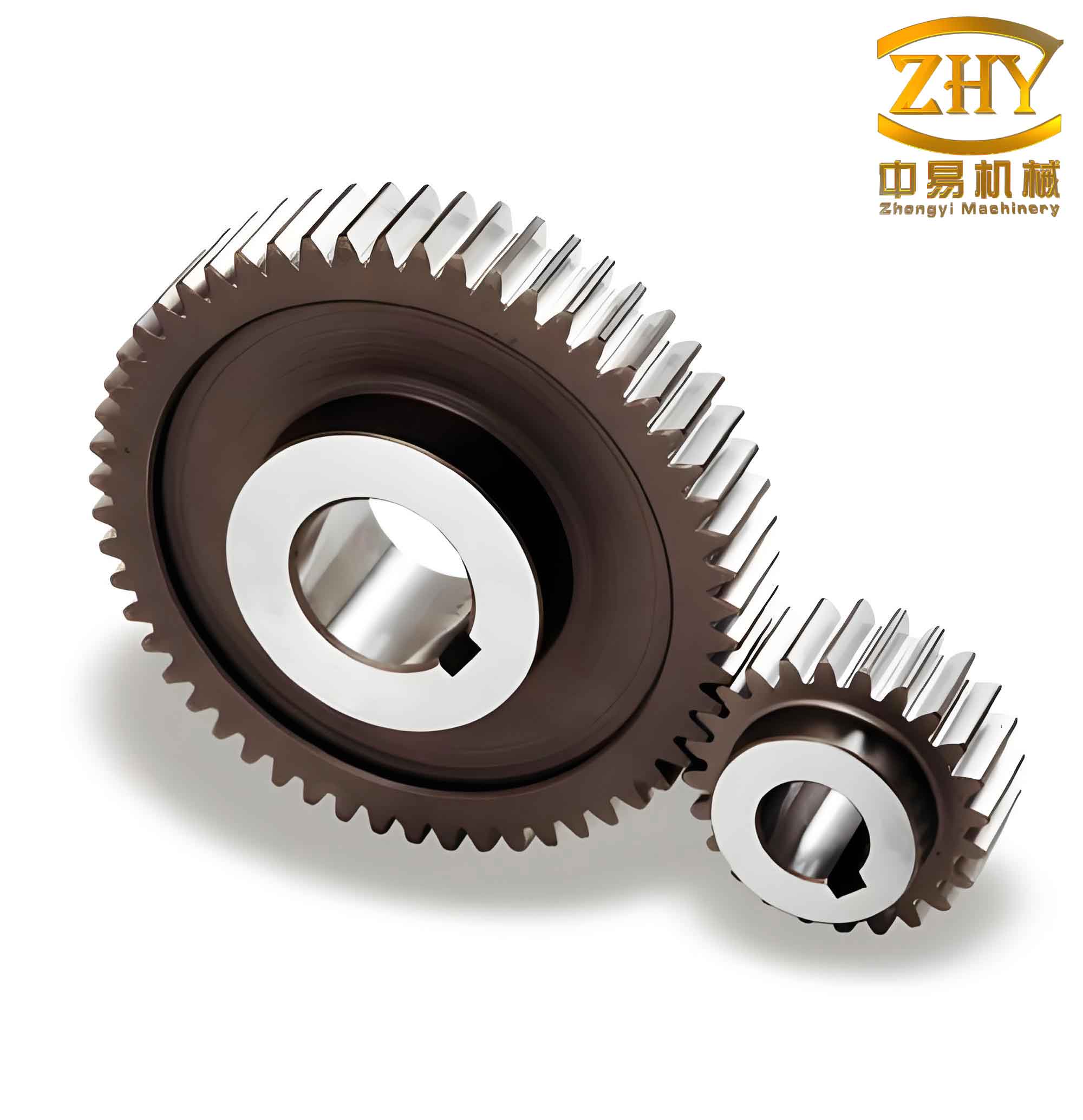
The image above illustrates a typical straight spur gear produced by warm extrusion. In the simulation, however, the geometry often deviates from this ideal shape due to the defects discussed below.
1. File Format Conversion Defects
The first class of defects arises when transferring geometry from the CAD environment (Pro/E, using PRT format) to the simulation environment (DEFORM, which accepts STL format). The STL (stereolithography) file represents the surface of a 3D model as a collection of triangular facets. Although widely used, this representation inherently introduces approximations. Three specific anomalous phenomena were observed in the simulation of straight spur gears:
- Top flash (burr) formation: A thin ring of material appears at the top of the unformed billet, resembling a flash that would occur in actual extrusion when a clearance exists between the punch and container. In the ideal model, no such clearance exists, yet the simulation produces it.
- Tooth tip oversize: The outer diameter of the gear teeth at the bottom of the formed part is slightly larger than the original billet diameter. Since the billet diameter equals the tooth tip diameter in the CAD model, the formed part should not exceed this dimension.
- Billet-container gap: At the start of the simulation, a significant portion (about 50%) of the billet surface does not contact the container wall, even though the billet and container have identical diameters.
All three defects are artifacts of the STL representation. When a cylindrical surface is approximated by planar triangular facets, the cylinder becomes a faceted polygon. The punch, billet, and container surfaces are all affected. Consequently, local gaps appear between the punch and container (leading to flash), the container wall is no longer perfectly cylindrical (leading to uneven contact), and the die cavity has truncated tooth tips (causing oversize teeth). The following table summarizes these defects, their manifestations, and the root cause.
| Defect | Observed Phenomenon | Root Cause | Impact on Simulation Accuracy |
|---|---|---|---|
| Top flash | Thin ear-like protrusion at the top of the billet | Polygonal approximation of punch and container creates local gaps | Overestimates material flow into clearance; false stress concentration |
| Tooth tip oversize | Formed gear tip diameter exceeds original billet diameter | STL facets truncate die cavity apex, allowing metal to expand | Underestimates die filling; inaccurate final geometry |
| Billet-container gap | Billet only partially contacts container wall in first step | Both billet and container are approximated by faceted surfaces with mismatched normals | Delays contact initiation; alters friction and material flow patterns |
The mathematical basis for these errors lies in the STL representation error. For a cylinder of radius \(R\) approximated by \(N\) triangular facets around its circumference, the maximum radial deviation \(\delta_r\) from the true cylinder is:
$$
\delta_r = R \left(1 – \cos\frac{\pi}{N}\right) \approx \frac{R\pi^2}{2N^2} \quad \text{for large } N.
$$
If the original CAD model has \(N\) facets generated during export, the effective radius of the container or punch varies by \(\pm \delta_r\). Consequently, even though the nominal diameters are equal, local gaps of up to \(2\delta_r\) can appear. For a typical export setting with \(N=36\), the radial error is about 0.38% of \(R\). While seemingly small, this error is amplified in the extrusion simulation because the contact algorithm detects gaps and allows material to extrude into them, producing the top flash. Similarly, the die cavity’s tooth tip geometry (which has sharp corners) is particularly sensitive to facet approximation; the STL file flattens the tip, effectively creating a larger cavity volume.
2. Finite Element Mesh Induced Defects
The second category of defects originates from the discretization of the workpiece into finite elements. Even if the STL geometry were perfect, the simulation would still produce a surface that is not perfectly smooth. As shown in the simulation results of straight spur gears, the tooth flanks exhibit small protrusions and undulations that are not present in the actual forming process. These are not surface roughness in the physical sense but are rather artifacts of the mesh.
During the remeshing and deformation steps, the material flow is computed at integration points and interpolated across element faces. Each element can deform independently, leading to a faceted appearance of the gear profile. The severity depends on the mesh size. The following table details the mesh-related defect and its characteristics.
| Defect | Observed Phenomenon | Root Cause | Impact |
|---|---|---|---|
| Surface waviness | Small bumps and depressions on gear tooth flanks | Element faces cannot represent a continuously curved surface; node displacements create facets | Affects stress concentration prediction; misleading for surface integrity analysis |
| Edge rounding | Sharp corners of gear teeth become rounded in simulation | Elements near corners experience excessive distortion; remeshing averages positions | Underestimates die corner filling; requires careful mesh refinement |
The magnitude of the surface error is related to the characteristic element size \(h\). For linear tetrahedral elements, the maximum geometric deviation from a smooth curve of curvature radius \(\rho\) is approximately:
$$
\epsilon_{\text{mesh}} \approx \frac{h^2}{8\rho}.
$$
If we apply this to the tooth profile of a straight spur gear with a typical root radius \(\rho = 0.5\,\text{mm}\) and an element size \(h = 0.2\,\text{mm}\), the deviation is about \(0.01\,\text{mm}\). While small, such deviations accumulate over many elements and become visible when magnified. More importantly, the stress field computed on such a faceted surface can have local peaks that are purely numerical.
3. Quantitative Analysis of Errors
To better understand the combined effect of STL conversion and mesh discretization, we can formulate an overall geometric error. Let \(\Delta_{\text{STL}}\) be the maximum radial error from the STL approximation (as given above) and \(\Delta_{\text{mesh}}\) be the maximum surface deviation from the finite element mesh. Assuming they are independent, the total deviation from the ideal geometry is:
$$
\Delta_{\text{total}} = \sqrt{\Delta_{\text{STL}}^2 + \Delta_{\text{mesh}}^2}.
$$
For a typical simulation of a straight spur gear with module \(m=2\,\text{mm}\), 20 teeth, and billet diameter \(40\,\text{mm}\), using 40 facets per circumference (N=40) and element size \(h=0.15\,\text{mm}\), we obtain:
$$
\Delta_{\text{STL}} \approx 40\left(1-\cos\frac{\pi}{40}\right) \approx 40 \times 0.00308 = 0.123\,\text{mm},
$$
$$
\Delta_{\text{mesh}} \approx \frac{0.15^2}{8 \times 0.5} = 0.0056\,\text{mm}.
$$
Hence, the dominant error is from the STL conversion. This explains why the top flash and tooth tip oversize are much more pronounced than the mesh-induced waviness.
Furthermore, the simulation time is heavily influenced by the number of elements. The computational cost scales as \(O(N_{\text{elem}}^\alpha)\) with \(\alpha \approx 1.5\) to 2 for typical solvers. Let \(N_{\text{elem}}\) be the element count, which for a fixed volume is inversely proportional to \(h^3\). Therefore, reducing \(h\) by a factor of 2 increases computation by a factor of \(2^{3\alpha} \approx 8\) to 16. This trade-off must be carefully managed.
4. Solutions and Mitigation Strategies
The two categories of defects require different approaches. For STL-induced errors, the most effective solution is to repair the STL file using specialized software such as Magics STL Fix or netfabb. These tools can:
- Detect and fill gaps in the triangular mesh.
- Adjust facet normals to ensure a closed manifold.
- Reduce faceting error by increasing the number of triangles or using adaptive tessellation.
Additionally, one can export the CAD model with a higher resolution setting (e.g., increasing the chord height tolerance) to reduce \(\Delta_{\text{STL}}\). For the example above, using \(N=100\) facets would reduce \(\Delta_{\text{STL}}\) to about \(0.02\,\text{mm}\), effectively eliminating the flash and tip oversize.
For mesh-induced surface waviness, complete elimination is impossible because the finite element method inherently works with discrete representations. However, the defect can be reduced by:
- Refining the mesh in regions of high curvature (e.g., tooth root and tip). Adaptive remeshing during the simulation can control element size locally.
- Using higher-order elements (e.g., quadratic tetrahedra) which better approximate curved surfaces.
- Applying a post-processing smoothing algorithm to the final geometry, although this may alter the stress field.
The following table summarizes the solutions and their effectiveness for straight spur gears.
| Defect Type | Recommended Solution | Anticipated Improvement | Trade-off |
|---|---|---|---|
| STL conversion (flash, gap, tip oversize) | Increase export resolution; use STL repair tool | Δ_STL reduced by factor 10 or more; defects become negligible | Larger STL file; slightly longer import time |
| Mesh discretization (surface waviness) | Adaptive mesh refinement at gear profile; use quadratic elements | Surface deviation reduced by factor 2–5 | Computation time increases significantly (up to 10×) |
In practice, a combination of both strategies is often employed. For the simulation of straight spur gears with warm extrusion, I recommend first optimizing the STL export to achieve a chord height error below 0.01 mm. Then, use a mesh size that is fine enough to capture the tooth root radius (e.g., 4–6 elements across the root fillet). Monitoring the simulation results for any remaining artifacts and performing a mesh convergence study is essential to ensure that the observed trends are physical, not numerical.
5. Validating the Simulation Against Physical Experiments
To confirm that the proposed solutions are effective, one should compare the simulated geometry of a straight spur gear with an actual extruded part. A typical metric is the maximum deviation between the simulated tooth profile and the measured profile. Let \(r(\theta)\) be the radial coordinate from the gear axis at angle \(\theta\) in the simulation, and \(r_{\text{exp}}(\theta)\) the measured value. The root-mean-square error (RMSE) is:
$$
\text{RMSE} = \sqrt{\frac{1}{2\pi} \int_0^{2\pi} \left( r(\theta) – r_{\text{exp}}(\theta) \right)^2 d\theta}.
$$
In the absence of physical data, we can perform a mesh convergence study. For a sequence of mesh sizes \(h_1, h_2, \dots, h_k\), the simulated tooth tip diameter \(D_{\text{tip}}(h)\) should converge to a limit value \(D_{\text{tip}}^*\). The error due to mesh can be estimated as:
$$
E_{\text{mesh}}(h) \approx C h^p,
$$
where \(p\) is the convergence rate (usually 1–2 for linear elements). By plotting \(D_{\text{tip}}(h)\) versus \(h^p\), we can extrapolate to \(h=0\) and quantify the mesh-induced error. Similarly, repeating the simulation with different STL resolutions allows us to separate the STL error.
6. Concluding Remarks
Numerical simulation of warm extrusion for straight spur gears is a powerful tool, but users must be aware of systematic defects that arise from the numerical representation of geometry and the discretization of the continuum. The file format conversion (PRT to STL) introduces faceting errors that can cause top flash, tooth tip oversize, and unrealistic gaps between billet and container. The finite element mesh, even after perfect geometry transfer, inevitably produces a faceted surface that deviates from the smooth gear profile. Both types of defects can be mitigated: STL errors are effectively eliminated by increasing export resolution and using repair tools; mesh errors are reduced by adaptive refinement and higher-order elements, albeit at a computational cost. By understanding these defects and applying the appropriate countermeasures, researchers and engineers can obtain reliable simulation results that faithfully represent the forming behavior of straight spur gears.
Future work should focus on developing seamless integration between CAD and simulation that avoids intermediate faceted formats, perhaps by using direct geometry transfer (e.g., Parasolid or STEP with tolerance-driven meshing). Additionally, the development of mesh-free methods may eventually overcome the surface quality limitations inherent in Lagrangian finite element approaches. Until then, the practices outlined here provide a practical path to accurate and trustworthy simulations of straight spur gears and similar extrusions.