
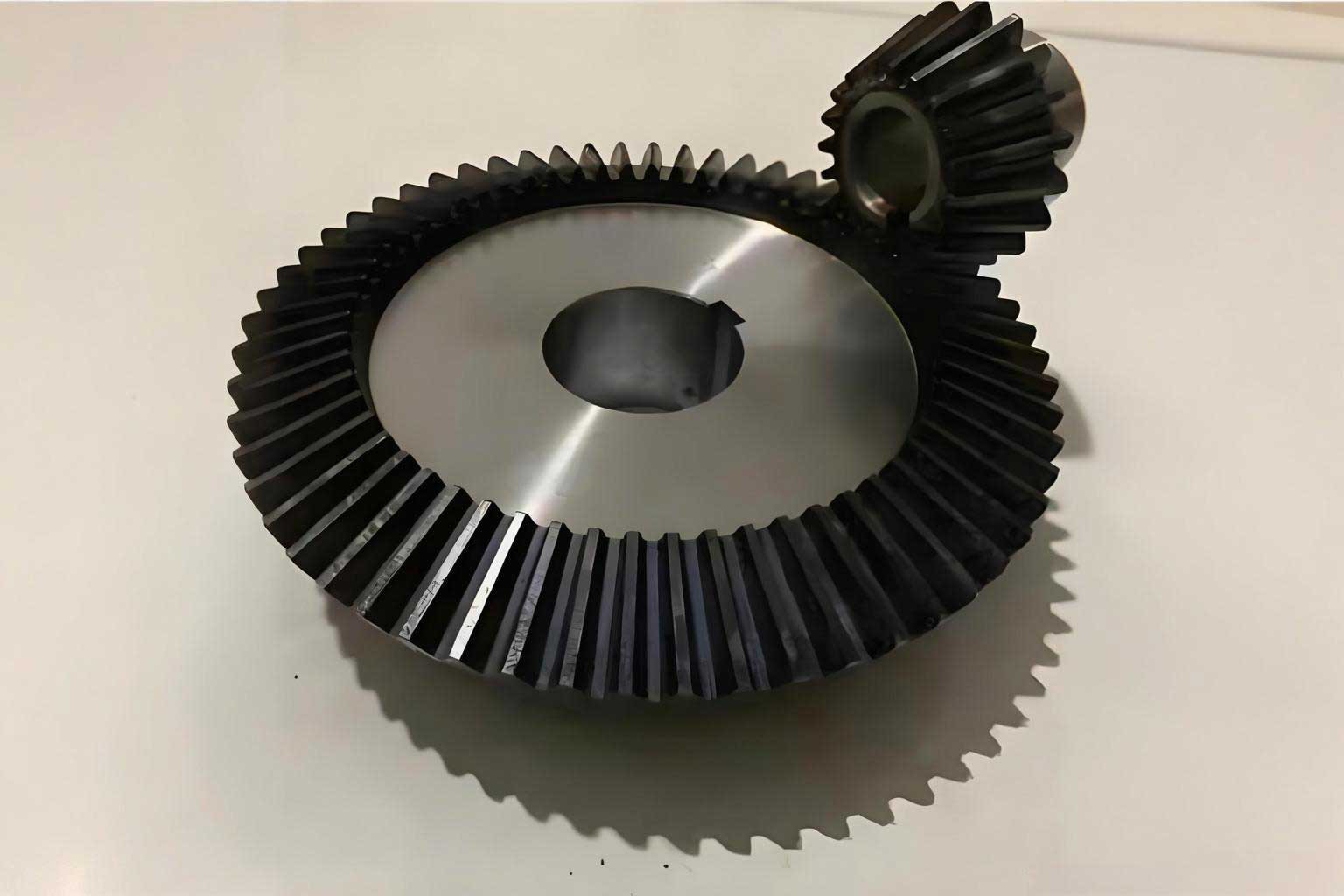
The design and analysis of miter gears, a specialized subset of bevel gears with a 1:1 ratio operating on perpendicular intersecting axes, traditionally rely on the well-established yet complex framework of conjugate action derived from a known generating surface. Conventional theory for straight bevel gears is predominantly centered on the spherical involute surface, which presents manufacturing challenges due to its theoretical nature, leading to approximations in practice. This paper introduces an alternative and streamlined methodology that fundamentally shifts the design paradigm for miter gears and straight bevel gears in general. Instead of commencing with a predefined tooth profile, we propose initiating the process with the specification of the tooth surface’s normal vector field. From this foundational element, we directly derive the complete ruled surface geometry and its critical performance characteristics for a pair of conjugate miter gear tooth flanks. This approach not only simplifies the synthesis process but also opens new avenues for the creative and performance-oriented design of miter gear systems, enabling the exploration of non-standard, high-performance tooth surfaces beyond the classical spherical involute.
Fundamental Theory: The Normal Vector Field
Our methodology is predicated on the principle that a ruled surface, which is generated by the motion of a straight line (the ruling), can be fully described by the trajectory of its unit normal vector. For a miter gear tooth surface, we consider a point \( M \) on the flank. The normal vector to the surface at \( M \) is denoted by \( \mathbf{l} \). Its magnitude, \( l = |\mathbf{l}| \), is defined as the length from the pitch point \( O_p \) to point \( M \), termed the “normal line length.” Its orientation is crucial.
We establish a local Cartesian coordinate system \( S_p (O_p; x_p, y_p, z_p) \) with its origin at the pitch point \( O_p \). The \( y_p \)-axis is tangent to the pitch circle, and the \( z_p \)-axis is parallel to the gear axis, as shown in the referenced figures. In this system, the direction of the unit normal vector \( \mathbf{n}^{(p)} \) is defined by two angles: \( \beta \) and \( \lambda \). The angle \( \beta \) is measured from the \( z_p \)-axis, and \( \lambda \) is the projection angle in the \( x_p-O_p-y_p \) plane. The components of the unit normal vector are therefore:
$$ \mathbf{n}^{(p)} = \begin{bmatrix} \sin\beta \cos\lambda \\ \cos\beta \\ -\sin\beta \sin\lambda \end{bmatrix} $$
Consequently, the normal vector itself is:
$$ \mathbf{l}^{(p)} = l \, \mathbf{n}^{(p)} = l \begin{bmatrix} \sin\beta \cos\lambda \\ \cos\beta \\ -\sin\beta \sin\lambda \end{bmatrix} $$
The fundamental hypothesis for a ruled surface suitable for a miter gear is that the orientation of the unit normal vector \( \mathbf{n} \) is independent of the axial position along the gear blank. This implies that the direction angles \( \beta \) and \( \lambda \) are functions only of an angular parameter \( v \) (related to the rotational position around the gear), and not of the axial coordinate \( u \). This condition, \( \partial \mathbf{n} / \partial u = 0 \), is the hallmark of a ruled surface and greatly simplifies the subsequent analysis.
Derivation of the Ruled Tooth Surface Equation
To obtain the global Cartesian coordinates of the tooth surface, we define a fixed coordinate system \( S (O; x, y, z) \) attached to the miter gear. The position vector \( \mathbf{R}(u, v) \) of any point \( M \) on the surface can be expressed as the sum of three vectors: the axial displacement \( \mathbf{u} \), the radial position vector \( \mathbf{r} \) to the pitch circle, and the normal vector \( \mathbf{l} \).
$$ \mathbf{R}(u, v) = \mathbf{u} + \mathbf{r} + \mathbf{l} $$
Where:
$$ \mathbf{u} = (0, 0, u)^T, \quad \mathbf{r} = (r \sin v, r \cos v, 0)^T $$
and \( r \) is the pitch radius. The normal vector in system \( S \) is obtained by a coordinate transformation from \( S_p \) to \( S \): \( \mathbf{l} = \mathbf{M}_{sp} \mathbf{l}^{(p)} \), where \( \mathbf{M}_{sp} \) is the rotation matrix:
$$ \mathbf{M}_{sp} = \begin{bmatrix} \sin v & -\cos v & 0 \\ \cos v & \sin v & 0 \\ 0 & 0 & 1 \end{bmatrix} $$
The unit normal vector in system \( S \) is \( \mathbf{n} = \mathbf{M}_{sp} \mathbf{n}^{(p)} \).
According to the theory of gearing and the condition for a surface to be the envelope of a family of curves (or for contact along a line), the partial derivatives of \( \mathbf{R} \) must be orthogonal to the normal vector:
$$ \frac{\partial \mathbf{R}}{\partial v} \cdot \mathbf{n} = 0 \quad \text{(1)} $$
$$ \frac{\partial \mathbf{R}}{\partial u} \cdot \mathbf{n} = 0 \quad \text{(2)} $$
Substituting the expressions for \( \mathbf{R} \) and \( \mathbf{n} \) into equation (1) yields the differential relation governing the variation of the normal length \( l \) with the angular parameter \( v \):
$$ \frac{dl}{dv} = r \cos \beta = u \tan \delta \cos \beta \quad \text{(3)} $$
where \( \delta \) is the pitch cone angle of the miter gear (typically 45° for a true miter gear, but we keep it general).
Substituting into equation (2) and applying the condition \( \partial \mathbf{n} / \partial u = 0 \) for a ruled surface gives a simple algebraic relation:
$$ \frac{dl}{du} = \frac{\sin \beta}{\cos \delta} \sin(\lambda – \delta) \quad \text{(4)} $$
Since the right-hand side of (4) is independent of \( u \) (as \( \beta \) and \( \lambda \) are functions of \( v \) only), integration with respect to \( u \) gives a linear relationship:
$$ l(u, v) = u \cdot \frac{\sin \beta}{\cos \delta} \sin(\lambda – \delta) \quad \text{(5)} $$
Simultaneously, equation (3) can be integrated with respect to \( v \), assuming an initial condition \( l(u, v_0) \):
$$ l(u, v) = u \tan \delta \int_{v_0}^{v} \cos \beta \, dv \quad \text{(6)} $$
For equations (5) and (6) to be consistent for all \( u \) and \( v \), their kernels must be equal. This leads to the fundamental design equation that links the directional angles \( \beta \) and \( \lambda \):
$$ \sin(\lambda – \delta) = \frac{\sin \delta}{\sin \beta} \int \cos \beta \, dv \quad \text{(7)} $$
This equation is the cornerstone of the method. The designer chooses a function for the angle \( \beta(v) \), which essentially dictates the “lean” of the normal vector. Equation (7) then determines the corresponding function \( \lambda(v) \) required to form a valid, conjugate ruled surface pair for a miter gear. Finally, the explicit tooth surface coordinates are given by:
$$ \mathbf{R}(u, v) = \begin{bmatrix} 0 \\ 0 \\ u \end{bmatrix} + \begin{bmatrix} r \sin v \\ r \cos v \\ 0 \end{bmatrix} + l(u, v) \, \mathbf{M}_{sp} \begin{bmatrix} \sin\beta \cos\lambda \\ \cos\beta \\ -\sin\beta \sin\lambda \end{bmatrix} \quad \text{(8)} $$
In this parameterization, \( u \) curves (v constant) are straight lines—the rulings or generators of the surface. These lines also represent the instantaneous lines of contact between the mating miter gear flanks. The \( v \) curves (u constant) represent the contact path trajectories on a specific flank.
Geometric Properties Derived from the Normal Vector
A significant advantage of this normal-vector-based approach is the direct computation of crucial geometric properties without needing the explicit surface point cloud first.
Principal Curvatures and Singularities
For a ruled surface, one of the principal directions is along the ruling (the \( u \)-curve). The curvature along this direction, \( k_2 \), is zero:
$$ k_2 = 0 $$
The other principal curvature, \( k_1 \), lies in the direction perpendicular to the ruling (along the \( v \)-curve). Its magnitude can be derived from the fundamental forms of the surface. The first fundamental form coefficients \( E, F, G \) and the second fundamental form coefficient \( L \) are calculated from derivatives of \( \mathbf{R}(u,v) \). Notably, for our ruled surface, \( M = N = 0 \). The non-zero principal curvature is then:
$$ k_1 = \frac{G L}{E G – F^2} \quad \text{(9)} $$
Where:
$$ E = \frac{\partial \mathbf{R}}{\partial v} \cdot \frac{\partial \mathbf{R}}{\partial v}, \quad F = \frac{\partial \mathbf{R}}{\partial u} \cdot \frac{\partial \mathbf{R}}{\partial v}, \quad G = \frac{\partial \mathbf{R}}{\partial u} \cdot \frac{\partial \mathbf{R}}{\partial u}, \quad L = -\frac{\partial \mathbf{R}}{\partial v} \cdot \frac{\partial \mathbf{n}}{\partial v} $$
A critical manufacturing and performance constraint is the avoidance of singularities (undercut or tips) on the active flank. A singularity occurs when the surface normal is undefined, which corresponds to the condition where the first fundamental form becomes degenerate:
$$ E G – F^2 = 0 \quad \text{(10)} $$
Equation (10), expressed in terms of \( \beta(v) \), \( \lambda(v) \), and their derivatives, provides the criterion to check for potential undercut in a proposed miter gear design.
Sliding Velocity and Slip Coefficients
The wear characteristics of a gear pair are largely governed by the sliding between contacting flanks. The specific sliding coefficients \( \sigma_1 \) and \( \sigma_2 \) for gear 1 and gear 2, respectively, are vital indicators. They are defined as:
$$ \sigma_1 = \frac{ |\mathbf{V}_r| }{ |\mathbf{v}_1| } \quad \text{(11)} $$
$$ \sigma_2 = \frac{ \sigma_1 }{ \sigma_1 – 1 } \quad \text{(12)} $$
where \( \mathbf{V}_r \) is the relative sliding velocity vector at the contact point, and \( \mathbf{v}_1 \) is the velocity of the contact point over the surface of gear 1.
Using our vector framework in the \( S_p \) coordinate system, these velocities can be derived directly from the normal vector parameters. The velocity of the contact point on gear 1 is:
$$ \mathbf{v}_1^{(p)} = \omega_1 \left( \frac{dl}{dv} \mathbf{n}^{(p)} + l \frac{d\mathbf{n}^{(p)}}{dv} \right) + \left( \mathbf{r}^{(p)} + \mathbf{l}^{(p)} \right) \times \boldsymbol{\omega}_1^{(p)} \quad \text{(13)} $$
The relative sliding velocity is:
$$ \mathbf{V}_r^{(p)} = \left( \boldsymbol{\omega}_1^{(p)} – \boldsymbol{\omega}_2^{(p)} \right) \times \mathbf{l}^{(p)} \quad \text{(14)} $$
Here, \( \boldsymbol{\omega}_1^{(p)} = (0, 0, \omega_1)^T \) and \( \boldsymbol{\omega}_2^{(p)} = (-\omega_2, 0, 0)^T \) are the angular velocity vectors of the two miter gears in the pitch coordinate system, with \( \omega_1 = \omega_2 \) for a 1:1 ratio. Substituting the expressions for \( l \), \( \mathbf{n}^{(p)} \), and their derivatives from equations (3), (5), and (7) into (13) and (14) allows for the direct calculation of \( \sigma_1 \) and \( \sigma_2 \) for any chosen \( \beta(v) \) function. This enables pre-screening of different miter gear tooth surface designs for their friction and wear performance.
The condition \( \mathbf{v}_1 = 0 \) defines the limit line of contact, beyond which conjugate action is not possible (leading to undercut if the flank extends there). Setting equation (13) to zero provides the equation for this limit curve on the tooth flank of the miter gear.
Design Examples and Comparative Analysis
To illustrate the power and flexibility of this method, we apply it to generate and analyze several miter gear designs. For consistency, we use a common base set of parameters: pressure angle \( \alpha_0 = 20^\circ \), pitch cone angle \( \delta = 45^\circ \), number of teeth \( z = 18 \), and a reference axial position \( u_0 \). The key variable is the designer’s choice of the normal vector angle function \( \beta(v) \).
| Parameter | Symbol | Value |
|---|---|---|
| Pitch Cone Angle | $$ \delta $$ | $$ 45^\circ $$ |
| Number of Teeth | $$ z $$ | 18 |
| Reference Module (implied) | – | Based on pitch radius |
| Pressure Angle (for spherical involute reference) | $$ \alpha_0 $$ | $$ 20^\circ $$ |
Example 1: The Classical Spherical Involute Miter Gear
The spherical involute surface, the standard for straight bevel and miter gears, can be elegantly derived as a special case of our method. For a spherical involute, the normal vector length \( l \) is related to the base cone angle \( \delta_b \) (\(\sin \delta_b = \cos \alpha_0 \sin \delta\)). It can be shown that:
$$ l(u, v) = u \frac{\cos \delta}{\cos \delta_b} \sin(v \sin \delta_b) \quad \text{(15)} $$
Comparing this with equations (5) and (6) allows us to back-solve for the corresponding \( \beta(v) \) function:
$$ \cos \beta(v) = \frac{\sin \delta_b}{\sin \delta} \cos(v \sin \delta_b) \quad \text{(16)} $$
$$ \sin(\lambda(v) – \delta) = \frac{\sin(v \sin \delta_b)}{\sin \beta(v)} $$
This verifies that the spherical involute is indeed a ruled surface conforming to our general theory. The principal curvature and specific sliding for this benchmark case can be calculated from the formulas in sections 2.2 and 2.3.
Example 2: Constant Normal Angle Miter Gear
We explore a novel design by choosing the simplest non-standard function: a constant normal angle. Let \( \beta(v) = \beta_0 \), where \( \beta_0 \) is a constant (e.g., \( 20^\circ \)). From equation (7), we solve for \( \lambda(v) \):
$$ \sin(\lambda(v) – \delta) = \frac{\sin \delta}{\sin \beta_0} \int \cos \beta_0 \, dv = \frac{\sin \delta \, \cos \beta_0}{\sin \beta_0} (v – v_0) $$
Thus, \( \lambda(v) = \delta + \arcsin\left( C (v – v_0) \right) \), where \( C = (\sin \delta \cos \beta_0)/\sin \beta_0 \). This generates a new family of ruled surfaces for a miter gear. The surface equation is obtained by plugging \( \beta_0 \) and this \( \lambda(v) \) into equation (8).
Example 3: Linear Normal Angle Miter Gear
A more general design uses a linearly varying normal angle: \( \beta(v) = \beta_0 + c v \), where \( c \) is a small constant slope. The integral in equation (7) becomes \( \int \cos(\beta_0 + c v) dv = (1/c) \sin(\beta_0 + c v) \). This yields:
$$ \sin(\lambda(v) – \delta) = \frac{\sin \delta}{c \sin(\beta_0 + c v)} \sin(\beta_0 + c v) = \frac{\sin \delta}{c} $$
For a constant right-hand side to be valid, \( c \) must be chosen as \( c = \sin \delta / \sin(\lambda_0 – \delta) \), making \( \lambda \) constant as well. This shows an interesting subclass where both \( \beta \) varies linearly and \( \lambda \) is constant, defining another viable miter gear tooth surface.
| Design Type | Normal Angle Function $$ \beta(v) $$ | Key Characteristic | Principal Curvature $$ k_1 $$ (Qualitative) | Specific Sliding $$ \sigma_1 $$ (Qualitative) |
|---|---|---|---|---|
| Spherical Involute (Standard) | $$ \beta(v) = \arccos\left[ \frac{\sin \delta_b}{\sin \delta} \cos(v \sin \delta_b) \right] $$ | Conjugate to itself, standard geometry. | Variable, higher near the base. | Moderate, varies along flank. |
| Constant-Angle Design | $$ \beta(v) = \beta_0 $$ (constant) | Simplest novel form, normal lean is fixed. | Can be lower and more uniform than involute. | Often lower than involute, improving wear resistance. |
| Linear-Angle Design | $$ \beta(v) = \beta_0 + c v $$ | Provides controlled modification of pressure distribution. | Adjustable via slope \( c \). | Can be optimized for minimum sliding in load zone. |
The table above provides a qualitative comparison. Quantitative analysis requires computing equations (9), (13), and (14) for each specific design. A key finding is that by deviating from the spherical involute’s \( \beta(v) \) function, we can generate miter gear tooth surfaces that exhibit more favorable pressure distributions and, crucially, lower specific sliding coefficients \( \sigma_1 \). Lower sliding implies reduced friction and wear, potentially leading to higher efficiency and longer service life for the miter gear drive. Furthermore, the condition for singularity (undercut) from equation (10) must be evaluated for each novel design to define the feasible boundaries of the tooth flank.
Conclusion and Implications for Miter Gear Technology
This paper has established a comprehensive and innovative framework for the synthesis and analysis of straight bevel and miter gear tooth surfaces based on the preliminary specification of the normal vector field. The methodology pivots away from the traditional sequence of operations in gear theory, offering a more direct and intuitive path from design intent to final geometry.
The core contributions are threefold. First, we derived the fundamental governing equation (7) that links the directional angles of the normal vector to form a valid, conjugate ruled surface pair for a miter gear. Second, we demonstrated that critical performance metrics—principal curvatures, conditions for undercut, and specific sliding coefficients—can be derived directly from the normal vector parameters without first generating the explicit 3D surface model. This allows for rapid computational screening and optimization of potential miter gear designs. Third, we illustrated the method’s versatility by generating both the classical spherical involute and novel non-standard tooth forms, showing that the latter can potentially offer improved tribological performance.
The implications for miter gear design and manufacturing are significant. This approach facilitates true performance-driven design, where the tooth surface is tailored to minimize sliding, optimize contact pressure distribution, or meet other specific functional requirements. The ruled surface nature of the generated flanks is inherently compatible with modern manufacturing techniques, such as 4-axis and 5-axis CNC machining with end mills or grinding wheels that move along straight lines. While dedicated gear generators (e.g., face mills) would require recalculation of tool geometry based on the new surface equations, the method provides the precise mathematical foundation to do so.
In summary, the normal-vector-based methodology presented here provides a powerful, simplified, and flexible new paradigm for the creative and analytical design of miter gears. It breaks free from the constraint of the spherical involute, opening a broad design space for high-performance, customized gear solutions in advanced mechanical systems.