
In gear transmission systems, straight spur gears are widely used owing to their simplicity and efficiency. One critical parameter that governs the performance of such systems is the backlash—the clearance between mating tooth flanks. Backlash is essential not only to accommodate lubricant and form a stable oil film, but also to compensate for manufacturing errors, assembly misalignments, elastic deformations under load, and thermal expansions. Extensive research indicates that backlash significantly influences noise, vibration, and load distribution in gear drives. Therefore, a rational design of backlash is indispensable for ensuring smooth and reliable transmission. In this paper, I systematically investigate the factors affecting backlash in straight spur gears, present computational methods, and provide quantitative analyses using tables and formulas derived from my practical experience and theoretical studies.
The fundamental definitions of the variables used throughout this paper are as follows: $\Delta t_1$ and $\Delta t_2$ represent the differences between the operating temperature and the standard temperature for the gearbox housing and the gear, respectively; $\alpha_1$ and $\alpha_2$ are the linear expansion coefficients of the housing and the gear material; $\alpha_n$ denotes the normal pressure angle of the gear; $a$ is the center distance of the gear pair; $f_{pt1}$ and $f_{pt2}$ are the individual pitch deviations of the pinion and the gear; and $F_\beta$ is the helix deviation (for straight spur gears, essentially the tooth trace deviation). Additional symbols such as $j_{bn,\min}$, $E_{sns}$, $f_a$, and $J_n$ will be introduced when necessary.
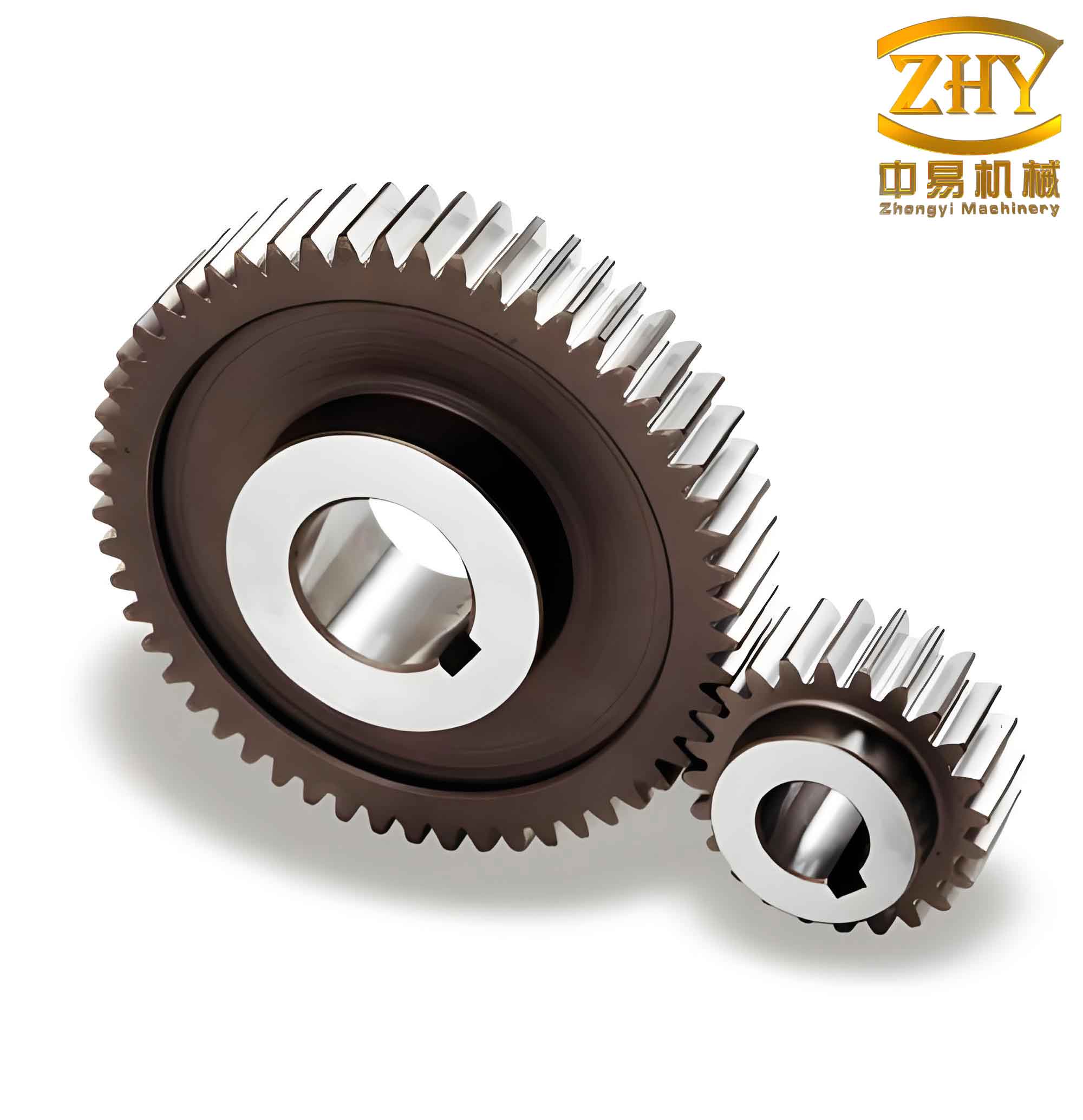
1. Design Methods for Backlash of Straight Spur Gears
Backlash is generally characterized by its minimum and maximum values. In the design of straight spur gears, three common approaches are employed to determine the appropriate backlash:
1.1 Empirical Method
This method relies on existing successful gear transmission prototypes. The designer compares the intended application with a reference gear set in terms of transmitted load, operating environment, assembly structure, and lubrication type. Adjustments are made to the reference backlash based on engineering judgment. While straightforward, this method demands substantial experience and a comprehensive library of mature examples.
1.2 Computational Method
The computational method derives backlash values using theoretical formulas. These formulas are based on kinematic and geometric relationships and account for the major influencing factors. However, simplifications and idealizations are often introduced during derivation, which may reduce the accuracy for specific real‑world applications. Consequently, this method is more suitable for comparative analyses and preliminary design stages.
1.3 Look‑Up Table Method
This method uses standardized tables (e.g., those provided in GB/Z 18620.2‑2008) that list recommended backlash values for various operating conditions such as pitch‑line velocity, temperature, load, and lubrication. The tables are derived from extensive practical experience and are considered highly reliable. This approach is essentially a variant of the empirical method and is often preferred due to its simplicity. Nevertheless, the designer must still adjust the tabulated values to match the specific characteristics of the gear set.
In my practice, I prioritize the look‑up table method supplemented by computational verification, especially for straight spur gears with demanding requirements.
2. Factors Influencing Backlash of Straight Spur Gears
Any factor that alters the effective center distance or the tooth thickness of the meshing gears will affect the backlash. For straight spur gears made of common ferrous materials, the primary factors are summarized in Table 1. I present these factors along with their mechanisms and typical calculation methods.
| No. | Factor | Influence Mechanism | Calculation Method |
|---|---|---|---|
| 1 | Temperature effect | Differences in operating temperature and expansion coefficients between gearbox housing and gears cause the tooth flanks to approach or separate, thereby altering backlash. Significant temperature differences can induce substantial clearance changes. | $$j_{bn,\min,2} = a \cdot (\Delta t_1 \alpha_1 – \Delta t_2 \alpha_2) \cdot 2\sin\alpha_n$$ |
| 2 | Center distance deviation | Variations in the actual center distance directly change the distance between mating teeth, increasing or decreasing backlash. | $$f_a = 2\sin\alpha_n \quad \text{(affects backlash by } \pm f_a \sin\alpha_n\text{)}$$ |
| 3 | Parallelism error of gear axes | Misalignment of the two gear axes (including contributions from shaft, bearing, and gear runout) introduces random variations in effective meshing geometry. | Incorporated into the combined error term $J_n$ (see below). |
| 4 | Manufacturing errors of gears | Pitch deviation, profile error, helix deviation (tooth trace error), and radial runout all affect the instantaneous tooth thickness and meshing geometry. Their effects are stochastic in nature. | Combined through the root‑sum‑square (probabilistic) formula: $$J_n = \sqrt{(f_{pt1}\cos\alpha_n)^2 + (f_{pt2}\cos\alpha_n)^2 + 2.104\,F_\beta^2}$$ |
| 5 | Clearance fits between shaft and gear bore, and between shaft and bearings | These clearances alter the effective center distance in a random manner. In typical precision applications, the clearance is small and its influence is often negligible. | If significant, treat as additional center distance variation using the same formula as factor 2. |
| 6 | Elastic deformation under load | Load‑induced bending and contact deformations change the tooth separation. For fixed‑axis drives the deformation direction is relatively fixed. | Usually negligible for moderate loads; otherwise, incorporate as an effective center distance shift. |
Among these factors, temperature, center distance deviation, and manufacturing errors are the most dominant. In the following sections, I provide a deeper quantitative analysis for straight spur gears.
3. Quantitative Influence of Center Distance Deviation $f_a$ and Combined Manufacturing Error $J_n$
3.1 Effect of $f_a$ on Backlash
The center distance tolerance is specified according to standard tolerance systems (e.g., GB/T 1800.1) and is directly linked to the gear precision grade. Higher accuracy grades result in tighter center distance tolerances. Table 2 presents the ratio $2 f_a \tan\alpha_n \,/\, j_{bn,\min1}$ for various gear accuracy grades and module sizes, where $j_{bn,\min1}$ is the basic minimum backlash recommended by GB/Z 18620.2‑2008 (primarily to ensure oil film formation). I have calculated these values using typical center distances of 50 mm, 100 mm, 200 mm, 400 mm, and 800 mm for straight spur gears with normal pressure angle $\alpha_n = 20^\circ$.
| Accuracy Grade | Module $m_n$ (mm) | Center distance $a$ (mm) | ||||
|---|---|---|---|---|---|---|
| 50 | 100 | 200 | 400 | 800 | ||
| 1–2 | 2 | 2.5 | 3 | 3.4 | 3.1 | — |
| 1–2 | 4 | — | 2 | 2.4 | 2.3 | 1.9 |
| 1–2 | 8 | — | — | 1.5 | 1.5 | — |
| 3–4 | 2 | 5.8 | 6.7 | 7.3 | 6.2 | 4.6 |
| 3–4 | 4 | — | 4.4 | 5.2 | 4.6 | 3.8 |
| 3–4 | 8 | — | — | 3.1 | 3.1 | — |
| 5–6 | 2 | 9 | 11 | 11.3 | 10 | 7.4 |
| 5–6 | 4 | — | 7.2 | 8.1 | 7.5 | 6.1 |
| 5–6 | 8 | — | — | 4.8 | 5 | — |
| 7–8 | 2 | 14 | 17 | 17 | 15 | 11.5 |
| 7–8 | 4 | — | 11 | 12 | 11.4 | 9.6 |
| 7–8 | 8 | — | — | 7.4 | 7.6 | — |
| 9–10 | 2 | 22 | 27 | 28 | 24 | 30 |
| 9–10 | 4 | — | 18 | 20 | 18 | 27 |
| 9–10 | 8 | — | — | 12 | 12 | — |
The data clearly show that the influence of center distance deviation on backlash increases with lower accuracy grades and decreases with larger modules. For high‑precision straight spur gears (grades 1–6), the contribution of $f_a$ is generally below 10%, whereas for low‑precision gears (grades 9–10) it can exceed 25%. Moreover, for a given accuracy and module, the ratio remains relatively stable across different center distances, indicating that the center distance deviation effect is primarily a function of tolerance grade and tooth size.
3.2 Effect of $J_n$ on Backlash
The combined error $J_n$ incorporates the stochastic effects of pitch deviations, profile deviations, helix deviations, and axis parallelism errors. Table 3 shows the ratio $J_n / j_{bn,\min1}$ for straight spur gears under the same accuracy grades and geometric parameters. The calculations assume typical values for $f_{pt}$, $F_\beta$, etc., according to the respective tolerance standards.
| Accuracy Grade | Module $m_n$ (mm) | Center distance $a$ (mm) | ||||
|---|---|---|---|---|---|---|
| 50 | 100 | 200 | 400 | 800 | ||
| 2 | 2 | 5.5 | 4.6 | 4.0 | 2.8 | 3.3 |
| 2 | 4 | — | 3.2 | 2.9 | 2.2 | 2.8 |
| 2 | 8 | — | — | 1.8 | 1.5 | — |
| 4 | 2 | 10.5 | 9.4 | 8.0 | 5.7 | 6.7 |
| 4 | 4 | — | 6.6 | 6.0 | 4.5 | 5.7 |
| 4 | 8 | — | — | 3.7 | 3.1 | — |
| 6 | 2 | 21 | 18.7 | 16 | 11.7 | 14 |
| 6 | 4 | — | 13 | 12 | 9.0 | 12 |
| 6 | 8 | — | — | 7.4 | 6.2 | — |
| 8 | 2 | 43 | 37.5 | 31.7 | 22.7 | 27.5 |
| 8 | 4 | — | 26 | 23.4 | 17.8 | 23.6 |
| 8 | 8 | — | — | 15 | 12.3 | — |
| 10 | 2 | 86 | 75 | 63 | 45.5 | — |
| 10 | 4 | — | 52 | 47 | 35.5 | — |
| 10 | 8 | — | — | 29 | 25 | — |
Comparing Table 3 with Table 2, it is evident that $J_n$ exerts a considerably stronger influence on backlash than $f_a$, especially for low‑precision gears. For example, at accuracy grade 8 with $m_n=2$ mm and $a=200$ mm, $J_n$ accounts for 31.7% of the basic backlash, whereas $f_a$ contributes only 17%. This indicates that manufacturing errors are the dominant source of backlash variation. For high‑precision gears (grades 2–4), both factors become relatively small, and in such cases the backlash can be approximated by the simplified formula:
$$j_{bn,\min} = |E_{sns1} + E_{sns2}| \cos\alpha_n$$
This simplification is particularly useful when the gear pair is manufactured to tight tolerances, as the contributions from $f_a$ and $J_n$ are negligible compared to the deliberately provided tooth thickness reduction.
4. Determinination of Tooth Thickness Deviations for Straight Spur Gears
In the Chinese standard practice (base center distance system), backlash is achieved by reducing the tooth thickness from the nominal value while keeping the center distance fixed. The minimum backlash is related to the upper deviations of tooth thickness $E_{sns1}$ and $E_{sns2}$ (for pinion and gear) as follows:
$$j_{bn,\min} = |E_{sns1} + E_{sns2}| \cos\alpha_n – f_a \sin\alpha_n – J_n$$
Here, $j_{bn,\min1}$ (the recommended minimum from standards) and $j_{bn,\min2}$ (the temperature compensation term) together determine the total $j_{bn,\min}$. In practice, the designer selects $E_{sns1}$ and $E_{sns2}$ to satisfy the above equation. Three allocation strategies are commonly used:
- Equal allocation: $E_{sns1} = E_{sns2}$. This simplifies calculation but does not consider the different fatigue lives of the pinion and gear. Since the pinion experiences more load cycles, it may be beneficial to give it a larger tooth thickness (i.e., a less negative deviation) to enhance its strength.
- Proportional allocation: $E_{sns1} : E_{sns2} = Z_1 : Z_2$ (where $Z_1$ and $Z_2$ are the numbers of teeth). This approach aims to equalize the tooth strength by providing more material to the smaller gear.
- Zero deviation for the pinion: Set $E_{sns1}=0$, and assign the entire necessary reduction to the gear: $E_{sns2} = – (j_{bn,\min} + f_a \sin\alpha_n + J_n)/\cos\alpha_n$. This method is recommended for high‑ratio transmissions where the pinion is very small and thus more vulnerable.
In my experience, for straight spur gears with large speed ratios and high pitch‑line velocities, the zero‑deviation approach for the pinion yields the best compromise between backlash control and gear durability.
5. Comprehensive Discussion and Practical Recommendations
Based on the above analysis, I draw several conclusions regarding the design and manufacturing of straight spur gears:
- Both center distance deviation $f_a$ and combined manufacturing error $J_n$ affect the backlash, but $J_n$ is generally the more significant contributor. For high‑accuracy gears (grade 6 or better), the combined effect is small enough that a simplified formula can be used without appreciable error.
- Center distance deviation has a relatively minor influence compared to manufacturing errors. Therefore, to achieve precise backlash control, the gear manufacturing accuracy should be prioritized over tightening the center distance tolerance alone.
- Backlash directly impacts contact pattern and noise. For low‑speed, heavy‑load applications requiring high contact accuracy and low noise, a small backlash is essential. In such cases, the gear accuracy grade should not be selected solely based on pitch‑line velocity; instead, a higher grade should be chosen to guarantee tight backlash control.
- When assigning tooth thickness deviations, the pinion’s higher stress‑cycle frequency must be considered. Using the proportional or zero‑deviation method can extend the service life of the pinion and the overall transmission.
6. Conclusion
This paper has presented a systematic investigation into the factors affecting the backlash of straight spur gears. I have described three design methods (empirical, computational, and look‑up table), analyzed six major influencing factors, and provided quantitative tables showing the relative contributions of center distance deviation and manufacturing errors under various accuracy grades and module sizes. The study confirms that manufacturing errors are the dominant factor, especially in medium‑to‑low accuracy gears. For high‑precision straight spur gears, the influence of both $f_a$ and $J_n$ becomes minor, allowing simplification of the backlash calculation. Recommendations for tooth thickness allocation have been given to balance backlash requirements and gear strength. These insights are intended to assist design engineers in achieving reliable and quiet straight spur gear transmissions.
The formulas and tables presented here are based on standard Chinese practices (GB/Z 18620.2‑2008, GB/T 1800.1) and can be adapted to other standards. I hope this work contributes to a deeper understanding of backlash in straight spur gears and provides practical guidance for gear designers.