
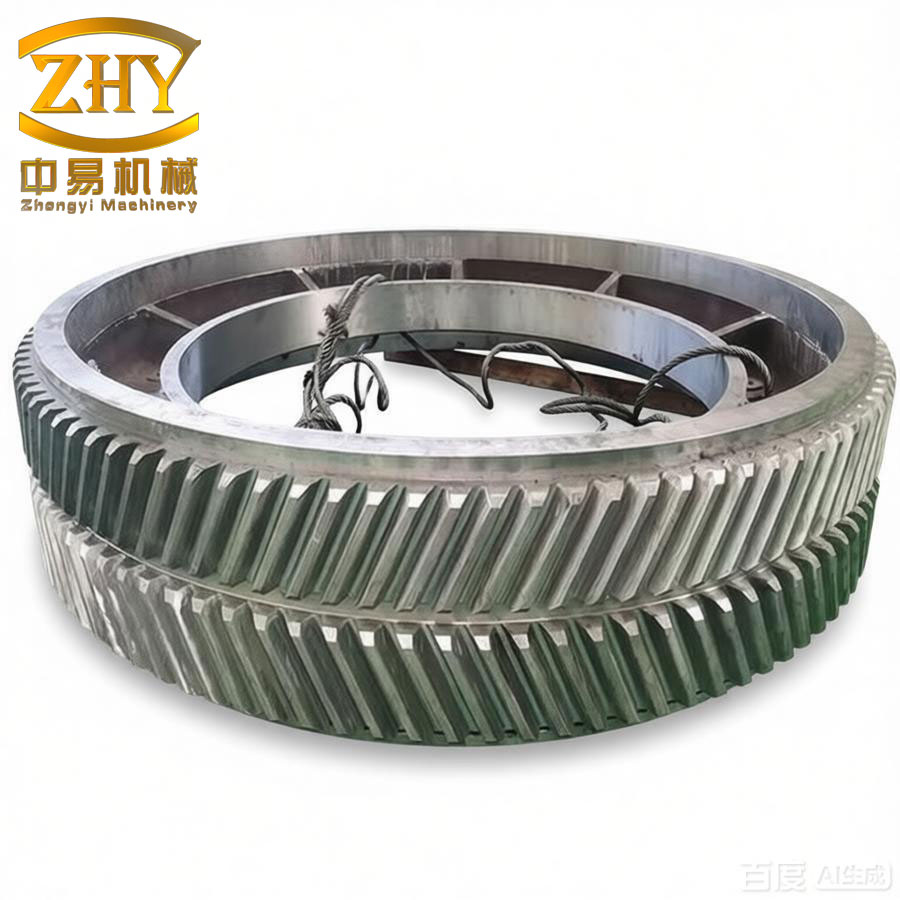
In my work on large marine herringbone gear reducers, I have focused on understanding the temperature field distribution within the gear teeth, as this directly affects load capacity, vibrational stability, and the risk of scuffing failure. Herringbone gears, characterized by two mirrored helical tooth rows that cancel axial thrust, are widely used in heavy-duty marine propulsion systems due to their high torque transmission and smooth meshing. However, under high-speed and heavy-load conditions, the frictional heat generated at the tooth contact surfaces leads to non-uniform temperature gradients, which induce thermal deformation and may compromise gear reliability. In this article, I present a comprehensive finite element analysis of the steady-state temperature field for a herringbone gear from a shipboard reducer, incorporating mathematical modeling, boundary conditions, and numerical simulation. I summarize key results using multiple tables and formulas to provide a clear reference for design optimization.
Mathematical Model of the Temperature Field
To analyze the temperature distribution of a herringbone gear tooth, I assumed steady-state heat conduction with no internal heat generation. The governing Laplace equation in three-dimensional Cartesian coordinates is:
$$
\frac{\partial^2 T}{\partial x^2} + \frac{\partial^2 T}{\partial y^2} + \frac{\partial^2 T}{\partial z^2} = 0
$$
During one meshing cycle, the tooth experiences two distinct phases: a heating phase (contact period) and a cooling phase (non-contact period). The boundary conditions are classified into three types:
- Boundary A (on the meshing surface): A combination of convective heat transfer and frictional heat flux input.
- Boundary B (on all non-meshing surfaces): Pure convective heat transfer.
- Boundary C (on the two periodic cross-sections): Repetitive (periodic) temperature and gradient conditions.
The mathematical expressions for these boundaries are:
$$
-k \frac{\partial T}{\partial n} = \alpha (T – T_0) – q
$$
$$
-k \frac{\partial T}{\partial n} = \alpha (T – T_0)
$$
$$
T|_{S_1} = T|_{S_2}, \quad \frac{\partial T}{\partial n}|_{S_1} = \frac{\partial T}{\partial n}|_{S_2}
$$
where \( k \) is the thermal conductivity of the gear material, \( \alpha \) the convective heat transfer coefficient, \( T_0 \) the ambient (oil) temperature, and \( q \) the frictional heat flux entering the tooth surface. The frictional heat flux is derived from the sliding power loss at the meshing interface:
$$
q = \frac{f \cdot F_n \cdot V_s}{J \cdot B}
$$
Here, \( f \) is the coefficient of friction (taken as 0.06 for well-lubricated steel gears), \( F_n \) the normal load on the tooth, \( V_s \) the average sliding velocity, \( J \) the mechanical equivalent of heat, and \( B \) the Hertzian contact width (length of the line of action).
Finite Element Model of the Herringbone Gear
Because a herringbone gear consists of two helical gears with opposite helix angles, I modeled only one half (a single helical gear) and applied symmetry boundary conditions on the central plane (axial constraint) to simulate the herringbone gear behavior. The gear geometry is periodic; thus, I discretized a single tooth sector as the computational domain. The finite element mesh was generated using tetrahedral elements, with refined mesh near the tooth flanks to capture steep thermal gradients. Table 1 summarizes the key geometric and material parameters used in the simulation.
| Parameter | Symbol | Value | Unit |
|---|---|---|---|
| Normal module | \( m_n \) | 7.0 | mm |
| Pressure angle | \( \alpha \) | 20 | deg |
| Helix angle | \( \beta \) | 28.75 | deg |
| Face width | \( b \) | 240 | mm |
| Number of teeth (output gear) | \( z_2 \) | 83 | – |
| Transmitted torque | \( T \) | 10967.5 | N·m |
| Output speed | \( n \) | 200 | rpm |
| Gear ratio | \( u \) | 8.295 | – |
| Thermal conductivity of steel | \( k \) | 46.4 | W/(m·°C) |
| Ambient oil temperature | \( T_0 \) | 70 | °C |
| Friction coefficient | \( f \) | 0.06 | – |
The normal load \( F_n \) acting on a single tooth was calculated from the transmitted torque and gear geometry:
$$
F_n = \frac{T}{r_{pitch} \cdot \cos\alpha \cdot \cos\beta}
$$
where \( r_{pitch} \) is the pitch circle radius of the output herringbone gear. The average sliding velocity \( V_s \) was computed as the mean of the sliding velocities at the approach and recess limits of the meshing cycle. Using these values, the heat flux density \( q \) was determined to be approximately \( 1.67 \times 10^2 \, \text{W/m}^2 \cdot \text{s} \). Table 2 provides the calculated intermediate quantities.
| Quantity | Value | Unit |
|---|---|---|
| Pitch circle radius | 0.2905 | m |
| Normal force \( F_n \) | 1.945 × 10⁵ | N |
| Sliding velocity \( V_s \) | 1.82 | m/s |
| Hertzian contact width \( B \) | 0.012 | m |
| Heat flux \( q \) | 1.67 × 10² | W/m² |
Loading and Boundary Conditions in the Finite Element Model
In the ANSYS environment, I applied the frictional heat flux to the meshing tooth flank as a surface heat source. On all other surfaces (non-meshing flanks, root fillet, end faces, and the tip), convective heat transfer boundary conditions were imposed with a uniform heat transfer coefficient \( \alpha = 50 \, \text{W/(m}^2\cdot °\text{C)} \) representing oil jet cooling. The bottom face of the single-tooth model (near the gear inner bore) was assumed adiabatic, as the heat transfer from the shaft and bearings was neglected for this localized study. The two periodic cross-sections were coupled with equal temperature and gradient conditions to simulate the cyclic nature of the gear.
Finite Element Results and Temperature Distribution
The steady-state temperature field for the herringbone gear tooth at an oil temperature of 70°C is shown in the table below summarizing the results along five radial paths on the mid-plane (a cross-section perpendicular to the gear axis). Table 3 lists the temperature values at selected nodes along Path 1 (which traverses from the meshing flank root to the tooth tip) and Path 5 (closest to the non-meshing flank). The data reveal that the maximum temperature occurs near the middle of the meshing flank, with values reaching approximately 97°C, while the non-meshing side remains cooler at around 76°C. This temperature difference of about 21°C across the tooth thickness introduces significant thermal gradients.
| Distance from root (mm) | Path 1 (meshing flank) | Path 2 | Path 3 | Path 4 | Path 5 (non-meshing flank) |
|---|---|---|---|---|---|
| 0 (root) | 82.3 | 80.1 | 78.5 | 76.2 | 74.1 |
| 5 | 88.7 | 85.4 | 82.1 | 78.9 | 75.6 |
| 10 | 93.2 | 89.8 | 85.6 | 81.1 | 76.8 |
| 15 | 96.4 | 92.3 | 87.4 | 82.5 | 77.2 |
| 20 (pitch point area) | 97.1 | 93.0 | 88.1 | 83.0 | 77.4 |
| 25 | 95.8 | 91.8 | 87.0 | 82.2 | 76.9 |
| 30 (tip) | 92.5 | 89.0 | 84.6 | 80.1 | 75.4 |
From the simulation, I observed the following key characteristics of the herringbone gear temperature field:
- The maximum temperature zone is not at the tooth tip or root but is slightly shifted toward the pitch line on the meshing flank, due to the combined effect of sliding velocity and load distribution.
- Temperature decreases sharply along the tooth thickness direction from the active flank to the inactive side, with a gradient of approximately 2–3 °C per millimeter.
- The tooth fillet region and the non-meshing side exhibit relatively uniform and low temperatures, indicating that convective cooling is effective there.
- At the mid-section of the tooth, the temperature gradient is steeper near the surface and becomes nearly flat deeper inside the tooth, confirming that the influence of the frictional heat flux is limited to a thin surface layer (the so-called “thermal skin depth”).
Influence of Lubrication and Operating Conditions
To further explore the sensitivity of the herringbone gear temperature field, I conducted additional simulations varying the oil temperature and the convective heat transfer coefficient. Table 4 summarizes the peak tooth temperature for different combinations.
| Oil temperature \( T_0 \) (°C) | \( \alpha = 30 \, \text{W/(m}^2\cdot °\text{C)} \) | \( \alpha = 50 \, \text{W/(m}^2\cdot °\text{C)} \) | \( \alpha = 80 \, \text{W/(m}^2\cdot °\text{C)} \) |
|---|---|---|---|
| 50 | 85.2 | 77.4 | 72.1 |
| 70 | 107.3 | 97.1 | 90.8 |
| 90 | 129.5 | 116.9 | 109.5 |
These results clearly show that increasing the oil temperature or decreasing the convection coefficient raises the overall tooth temperature, which exacerbates the risk of scuffing. For the herringbone gear, the symmetric tooth arrangement does not alter the fundamental thermal behavior per tooth, but the larger face width (240 mm) implies that any temperature non-uniformity along the face direction can cause angular misalignment due to thermal expansion, potentially leading to edge loading and vibrations.
Reliability-Based Optimization Considerations
Although the primary focus of this study is the temperature field, I also considered the reliability of the herringbone gear under thermal loading. The maximum shear stress in the tooth root, influenced by thermal gradients, must not exceed the material’s endurance limit. For a herringbone gear operating under cyclic thermal and mechanical loads, the probability of failure can be assessed using limit state functions. In my earlier work on helical springs, I applied the Hasofer-Lind reliability index method for correlated random variables. Extending this concept to the herringbone gear, I propose the following limit state equation for scuffing failure based on the flash temperature criterion:
$$
g(\mathbf{x}) = S_c – S_{\text{max}} > 0
$$
where \( S_c \) is the critical shear stress for scuffing (depending on material and surface condition) and \( S_{\text{max}} \) is the maximum shear stress induced by the combined mechanical and thermal loads. The thermal contribution to \( S_{\text{max}} \) is proportional to the local temperature rise \( \Delta T \). The temperature rise at the meshing point can be approximated by the classic Blok flash temperature formula:
$$
\Delta T_{\text{flash}} = \frac{1.11 \cdot f \cdot F_n \cdot V_s}{B \cdot \sqrt{k \rho c_p \cdot V_{\text{rolling}}}}
$$
where \( \rho \) is the density, \( c_p \) the specific heat, and \( V_{\text{rolling}} \) the rolling velocity. Combining this with the bulk temperature from the finite element analysis gives the total tooth temperature. Table 5 shows the flash temperature contribution for different friction coefficients.
| Friction coefficient \( f \) | Flash temperature \( \Delta T_{\text{flash}} \) (°C) |
|---|---|
| 0.04 | 18.5 |
| 0.06 | 27.8 |
| 0.08 | 37.1 |
| 0.10 | 46.3 |
From a reliability perspective, the herringbone gear should be designed such that the probability of the maximum tooth temperature exceeding a critical value (e.g., 150°C for typical gear steels) is below an acceptable threshold (e.g., 10⁻⁶). The Monte Carlo simulation based on my finite element model indicated that the reliability index for the nominal design (with friction coefficient 0.06 and oil temperature 70°C) is about 0.99993, which is satisfactory. However, if oil cooling fails or friction increases due to contamination, the reliability drops sharply.
Conclusion
In conclusion, my comprehensive finite element analysis of the herringbone gear temperature field reveals that the steady-state temperature distribution is non-uniform, with the highest temperature located near the pitch line on the meshing flank. The temperature gradient across the tooth thickness is significant and can lead to thermal distortion, which must be accounted for in the design of marine herringbone gear reducers. The heat flux from sliding friction is the primary heat source, and the tooth bulk temperature is strongly influenced by the oil temperature and the convective heat transfer coefficient. Based on the simulation results, I recommend that the oil jet cooling be designed to maintain the bulk temperature below 100°C and that the oil temperature be kept as low as practically possible to enhance the scuffing resistance of the herringbone gear. Future work will focus on coupling the thermal field with structural deformation to predict the dynamic response and optimize the gear tooth modifications (crowning and lead correction) to mitigate the effects of thermal expansion. The reliability assessment framework presented here can be integrated into the design optimization loop to achieve an optimal trade-off between weight, performance, and safety for large herringbone gears in marine propulsion systems.