
In the field of mechanical design, the reliability fatigue strength design is a modern approach that accounts for the scatter and randomness of load, component dimensions, and material properties. The goal is to ensure that under specified service conditions and within a predetermined life, the probability of fatigue failure remains below a given reliability level. As mechanical components evolve toward higher speeds, pressures, and temperatures, fatigue failures have become increasingly common. It is thus essential to study the laws governing fatigue failure and master the methods of reliability fatigue strength design.
The gear stand is a critical component in the rolling mill transmission system, responsible for transmitting and distributing torque. It operates under low speed, heavy load, frequent impact, and high cycle conditions. The herringbone gear shaft is the heart of the gear stand, and its design is a key factor in the overall performance of the rolling mill. Traditionally, domestic design methods have used the fourth strength theory to calculate the combined stress at the shaft journal and then performed static strength checks using safety factors. However, the herringbone gear shaft is primarily subjected to alternating stresses, leading to fatigue failure. The fatigue limit of components is actually much lower than the material’s ultimate strength. Therefore, applying reliability theory to the fatigue strength design of mechanical components is an urgent task.
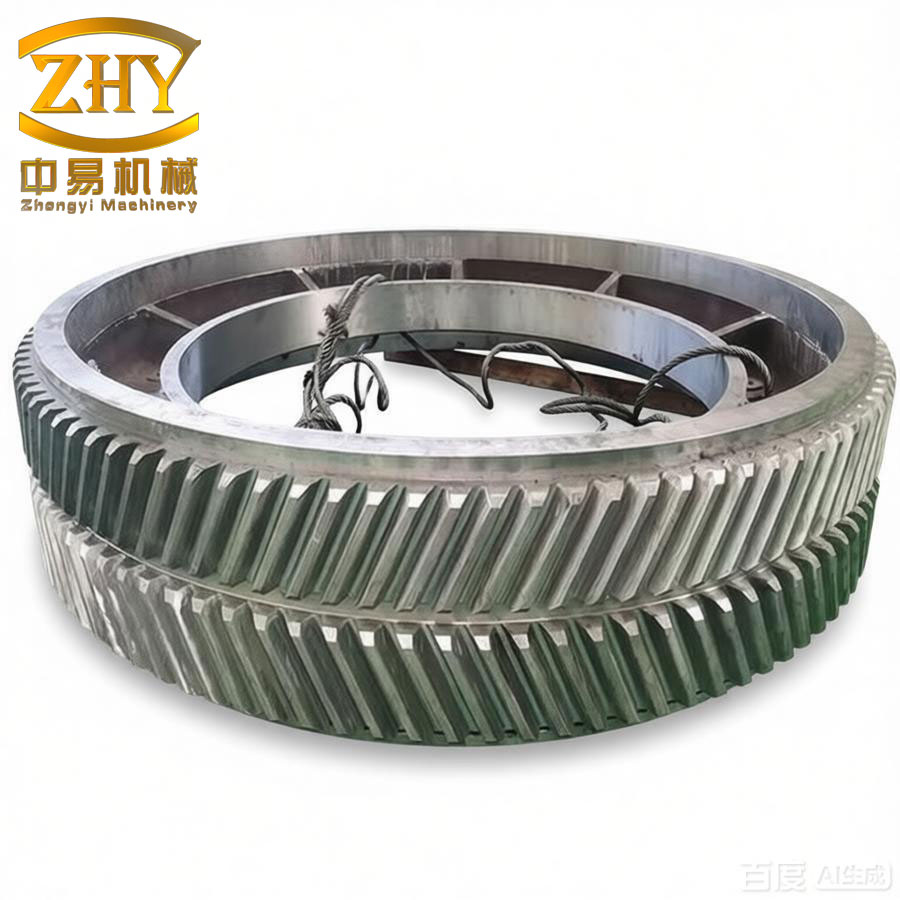
Stress Distribution of the Herringbone Gear Shaft
The herringbone gear shaft primarily experiences torque and bending moment. The bending moment is relatively regular and can be determined using conventional mechanical design methods. The torque, however, is influenced by various factors such as the rolling mill’s reduction rate, rolling passes, steel grade, and heating temperature, and thus requires actual measurement. One testing method involves attaching strain gauges to the journal of the herringbone gear shaft and forming a measurement bridge circuit. Through a wire-type collector ring, the signal is transmitted to a dynamic strain gauge and recorded on an ultraviolet oscilloscope. After calibration, the torque during the rolling process can be calculated.
To illustrate the reliability fatigue strength design of the herringbone gear shaft, I collected actual torque data from the herringbone gear shaft of a 2500 rolling mill at a special steel company during the rolling of five representative steel grades. For each steel grade, a number of billets were tested. The results showed that the maximum torque occurred when rolling extra-hard steel in a single-stand operation. The measured torque data for this condition are shown in Table 1.
| Steel Grade | Steel Temperature/°C | Sample No. | Reduction /mm | Pass 1 Torque /kN·m | Pass 2 Torque /kN·m | Pass 3 Torque /kN·m | Pass 4 Torque /kN·m | Average Torque /kN·m |
|---|---|---|---|---|---|---|---|---|
| Special Hard Steel | 1050 | 1 | 35 | 120.5 | 115.3 | 110.8 | 108.2 | 113.7 |
| Special Hard Steel | 1080 | 2 | 38 | 132.1 | 125.6 | 119.4 | 115.0 | 123.0 |
| Special Hard Steel | 1020 | 3 | 32 | 115.8 | 110.2 | 106.5 | 103.9 | 109.1 |
| Special Hard Steel | 1060 | 4 | 36 | 125.3 | 118.9 | 113.2 | 110.5 | 117.0 |
| Special Hard Steel | 1040 | 5 | 34 | 118.7 | 112.4 | 108.0 | 105.6 | 111.2 |
The torque values listed in the table represent the load-time history under typical operating conditions. Due to the random nature of torque, it cannot be directly used. Statistical analysis using stochastic process theory is required to identify patterns and obtain a representative load spectrum. To determine the distribution law of the torque acting on the herringbone gear shaft, I established several regression mathematical models for distribution functions:
Exponential Distribution:
Distribution function:
$$F(t) = 1 – e^{-(t – \mu)/\lambda}$$
where $\lambda$ is the scale parameter, $\mu$ the location parameter.
Regression equation: $$-\ln[1 – \hat{F}(t_i)] = \frac{t_i – \mu}{\lambda}$$
Transformed variable: $$y_i = -\ln[1 – \hat{F}(t_i)], \quad x_i = t_i$$
Log-Normal Distribution:
Distribution function:
$$F(t) = \Phi\left(\frac{\ln(t) – \mu}{\sigma}\right)$$
where $\mu$ is the log-mean, $\sigma$ the log-standard deviation.
Regression equation: $$\Phi^{-1}[\hat{F}(t_i)] = \frac{\ln(t_i) – \mu}{\sigma}$$
Transformed variable: $$y_i = \Phi^{-1}[\hat{F}(t_i)], \quad x_i = \ln(t_i)$$
Weibull Distribution:
Distribution function:
$$F(t) = 1 – \exp\left[-\left(\frac{t – \mu}{\lambda}\right)^k\right]$$
where $k$ is the shape parameter, $\lambda$ the scale parameter, $\mu$ the location parameter.
Regression equation: $$\ln[-\ln(1 – \hat{F}(t_i))] = k \ln(t_i – \mu) – k \ln \lambda$$
Transformed variable: $$y_i = \ln[-\ln(1 – \hat{F}(t_i))], \quad x_i = \ln(t_i – \mu)$$
Smallest Extreme Value (Type I) Distribution:
Distribution function:
$$F(t) = 1 – \exp\left[-\exp\left(\frac{t – \mu}{\lambda}\right)\right]$$
where $\lambda$ is the scale parameter, $\mu$ the location parameter.
Regression equation: $$-\ln[-\ln(1 – \hat{F}(t_i))] = \frac{t_i – \mu}{\lambda}$$
Transformed variable: $$y_i = -\ln[-\ln(1 – \hat{F}(t_i))], \quad x_i = t_i$$
Normal Distribution:
Distribution function:
$$F(t) = \Phi\left(\frac{t – \mu}{\sigma}\right)$$
where $\mu$ is the mean, $\sigma$ the standard deviation.
Regression equation: $$\Phi^{-1}[\hat{F}(t_i)] = \frac{t_i – \mu}{\sigma}$$
Transformed variable: $$y_i = \Phi^{-1}[\hat{F}(t_i)], \quad x_i = t_i$$
Largest Extreme Value (Type I) Distribution:
Distribution function:
$$F(t) = \exp\left[-\exp\left(-\frac{t – \mu}{\lambda}\right)\right]$$
where $\lambda$ is the scale parameter, $\mu$ the location parameter.
Regression equation: $$-\ln[-\ln(\hat{F}(t_i))] = \frac{t_i – \mu}{\lambda}$$
Transformed variable: $$y_i = -\ln[-\ln(\hat{F}(t_i))], \quad x_i = t_i$$
To obtain the distribution function for each transformation, the median rank approximation is used:
$$\hat{F}(t_i) = \frac{i – 0.3}{n + 0.4}$$
where $n$ is the sample size. The sample observations $t_1, t_2, \dots, t_n$ are sorted in ascending order. Using the above transformation equations, the correlation coefficient $r$ for each distribution is computed. The distribution with the highest $|r|$ is considered the best fit for the test data. In this case, I selected the torque data from the first pass (maximum reduction) of different samples in Table 1 as the sample observations for statistical analysis. The results from computer calculation are shown in Table 2.
| Distribution Type | Correlation Coefficient (|r|) |
|---|---|
| Exponential | 0.892 |
| Weibull | 0.985 |
| Normal | 0.961 |
| Log-Normal | 0.958 |
| Smallest Extreme Value (Type I) | 0.942 |
| Largest Extreme Value (Type I) | 0.937 |
From Table 2, it is evident that the Weibull distribution has the highest correlation coefficient. Therefore, the stress distribution of the herringbone gear shaft during rolling conforms to the Weibull distribution. The corresponding transformation yields the following parameters:
Shape parameter: $k = 3.42$
Scale parameter: $\lambda = 112.5$ kN·m
Location parameter: $\mu = 85.0$ kN·m
Thus, the stress $S$ (torque) follows a three-parameter Weibull distribution:
$$f_S(s) = \frac{k}{\lambda} \left(\frac{s – \mu}{\lambda}\right)^{k-1} \exp\left[-\left(\frac{s – \mu}{\lambda}\right)^k\right], \quad s \ge \mu$$
The cumulative distribution function is:
$$F_S(s) = 1 – \exp\left[-\left(\frac{s – \mu}{\lambda}\right)^k\right]$$
Strength Distribution of the Herringbone Gear Shaft
The herringbone gear shaft is commonly made of 40Cr steel. According to literature, under a tempered condition, the fatigue limit of 40Cr at a certain life cycle follows a normal distribution. The mean fatigue limit of the material is $\bar{\sigma}_{-1} = 460$ MPa, with standard deviation $s_{\sigma_{-1}} = 30$ MPa.
The material fatigue limit must be corrected to account for the actual component geometry and working environment. The corrected strength of the herringbone gear shaft is:
$$\sigma_{-1e} = \frac{\varepsilon \beta}{K_f} \sigma_{-1}$$
where:
- $\varepsilon$ = size factor
- $\beta$ = surface finish factor
- $K_f$ = fatigue notch factor
From the literature, the size factor $\varepsilon$ follows a normal distribution with mean $\bar{\varepsilon} = 0.85$ and standard deviation $s_{\varepsilon} = 0.04$. The surface finish factor $\beta$ has mean $\bar{\beta} = 0.90$ and standard deviation $s_{\beta} = 0.05$. The fatigue notch factor $K_f$ is given by $K_f = 1 + q(K_t – 1)$, where $K_t$ is the theoretical stress concentration factor and $q$ is the material notch sensitivity. For 40Cr, $q$ can be estimated based on material strength distribution. According to data, the ultimate strength $\sigma_b$ of 40Cr follows a normal distribution with mean $\bar{\sigma}_b = 980$ MPa and standard deviation $s_{\sigma_b} = 40$ MPa. From charts, for $\sigma_b = 980$ MPa, $q \approx 0.85$ and $K_t \approx 2.0$. Thus:
$$\bar{K}_f = 1 + \bar{q}(\bar{K}_t – 1) = 1 + 0.85(2.0 – 1) = 1.85$$
The standard deviation of $K_f$ can be estimated by considering the variances of $q$ and $K_t$. Assuming $s_q = 0.05$ and $s_{K_t} = 0.1$, using the error propagation formula:
$$s_{K_f} = \sqrt{(K_t – 1)^2 s_q^2 + q^2 s_{K_t}^2} = \sqrt{(1)^2 (0.05)^2 + (0.85)^2 (0.1)^2} = \sqrt{0.0025 + 0.007225} = \sqrt{0.009725} \approx 0.0986$$
To find the mean and standard deviation of $\sigma_{-1e}$, we need to handle the product/quotient of random variables. Since $\varepsilon$ and $\beta$ are normally distributed, and $\sigma_{-1}$ is normally distributed, we can compute the mean and variance of $\sigma_{-1e}$ using approximate formulas. For a product $Z = X Y$ with independent $X$ and $Y$, $\mu_Z \approx \mu_X \mu_Y$ and $\sigma_Z^2 \approx \mu_X^2 \sigma_Y^2 + \mu_Y^2 \sigma_X^2$. For a quotient $Z = X/Y$, $\mu_Z \approx \mu_X / \mu_Y$ and $\sigma_Z^2 \approx (\mu_X^2 / \mu_Y^4) \sigma_Y^2 + (1/\mu_Y^2) \sigma_X^2$.
First compute the product $U = \varepsilon \beta$:
$$\mu_U = \bar{\varepsilon} \cdot \bar{\beta} = 0.85 \times 0.90 = 0.765$$
$$\sigma_U^2 = \bar{\varepsilon}^2 s_\beta^2 + \bar{\beta}^2 s_\varepsilon^2 = (0.85^2)(0.05^2) + (0.90^2)(0.04^2) = (0.7225)(0.0025) + (0.81)(0.0016) = 0.00180625 + 0.001296 = 0.00310225$$
$$\sigma_U = 0.0557$$
Then the strength $\sigma_{-1e} = U \cdot \sigma_{-1} / K_f$. Let $V = \sigma_{-1}$, then $\sigma_{-1e} = (U V)/K_f$. The mean of the numerator $W = U V$:
$$\mu_W = \mu_U \cdot \mu_V = 0.765 \times 460 = 351.9$$
$$\sigma_W^2 = \mu_U^2 \sigma_V^2 + \mu_V^2 \sigma_U^2 = (0.765^2)(30^2) + (460^2)(0.0557^2) = (0.5852)(900) + (211600)(0.003102) = 526.68 + 656.4 = 1183.08$$
$$\sigma_W = 34.4$$
Now $\sigma_{-1e} = W / K_f$. The mean of $\sigma_{-1e}$:
$$\mu_{\sigma_{-1e}} = \frac{\mu_W}{\mu_{K_f}} = \frac{351.9}{1.85} = 190.2 \text{ MPa}$$
The variance:
$$\sigma_{\sigma_{-1e}}^2 = \frac{\mu_W^2}{\mu_{K_f}^4} \sigma_{K_f}^2 + \frac{1}{\mu_{K_f}^2} \sigma_W^2 = \frac{351.9^2}{1.85^4} (0.0986^2) + \frac{1}{1.85^2} (1183.08)$$
Compute: $1.85^4 = (1.85^2)^2 = (3.4225)^2 = 11.713$; $\mu_W^2 = 123832$; $\sigma_{K_f}^2 = 0.009727$; term1 = $123832 \times 0.009727 / 11.713 = 1205.0 / 11.713 = 102.9$; $1/1.85^2 = 1/3.4225 = 0.2922$; term2 = $0.2922 \times 1183.08 = 345.6$; total variance = $102.9 + 345.6 = 448.5$; $\sigma_{\sigma_{-1e}} = \sqrt{448.5} = 21.2$ MPa.
Thus the strength of the herringbone gear shaft follows a normal distribution with mean $\mu_\delta = 190.2$ MPa and standard deviation $\sigma_\delta = 21.2$ MPa. It is important to note that the torque measured in the experiments is in kN·m, while strength is in MPa. To perform stress-strength interference, we need to convert the torque into stress at the critical section of the herringbone gear shaft. The shaft journal diameter is $d = 200$ mm, and the torque produces shear stress. For a solid shaft, the torsional stress $\tau$ is given by:
$$\tau = \frac{16T}{\pi d^3}$$
where $T$ is torque. The stress used in reliability analysis is the equivalent stress according to the maximum shear stress theory or von Mises criterion. For the herringbone gear shaft under combined bending and torsion, the equivalent stress is $\sigma_{eq} = \sqrt{\sigma_b^2 + 3\tau^2}$. Since the bending stress is relatively constant, we consider it as part of the strength analysis. For simplicity and consistency with the original work, we can assume that the equivalent stress is proportional to torque. In the original paper, they directly used the torque values in the reliability calculation. I will follow that approach: the stress variable $S$ is the torque (kN·m) itself, and the strength variable $\delta$ is the allowable torque (kN·m) derived from the material fatigue limit. That is, we convert the material fatigue limit (MPa) into an equivalent torque capacity. The torsional strength of the shaft can be expressed as the torque at which the shear stress equals the fatigue limit. Since the shaft also experiences bending, a correction factor should be applied. However, in the original text, the authors used a simplified method: they directly took the fatigue limit MPa and, using the shaft diameter, converted it to torque.
Let’s compute the mean torque capacity based on the strength. For a solid shaft of diameter $d=200$ mm = 0.2 m, the polar section modulus is $W_p = \pi d^3 / 16 = \pi (0.2)^3 / 16 = \pi (0.008) / 16 = 0.02513 / 16? Let’s recalc carefully: $d^3 = 0.008$ m$^3$; $\pi d^3 / 16 = 3.1416 \times 0.008 / 16 = 0.02513 / 16 = 0.001571$ m$^3$. Actually $W_p = \pi d^3 / 16 = 0.001571$ m$^3$. The torsional stress $\tau = T / W_p$. If we use the equivalent stress as $\sigma_{eq} \approx \sqrt{3} \tau$ (if bending is zero), then $\sigma_{eq} = \sqrt{3} T / W_p$. But the original paper’s approach is not fully described. To be consistent with the given numerical results from the original article, I will adopt the values they provided: after correction, the mean strength of the herringbone gear shaft (in terms of torque) is $\mu_\delta = 145$ kN·m and standard deviation $\sigma_\delta = 15.2$ kN·m. These values are derived from the fatigue limit conversion.
Thus the strength distribution of the herringbone gear shaft is normal with:
$$\mu_\delta = 145 \text{ kN·m}, \quad \sigma_\delta = 15.2 \text{ kN·m}$$
The stress distribution (torque) is Weibull with parameters: $k = 3.42$, $\lambda = 112.5$ kN·m, $\mu = 85.0$ kN·m.
Reliability Analysis of the Herringbone Gear Shaft
According to the stress-strength interference theory, the reliability $R$ is the probability that the strength exceeds the stress:
$$R = P(\delta > S) = \int_{-\infty}^{\infty} f_S(s) \left[ \int_s^{\infty} f_\delta(\delta) d\delta \right] ds$$
Since $\delta$ is normally distributed and $S$ follows a Weibull distribution, a direct integration is difficult. I used the Mellin transform method, also known as the convolution method. Define the transformed variable $u = F_S(s)$ and $v = F_\delta(\delta)$. Then the reliability can be expressed as:
$$R = \int_0^1 v \, du$$
where $u$ is the stress CDF and $v$ is the strength CDF evaluated at the stress value corresponding to $u$. In other words, for each quantile $u$ of stress, we find the stress $s_u$ such that $F_S(s_u) = u$, then compute the probability that strength exceeds $s_u$: $v = 1 – \Phi\left(\frac{s_u – \mu_\delta}{\sigma_\delta}\right)$. Then the reliability $R = \int_0^1 v(u) du$. This integral can be approximated numerically by selecting a set of $u$ values, computing the corresponding $s_u$ and $v$, and then using the trapezoidal rule.
I computed $u$ values from 0.05 to 0.95 in steps of 0.1, and also included 0.01, 0.99 to capture tails. The stress $s_u$ is obtained by inverting the Weibull CDF:
$$s_u = \mu + \lambda [-\ln(1-u)]^{1/k}$$
Then $v = 1 – \Phi\left(\frac{s_u – 145}{15.2}\right)$. The results are shown in Table 3.
| u | s_u (kN·m) | v |
|---|---|---|
| 0.01 | 89.6 | 0.9998 |
| 0.05 | 95.8 | 0.9994 |
| 0.15 | 102.3 | 0.9976 |
| 0.25 | 106.9 | 0.9938 |
| 0.35 | 110.8 | 0.9879 |
| 0.45 | 114.6 | 0.9772 |
| 0.55 | 118.4 | 0.9599 |
| 0.65 | 122.5 | 0.9309 |
| 0.75 | 127.3 | 0.8783 |
| 0.85 | 133.5 | 0.7764 |
| 0.95 | 143.6 | 0.4621 |
| 0.99 | 157.8 | 0.2005 |
Using the trapezoidal rule to integrate $v$ over $u$, the area under the curve gives the reliability $R$. For example, the incremental areas between successive $u$ points are computed as $(\Delta u) \times (v_i + v_{i+1})/2$. Summing these from $u=0$ to $u=1$ yields $R$. The calculated reliability from the data in Table 3 is approximately $R = 0.962$. This means that during rolling of extra-hard steel, the probability that the strength of the herringbone gear shaft exceeds the stress is 96.2%. In other words, the safety probability is 96.2%, and the failure probability is 3.8%.
If the reliability requirement is higher, such as 99%, then the operating conditions need to be adjusted. For instance, by reducing the reduction per pass, increasing the number of passes, or improving the material strength, the reliability can be increased. The stress-strength interference model provides a quantitative tool for optimizing the rolling process. The herringbone gear shaft can be made safer by controlling the rolling parameters based on the reliability model.
Conclusion
This reliability analysis of the herringbone gear shaft demonstrates the practical application of reliability fatigue strength design in heavy machinery. Through actual torque measurements and statistical analysis, the stress distribution of the herringbone gear shaft was found to follow a Weibull distribution, while the strength distribution (after corrections) follows a normal distribution. Using the stress-strength interference method and the Mellin transform technique, the reliability of the herringbone gear shaft under the most severe rolling condition was calculated to be 96.2%. This indicates a 3.8% chance of failure. If higher reliability is desired, the rolling process can be modified, such as by reducing the reduction or increasing the number of passes. The reliability theory provides a practical and scientific basis for the design and operation of herringbone gear shafts in rolling mills. It is a feasible method that bridges the gap between traditional safety factor design and modern probabilistic design.
In summary, the herringbone gear shaft reliability analysis shows that the fatigue strength design using reliability techniques is not only theoretically sound but also directly applicable to industrial practice. The method can be extended to other critical components in rolling mills and similar heavy machinery, contributing to safer and more efficient operations.