
In this study, we focus on the dynamic behavior of herringbone gears affected by asymmetric tooth pitch deviation. Herringbone gears are widely used in heavy machinery, aerospace, and marine applications due to their high load capacity, compact structure, and low axial forces. However, manufacturing and assembly deviations inevitably lead to asymmetries between the left and right helical gear pairs. Among these, tooth pitch deviation is a common long-period error that significantly influences the transmission performance. We propose a large-period load-bearing contact analysis method for herringbone gears with asymmetric tooth pitch deviation, which allows us to obtain the comprehensive meshing stiffness, axial displacement, comprehensive meshing error, and meshing impact forces over a large period. Using a lumped-parameter dynamic model, we investigate the three-dimensional vibration characteristics under different loads and rotational speeds. Our results reveal distinct vibration patterns that are critical for the design and condition monitoring of herringbone gear systems.
The fundamental parameters of the herringbone gear pair used in this analysis are listed in Table 1.
| Parameter | Pinion (small wheel) | Gear (large wheel) |
|---|---|---|
| Number of teeth | 17 | 44 |
| Normal module (mm) | 6 | 6 |
| Normal pressure angle (°) | 20 | 20 |
| Helix angle (°) | 24.43 | -24.43 |
| Face width (mm) | 55 | 55 |
| Gap width (mm) | 58 | 58 |
| Gap diameter (mm) | 92 | 260 |
The tooth pitch deviation is measured along the tangential direction at the pitch circle on the gear face. To incorporate this into the meshing analysis, we project the relative pitch deviation onto the normal direction of the tooth flank. The relative tooth pitch deviation along the line of action for the herringbone gear pair is given by:
$$ \lambda = (F_{pt1} – F_{pt2}) \cos \beta_b \cos \alpha_t $$
where \(F_{pt1}\) and \(F_{pt2}\) are the cumulative pitch deviations of the pinion and gear, \(\beta_b\) is the base helix angle, and \(\alpha_t\) is the transverse pressure angle. The short-period deviation fluctuates within one meshing cycle, while the long-period deviation cycle is determined by the number of teeth and the rotational periods of the two gears. The large period \(T_l\) of the asymmetric pitch deviation can be expressed as:
$$ T_m = \frac{60}{n_1 Z_1}, \quad T_1 = \frac{60}{n_1}, \quad T_2 = \frac{60 Z_2}{n_1 Z_1}, \quad T_l = T_m \cdot \text{lcm}(Z_1, Z_2) $$
where \(Z_1\) and \(Z_2\) are the tooth numbers of the pinion and gear, \(n_1\) is the pinion rotational speed, and lcm denotes the least common multiple. For our gear pair with \(Z_1 = 17\) and \(Z_2 = 44\), which are coprime, one large period contains 748 meshing cycles. The relative pitch deviations over one large period are clearly different for the left and right helical gear pairs, forming the asymmetric tooth pitch deviation of the herringbone gears.
1. Load-Bearing Contact Analysis Model
Considering the asymmetric tooth pitch deviation, the tooth surface clearance for each meshing cycle includes three components: (i) the initial tooth clearance calculated from geometric contact analysis, (ii) the clearance caused by the asymmetric pitch deviation for simultaneously meshing tooth pairs, and (iii) the normal clearance increment induced by the axial displacement of the pinion. Assuming at a certain meshing instant there are \(m\) discrete points on the left helical gear pair and \(q\) on the right, with total \(N = m+q\) points, the displacement compatibility condition is:
$$ -F_k p_k + e Z + I d_k + A \delta_p = w_k + \lambda_k $$
where \(k\) denotes the tooth pair in contact, \(w_k\) is the initial clearance, \(\lambda_k\) is the matrix of meshing clearances due to relative pitch deviation, \(F_k\) is the \(N \times N\) normal flexibility matrix, \(p_k\) is the normal load vector, \(Z\) is the normal line displacement of the tooth, \(I\) is the identity matrix, \(d_k\) is the deformed tooth clearance, and \(A\) is a matrix accounting for the helix angle effect. The load-bearing contact analysis model is then formulated as an optimization problem solved by the modified simplex method. From this, we obtain the normal loaded transmission error \(Z\), the axial displacement \(\delta_p\), and the comprehensive meshing error for the herringbone gear pair.
The comprehensive meshing stiffness of the left and right helical gear pairs can be calculated as:
$$ k_{m1} = \frac{T}{r_{p2} \cos \alpha_n \cos \beta (Z – \delta_{TE1})}, \quad k_{m2} = \frac{T}{r_{p2} \cos \alpha_n \cos \beta (Z – \delta_{TE2})} $$
where \(\delta_{TE1}\) and \(\delta_{TE2}\) are the comprehensive meshing errors, \(T\) is the load torque on the large wheel, \(\alpha_n\) is the normal pressure angle, \(\beta\) is the helix angle, and \(r_{p2}\) is the pitch radius of the large wheel. By repeating the solution over the entire large period (lcm(\(Z_1,Z_2\)) meshing cycles), we obtain the large periodic variations of stiffness, axial displacement, and meshing error.
2. Meshing Impact Force Calculation
The key to calculating the meshing impact force lies in accurately determining the initial contact point. The equivalent clearance of the current meshing tooth pair is the difference between its relative pitch deviation and that of the preceding tooth pair, while the elastic deformation of other tooth pairs is obtained from the load-bearing contact analysis. The maximum meshing impact force \(f_s\) for each helical gear pair is given by:
$$ f_s = \left( \frac{c + \frac{1}{2} \frac{I_1 I_2}{I_1 r_{b2}^2 + I_2 r_{b1}^2} v_s^2 k_s}{c} \right)^{c/(c+1)} $$
where \(I_1\) and \(I_2\) are the moments of inertia of the pinion and gear, \(k_s\) is the meshing stiffness at the impact point, \(c\) is the deformation coefficient under static load, \(v_s\) is the relative velocity at the impact point, and \(r_{b1}, r_{b2}\) are the base radii. Since the asymmetric pitch deviation causes different equivalent clearances and elastic deformations for each meshing cycle within the large period, the impact forces for the left and right helical gear pairs are computed cyclically over the lcm(\(Z_1,Z_2\)) cycles, resulting in asymmetric meshing impact excitations.
3. Dynamic Model of Herringbone Gears with Asymmetric Pitch Deviation
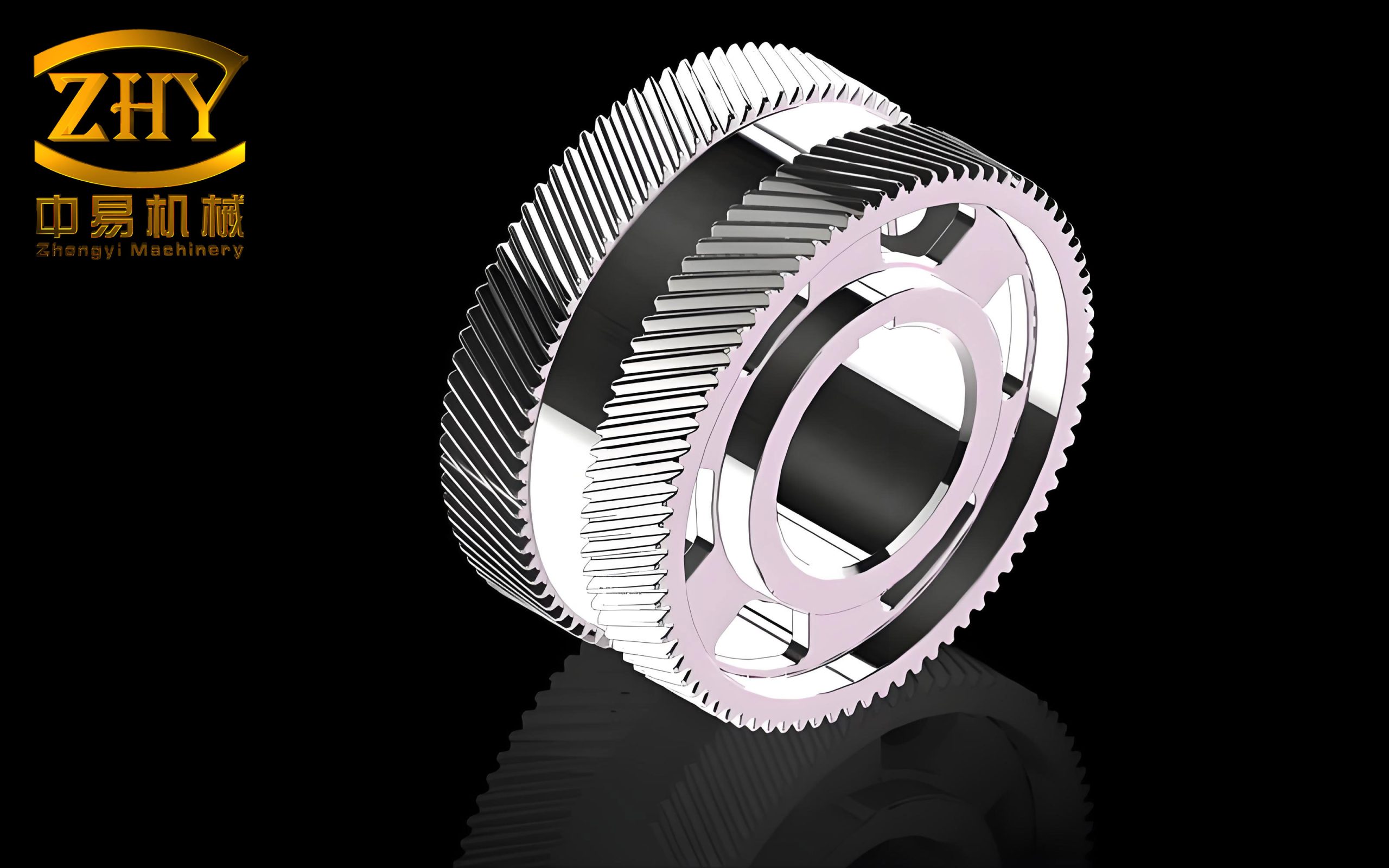
We establish a 16-degree-of-freedom lumped-parameter dynamic model for the herringbone gear transmission system, as illustrated conceptually in Figure 1. The model includes translational and torsional vibrations for both the left and right sides of the pinion and gear. The pinion is supported with axially floating bearings (i.e., axial stiffness \(k_{z1L} = k_{z1R} = 0\) in practice). The relative vibration displacements along the line of action for the left and right helical gear pairs are:
$$ \lambda_{12L} = \left[ (x_{1L} – x_{2L})\sin\psi_{12L} + (y_{1L} – y_{2L})\cos\psi_{12L} + (r_{b1L}\theta_{1L} + r_{b2L}\theta_{2L}) \right] \cos\beta_{bL} + (-z_{1L} + z_{2L})\sin\beta_{bL} – \delta_p \sin\beta_{bL} – e_{TE1} $$
$$ \lambda_{12R} = \left[ (x_{1R} – x_{2R})\sin\psi_{12R} + (y_{1R} – y_{2R})\cos\psi_{12R} + (r_{b1R}\theta_{1R} + r_{b2R}\theta_{2R}) \right] \cos\beta_{bR} + (-z_{1R} + z_{2R})\sin\beta_{bR} – \delta_p \sin\beta_{bR} – e_{TE2} $$
where the variables with subscripts 1L, 1R, 2L, 2R represent the left and right halves of the pinion and gear, respectively; \(x, y, z\) are translational displacements; \(\theta\) are torsional displacements; \(\psi_{12L}\) and \(\psi_{12R}\) are the angles between the transverse line of action and the y-axis; \(\beta_{bL}, \beta_{bR}\) are the base helix angles (equal in magnitude but opposite sign); \(\delta_p\) is the axial displacement excitation obtained from the static analysis; \(e_{TE1}, e_{TE2}\) are the comprehensive meshing error excitations. The normal dynamic meshing force is \(F_{nj} = c_{12j} \dot{\lambda}_{12j} + k_{mj} \lambda_{12j}\) where \(c_{12j}\) is the meshing damping. The equations of motion for the 16 degrees of freedom are derived using Newton’s second law. For example, for the left pinion (1L):
$$ m_{1L}\ddot{x}_{1L} + c_{x1L}\dot{x}_{1L} + k_{x1L}x_{1L} + c_{b1}(\dot{x}_{1L} – \dot{x}_{1R}) + k_{b1}(x_{1L} – x_{1R}) + F_{nLx} + f_{s1}(t)\cos\beta_{bL}\sin\psi_{12L} = 0 $$
Similar equations hold for the other components. The system parameters used in the dynamic analysis are listed in Table 2.
| Parameter | Pinion | Gear |
|---|---|---|
| Mass (kg) | 7.11 | 64.75 |
| Moment of inertia (kg·m²) | 0.012 | 0.7279 |
| Equivalent support stiffness \(k_x\) (N/m) | 2.42 × 10⁸ | 3.83 × 10⁸ |
| Equivalent support stiffness \(k_y\) (N/m) | 2.42 × 10⁸ | 3.83 × 10⁸ |
| Equivalent support stiffness \(k_z\) (N/m) | — | 2.96 × 10⁸ |
| Gap bending stiffness \(k_b\) (N/m) | 1.11 × 10¹⁰ | 7.11 × 10¹¹ |
| Gap tension/compression stiffness \(k_p\) (N/m) | 2.36 × 10¹⁰ | 1.89 × 10¹¹ |
| Gap torsional stiffness \(k_t\) (N·m/rad) | 9.61 × 10⁶ | 6.13 × 10⁸ |
4. Results and Discussion
4.1 Effect of Load on Vibration Characteristics
We solved the dynamic equations using the Runge-Kutta method for a pinion speed of 2000 r/min and gear torques of 828 N·m, 2000 N·m, and 5000 N·m. The 3D vibration displacements (transverse and axial) and their spectra are analyzed. For the left helical gear pair, at low load (828 N·m), the transverse displacement spectrum shows prominent shaft frequency components (large wheel shaft frequency \(f_2 = 12.88\) Hz and small wheel shaft frequency \(f_1 = 33.33\) Hz), while the meshing frequency \(f_m = 566.67\) Hz and its harmonics are relatively weak. The axial displacement spectrum exhibits strong modulation sidebands around the meshing frequency harmonics, for example, \(2f_m – 5f_1\) and \(2f_m – 2f_1\) are clearly visible. As the load increases to 5000 N·m, the meshing frequency and its harmonics become more pronounced, and the sideband amplitudes decrease. This is because at higher loads, the elastic deformation dominates over the effects of pitch deviation, leading to higher meshing stiffness and stronger meshing frequency components.
Similar trends are observed for the 3D vibration accelerations. The transverse acceleration spectra are dominated by meshing frequency and its harmonics, with sidebands around the second harmonic. The axial acceleration spectra show less distinct meshing frequency components, but at high load, the second harmonic becomes the strongest. The root mean square (RMS) values of transverse and axial accelerations increase with load, with axial acceleration generally larger than transverse acceleration.
4.2 Effect of Rotational Speed
At a constant gear torque of 5000 N·m, we varied the pinion speed from 800 r/min to 20,000 r/min. The transverse acceleration RMS increases rapidly with speed, showing two clear peaks corresponding to half the resonance speed and the main resonance speed (around 1700 r/min and 2000 r/min). Beyond the resonance, the transverse acceleration continues to rise until about 16,400 r/min, then decreases. The axial acceleration RMS also increases but at a slower rate, and exhibits multiple irregular peaks not aligned with the transverse resonance speeds. Interestingly, when the pinion speed remains below the resonance, the left and right helical gear pairs have nearly identical 3D acceleration RMS values. However, once the speed exceeds the resonance, the asymmetric meshing impact forces become dominant, leading to significant differences between the left and right sides. For example, at 17,200 r/min, the left transverse acceleration RMS is 2379.46 m/s² while the right is 2428.73 m/s²; the left axial is 176.33 m/s² and the right is 183.21 m/s². The dynamic load coefficients also differ: left maximum 1.4161, right maximum 1.4597.
4.3 Comparison of Left and Right Helical Gear Pairs
To further illustrate the effect of asymmetric meshing impact, we compare the dynamic meshing forces and dynamic load coefficients at 2000 r/min and 17,200 r/min. At 2000 r/min, the left and right dynamic meshing forces are very close, and the maximum dynamic load coefficients differ by only 0.0178. At 17,200 r/min, the difference becomes 0.0436, confirming that the asymmetric impact excitation is the primary cause of the divergence in dynamic responses of the two helical gear pairs.
5. Conclusions
We have systematically analyzed the large periodic three-dimensional vibration characteristics of herringbone gears with asymmetric tooth pitch deviation. The main findings are:
- In the vibration displacement spectra, shaft frequency components dominate, especially the large wheel shaft frequency. Meshing frequency and its harmonics are relatively weak but become more prominent with increasing load, while sideband amplitudes diminish.
- The vibration acceleration spectra show pronounced meshing frequency and harmonics with sidebands, particularly on the transverse acceleration. Axial acceleration spectra are more complex, with less pronounced meshing harmonics.
- As load increases, the RMS values of both transverse and axial accelerations increase monotonically. The axial acceleration RMS is generally larger than the transverse at low speeds.
- The transverse acceleration RMS has two distinct resonance peaks at half-resonance and main resonance speeds. The axial acceleration RMS exhibits multiple scattered peaks.
- Below the resonance speed, the left and right helical gear pairs exhibit nearly identical vibration characteristics due to the dominance of stiffness excitation. Above the resonance speed, asymmetric meshing impact forces become dominant, causing significant differences (up to 2-3%) in acceleration RMS and dynamic load coefficients between the two sides.
These insights provide valuable guidelines for the design and condition monitoring of herringbone gear systems, emphasizing the importance of controlling tooth pitch deviation and accounting for asymmetric excitations in high-speed applications.