
In our work on high contact ratio herringbone gears, we have focused on the dynamic behavior optimization of these complex transmission systems. Herringbone gears are widely used in aerospace, marine, and heavy machinery due to their high load-carrying capacity, smooth operation, and self-balancing axial forces. However, when designed with a high contact ratio, they become more sensitive to excitations such as mesh stiffness variation, transmission errors, and meshing impacts. To address these challenges, we developed a comprehensive dynamic optimization framework that integrates loaded tooth contact analysis, nonlinear dynamic modeling, and a novel genetic algorithm with fitness approximation. This article presents our methodology, results, and experimental validation.
Our primary objective was to reduce the vibration and noise of herringbone gear transmissions while increasing the total contact ratio. We established a bending-torsional-axial coupled nonlinear dynamic model for a herringbone gear pair, considering the axial floating characteristic of the pinion. This model incorporates time-varying mesh stiffness, error excitation, and meshing impact excitation. We then applied a parabolic profile and lead modification to the pinion teeth to improve the dynamic performance. Using a fitness approximation genetic algorithm (FAGA), we optimized the basic design parameters and modification coefficients. The root mean square (RMS) of the vibration acceleration along the line of action was selected as the objective function. Finally, we conducted load tests on a noise reduction test rig to compare the noise levels before and after optimization.
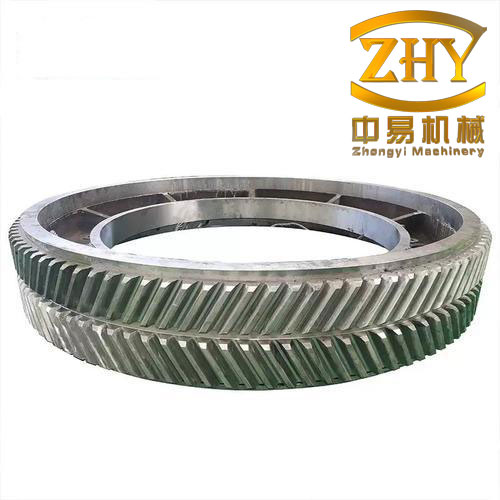
High Contact Ratio Design Analysis for Herringbone Gears
Increasing the contact ratio is beneficial for improving the smoothness and load capacity of gear transmission. For herringbone gears, we can achieve a high total contact ratio by enlarging both the transverse contact ratio $\varepsilon_\alpha$ and the axial contact ratio $\varepsilon_\beta$. The total contact ratio $\varepsilon_\gamma$ is given by:
$$ \varepsilon_\gamma = \varepsilon_\alpha + \varepsilon_\beta $$
where the transverse contact ratio depends on the tooth addendum coefficient $h_{an}^*$, the pressure angle, and the number of teeth. The axial contact ratio is directly proportional to the face width and the helix angle $\beta$. In our design, we adopted a larger helix angle (up to $40^\circ$) and an increased addendum coefficient to boost $\varepsilon_\gamma$. We also used an equal shift coefficient transmission, with the pinion having a positive shift and the gear a negative shift, to control the gear size and improve load capacity.
The key parameters influencing the contact ratio are summarized in Table 1.
| Parameter | Symbol | Effect on $\varepsilon_\gamma$ |
|---|---|---|
| Helix angle | $\beta$ | Increases $\varepsilon_\beta$ |
| Normal addendum coefficient | $h_{an}^*$ | Increases $\varepsilon_\alpha$ |
| Normal pressure angle | $\alpha_n$ | Minor effect |
| Number of teeth (pinion/gear) | $z_1/z_2$ | Increases $\varepsilon_\alpha$ with larger tooth numbers |
| Face width | $b$ | Increases $\varepsilon_\beta$ |
| Profile shift coefficient | $x_{n1}/x_{n2}$ | Moderate effect |
Dynamic Modeling of Herringbone Gear Transmission
Excitation Sources
The dynamic behavior of herringbone gears is governed by three main excitations: stiffness excitation, error excitation, and meshing impact excitation.
Time-varying mesh stiffness: We employed a loaded tooth contact analysis (LTCA) based on the finite element flexibility matrix and nonlinear programming to compute the mesh stiffness for parabolic modified herringbone gears. The discrete stiffness values over one mesh cycle were fitted into a periodic function using Fourier series:
$$ k_m(t) = k_{m0} + \sum_{n=1}^{N} \left[ a_n \cos(n\omega_m t) + b_n \sin(n\omega_m t) \right] $$
where $\omega_m$ is the mesh frequency.
Error excitation: Machining and assembly errors were represented as an equivalent composite error $e(t)$ along the line of action. For a 5-grade precision gear, the error amplitude was relatively small but still significant for dynamic response.
Meshing impact excitation: At the entry and exit of meshing, impact forces occur due to elastic deformation and errors. We focused on the entry impact and calculated the impact force $F_{imp}(t)$ based on the impact velocity and equivalent mass.
Coupled Vibration Model
We modeled a single-stage herringbone gear pair where the pinion is axially floating and the gear is fixed. The system has 12 degrees of freedom: for each of the two helical halves (left and right), we considered translational vibrations in the $y$ (line of action) and $z$ (axial) directions, plus rotational vibrations $\theta$. The model also accounts for the coupling between the two helical halves through the shaft and bearings.
The generalized displacement vector is:
$$ \{\delta\} = \left[ y_{p1}, z_{p1}, \theta_{p1}, y_{g1}, z_{g1}, \theta_{g1}, y_{p2}, z_{p2}, \theta_{p2}, y_{g2}, z_{g2}, \theta_{g2} \right]^T $$
The equations of motion for the left pinion (first half) are:
$$ m_p \ddot{y}_{p1} + c_{p1y} \dot{y}_{p1} + k_{p1y} y_{p1} + c_{py} (\dot{y}_{p1} – \dot{y}_{p2}) + k_{py} (y_{p1} – y_{p2}) = -F_{yp1} $$
$$ m_p \ddot{z}_{p1} + c_{pz} (\dot{z}_{p1} + \dot{z}_{p2}) + k_{pz} (z_{p1} + z_{p2}) = -F_{z1} $$
$$ I_{p1} \ddot{\theta}_{p1} = T_{p1} – F_{yp1} R_{p1} $$
Similar equations hold for the gear side and for the right helical halves. After non-dimensionalization with time $\tau = \omega_n t$ and a characteristic length $b_c$, we obtained a set of dimensionless equations solved by the fourth-order Runge-Kutta method. The dynamic response, particularly the vibration acceleration along the line of action, was extracted.
Parabolic Modification
To reduce vibration, we applied parabolic profile and lead modifications only to the pinion. The profile modification curve is given by:
$$ y = A x^2 + B $$
where $A$ determines the amount of modification and $B$ determines the location of the modification vertex. The lead modification (along the face width) is:
$$ y = C x^2 $$
with vertex at the mid-point of the face width. These modifications reduce the mesh stiffness fluctuation and meshing impact, thereby improving dynamic performance.
Optimization Methodology
Design Variables
We selected six design variables that significantly influence both the contact ratio and dynamic performance:
$$ X = [x_1, x_2, x_3, x_4, x_5, x_6]^T = [\beta, x_{n1}, h_{an}^*, A, B, C]^T $$
Objective Function
The objective is to minimize the root mean square (RMS) of the vibration acceleration of the left herringbone gear along the line of action over one mesh cycle:
$$ \min f_1(X) = \sqrt{ \frac{1}{n} \sum_{i=1}^{n} \ddot{x}_{i}^2 } $$
where $\ddot{x}_i$ is the relative vibration acceleration at discrete time steps.
Constraints
We imposed several practical constraints: minimum contact ratio ($\varepsilon_\gamma > 7$), bending strength, contact strength, scoring resistance, sliding ratio, and limits on maximum dynamic load and stiffness fluctuation. The modified gear must also satisfy geometric limits (e.g., no undercut, tip thickness > 0.3 m_n).
Fitness Approximation Genetic Algorithm (FAGA)
Evaluating the objective function requires running the LTCA and solving the dynamic model, which is computationally expensive. To reduce the number of true fitness evaluations, we developed a genetic algorithm with a fitness prediction mechanism based on a credibility concept.
In FAGA, each individual $i$ has a fitness value $f(i)$ and a credibility $R(i)$. If $f(i)$ is computed from the actual model, $R(i)=1$; otherwise $0 \le R(i) < 1$. The algorithm defines a shared region $\Omega_i$ around each individual with a radius $r_{share}$. For a new individual, we find all individuals in the history database within $\Omega_i$ and compute the predicted credibility:
$$ R(i) = \sum_{j=1}^{m} \omega(s_j) \cdot R(s_j) $$
where $\omega(s_j)$ is a weight based on Euclidean distance. If $R(i) \ge R^*$ (a threshold), we predict the fitness as a weighted average of the neighbors; otherwise we compute the true fitness. Historical individuals with low redundancy are kept, and the credibility of predicted individuals decays over generations.
We tested FAGA on three benchmark functions (Goldstein-Price, Six-Hump Camel-Back, Shekel’s Foxholes) and found that it reduced true fitness evaluations by about 64%, 62%, and 64% respectively, as shown in Table 2.
| Function | Max. Evaluations | Avg. True Evaluations | Percentage |
|---|---|---|---|
| Goldstein-Price | 20,000 | 7,167.5 | 35.84% |
| Six-Hump Camel-Back | 20,000 | 7,560.5 | 37.80% |
| Shekel’s Foxholes | 20,000 | 7,212.1 | 36.06% |
Optimization Results and Analysis
We applied the proposed method to an aerospace herringbone gear pair. The initial gear parameters and optimized parameters are listed in Table 3.
| Parameter | Before Optimization | After Optimization |
|---|---|---|
| Number of teeth $z_1/z_2$ | 31/103 | 31/103 |
| Normal module $m_n$ (mm) | 4.5 | 4.5 |
| Helix angle $\beta$ (°) | 31 | 34 |
| Normal addendum coefficient $h_{an}^*$ | 1.0 | 1.297 |
| Normal shift coefficient $x_{n1}/x_{n2}$ | 0/0 | 0.4203/-0.4203 |
| Profile modification coefficient $A$ | 0 | 0.005 |
| Profile modification coefficient $B$ | 0 | 0.03 |
| Lead modification coefficient $C$ | 0 | 4.0E-6 |
| Total contact ratio $\varepsilon_\gamma$ | 7.3275 | 8.4004 |
| Transverse contact ratio $\varepsilon_\alpha$ | 1.3985 | 1.7254 |
| RMS acceleration (m/s²) | 28.3746 | 18.9331 |
The optimized design exhibits a 14.6% increase in total contact ratio and a 23.4% increase in transverse contact ratio. The RMS vibration acceleration along the line of action decreased by 33%. The fitness curve from the genetic algorithm showed convergence after about 25 generations, confirming the effectiveness of FAGA.
Figure 6 (not shown here) illustrates the time-domain vibration acceleration of the herringbone gear pair in the circumferential direction before and after optimization. The optimized gear clearly shows reduced peak-to-peak amplitude. Similarly, the axial vibration acceleration also decreased significantly, as shown in Figure 7. These results demonstrate that the parabolic profile and lead modifications, combined with increased contact ratio, effectively suppress dynamic excitation.
Experimental Validation
To verify the optimization, we manufactured both the original and optimized herringbone gears (5-grade precision, case-hardened steel) and conducted load tests on a power-open type gear test rig. The test rig consisted of a DC motor (200 kW, 300–1200 rpm), the gearbox, and a load absorber. The gearbox had a speed ratio of 1:3.322.
Noise measurements were taken at six microphone positions 1 m from the gearbox surface. Tests were performed at two torque levels (2000 N·m and 1000 N·m) and three speeds (500, 750, 1000 rpm). The average noise values are shown in Tables 4 and 5.
| Microphone position | Before optimization | After optimization |
|---|---|---|
| 1 | 125.32 | 119.82 |
| 2 | 122.13 | 116.06 |
| 3 | 127.54 | 120.14 |
| 4 | 125.51 | 119.50 |
| 5 | 123.47 | 117.93 |
| 6 | 125.11 | 118.35 |
| Microphone position | Before optimization | After optimization |
|---|---|---|
| 1 | 115.46 | 110.09 |
| 2 | 117.87 | 111.16 |
| 3 | 113.40 | 107.05 |
| 4 | 114.17 | 108.67 |
| 5 | 115.13 | 109.93 |
| 6 | 112.07 | 106.96 |
The results show that the optimized herringbone gears reduced the average noise level by 5–7 dB under both torque conditions. This clearly indicates that our dynamic optimization approach effectively mitigates vibration and noise in herringbone gear transmissions.
Conclusion
In this work, we developed a comprehensive methodology for optimizing the dynamic performance of high contact ratio herringbone gears. The key contributions include:
- An accurate dynamic model for herringbone gears considering axial floating, parabolic modifications, and all major excitations.
- A novel genetic algorithm with fitness approximation (FAGA) that significantly reduces computational cost for expensive fitness functions.
- A successful optimization that increased the total contact ratio by 14.6% and reduced the RMS vibration acceleration by 33%.
- Experimental validation confirming a noise reduction of 5–7 dB for the optimized herringbone gears.
Our approach provides a practical design tool for improving the performance of herringbone gears in demanding applications such as aerospace and marine transmissions. Future work will extend the model to multi-stage herringbone gear systems and consider additional dynamic phenomena like friction and backlash.