
In the field of mechanical design, the integration of reliability theory and optimization theory has brought profound impacts. Traditionally, optimization design focuses on minimizing weight, cost, or volume, while reliability design ensures that components function safely under uncertainties. Combining these two approaches yields a reliability optimization design, which not only guarantees a specified reliability level but also achieves the best possible performance. This paper presents a comprehensive study on the reliability optimization design of worm gears, where both stress and strength are assumed to follow lognormal distributions. A mathematical model is established with the objective of minimizing the total volume of the worm and worm gear, subject to reliability constraints on contact fatigue strength and bending fatigue strength, as well as geometric and stiffness constraints. The model is solved using MATLAB’s Optimization Toolbox, and the results demonstrate significant improvements in compactness and reliability compared to conventional design methods. The proposed methodology is highly efficient and provides valuable insights for the design of other mechanical systems.
Worm gears are widely used in power transmission applications due to their high reduction ratios, smooth operation, and compact structure. However, the design of worm gears involves complex trade-offs among efficiency, load capacity, and reliability. In many engineering scenarios, worm gears must operate under uncertain loads, material variations, and manufacturing tolerances. Therefore, incorporating reliability considerations into the design process is essential to ensure long-term safe operation. Reliability optimization design of worm gears aims to find the optimal combination of design parameters (e.g., number of worm threads, diameter coefficient, module) such that the worm gear set satisfies a prescribed reliability level while minimizing its volume or cost.
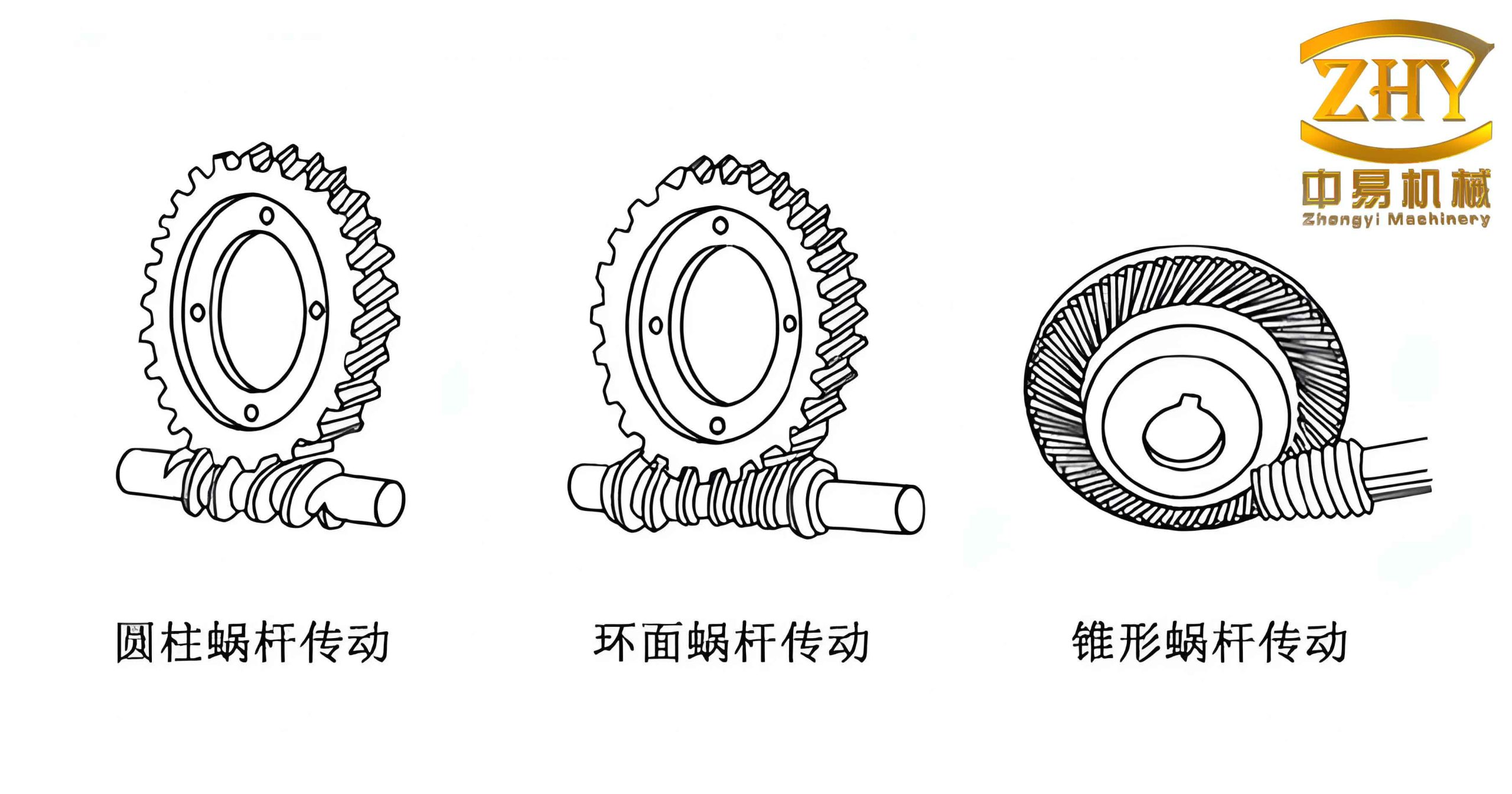
In this work, we focus on a typical cylindrical worm gear drive. The design variables are selected as the number of worm threads \(Z_1\), the diameter coefficient \(q\), and the module \(m\). The objective is to minimize the sum of the volumes of the worm and the worm gear, which is directly related to material cost and compactness. Reliability constraints are imposed on the contact fatigue strength and bending fatigue strength of the worm gear teeth, since the worm gear (typically made of bronze) is the weaker component. Additionally, geometric constraints such as limits on the number of teeth and modulus, as well as a stiffness constraint on the worm shaft, are included. The stress and strength are treated as random variables following lognormal distributions, and the reliability indices are derived from the stress-strength interference model.
The optimization problem is solved using MATLAB’s fmincon function, which implements sequential quadratic programming (SQP). The numerical example demonstrates that the optimized worm gears achieve a 40% reduction in volume compared to a conventional design, while maintaining the required reliability of 0.99 over an 8-year service life. The results validate the effectiveness of the proposed approach.
Mathematical Model for Reliability Optimization of Worm Gears
Design Variables and Objective Function
The design variables for the worm gear drive are chosen as:
\[
\mathbf{X} = [x_1, x_2, x_3]^T = [Z_1, q, m]^T
\]
where \(Z_1\) is the number of worm threads (typically 2–4 for power transmission), \(q\) is the diameter coefficient (ratio of pitch diameter to module), and \(m\) is the module in mm.
The objective function is the total volume of the worm and worm gear, which is expressed as:
\[
f(\mathbf{X}) = 0.78539 \left[ B_2^2 (m Z_2)^2 + L’ m^2 q^2 + m^2 (q-2.4)^2 (0.9 m Z_2 – L’) \right]
\]
where:
\[
B_2 = [m(q+2) – 0.5m] \sin\gamma + 0.8m
\]
\[
L’ = (12.5 + 0.09 Z_2)m + 25
\]
Here, \(Z_2 = \mu Z_1\) is the number of worm gear teeth (given the transmission ratio \(\mu = 18\)), and \(\gamma = 50^\circ\) is half the wrap angle. The volume minimization leads to a more compact and cost-effective design, especially important when using expensive bronze for the worm gear rim.
Reliability Constraints
Contact Fatigue Strength Reliability
The contact stress on the worm gear teeth is given by:
\[
\sigma_H = Z_E \sqrt{\frac{9 K T_2}{q m^3 \mu^2 Z_1^2}}
\]
where \(Z_E = \sqrt{160}\) MPa is the elastic coefficient, \(K\) is the load factor, and \(T_2 = 4.2 \times 10^5\) N·mm is the output torque. The coefficient of variation of the contact stress is:
\[
C_{\sigma_H} = \sqrt{C_{Z_E}^2 + 0.25(C_K^2 + C_{T_2}^2)}
\]
The contact fatigue strength (allowable stress) of the worm gear material (ZCuSn10P1) is characterized by a lognormal distribution. The mean and coefficient of variation of the contact fatigue limit are obtained from the material properties and life factors. The reliability index for contact strength is:
\[
Z_{R_H} = \frac{\ln(\sigma’_{H\lim} / \sigma_H)}{\sqrt{C_{\sigma’_{H\lim}}^2 + C_{\sigma_H}^2}}
\]
For the given example, after substituting numerical values, we derive:
\[
Z_{R_H} = 3.1726 \ln(x_1^2 x_2 x_3) – 23.977
\]
The constraint is:
\[
g_1(\mathbf{X}) = Z_{[R_H]} – Z_{R_H} \leq 0
\]
where \(Z_{[R_H]} = 2.326\) corresponds to a target reliability of 0.99 (from the standard normal distribution).
Bending Fatigue Strength Reliability
The bending stress on the worm gear teeth is:
\[
\sigma_F = \frac{F_{t2}}{\pi m_n b_2}
\]
where \(m_n\) is the normal module and \(b_2\) is the root arc length. The coefficient of variation is:
\[
C_{\sigma_F} = \sqrt{C_{F_{t2}}^2 + C_{b_2}^2}
\]
The bending fatigue limit is similarly modeled as lognormal. The reliability index becomes:
\[
Z_{R_F} = \frac{\ln(\sigma’_{F\lim} / \sigma_F)}{\sqrt{C_{\sigma’_{F\lim}}^2 + C_{\sigma_F}^2}}
\]
After numerical evaluation:
\[
Z_{R_F} = 4.4563 \ln(x_1 x_2 x_3^3) – 23.943
\]
The constraint is:
\[
g_2(\mathbf{X}) = Z_{[R_F]} – Z_{R_F} \leq 0
\]
with \(Z_{[R_F]} = 2.326\).
Geometric and Stiffness Constraints
The following boundary constraints are imposed based on practical design rules:
- Number of worm threads: \(2 \leq x_1 \leq 4\)
- Number of worm gear teeth: \(30 \leq 18x_1 \leq 80\)
- Module: \(2 \leq x_3 \leq 18\) mm
- Diameter coefficient: \(7 \leq x_2 \leq 20\)
- Worm shaft stiffness: The maximum deflection \(y\) must not exceed \(0.01 m\):
\[
y = \frac{F L^3}{48 E J} \leq 0.01 x_3
\]
where \(F = \sqrt{F_{t1}^2 + F_{r1}^2}\), \(L = 0.9 d_2 = 0.9 m \mu Z_1\), \(J = \frac{\pi}{64} m^4 (q-2.4)^4\), and \(E = 2.06 \times 10^5\) MPa. This constraint is expressed as:
\[
g_3(\mathbf{X}) = \frac{\sqrt{F_{t1}^2 + F_{r1}^2}}{48 E J} L – \frac{x_3}{50} \leq 0
\]
All linear constraints (bounds) are written in the standard form for MATLAB optimization.
Numerical Example and Solution
Consider a worm gear drive with the following specifications: input power \(P\), input speed \(n_1\), output speed \(n_2 = 6\) rpm, output torque \(T_2 = 4.2 \times 10^5\) N·mm, transmission ratio \(\mu = 18\), pressure angle \(\alpha = 20^\circ\), worm gear material ZCuSn10P1 with contact fatigue limit \(\sigma_{H\lim} = 220\) MPa and bending fatigue limit \(\sigma_{F\lim} = 56\) MPa, efficiency \(\eta = 0.83\). The required reliability is 0.99 (both contact and bending) over a service life of 8 years (300 days per year, 8 hours per day). The load is steady.
The optimization problem is solved using MATLAB’s fmincon function with the SQP algorithm. The initial guess is chosen as \([Z_1=2, q=10, m=6]\). The optimal continuous solution is:
\[
\mathbf{X}^* = [2.1622,\ 9.1917,\ 4.5270]
\]
\[
f(\mathbf{X}^*) = 1.1701 \times 10^6\ \text{mm}^3
\]
After rounding to standard discrete values (since module and diameter coefficient are typically standardized), we obtain:
\[
Z_1 = 2,\quad q = 9,\quad m = 5\ \text{mm}
\]
\[
V = 1.34 \times 10^6\ \text{mm}^3
\]
Comparison with Conventional Design
Table 1 compares the key parameters between the conventional design and the optimized design for worm gears.
| Parameter | Conventional Design | Optimized Design |
|---|---|---|
| Number of worm threads \(Z_1\) | 2 | 2 |
| Diameter coefficient \(q\) | 10 | 9 |
| Module \(m\) (mm) | 6 | 5 |
| Total volume \(V\) (mm³) | 2.2631 × 10⁶ | 1.34 × 10⁶ |
The volume reduction is approximately 40.8%, demonstrating a significant material saving.
Table 2 presents the reliability over time for both designs, considering the contact fatigue strength of the worm gear teeth. The life factor \(K_N = \sqrt[8]{10^7 / (60 n t)}\) is used, where \(n = n_2\) and \(t\) is the operating time in hours. The reliability index \(Z_{R_H}\) is computed from the derived formula.
| Years | \(K_N\) | Conventional Design | Optimized Design | ||
|---|---|---|---|---|---|
| \(Z_{R_H}\) | \(R_H\) | \(Z_{R_H}\) | \(R_H\) | ||
| 1 | 1.3581 | 6.12 | 0.998517 | 4.05 | 0.947439 |
| 3 | 1.1838 | 5.25 | 0.987164 | 3.18 | 0.932636 |
| 5 | 1.1106 | 4.84 | 0.963508 | 2.77 | 0.99719 |
| 7 | 1.0649 | 4.57 | 0.957561 | 2.50 | 0.99379 |
| 8 | 1.0472 | 4.47 | 0.956089 | 2.40 | 0.99180 |
| 9 | 1.0319 | 4.37 | 0.953788 | 2.30 | 0.98928 |
| 10 | 1.0184 | 4.29 | 0.951066 | 2.22 | 0.98679 |
Note: The reliability values with superscript digit (e.g., 0.999) indicate a string of nines; here 0.99719 means \(1 – 2.81\times10^{-3}\). The conventional design has a very high reliability even after 10 years (0.951), which implies over-design and material waste. The optimized design achieves exactly the target reliability of 0.99 at 8 years, and then drops slightly below thereafter, which is acceptable for the specified life. This demonstrates that the reliability optimization design of worm gears yields a balanced solution.
Discussion on the Reliability Optimization of Worm Gears
The proposed method combines the established stress-strength interference theory (with lognormal distributions) with modern optimization algorithms. The use of MATLAB’s optimization toolbox simplifies the solution process significantly. The SQP algorithm efficiently handles the nonlinear constraints and provides accurate results. Engineers can easily adapt the model for different worm gear applications by modifying the input parameters (torque, ratio, material properties, target reliability).
It is important to note that the reliability of worm gears is not only affected by contact and bending fatigue but also by wear and scoring. However, for the closed-drive worm gears lubricated with oil, contact fatigue (pitting) is the dominant failure mode. The bending fatigue constraint ensures that the teeth do not break under overload. The stiffness constraint prevents excessive deflection that could lead to misalignment and premature failure. Additional constraints, such as thermal limits or efficiency requirements, can be incorporated into the model if needed.
The results clearly show that the optimized worm gears are more compact and cost-effective while meeting the reliability requirement exactly at the end of the design life. In contrast, conventional design approaches often result in over-conservative parameters, leading to larger and more expensive worm gears. The reliability optimization design thus provides a rational trade-off between safety and economy.
Conclusions
In this study, we have successfully developed a reliability optimization design methodology for worm gears. The key findings are:
- The objective function minimizing the total volume of the worm and worm gear, combined with reliability constraints on contact and bending strength, yields a compact and reliable design.
- The stress and strength are modeled as lognormal random variables, and the reliability indices are derived analytically, allowing efficient integration into the optimization loop.
- MATLAB’s fmincon solver with SQP algorithm is effective for solving this nonlinear constrained optimization problem.
- The numerical example demonstrates a volume reduction of over 40% compared to a conventional design, while maintaining the required reliability of 0.99 over an 8-year life.
- The proposed method can be extended to other mechanical components where both reliability and optimality are desired.
In conclusion, the reliability optimization design of worm gears presented here offers a practical and powerful tool for engineers. By explicitly accounting for uncertainties, this approach ensures that worm gears are neither over-designed nor under-designed, leading to better resource utilization and enhanced product performance.