
In my research on the modification design of herringbone gears, I have focused on optimizing the performance of double helical gear pairs through the use of KISSsoft software. Herringbone gears are widely used in high-end equipment such as ship propulsion systems, helicopter main transmissions, and geared turbofan engines due to their high load-carrying capacity and smooth operation. However, issues such as installation errors, elastic deformations, and manufacturing inaccuracies often lead to edge contact, stress concentration, and increased vibration and noise. To address these problems, profile and lead modifications are essential. In this study, I present a systematic method for designing and optimizing modification parameters for herringbone gears using KISSsoft, and I validate the approach with a practical industrial case.
The traditional approach to gear modification design typically involves calculating modification parameters based on design handbooks and standards, followed by experimental verification through rolling inspection and transmission error measurement. This iterative process is time-consuming and costly. In contrast, KISSsoft software provides a powerful platform for simulating gear contact and analyzing performance indicators such as transmission error, normal line load, and tooth surface load distribution. By integrating these simulations, I can efficiently evaluate and refine modification parameters without the need for repeated physical prototyping.
Traditional Modification Design Process for Herringbone Gears
In the conventional method, modification parameters are first derived from recommended formulas in standards such as AGMA 109.16 and ISO 6336. The gear pair is then manufactured and tested on a test rig to measure transmission error, vibration, and noise, and to inspect the contact pattern. If the performance does not meet requirements, the modification parameters are adjusted and the process is repeated. This approach is illustrated in the following flowchart (not shown here due to the constraint of no image citations, but the concept is standard). The iterative nature of this method makes it inefficient, especially for complex herringbone gear systems where the double helical structure introduces additional considerations.
KISSsoft-Based Modification Design Methodology
My proposed method using KISSsoft software streamlines the process. Since a herringbone gear consists of two mirrored helical gears, KISSsoft requires that each side be modeled separately for contact analysis. The software calculates initial profile and lead modification parameters based on international standards (ISO 21771 and ISO 6336). Then, I set the gear parameters for one flank of the herringbone gear and perform a contact analysis. The resulting transmission error curve, normal line load, and tooth surface load distribution serve as criteria to judge the quality of the modifications. If the performance is suboptimal, I adjust the modification parameters and re-analyze until satisfactory results are obtained. The overall flow is summarized as follows:
- Input basic gear geometry, material properties, lubrication, and operating conditions into KISSsoft.
- Define initial profile and lead modifications based on standards or experience.
- Run contact analysis and evaluate performance indicators.
- If performance is acceptable, finalize the modification parameters; otherwise, adjust parameters and repeat step 3.
This simulation-driven approach significantly reduces the development time and cost compared to the traditional trial-and-error method.
Performance Evaluation Indicators
To assess the effectiveness of modification parameters, I rely on several key indicators. The most important ones for herringbone gears include the minimum root bending fatigue safety factor $S_{Fmin}$, the minimum flank contact fatigue safety factor $S_{Hmin}$, the transmission error (TE), and the tooth surface load distribution. Table 1 summarizes the recommended threshold values for the safety factors based on reliability requirements.
| Reliability Level | $S_{Fmin}$ | $S_{Hmin}$ |
|---|---|---|
| General | $\ge 1.25$ | $\ge 1.00$ |
| High | $\ge 1.60$ | $\ge 1.25$ |
Transmission error is defined as the difference between the actual angular position of the driven gear and its theoretical position assuming ideal involute profiles and no elastic deformation. It is widely recognized as the primary excitation source for gear noise and vibration. Therefore, minimizing the peak-to-peak value of TE is a critical goal in modification design. The tooth surface load distribution indicates how evenly the load is spread across the tooth face. Concentrated loads at the tooth ends can lead to premature failure, so a uniform distribution is desired.
Influence of Axis Parallelism Deviation
Axis parallelism deviations arise from support shaft deflections, bearing clearances, and housing deformations. For herringbone gears, these deviations can significantly affect meshing behavior. According to ISO standards, two types of deviations are distinguished: the deviation in the plane of action $f_{\sum \delta}$ and the deviation in the perpendicular plane $f_{\sum \beta}$. The recommended maximum values are given by:
$$ f_{\sum \beta} = 0.5 \left( \frac{L}{b} \right) F_{\beta} $$
$$ f_{\sum \delta} = 2 f_{\sum \beta} $$
where $L$ is the bearing span, $b$ is the face width, and $F_{\beta}$ is the total helix deviation. For a herringbone gear with a single helical flank width $b$ and a gap width $c$, the deviations are distributed between the two flanks. The modified deviations for each single helical gear are:
$$ f’_{\sum \beta} = \frac{b}{2b + c} f_{\sum \beta} $$
$$ f’_{\sum \alpha} = \frac{b}{2b + c} f_{\sum \delta} $$
In KISSsoft, these values are input as axis alignment errors for each flank. Proper accounting of these deviations is essential for realistic simulation of herringbone gear contact.
Optimization Case Study: Industrial Herringbone Gear Pair
To demonstrate the effectiveness of my modification design method, I selected a real industrial herringbone gear pair (referred to as gears $z_3$ and $z_4$) from a reduction gearbox. The gearbox schematic is omitted here. The output power is 1000 kW at 1020 rpm on the output shaft, meaning each single flank of the $z_3$-$z_4$ pair handles 250 kW. The gear material is 18CrNiMo7-6, case-carburized and hardened to 60-62 HRC. The lubrication oil is ISO VG100 with jet lubrication. The basic parameters of the herringbone gear pair are listed in Table 2.
| Parameter | $z_3$ | $z_4$ |
|---|---|---|
| Normal module $m_n$ (mm) | 3.5 | 3.5 |
| Number of teeth $z$ | 25 | 110 |
| Normal pressure angle $\alpha_n$ (°) | 22.5 | 22.5 |
| Helix angle $\beta$ (°) | 30 | 30 |
| Hand of helix | Left – Right | Right – Left |
| Addendum coefficient $h_{an}^*$ | 1.2 | 1.2 |
| Clearance coefficient $c_n^*$ | 0.45 | 0.45 |
| Root fillet radius coefficient $\rho_{fp}^*$ | 0.152 | 0.152 |
| Profile shift coefficient $x_n$ | 0.05 | -0.05 |
| Single flank face width $b$ (mm) | 47 | 47 |
| Gap width $c$ (mm) | 20 | 20 |
| Accuracy grade (ISO) | 5 | 5 |
The original modification parameters (from the existing design) and the optimized parameters obtained through my KISSsoft-based method are compared in Table 3. The profile modification curve is a quadratic parabola in both cases. The axis parallelism deviations were calculated using the formulas above, with the total helix deviation $F_{\beta} = 11\ \mu$m (from ISO 5 grade) and bearing span $L = 292.2\ \text{mm}$. The resulting deviations for each single flank were $f’_{\sum \beta} = 5.8\ \mu$m and $f’_{\sum \alpha} = 11.6\ \mu$m.
| Parameter | Flank | Original | Optimized (KISSsoft) |
|---|---|---|---|
| Profile modification amount ($\mu$m) | $z_{3L}$ | 18 | 15 |
| $z_{4L}$ | 18 | 15 | |
| $z_{3R}$ | 18 | 15 | |
| $z_{4R}$ | 18 | 15 | |
| Profile modification start diameter $d_{ca}$ (mm) | $z_{3L}$ | 124.360 | 126.532 |
| $z_{4L}$ | 531.650 | 534.118 | |
| $z_{3R}$ | 124.360 | 126.532 | |
| $z_{4R}$ | 531.650 | 534.118 | |
| Lead crown modification ($\mu$m) | $z_{3L}$ | 27.4 | 20 |
| $z_{4L}$ | 27.4 | 0 | |
| $z_{3R}$ | 27.4 | 20 | |
| $z_{4R}$ | 27.4 | 0 | |
| Helix slope modification ($\mu$m) | $z_{3L}$ | 0 | 10 |
| $z_{4L}$ | 0 | 0 | |
| $z_{3R}$ | 0 | 10 | |
| $z_{4R}$ | 0 | 0 |
After setting up the model in KISSsoft with the above parameters, I performed a contact analysis for both the original and optimized modifications. The results for the left and right flanks are presented in Tables 4 and 5. Note that due to symmetry, the left and right flanks show identical safety factors and nearly identical performance improvements.
| Parameter | Original | Optimized |
|---|---|---|
| Root bending fatigue safety factor $S_F$ | 4.8723 / 3.5574 | 4.8572 / 3.5463 |
| Flank contact fatigue safety factor $S_H$ | 2.1045 / 2.2019 | 2.1014 / 2.1986 |
| Anti-scuffing safety factor (integral temperature) | 4.4452 | 4.4066 |
| Anti-scuffing safety factor (flash temperature) | 12.6513 | 12.6520 |
| Load distribution factor $K_{H\beta}$ | 1.6412 | 1.2368 |
| Parameter | Original | Optimized |
|---|---|---|
| Root bending fatigue safety factor $S_F$ | 4.8723 / 3.5574 | 4.8572 / 3.5463 |
| Flank contact fatigue safety factor $S_H$ | 2.1045 / 2.2019 | 2.1014 / 2.1986 |
| Anti-scuffing safety factor (integral temperature) | 4.4452 | 4.4066 |
| Anti-scuffing safety factor (flash temperature) | 12.6513 | 12.6520 |
| Load distribution factor $K_{H\beta}$ | 1.6412 | 1.2368 |
The safety factors for bending and contact fatigue remain essentially unchanged, which is expected because these are primarily influenced by gear geometry and material rather than modification. However, the load distribution factor $K_{H\beta}$ decreased significantly from 1.6412 to 1.2368, a reduction of 24.6%, indicating much more uniform load sharing along the face width.
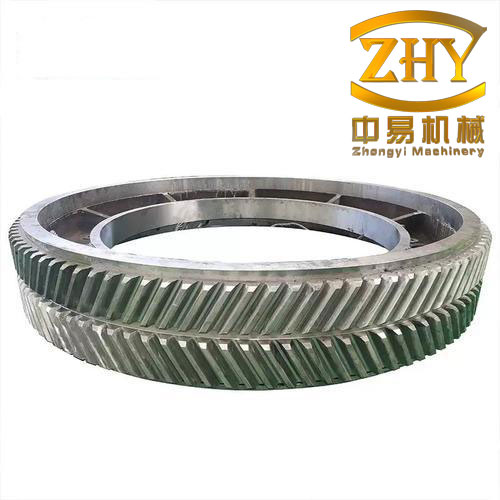
Figure 1 (inserted below) shows the herringbone gear pair used in this study. The image illustrates the typical double helical structure.
The transmission error curves are another critical indicator. The peak-to-peak transmission error for the left flank was reduced from 1.483 $\mu$m to 0.849 $\mu$m, a decrease of 42.8%. For the right flank, the reduction was from 1.492 $\mu$m to 0.797 $\mu$m, a decrease of 46.6%. These substantial reductions imply that the optimized modification significantly lowers the vibration and noise excitation of the herringbone gear pair.
The normal line load also improved dramatically. For the left flank, the maximum normal line load decreased from 484.131 N/mm to 329.552 N/mm (a 31.9% reduction), and for the right flank from 482.181 N/mm to 327.709 N/mm (32.0% reduction). This reduction in contact pressure enhances the fatigue life of the gear teeth.
The tooth surface load distribution plots (not reproduced here due to the text-only requirement) showed that the original modification led to a concentrated load near the middle of the tooth, while the optimized modification spread the load more evenly across the entire face width, avoiding edge loading and reducing peak stresses.
Conclusion
In this study, I have presented a systematic approach for designing modification parameters of herringbone gears using KISSsoft software. By incorporating axis parallelism deviations and torque effects, the method allows for realistic simulation and optimization of both profile and lead modifications. The industrial case study demonstrated that the optimized parameters reduced the load distribution factor $K_{H\beta}$ by 24.6%, peak-to-peak transmission error by over 42%, and maximum normal line load by nearly 32%, all while maintaining equivalent safety factors. This confirms that the KISSsoft-based approach is a powerful and efficient tool for herringbone gear modification design, avoiding the costly and time-consuming iterative process of traditional methods. The methodology can be directly applied to other herringbone gear designs to improve their performance in terms of noise, vibration, and load-carrying capacity.