
In modern power transmission systems, helical gear sets are widely used in high-speed, high-load applications such as aerospace, marine propulsion, and electric vehicles. The dynamic performance of these systems is critically influenced by the loaded transmission error (LTE) fluctuation, which serves as a primary excitation source for vibration and noise. To mitigate these adverse effects, we propose a novel method for the optimization design of triangular end relief (also known as diagonal modification) on helical gear tooth surfaces, combined with a grinding process using a large plane grinding wheel. This paper presents a comprehensive framework that covers the theoretical definition of the modified tooth surface, optimization of modification parameters based on genetic algorithms, derivation of the grinding principle, and numerical validation. Our results demonstrate that the proposed method can significantly reduce LTE fluctuation while maintaining high tooth surface accuracy, with deviations controlled within 2 μm. The approach is also well-suited for numerical control (NC) programming, offering a practical solution for industrial implementation.
We begin by defining the geometry of a standard involute helical gear tooth surface. Let the position vector and unit normal vector of the standard involute surface for the pinion (small gear) be expressed as:
$$ \mathbf{r}_1(u_1, \theta_1) = \begin{bmatrix} x_1(u_1,\theta_1) \\ y_1(u_1,\theta_1) \\ z_1(u_1,\theta_1) \end{bmatrix}, \quad \mathbf{n}_1(u_1,\theta_1) = \frac{\partial \mathbf{r}_1/\partial u_1 \times \partial \mathbf{r}_1/\partial \theta_1}{|\partial \mathbf{r}_1/\partial u_1 \times \partial \mathbf{r}_1/\partial \theta_1|} $$
Here, \(u_1\) and \(\theta_1\) are the surface coordinates. The triangular end relief is characterized by modification zones only at the tooth tip and root regions, leaving the central part of the tooth flank unmodified (or with minimal modification). The key geometric parameters of triangular end relief are illustrated in the following definition:
Let \(L_{Ea}\) be the tooth tip modification height, \(C_{Ea}\) the maximum modification amount at the tooth tip, \(L_{Ef}\) the tooth root modification height, and \(C_{Ef}\) the maximum modification amount at the tooth root. The modification start lines (the boundaries between modified and unmodified regions) are the contact lines corresponding to these heights. On the rotational projection plane (a plane where the gear axis is represented by the vertical coordinate and the radial direction by the horizontal coordinate), these start lines are approximately straight lines with helix angles \(\beta_a\) and \(\beta_f\) for the tip and root, respectively.
To determine the exact coordinates of the start points, we solve the following system of nonlinear equations for points B (tip start) and Q (root start):
$$ \begin{cases} x_{1i}^2(u_{1i},\theta_{1i}) + y_{1i}^2(u_{1i},\theta_{1i}) = R_i \\ z_{1i}(u_{1i},\theta_{1i}) = L_i \end{cases}, \quad i = B, C \text{ for tip; } E, F \text{ for root} $$
Here, \(R_i\) and \(L_i\) are the coordinates in the rotational projection plane. The tip modification termination line is at the addendum circle (or slightly below to account for chamfering), while the root modification termination line is at the start of active profile determined by the minimum working length. The root start radius \(r_{k1}\) is computed from:
$$ r_{k1} = \sqrt{ r_{b1}^2 + \left[ (r_{p1}+r_{p2})\sin\alpha_t – \sqrt{ r_{a2}^2 – r_{b2}^2 } \right]^2 } $$
where \(r_{a2}\) is the addendum radius of the mating gear, \(r_{b1}, r_{b2}\) are the base radii, \(r_{p1}, r_{p2}\) are the pitch radii, and \(\alpha_t\) is the transverse pressure angle.
Once the start lines are determined, the modification amount at any point P within the triangular zone is defined as a function of the distance \(l_p\) from P to the start line. The modification follows a power law of order \(k_a\) (tip) or \(k_f\) (root). Mathematically:
$$ \delta(x,y) = \begin{cases} C_{Ea} \left( \frac{l_p}{l_a} \right)^{k_a}, & P \in \triangle ABC \text{ (tip)} \\ C_{Ef} \left( \frac{l_p}{l_f} \right)^{k_f}, & P \in \triangle DEF \text{ (root)} \\ 0, & \text{otherwise} \end{cases} $$
where \(l_a\) and \(l_f\) are the maximum lengths in the tip and root modification zones, respectively. The modified tooth surface is then obtained by adding the modification amount in the normal direction to the standard involute surface:
$$ \mathbf{r}_{1m}(u_1,\theta_1) = \mathbf{r}_1(u_1,\theta_1) + \delta(x,y)\,\mathbf{n}_1(u_1,\theta_1) $$
The unit normal of the modified surface is given by:
$$ \mathbf{n}_{1m} = \frac{ \left( \frac{\partial \mathbf{r}_1}{\partial u_1} + \frac{\partial \delta}{\partial u_1} \mathbf{n}_1 \right) \times \left( \frac{\partial \mathbf{r}_1}{\partial \theta_1} + \frac{\partial \delta}{\partial \theta_1} \mathbf{n}_1 \right) }{ \left| \left( \frac{\partial \mathbf{r}_1}{\partial u_1} + \frac{\partial \delta}{\partial u_1} \mathbf{n}_1 \right) \times \left( \frac{\partial \mathbf{r}_1}{\partial \theta_1} + \frac{\partial \delta}{\partial \theta_1} \mathbf{n}_1 \right) \right| } $$
To achieve the best vibration reduction, we perform an optimization with the objective of minimizing the fluctuation of loaded transmission error \(\Delta T_e\). The fluctuation is defined as the difference between the maximum and minimum of the loaded transmission error over one meshing cycle:
$$ \Delta T_e = \max(T_e) – \min(T_e) $$
The design variables are the four key modification parameters: \(L_{Ea}, C_{Ea}, L_{Ef}, C_{Ef}\). Additionally, the order of the modification curve (linear, quadratic, or quartic) is considered. We employ a genetic algorithm (GA) for optimization, as the relationship between design variables and the objective function is highly nonlinear and cannot be expressed analytically. The GA flowchart includes encoding, initialization, fitness evaluation (based on TCA and LTCA), selection, crossover, and mutation. The population size is set to 50, number of generations to 30, crossover probability 0.6, and mutation probability 0.1.
The tooth contact analysis (TCA) and loaded tooth contact analysis (LTCA) are performed iteratively within the GA loop. TCA computes the unloaded contact pattern and geometric transmission error. LTCA uses a semi-analytical approach combining finite element method (for tooth compliance) and Hertzian contact theory to determine the loaded deformation and the resulting loaded transmission error under specified torque (e.g., 1500 Nm in our example).
The grinding of the modified helical gear is realized by a large plane grinding wheel that simulates one side of an imaginary rack cutter. The grinding principle is based on the generating motion between the grinding wheel (acting as the rack tooth surface) and the workpiece gear. The large plane grinding wheel has a flat working face that corresponds to the side face of the rack cutter. The wheel rotates about its own axis (main cutting motion) and does not require axial feed, which significantly improves efficiency. The workpiece rotates about its own axis while also executing an additional tangential translation (or equivalently an additional rotation) to achieve the diagonal modification effect.
Figure
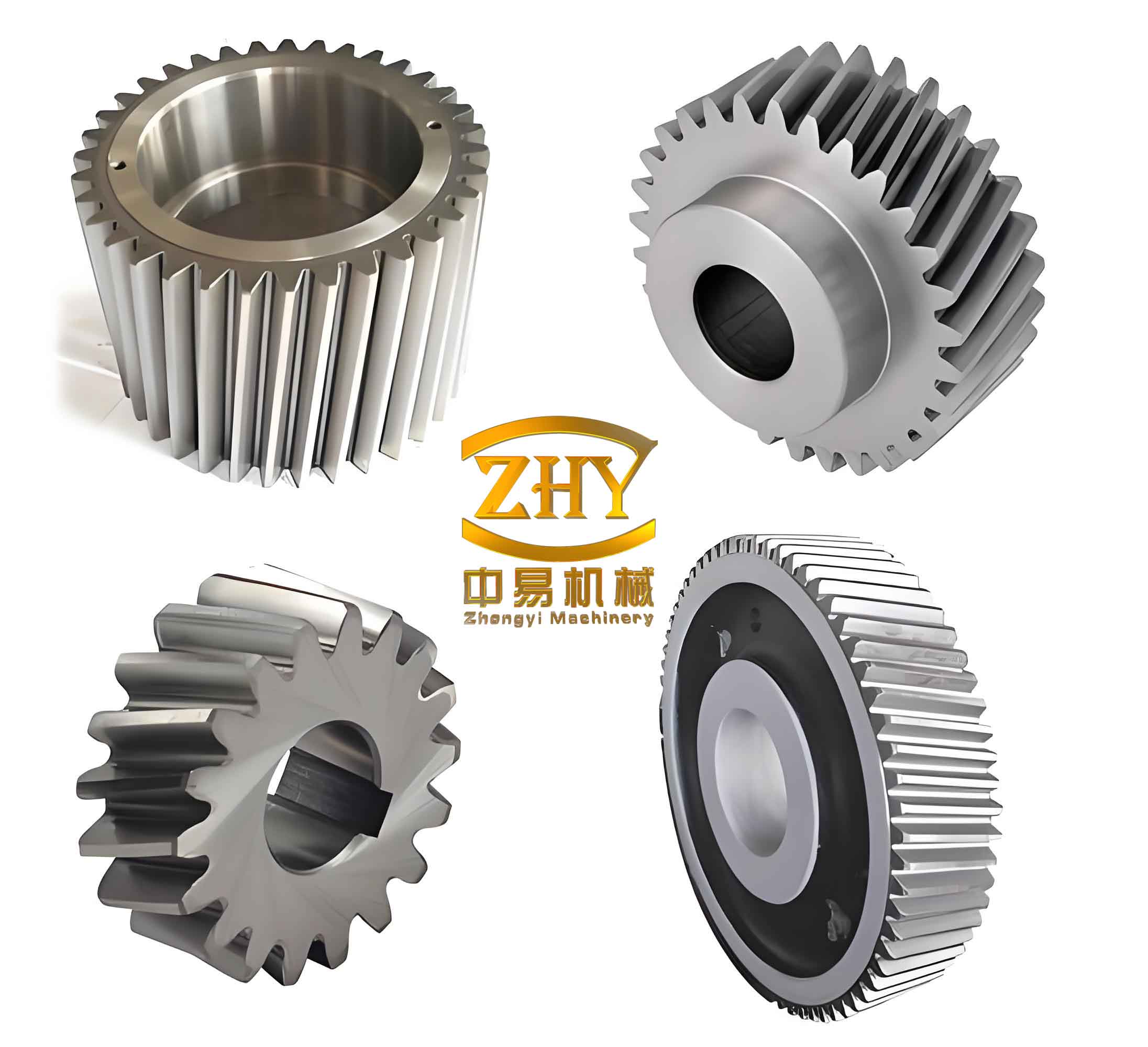
illustrates a typical helical gear pair.
Several coordinate systems are defined for the grinding kinematics: a fixed reference frame \(S_f\), a moving frame \(S_1\) attached to the workpiece, and a frame \(S_t\) attached to the grinding wheel. The rack cutter surface generated by the wheel is expressed in coordinates \(S_c\). The transformation from the wheel frame to the rack cutter frame involves translations and rotations accounting for the helix angle \(\beta\) and the normal pressure angle \(\alpha_n\).
The position and unit normal of the grinding wheel’s working face in its own frame \(S_t\) are simply:
$$ \mathbf{R}_t(r_t,\theta_t) = \begin{bmatrix} -r_t \cos\theta_t \\ 0 \\ r_t \sin\theta_t \end{bmatrix}, \quad \mathbf{N}_t = \begin{bmatrix} 0 \\ 1 \\ 0 \end{bmatrix} $$
where \(r_t\) and \(\theta_t\) are parameters of the wheel surface. After transferring to the rack cutter frame \(S_c\), we obtain the rack tooth surface:
$$ \mathbf{R}_c(r_t,\theta_t) = \mathbf{M}_{ct} \mathbf{R}_t(r_t,\theta_t), \quad \mathbf{N}_c = \mathbf{L}_{ct} \mathbf{N}_t $$
Here, \(\mathbf{M}_{ct}\) is the homogeneous transformation matrix, and \(\mathbf{L}_{ct}\) is its rotational part.
The key innovation for grinding triangular end relief is the addition of a tangential displacement \(\Delta L\) of the rack cutter (or equivalently the workpiece) as a function of the workpiece rotation angle \(\theta_1\). The displacement is zero in the unmodified region and follows the same power law as the modification amount in the tip and root zones. Specifically:
$$ \Delta L(\theta_1) = \begin{cases} C_{Ea} \frac{r_{p1}}{r_{b1}} \left( \frac{\theta_1 – \theta_B}{\theta_A – \theta_B} \right)^{k_a}, & \theta_1 > \theta_B \quad (\text{tip}) \\ 0, & \theta_E \le \theta_1 \le \theta_B \\ C_{Ef} \frac{r_{p1}}{r_{b1}} \left( \frac{\theta_1 – \theta_E}{\theta_D – \theta_E} \right)^{k_f}, & \theta_1 < \theta_E \quad (\text{root}) \end{cases} $$
where \(\theta_A\) and \(\theta_B\) are the workpiece rotation angles when grinding the addendum circle and the tip start line, respectively; \(\theta_D\) and \(\theta_E\) are the angles for the root termination and root start line, respectively.
The generated tooth surface of the helical gear is the envelope of the family of rack cutter surfaces. The family of surfaces in the workpiece frame \(S_1\) is:
$$ \mathbf{R}_1(r_t,\theta_t,\theta_1) = \mathbf{M}_{1c}(\theta_1, \Delta L(\theta_1)) \, \mathbf{R}_c(r_t,\theta_t) $$
$$ \mathbf{N}_1(r_t,\theta_t,\theta_1) = \mathbf{L}_{1c}(\theta_1, \Delta L(\theta_1)) \, \mathbf{N}_c(r_t,\theta_t) $$
The meshing condition (envelope condition) requires:
$$ f(r_t,\theta_t,\theta_1) = \mathbf{N}_1 \cdot \frac{\partial \mathbf{R}_1}{\partial \theta_1} = 0 $$
Solving this equation together with the surface representation yields the final ground tooth surface coordinates.
We performed numerical simulations for a helical gear pair with the parameters listed in Table 1. The pinion has 30 teeth, the gear 72 teeth, module 5 mm, pressure angle 20°, helix angle 33.273°, and both have a face width of 40 mm. The rated torque is 1500 Nm. The large plane grinding wheel is designed with a fillet radius \(r_f = 0.25\) mm. The minimum required wheel diameter is found to be 496.6 mm by ensuring that the chord length of the working face exceeds the gear tooth width projected in the transverse plane.
Table 1: Basic Parameters of the Helical Gear Pair
| Parameter | Pinion | Gear |
|---|---|---|
| Number of teeth | 30 | 72 |
| Module (mm) | 5 | 5 |
| Pressure angle (°) | 20 | 20 |
| Helix angle (°) | 33.273 | 33.273 |
| Hand of helix | Right | Left |
| Face width (mm) | 40 | 40 |
After optimization using the genetic algorithm, we obtained the optimal modification parameters for three different orders of the modification curve: linear (k=1), quadratic (k=2), and quartic (k=4). The results are summarized in Table 2.
Table 2: Optimal Triangular End Relief Parameters for Different Orders
| Modification Parameter | Linear (k=1) | Quadratic (k=2) | Quartic (k=4) |
|---|---|---|---|
| Tip modification height (mm) | 2.366 | 4.887 | 6.818 |
| Tip modification length (mm) | 8.272 | 18.050 | 26.555 |
| Max tip modification (μm) | 15.98 | 9.32 | 11.15 |
| Tip start line helix angle (°) | 15.96 | 15.15 | 14.40 |
| Root modification height (mm) | 2.541 | 2.923 | 6.352 |
| Root modification length (mm) | 13.155 | 14.888 | 28.766 |
| Max root modification (μm) | 16.27 | 9.62 | 17.57 |
| Root start line helix angle (°) | 10.93 | 11.11 | 12.45 |
The modification amount distributions over the tooth surface are characterized by a triangular zone at the tip and root. For the right-hand pinion left flank, the tip modification zone is near the axial coordinate \(z_a = -20\) mm (one end of the face width) and the root modification zone is near \(z_a = 20\) mm. The shape of the modification zone is defined by the start lines, which are approximately straight. The modification value increases from zero at the start line to the maximum at the tooth tip/root boundary. Higher order curves lead to more gradual increases near the start line and steeper increases near the boundary.
We compared the ground tooth surface (generated by the large plane grinding wheel with the tangential additional motion) with the theoretical modified surface to evaluate tooth surface deviations. The deviation is defined as the distance between the two surfaces measured along the normal direction of the theoretical surface. The maximum deviation for the linear case is 1.7 μm at the tip and 1.8 μm at the root. For the quadratic case, deviations are 1.2 μm and 0.85 μm, respectively. For the quartic case, deviations are 1.2 μm and 1.9 μm. These deviations are mainly caused by the approximation of the curved start line as a straight line during the theoretical modification definition; the grinding process actually produces a curved start line, leading to small errors that increase with distance from the start line. Nevertheless, all deviations are within 2 μm, which is considered excellent for high-precision gear manufacturing.
The additional tangential displacement \(\Delta L\) required for the grinding process is plotted as a function of the instantaneous workpiece rotation angle \(\theta_1\). The curve consists of three sections: the root modification zone (left portion, negative additional motion), the unmodified zone (middle, zero), and the tip modification zone (right portion, positive motion). The magnitude of the displacement is proportional to the maximum modification and follows the same power law. Higher-order curves produce smoother transitions at the boundaries.
Using the ground tooth surface equations, we performed TCA to obtain the contact pattern and geometric transmission error. The contact pattern (tooth bearing) is essentially unchanged among the three modification orders; it remains centered on the tooth flank. However, the geometric transmission error curve becomes steeper as the modification order increases. The loaded transmission error (LTE) under rated torque is computed and compared with the standard (unmodified) gear pair. The results are dramatic:
- Standard (unmodified): LTE fluctuation = 2.587 arcseconds
- Linear modification: LTE fluctuation = 0.9483 arcseconds (reduction of 63.3%)
- Quadratic modification: LTE fluctuation = 0.9049 arcseconds (reduction of 65.0%)
- Quartic modification: LTE fluctuation = 0.4507 arcseconds (reduction of 82.6%)
Thus, the higher-order modification yields the greatest reduction in loaded transmission error fluctuation. The quartic curve achieves the largest reduction, which is consistent with the fact that a smoother modification profile reduces the impact at the engagement and disengagement zones, leading to smaller dynamic excitation.
In summary, this work presents a comprehensive methodology for designing and grinding triangular end relief on helical gear tooth surfaces. The key contributions include:
- A mathematical model for the modified tooth surface based on superposition of a power-law triangular end relief onto a standard involute helical surface.
- An optimization framework using genetic algorithms to minimize loaded transmission error fluctuation, with modification parameters as design variables.
- A grinding principle employing a large plane grinding wheel that simulates a rack cutter, with an additional tangential motion controlled by the same power law to generate the modification.
- Numerical validation demonstrating that tooth surface deviations are minimal (within 2 μm) and that LTE fluctuation can be reduced by up to 82.6%.
The proposed method is highly suitable for NC programming because the additional motion can be easily superimposed on the basic generating motion. Future work will focus on experimental validation and extension to other types of tooth modifications (e.g., helix crowning) using the same grinding setup.