
In recent years, the rapid development of new energy vehicles has imposed stringent requirements on the noise, vibration, and harshness (NVH) performance of transmissions. As a key component, the helical gear must be manufactured with high precision to meet the demands of high speed and low noise. The worm wheel generating grinding method is widely adopted for its efficiency and accuracy in finishing cylindrical gears. However, when grinding helical gears with longitudinal tooth crowning (helix modification), an undesirable tooth flank twist often appears due to the asymmetry of instantaneous contact lines on the left and right flanks. This twist leads to inconsistent material removal along the tooth width, causing significant deviations in both profile and lead errors, which ultimately degrade the transmission performance. In our research, we propose a novel anti-twist grinding method that employs an arc-shaped worm wheel to compensate for the tooth flank twist. By carefully designing the curvature of the worm wheel profile, we can actively correct the varying pressure angle deviations along the tooth width, thereby eliminating the twist distortion. In this paper, we present a comprehensive theoretical analysis, computational models, and simulation verifications to demonstrate the effectiveness of the proposed method.
Our work begins with the establishment of the spatial meshing coordinate system for the worm wheel and the helical gear, based on the double-parameter envelope process. We derive the instantaneous contact lines on the tooth flanks and then compute the twist amounts at different tooth width positions according to the helix modification curve. By relating the pressure angle deviation at each cross-section to the required compensation displacement of the worm wheel, we determine the arc radius of the worm wheel at corresponding positions. Finally, using typical gear parameters, we simulate the grinding process and compare the deviations before and after compensation. The results show that the proposed arc-shaped worm wheel dressing method can reduce the twist by over 94%, validating its feasibility.
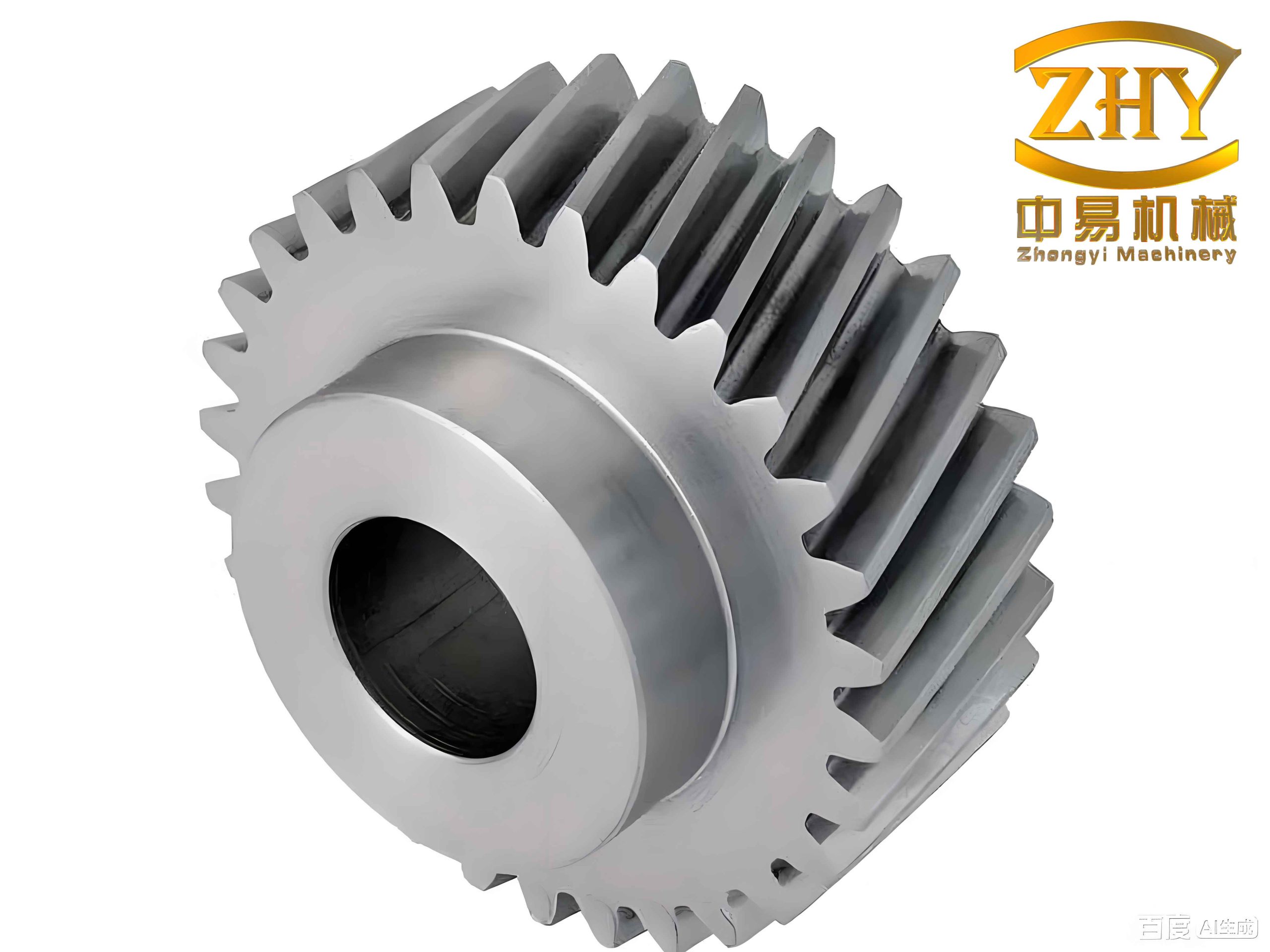
Theoretical Background and Twist Generation Mechanism
Instantaneous Contact Line Calculation
We consider the worm wheel and the helical gear as a pair of crossed-axis involute helical gears. The grinding process is a continuous generating motion, similar to hobbing. The coordinate systems are defined as shown in the standard grinding setup. The worm wheel rotates with angular velocity $\omega_1$ about its axis $z_1$, and simultaneously translates along $z_1$ with velocity $v_{01}$. The gear rotates with angular velocity $\omega_2$ about its axis $z_2$, and translates along $z_2$ with velocity $v_{02}$. The relationship between the angular velocities satisfies:
$$
\omega_2 = i_{21} \omega_1 + \frac{v_{02}}{P_2} – i_{21} \frac{v_{01}}{P_1}
$$
where $i_{21}$ is the transmission ratio, and $P_1$, $P_2$ are the helical parameters of the worm wheel and the helical gear, respectively.
The worm wheel surface $\mathbf{r}_1(u, \theta_1)$, expressed in its own coordinate system, is transformed into the gear coordinate system through a series of rotations and translations. The resulting surface $\mathbf{r}_2$ is given by:
$$
\mathbf{r}_2(\varphi_1, \varphi_2, u, \theta_1) = \mathbf{M}_{2p}(\varphi_2) \mathbf{M}_{p0} \mathbf{M}_{01}(\varphi_1) \mathbf{r}_1(u, \theta_1)
$$
The transformation matrices $\mathbf{M}_{2p}$, $\mathbf{M}_{p0}$, and $\mathbf{M}_{01}$ incorporate rotations $\varphi_1$, $\varphi_2$ and translations $l_{10}$, $l_{20}$ as well as the center distance $a$ and the shaft angle $\Sigma$. The meshing condition for point contact is expressed by the equation:
$$
\mathbf{v}_{12} \cdot \mathbf{n} = 0
$$
where $\mathbf{v}_{12} = \mathbf{v}_1 – \mathbf{v}_2$ is the relative velocity at the contact point, and $\mathbf{n}$ is the normal vector of the worm wheel surface. By solving this equation along with the surface equations, we obtain a set of contact lines on the gear tooth flank. These contact lines are spatial curves that vary along the tooth width. Figure 2 (not shown) illustrates the instantaneous contact lines on the left and right flanks at different axial positions. It is evident that the contact lines are asymmetric, which is the root cause of the tooth flank twist when a helix modification is applied.
Helical Gear Helix Modification and Twist Calculation
We consider a parabolic helix modification curve defined over the tooth width. Let $z$ be the axial coordinate along the tooth width, with the origin at the middle of the face width $b$. The maximum crowning amount is $C_r$, and the modification function is:
$$
f(z) = \frac{C_r}{(0.4b)^2} z^2, \quad -0.4b \le z \le 0.4b
$$
At a given axial position $z_d^k$, the modification value is $f(z_d^k)$. The tooth profile deviation $f_{H\alpha k}$ at axial position $k$ is defined as the difference between the modification values at the tip and root along that contact line. For a measurement section, we discretize the tooth width into $n$ points and the profile height into $m$ points. Then, for axial position $k$, the profile deviation (in the direction of pressure angle) is:
$$
f_{H\alpha k} = f(z_1^k) – f(z_m^k)
$$
The pressure angle deviation $\Delta \alpha_k$ is then obtained from:
$$
\Delta \alpha_k = -\frac{f_{H\alpha k}}{L_{ea} \tan \alpha_t}
$$
where $L_{ea}$ is the length of active involute and $\alpha_t$ is the transverse pressure angle. Similarly, the helix deviation at profile position $i$ is the difference between the modification values at the two ends of the tooth width on that profile line.
For a typical helical gear with parameters listed in Table 1, we compute the twist amounts along the tooth width. The results are shown in Table 2 and Table 3 for the left and right flanks, respectively. The twist manifests as a linear variation of pressure angle deviation along the tooth width, with opposite signs on the two flanks.
| Parameter | Value |
|---|---|
| Number of teeth $z$ | 50 |
| Normal module $m_n$ (mm) | 3 |
| Normal pressure angle $\alpha_n$ (°) | 20 |
| Transverse pressure angle $\alpha_t$ (°) | 22.8 |
| Length of active involute $L_{ea}$ (mm) | 17.98 |
| Helix angle $\beta$ (°) | 30 |
| Face width $b$ (mm) | 30 |
| Maximum helix crowning $C_r$ (μm) | 27.5 |
Arc-shaped Worm Wheel Dressing Method
To compensate for the twist, we propose to dress the worm wheel into an arc-shaped profile. During grinding, the worm wheel moves along the gear axis while simultaneously shifting along its own axis (stroking) so that different arc segments engage with different axial sections of the helical gear tooth. The key idea is to create a variable pressure angle along the worm wheel length, which, when combined with the axial feed, produces a controlled amount of profile modification that cancels the twist.
Define the total compensation length of the worm wheel as $W$. At a given axial position of the gear $\Delta Z_k$ (measured from the middle), the corresponding worm wheel axial shift (compensation length) $\Delta W_k$ is proportional:
$$
\Delta W_k = \frac{W}{B’} \Delta Z_k
$$
where $B’$ is the measured tooth width (usually 0.8b). The pressure angle deviation to be compensated at that position is $\Delta \alpha_k$. In the normal plane of the helical gear, we relate the required arc radius $R_k$ of the worm wheel to the pressure angle deviation and the compensation length increment:
$$
R_k = \left| \frac{W \Delta Z_k \cos \lambda}{B’ \Delta \alpha_k \cos(\Delta \alpha_k)} \right| + r
$$
Here, $\lambda$ is the lead angle of the worm wheel, and $r$ is the pitch circle radius of the helical gear. This formula is derived from geometric considerations: a small change in the radial distance of the worm wheel (due to its arc shape) causes a change in the effective pressure angle on the gear tooth.
Since the worm wheel is ground in its axial plane, we project the normal-plane radius $R_k$ onto the axial plane using the Baxter curvature relation. The axial-plane arc radius $R_k’$ becomes:
$$
R_k’ = \frac{R_k R_w \cos^2 \lambda}{R_w + R_k \cos^2(90^\circ – \lambda)}
$$
where $R_w$ is the nominal radius of the worm wheel. By computing $R_k’$ for a series of $\Delta Z_k$ values, we obtain a set of points that define the worm wheel profile. In practice, we use a spline curve to define the arc shape on the CNC machine, enabling precise dressing of the worm wheel.
Simulation Verification and Results
We selected the helical gear parameters given in Table 1 and performed a simulation of the grinding process using both a standard cylindrical worm wheel (no compensation) and the proposed arc-shaped worm wheel. The twist amounts before compensation were computed using the method described earlier. Table 2 and Table 3 list the twist results (profile deviation $f_{H\alpha k}$) and the corresponding pressure angle deviations for the left and right flanks at various axial positions, together with the required worm wheel compensation length $\Delta W_k$ and the computed arc radius $R_k$.
| Axial position $\Delta Z_k$ (mm) | Twist $f_{H\alpha k}$ (μm) | Pressure angle deviation $\Delta \alpha_k$ (rad) | Compensation length $\Delta W_k$ (mm) | Arc radius $R_k$ (mm) |
|---|---|---|---|---|
| 12 | 47.5 | -0.00628 | 30 | 4386.8 |
| 10 | 40.2 | -0.00532 | 25 | 4322.9 |
| 8 | 32.9 | -0.00435 | 20 | 4230.6 |
| 6 | 25.6 | -0.00338 | 15 | 4085.3 |
| 4 | 18.2 | -0.00242 | 10 | 3823.4 |
| 2 | 10.9 | -0.00145 | 5 | 3209.7 |
| 0 | 3.6 | -0.00048 | 0 | 86.5 |
| -2 | -3.7 | 0.00049 | -5 | 9190.4 |
| -4 | -11.0 | 0.00145 | -10 | 6243.0 |
| -6 | -18.3 | 0.00242 | -15 | 5643.4 |
| -8 | -25.6 | 0.00338 | -20 | 5385.3 |
| -10 | -32.9 | 0.00435 | -25 | 5241.7 |
| -12 | -40.2 | 0.00532 | -30 | 5150.2 |
| Axial position $\Delta Z_k$ (mm) | Twist $f_{H\alpha k}$ (μm) | Pressure angle deviation $\Delta \alpha_k$ (rad) | Compensation length $\Delta W_k$ (mm) | Arc radius $R_k$ (mm) |
|---|---|---|---|---|
| 12 | -40.2 | 0.00532 | 30 | 5150.2 |
| 10 | -32.9 | 0.00435 | 25 | 5241.7 |
| 8 | -25.6 | 0.00338 | 20 | 5385.3 |
| 6 | -18.3 | 0.00242 | 15 | 5643.4 |
| 4 | -11.0 | 0.00145 | 10 | 6243.0 |
| 2 | -3.7 | 0.00049 | 5 | 9190.4 |
| 0 | 3.6 | -0.00048 | 0 | 86.5 |
| -2 | 10.9 | -0.00145 | -5 | 3209.7 |
| -4 | 18.2 | -0.00242 | -10 | 3823.4 |
| -6 | 25.6 | -0.00338 | -15 | 4085.3 |
| -8 | 32.9 | -0.00435 | -20 | 4230.6 |
| -10 | 40.2 | -0.00532 | -25 | 4322.9 |
| -12 | 47.5 | -0.00628 | -30 | 4386.8 |
Using the arc-shaped worm wheel profile defined by the radii in the tables, we simulated the grinding process and computed the resulting profile and helix deviations. The compensation results are summarized in Table 4, which compares the helix deviations at the tooth tip and root before and after compensation.
| Flank | Helix deviation at tip before (μm) | Compensation value (μm) | Helix deviation at tip after (μm) | Helix deviation at root before (μm) | Compensation value (μm) | Helix deviation at root after (μm) |
|---|---|---|---|---|---|---|
| Left | 34.7 | -32.8 | 1.9 | -52.9 | 51.1 | -1.8 |
| Right | -34.7 | 32.8 | -1.9 | 52.9 | -51.1 | 1.8 |
As shown in Table 4, the tip helix deviation on the left flank was reduced from 34.7 μm to 1.9 μm, a reduction of 94.5%. Similarly, the root helix deviation decreased from -52.9 μm to -1.8 μm, a reduction of 96.6%. The right flank exhibited identical improvement percentages. We also examined the profile deviation at a specific axial position $\Delta Z_k = 12$ mm. For the left flank at this position, the profile deviation before compensation was 47.5 μm, and the simulated compensation value from the arc-shaped worm wheel (with $R_k = 4386.8$ mm) was -45.2 μm, leaving a residual of only 2.3 μm, a reduction of 95.2%. For the right flank, the profile deviation before was -40.2 μm, the compensation value was 38.7 μm, resulting in -1.5 μm, a reduction of 96.3%.
Furthermore, we analyzed the pressure angle deviation along the tooth width before and after compensation, as shown in Figure 9 (not shown). The linear variation of pressure angle deviation (the twist) is almost completely eliminated, and the remaining deviation is within sub-micrometer levels. The standard tooth profile and the compensated tooth profile at the 12 mm axial position are compared in Figure 10 (not shown), confirming that the arc-shaped worm wheel effectively corrects the twist without introducing additional distortions.
Conclusion
In this research, we have developed and verified a novel anti-twist grinding method for helical gears with longitudinal tooth crowning. By analyzing the generation mechanism of tooth flank twist, we established a relationship between the pressure angle deviation along the tooth width and the required compensation profile of the worm wheel. We proposed to dress the worm wheel into an arc shape, where the local curvature varies linearly along the wheel length. The main contributions of our work are as follows:
1. We derived the instantaneous contact lines of the helical gear under double-parameter enveloping and computed the twist amounts based on a parabolic helix modification curve. The results confirmed that the twist leads to opposite pressure angle deviations on the left and right flanks, varying linearly along the tooth width.
2. We presented a systematic method to calculate the arc radius of the worm wheel at different compensation positions. The formula links the pressure angle deviation, the compensation length, and the worm wheel geometry. The projection from the normal plane to the axial plane using Baxter’s curvature equation ensures an accurate profile.
3. We performed a simulation case study using a typical helical gear with a face width of 30 mm and a crowning of 27.5 μm. The results demonstrated that the arc-shaped worm wheel compensates more than 94% of the twist for both flanks, reducing the helix deviations at the tip and root to less than 2 μm. The profile deviations at critical axial positions were also reduced by over 95%.
In conclusion, the proposed arc-shaped worm wheel dressing method effectively eliminates the tooth flank twist in the generating grinding of helical gears. It provides a practical and efficient solution for high-precision gear manufacturing, especially for applications requiring superior NVH performance. Future work will focus on experimental validation and optimization of the arc profile for different gear geometries.