
In the field of mechanical transmission, helical gears are widely used due to their smooth meshing and high load capacity. However, the time-varying mesh stiffness (TVMS) induced by alternating tooth contacts is a primary internal excitation source that leads to vibration and noise. Traditional vibration mitigation methods, such as tooth profile modification or introducing dampers, often overlook the direct impact of mesh stiffness fluctuation magnitude on system dynamics. Our team proposes a novel parametric design strategy that minimizes the fluctuation in total contact line length during meshing, thereby achieving a low-fluctuation mesh stiffness for helical gear pairs. This paper presents the theoretical derivation, analytical stiffness model, dynamic analysis, and validation results.
1. Low-Fluctuation Mesh Stiffness Design Principle
The instantaneous total contact line length of a helical gear pair varies as the gear rotates, causing periodic stiffness variation. For a helical gear with face contact ratio $\varepsilon_\alpha$ and overlap ratio $\varepsilon_\beta$, the contact line pattern can be categorized into two types based on whether $\varepsilon_\alpha > \varepsilon_\beta$ or $\varepsilon_\alpha < \varepsilon_\beta$. The instantaneous contact line length $W(u)$ is given by:
$$ W_1(u) = \begin{cases} \dfrac{u}{\sin \beta_b} & u < L_\beta \\ \dfrac{B}{\cos \beta_b} & L_\beta \le u \le L_\alpha \\ \dfrac{B}{\cos \beta_b} – \dfrac{u – L_\alpha}{\sin \beta_b} & L_\alpha < u \le L_\alpha + L_\beta \end{cases} $$
$$ W_2(u) = \begin{cases} \dfrac{u}{\sin \beta_b} & u < L_\alpha \\ \dfrac{L_\alpha}{\sin \beta_b} & L_\alpha \le u \le L_\beta \\ \dfrac{B}{\cos \beta_b} – \dfrac{u – L_\alpha}{\sin \beta_b} & L_\beta < u \le L_\alpha + L_\beta \end{cases} $$
Here $B$ is the face width, $\beta_b$ is the base helix angle, $L_\alpha$ and $L_\beta$ are the lengths of the meshing zone in the transverse and axial directions respectively. The total contact line length over one mesh cycle can be evaluated by summing the contributions of all contacting tooth pairs. Analysis of the maximum and minimum total lengths $l_{h\max}$ and $l_{h\min}$ leads to the condition for zero fluctuation:
$$ l_{h\max} = l_{h\min}, \quad \varepsilon_h > 2, \quad \varepsilon_\alpha > 0, \quad \varepsilon_\beta > 0 $$
Under this condition, the total contact line length becomes independent of the meshing position. We derive the practical design criterion:
$$ \varepsilon_\alpha = N^+ \quad \text{or} \quad \varepsilon_\beta = N^+ \qquad (N^+ \in \mathbb{Z}^+) $$
Thus, by making either the face contact ratio or the overlap ratio a positive integer, the fluctuation in mesh stiffness can be theoretically minimized. For given modulus $m_n$, pressure angle $\alpha_n$, and tooth numbers $z_p$, $z_g$, the two most convenient parameters to adjust are the helix angle $\beta$ and face width $B$, which satisfy:
$$ B = \frac{\pi m_n}{\sin \beta} N^+ $$
2. Analytical Mesh Stiffness Model
We adopt a combined slice and offset method to calculate the time-varying mesh stiffness of helical gear pairs. Each tooth is sliced into $N$ thin sections along the face width, and the contact line of each slice is offset to account for the helical angle. The total mesh stiffness $K(t)$ is the sum of all tooth pair stiffness contributions. The flexibility of a single tooth slice includes bending, shear, axial compression, and Hertzian contact components. For a slice at meshing angle $\phi \in [\phi_{\min}, \phi_{\max}]$, the differential stiffness components are:
$$ \frac{1}{dk_a} = k_{a1} + k_{a2}, \quad \frac{1}{dk_b} = k_{b1} + k_{b2}, \quad \frac{1}{dk_s} = k_{s1} + k_{s2} $$
where $k_{a1},k_{a2},k_{b1},k_{b2},k_{s1},k_{s2}$ involve integrals over the involute and trochoid profiles. The Hertzian contact stiffness per slice is:
$$ dk_h = \frac{E^{0.9} (dB)^{0.8} (F \cdot l_{ns}^{r_i})^{0.1}}{1.275} $$
Then the stiffness of the $i$-th tooth slice is:
$$ k_t^i = \int_{\phi_{l\min}}^{\phi_{l\max}} \frac{d\phi}{1/dk_a + 1/dk_b + 1/dk_s + 1/dk_h} $$
The total mesh stiffness becomes:
$$ K = \frac{1}{\sum_{i=1}^{\lceil \varepsilon_h \rceil} 1/k_t^i + 1/\max(k_f)} $$
and the loaded static transmission error (LSTE) is $e_{LSTE} = F/K$.
3. Model Validation via Finite Element Method
We constructed a three-dimensional finite element (FE) model of the helical gear pair and compared the mesh stiffness computed by the analytical model (AM) and FE method. The agreement is excellent, with a maximum deviation of 4.7%. To demonstrate the effectiveness of the low-fluctuation design, we optimized two gears originally having a stiffness fluctuation coefficient $\varepsilon_k = 18.97\%$.
| Parameter | Gear Pair 1 (Original) | Gear Pair 2 (Optimized $\beta$) | Gear Pair 3 (Optimized $B$) |
|---|---|---|---|
| Teeth $z_p/z_g$ | 29/49 | 29/49 | 29/49 |
| Modulus $m_n$ (mm) | 1.75 | 1.75 | 1.75 |
| Pressure angle $\alpha_n$ (°) | 25 | 25 | 25 |
| Helix angle $\beta$ (°) | 10 | 15.95 | 10 |
| Face width $B$ (mm) | 20 | 20 | 31.66 |
| Transverse contact ratio $\varepsilon_\alpha$ | 1.470 | 1.422 | 1.470 |
| Overlap ratio $\varepsilon_\beta$ | 0.632 | 1.000 | 1.000 |
| Total contact ratio $\varepsilon_h$ | 2.102 | 2.422 | 2.470 |
After optimization, the stiffness fluctuation coefficient dropped to 2.02% (gear pair 2) and 2.96% (gear pair 3), compared to 18.97% for the original gear pair. The peak-to-peak LSTE was reduced by 95.6% and 96.7% respectively. The average LSTE also decreased by 34% for the face-width‑optimized design.
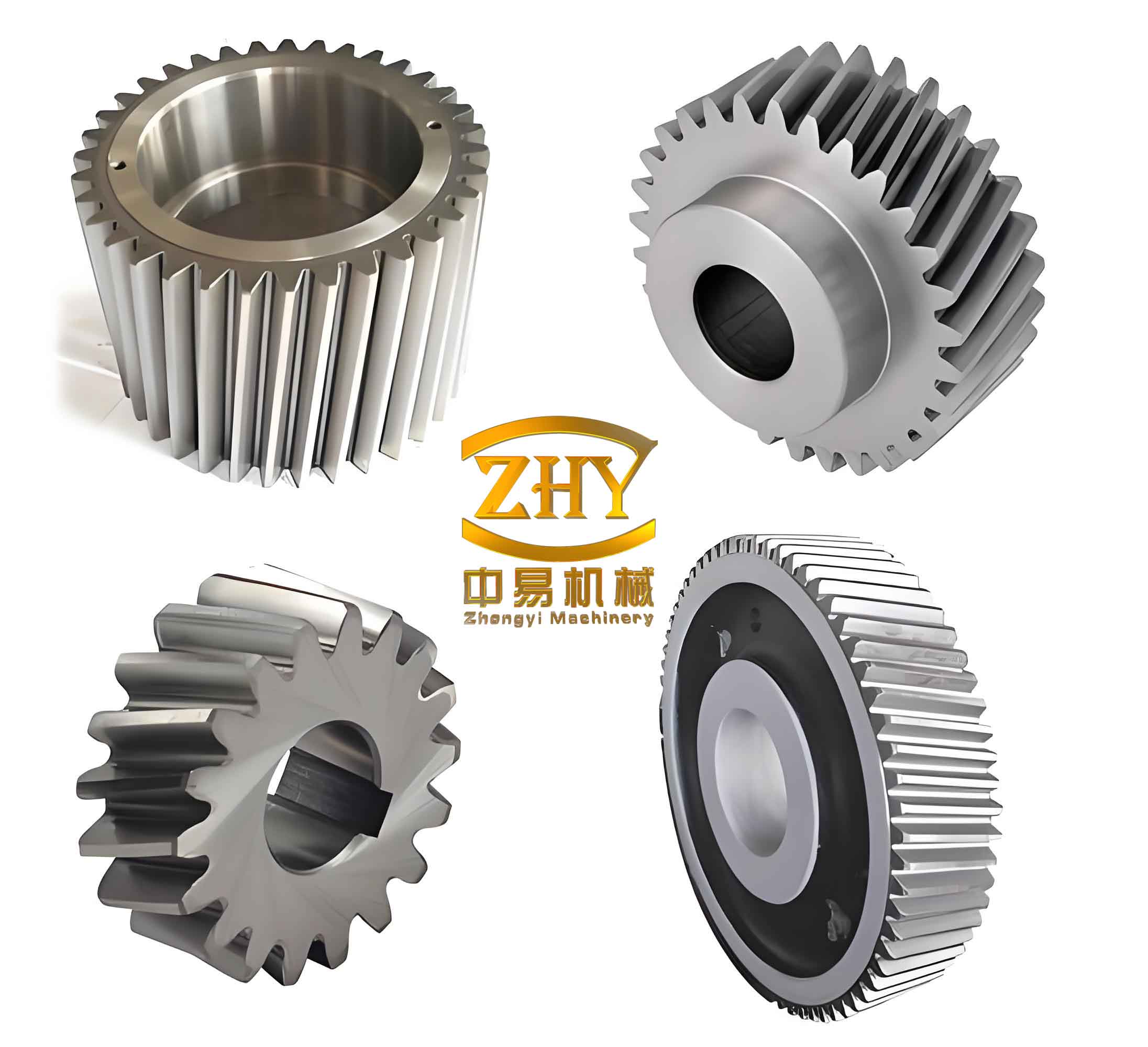
Figure above shows a typical helical gear pair used in our study. The manufactured helical gears with high precision ensure the reliability of the experimental validation.
4. Dynamic Modeling of Helical Gear System
We established an eight-degree-of-freedom lumped-parameter dynamic model including one helical gear pair, flexible shafts, and bearings. The displacement vector is:
$$ \mathbf{q} = [X_p, Y_p, Z_p, \theta_p, X_g, Y_g, Z_g, \theta_g]^T $$
The dynamic transmission error (DTE) along the line of action is:
$$ \delta_m = (X_p – X_g)\sin\alpha_n\cos\beta + (Y_p – Y_g)\cos\alpha_n\cos\beta + (r_{bp}\theta_p + r_{bg}\theta_g)\cos\beta + (Z_g – Z_p)\sin\beta – e(t) $$
The dynamic mesh force $F_m$ is computed using time-varying mesh stiffness $k_m(t)$ and damping $c_m(t)$, with a backlash function $f(\delta_m)$. The equations of motion are:
$$
\begin{cases}
I_p\ddot{\theta}_p + F_m r_{bp}\cos\beta = T_{in} \\
m_p\ddot{X}_p + c_{xp}\dot{X}_p + k_{xp}X_p + F_m\sin\alpha_n\cos\beta = 0 \\
m_p\ddot{Y}_p + c_{yp}\dot{Y}_p + k_{yp}Y_p + F_m\cos\alpha_n\cos\beta = 0 \\
m_p\ddot{Z}_p + c_{zp}\dot{Z}_p + k_{zp}Z_p – F_m\sin\beta = 0 \\
I_g\ddot{\theta}_g + F_m r_{bg}\cos\beta = T_{out} \\
m_g\ddot{X}_g + c_{xg}\dot{X}_g + k_{xg}X_g – F_m\sin\alpha_n\cos\beta = 0 \\
m_g\ddot{Y}_g + c_{yg}\dot{Y}_g + k_{yg}Y_g – F_m\cos\alpha_n\cos\beta = 0 \\
m_g\ddot{Z}_g + c_{zg}\dot{Z}_g + k_{zg}Z_g + F_m\sin\beta = 0
\end{cases}
$$
Bearing parameters used in the simulations are listed in Table 2.
| Parameter | Value |
|---|---|
| $k_{xj}, k_{yj}$ (N/m) | $1.5 \times 10^8$ |
| $k_{zj}$ (N/m) | $1.0 \times 10^7$ |
| $c_{xj}, c_{yj}, c_{zj}$ (N·s/m) | 1000 |
5. Vibration Response Analysis
The system was assumed to have an unloaded static transmission error $e(t) = 20\sin(\omega_m t)$ µm and a backlash of $2b_0 = 60$ µm. Input speed was varied from 500 to 50 000 r/min. We computed the root-mean-square (RMS) values of DTE, vibration displacements, and velocities for the three gear pairs. The low-fluctuation designs showed remarkable vibration reduction.
Table 3: Reduction in peak RMS vibration velocity at the third resonance (Y-direction)
| Gear Pair | Reduction relative to original (%) |
|---|---|
| Gear Pair 2 (optimized $\beta$) | 5.20 |
| Gear Pair 3 (optimized $B$) | 21.99 |
It was observed that the face width optimization consistently suppressed both radial and axial vibrations. However, the helix angle optimization (increasing $\beta$ from 10° to 15.95°) reduced radial vibrations but amplified axial vibrations by about 59% due to increased axial force component. Therefore, two alternative optimization strategies exist:
- Forward optimization: Increase $\beta$ to make $\varepsilon_\beta$ integer (e.g., 1.0). This reduces radial vibration but increases axial vibration.
- Backward optimization: Decrease $\beta$ from a larger value (e.g., 21.84°) to 15.95°, achieving the same integer $\varepsilon_\beta$ while reducing axial force. This leads to overall improvement.
We compared gear pairs 2 and 4 (see parameters in Table 1, gear pair 4 has $\beta = 21.84°$ and $\varepsilon_\beta=1.353$). After backward optimization, the axial displacement RMS dropped by 26.7% and axial velocity RMS by 14.3%. The DTE derivative remained nearly unchanged.
6. Conclusion
Our team has established a novel low‑fluctuation mesh stiffness design method for helical gears. By making either the face contact ratio or overlap ratio a positive integer, the fluctuation in contact line length—and hence the stiffness fluctuation—is minimized. The analytical stiffness model agrees well with finite element results. Two practical optimization routes (modifying helix angle or face width) are shown to significantly reduce LSTE and vibration responses. The backward helix angle optimization is particularly effective in simultaneously suppressing both radial and axial vibrations. The proposed methodology provides a theoretical foundation for designing quieter, more reliable helical gear transmissions.