
In the field of gear transmission dynamics, the time-varying mesh stiffness of helical gears is a critical parameter that directly influences vibration, noise, and load distribution. Tooth profile modification is widely adopted to compensate for manufacturing deviations and elastic deformations, thereby reducing meshing impacts and transmission errors. However, accurately calculating the mesh stiffness of modified helical gears remains challenging due to the three-dimensional geometry and variable contact length. In this work, we develop a novel analytical model based on the slicing principle, which efficiently computes the meshing stiffness of helical gear pairs incorporating arbitrary tooth profile modifications. Our approach avoids the need to evaluate the stiffness and error of each individual slice, making it both fast and versatile.
Methodology
We begin by considering a helical gear pair with a helix angle β. The gear tooth is sliced into numerous thin spur gear segments along the face width. Each segment is treated as a spur gear with negligible helix effect, and its meshing stiffness is determined using the well-established potential energy method, accounting for bending, shear, axial compression, fillet-foundation flexibility, and Hertzian contact. For a standard (unmodified) spur gear pair, the single tooth pair stiffness k_i is expressed as:
$$
k_i = \frac{1}{\frac{1}{k_{b1}} + \frac{1}{k_{s1}} + \frac{1}{k_{a1}} + \frac{1}{k_{f1}} + \frac{1}{k_{b2}} + \frac{1}{k_{s2}} + \frac{1}{k_{a2}} + \frac{1}{k_{f2}} + \frac{1}{k_h}}
$$
where the subscripts 1 and 2 denote the driving and driven gears, and the stiffness components are defined as:
$$
\frac{1}{k_b} = \int_0^d \frac{(d-x)\cos\alpha – h_g \sin\alpha}{EI_x} dx
$$
$$
\frac{1}{k_s} = \int_0^d \frac{1.2 \cos^2\alpha}{G A_x} dx
$$
$$
\frac{1}{k_a} = \int_0^d \frac{\sin^2\alpha}{E A_x} dx
$$
$$
\frac{1}{k_f} = \frac{\cos^2\alpha}{E W} \left[ L^* \left(\frac{U_f}{S_f}\right)^2 + P^* \left(1 + Q^* \tan^2\alpha\right) + M^* \frac{U_f}{S_f} \right]
$$
$$
k_h = \frac{E^{0.9} L^{0.8} F^{0.1}}{1.275}
$$
In the above, E and G are the elastic and shear moduli, α the pressure angle, h_g the half tooth thickness at the load point, d the distance from the load point to the root circle, I_x and A_x the area moment of inertia and cross‑sectional area of the tooth, and L^*, M^*, P^*, Q^*, U_f, S_f are dimensionless coefficients. The total mesh force is denoted by F and the face width by W.
To incorporate tooth profile modification, we define a parabolic or linear tip relief with maximum relief C_a and relief length L_a. The amount of modification at a distance x from the start of relief is given by:
$$
C(x) = C_a \left(\frac{x}{L_a}\right)^s
$$
where s is the shape exponent (s=1 for linear relief). The typical maximum values are C_{a,\max} = 0.02 M_t and L_{a,\max} = 0.6 M_t, with M_t = M/(1+\cos\beta) being the transverse module.
For a spur gear pair with profile modification, the total meshing stiffness K_m is computed by considering the combined effect of multiple tooth pairs and their corresponding profile errors. In a dual‑tooth contact region, the total profile error E_{pg} is the difference between the two engaged tooth errors. Based on the meshing stages (I, II, III), we derive the piecewise expressions for E_{pg}. Then the total stiffness is:
$$
K_m = \frac{\sum_{i=1}^{N_s} k_i}{1 + \sum_{i=1}^{N_s} k_i E_{pg} / F}
$$
where N_s is the number of engaging tooth pairs. The stiffness of a single modified spur gear pair k_{sm} can be extracted from the total stiffness by subtracting the contributions of adjacent standard pairs. For example, in the first dual‑mesh stage, the two engaged pairs are denoted by indices 1 and 2; the single-pair stiffness of pair 2 is k_{sm2} = K_m – k_{1}, where k_1 is the stiffness of the first pair (standard). In the single‑mesh stage, k_{sm2} = k_{std} (standard). In the third stage, k_{sm2} = K_m – k_{3}. Consequently, the modified single‑pair stiffness for a spur gear is expressed as:
$$
k_{sm}(\theta) = \begin{cases}
K_m – k_{i-1}, & 0 \le \theta \le \theta_0 \\[4pt]
k_i, & \theta_0 \le \theta \le \theta_2 – \theta_0 \\[4pt]
K_m – k_{i+1}, & \theta_2 – \theta_0 \le \theta \le \theta_2
\end{cases}
$$
where θ is the rotation angle of the pinion, θ_0 corresponds to the relief length, θ_1 = 2π(ε_α-1)/N, and θ_2 = 2πε_α/N, with ε_α being the transverse contact ratio and N the number of teeth.
Extension to Helical Gears
For helical gears, the contact lines are inclined and their length varies continuously. Using the slicing principle, the stiffness of a single modified helical gear pair k_{hm} is obtained by integrating the single‑pair stiffness of modified spur gears over the instantaneous contact line length L_t:
$$
k_{hm} = \int_0^{L_{t,\max}} \frac{k_{sm}(\theta)}{W \cos^2\beta} \, dL_t
$$
Because the contact line length is linearly related to the rotation angle along the action plane, the integral can be transformed into an integration over θ:
$$
k_{hmj} = \int_{\theta_{sj}}^{\theta_{ej}} k_{smb}(\theta) \, d\theta
$$
where the integrand k_{smb} is given by:
$$
k_{smb}(\theta) = \begin{cases}
(K_m – k_{i-1}) \dfrac{\cos\beta}{\theta_3}, & 0 \le \theta \le \theta_0 \\[6pt]
k_i \dfrac{\cos\beta}{\theta_3}, & \theta_0 \le \theta \le \theta_2 – \theta_0 \\[6pt]
(K_m – k_{i+1}) \dfrac{\cos\beta}{\theta_3}, & \theta_2 – \theta_0 \le \theta \le \theta_2
\end{cases}
$$
Here, θ_3 = 2π ε_β / N is the rotation angle corresponding to the axial overlap length, and ε_β is the overlap contact ratio. The limits θ_{sj} and θ_{ej} depend on the geometric type of the helical gear, which is classified into four categories according to the relationship among the relief length L_a, the transverse length L_p = 2π r_b ε_α / N, and the axial length L_β = 2π r_b ε_β / N:
- Type I: L_β < L_a (θ_3 < θ_0)
- Type II: L_a < L_β < L_p – L_a (θ_0 < θ_3 < θ_2 – θ_0)
- Type III: L_p – L_a < L_β < L_p (θ_2 – θ_0 < θ_3 < θ_2)
- Type IV: L_β > L_p (θ_3 > θ_2)
For each type, we derived closed‑form expressions for k_{hmj}. For example, for Type II (most common in moderate helix angles), the single‑pair stiffness is:
$$
k_{hmj} = \begin{cases}
\displaystyle \int_0^{\theta} k_{smb1} d\theta, & 0 \le \theta < \theta_0 \\[10pt]
\displaystyle \int_0^{\theta_0} k_{smb1} d\theta + \int_{\theta_0}^{\theta} k_{smb2} d\theta, & \theta_0 \le \theta \le \theta_3 \\[10pt]
\displaystyle \int_{\theta-\theta_3}^{\theta_0} k_{smb1} d\theta + \int_{\theta_0}^{\theta} k_{smb2} d\theta, & \theta_3 < \theta \le \theta_0 + \theta_3 \\[10pt]
\displaystyle \int_{\theta-\theta_3}^{\theta} k_{smb2} d\theta, & \theta_0 + \theta_3 < \theta \le \theta_2 – \theta_0 \\[10pt]
\displaystyle \int_{\theta-\theta_3}^{\theta_2-\theta_0} k_{smb2} d\theta + \int_{\theta_2-\theta_0}^{\theta} k_{smb3} d\theta, & \theta_2 – \theta_0 < \theta \le \theta_2 \\[10pt]
\displaystyle \int_{\theta-\theta_3}^{\theta_2-\theta_0} k_{smb2} d\theta + \int_{\theta_2-\theta_0}^{\theta_2} k_{smb3} d\theta, & \theta_2 < \theta \le \theta_2 + \theta_3 – \theta_0 \\[10pt]
\displaystyle \int_{\theta-\theta_3}^{\theta_2} k_{smb3} d\theta, & \theta_2 + \theta_3 – \theta_0 < \theta \le \theta_2 + \theta_3
\end{cases}
$$
The total mesh stiffness of the helical gear pair is the sum of the stiffnesses of all simultaneously engaged tooth pairs:
$$
K_{hm} = \sum_{j=1}^{N_h} k_{hmj}
$$
where N_h = \lceil \varepsilon_\alpha + \varepsilon_\beta \rceil is the maximum number of tooth pairs in contact. The loaded static transmission error (LSTE) is then:
$$
\delta_{\text{LSTE}} = \frac{F_N}{K_{hm}} + E_{pg,\min}
$$
with the minimum profile error defined appropriately.
Model Validation
To verify our method, we first tested the modified single spur gear pair stiffness by comparing the total stiffness computed via the superposition of single‑pair stiffness against the direct formula. Two sets of spur gear parameters from the literature were used (Table 1).
| Parameter | Model I | Model II |
|---|---|---|
| Number of teeth | 30 / 30 | 30 / 30 |
| Module (mm) | 2 / 2 | 4 / 4 |
| Face width (mm) | 20 / 20 | 40 / 40 |
| Pressure angle (°) | 20 | 20 |
| Torque (N·m) | 150 | 98 |
| Contact ratio ε | 1.65 | 1.61 |
| Relief (Cₐ, Lₐ) | 32 μm, 960 μm | 8 μm, 600 μm |
The computed total mesh stiffness using both methods matched exactly, confirming the correctness of our derived k_{sm}.
Next, we validated the helical gear model against published results by Wang et al. Two helical gear pairs—one with low contact ratio (LCR) and one with high contact ratio (HCR)—were analyzed. The gear parameters are listed in Table 2.
| Parameter | LCR pair | HCR pair |
|---|---|---|
| Teeth | 21 / 49 | 39 / 117 |
| Module (mm) | 5 | 4.5 |
| Face width (mm) | 16 | 200 |
| Pressure angle (°) | 20 | 20 |
| Helix angle β (°) | 15 | 13.5 |
| Torque (N·m) | 100 | 600 |
| Total contact ratio ε | 1.85 | 4.9 |
| Transverse εα | 1.58 | 1.71 |
| Overlap εβ | 0.27 | 3.19 |
We computed the total mesh stiffness for four different relief lengths (Lₐ = 932, 1600, 2200, 2800 μm) with a fixed maximum relief Cₐ = 52 μm. The results were compared with those from Wang et al. Table 3 summarizes the maximum and average stiffness values and the relative errors.
| Lₐ (μm) | Max K (N/m) – Ours | Max K (N/m) – Ref. | Error (%) | Avg K (N/m) – Ours | Avg K (N/m) – Ref. | Error (%) |
|---|---|---|---|---|---|---|
| 932 | 2.21×10⁸ | 2.20×10⁸ | 0.5 | 1.57×10⁸ | 1.61×10⁸ | 2.5 |
| 1600 | 1.89×10⁸ | 1.82×10⁸ | 3.8 | 1.41×10⁸ | 1.44×10⁸ | 2.0 |
| 2200 | 1.37×10⁸ | 1.33×10⁸ | 3.0 | 1.25×10⁸ | 1.29×10⁸ | 3.1 |
| 2800 | 1.27×10⁸ | 1.26×10⁸ | 0.8 | 1.10×10⁸ | 1.23×10⁸ | 2.7 |
Agreement is excellent; the maximum relative error is below 4%, confirming the accuracy of our analytical model. The small discrepancies arise from our nonlinear Hertzian contact stiffness and from ignoring the effect of modification on instantaneous contact line length—both are conservative simplifications.
Parametric Study on Tooth Profile Modification
Using the validated model, we investigated the influence of relief length and relief amount on the total mesh stiffness and loaded static transmission error for both LCR and HCR helical gear pairs. The nondimensional relief parameters are defined as Cₙ = Cₐ / Cₐ,max and Lₙ = Lₐ / Lₐ,max, where Cₐ,max = 50 μm and Lₐ,max = 1524 μm.
For the LCR pair (ε = 1.85), which belongs to Type III, two tooth pairs engage simultaneously during part of the meshing cycle. For the HCR pair (ε = 4.9, Type IV), up to five tooth pairs are in contact, resulting in much smoother stiffness variation. Figure (inserted below) shows a typical helical gear used in this study.
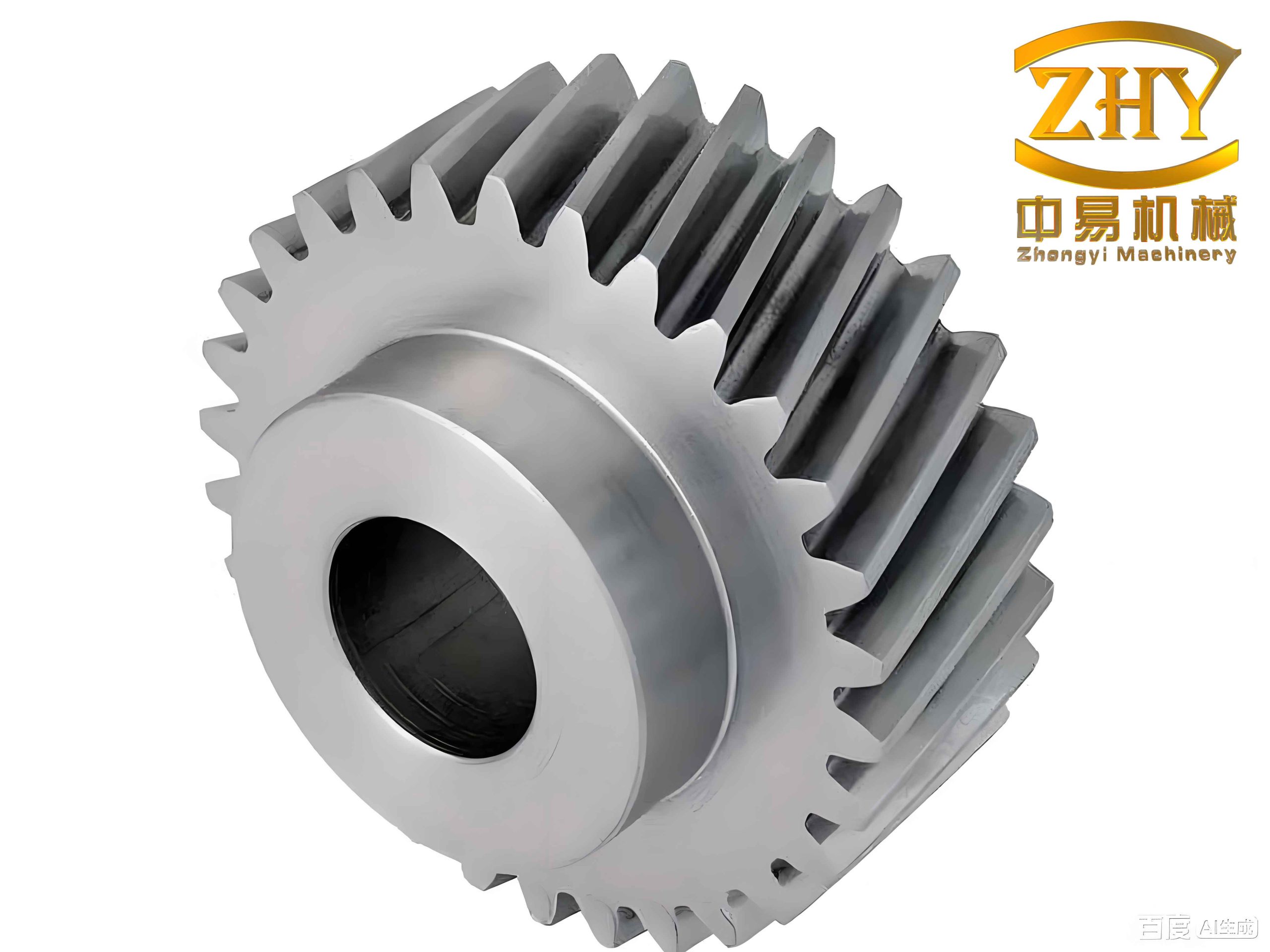
We computed the modified single‑pair stiffness for the spur gear equivalent (β=0) as a baseline. The results clearly show that tooth profile modification reduces the stiffness peak during the transition from single‑tooth to double‑tooth contact. For the helical gear, the smoothing effect becomes more pronounced as the overlap ratio increases.
We systematically varied the nondimensional relief length Lₙ from 0 to 1 while keeping Cₙ=1, and vice versa. The following trends were observed:
- Increasing Lₙ or Cₙ reduces the average mesh stiffness. For example, at Lₙ=1 and Cₙ=1, the average stiffness of the LCR pair drops by about 15% compared to the unmodified case.
- The variation of stiffness within one mesh cycle decreases significantly. The peak‑to‑peak amplitude of K_{hm} for the LCR pair reduces from 1.3×10⁸ N/m (unmodified) to 0.4×10⁸ N/m when fully modified.
- Similarly, the loaded static transmission error becomes more uniform. The maximum LSTE decreases, and the fluctuation over the mesh cycle is damped.
- For the HCR helical gear, due to the high overlap ratio, even moderate modification (Lₙ=0.4, Cₙ=0.6) leads to nearly constant stiffness and transmission error. This is beneficial for noise and vibration reduction.
Table 4 summarizes the quantitative results for selected modification parameters.
| Gear type | Lₙ | Cₙ | Average Khm (N/m) | Peak‑to‑peak Khm (N/m) | Max LSTE (μm) |
|---|---|---|---|---|---|
| LCR | 0.0 | 0.0 | 2.35×10⁸ | 1.30×10⁸ | 6.8 |
| LCR | 0.4 | 1.0 | 2.08×10⁸ | 0.72×10⁸ | 5.2 |
| LCR | 1.0 | 1.0 | 1.95×10⁸ | 0.41×10⁸ | 4.1 |
| HCR | 0.0 | 0.0 | 4.82×10⁸ | 0.15×10⁸ | 2.1 |
| HCR | 0.4 | 1.0 | 4.55×10⁸ | 0.08×10⁸ | 1.8 |
| HCR | 1.0 | 1.0 | 4.31×10⁸ | 0.05×10⁸ | 1.6 |
These results indicate that while profile modification reduces the average stiffness (which could slightly lower load capacity), it dramatically smooths the stiffness fluctuation and transmission error, which is the primary goal for reducing gear whine and dynamic loads.
Conclusion
We have developed an efficient analytical model for calculating the time‑varying mesh stiffness of helical gears with arbitrary tooth profile modification. The model is based on slicing the helical gear into spur gear segments, computing the modified spur gear pair stiffness, and integrating it along the variable contact line. The method avoids the need to evaluate the stiffness and error of each slice individually, making it computationally fast while maintaining good accuracy. Validation against published results shows a maximum error of less than 4%.
Using the model, we investigated the effects of relief length and amount on the mesh stiffness and transmission error of low‑contact‑ratio and high‑contact‑ratio helical gear pairs. The following conclusions can be drawn:
- Tooth profile modification reduces the average mesh stiffness of helical gears, but the amount of reduction depends on the modification parameters and the overlap ratio.
- Increasing the relief length or amount leads to a more gradual stiffness variation across the mesh cycle, effectively reducing the fluctuation amplitude. For HCR helical gears, even moderate modification can result in nearly constant stiffness.
- The loaded static transmission error becomes more uniform with modification, which is beneficial for reducing gear radiated noise and dynamic excitation.
- Our method is applicable to all four types of helical gears defined by the relationship between axial length, transverse length, and relief length. It can be readily extended to other modification curves (e.g., parabolic or cubic) by adjusting the profile error function.
In summary, the proposed model provides a practical tool for the design and analysis of helical gear transmissions, enabling engineers to optimize tooth profile modifications for improved dynamic performance while balancing load capacity.