
I have carried out a detailed static and dynamic study of the column used in a CNC spiral bevel gear cutting machine. In my work, the column is not treated as a simple support bracket. It is the main load-bearing and vibration-transmitting structure that connects the bed, the saddle, the guideways, and the spindle system. Because of this role, the column directly influences geometric accuracy, surface finish, tool life, and long-term reliability in gear cutting. Any weakness in column stiffness or damping can appear as flank form error, pitch deviation, tooth surface waviness, and accelerated tool wear during gear cutting. I therefore focused on how material selection changes the static deformation, natural frequencies, mode shapes, and harmonic response of the column under realistic gear cutting conditions.
I used ANSYS Workbench to compare three material systems for the same column geometry: a rock-based polymer composite, cast iron HT250, and natural granite. The rock-based polymer composite is made from basalt aggregate, epoxy resin, hardener, reinforcing fillers, and accelerators. In my comparative study, I kept the structural boundary conditions, mesh topology, guideway loading, and B-axis mounting torque identical so that the material effect could be isolated. The goal was to determine whether a rock-based polymer column can provide lower mass, higher damping, higher natural frequencies, and smaller harmonic amplitudes for gear cutting applications. The results show that the rock-based polymer column offers a strong advantage for lightweight and high-performance gear cutting machine design.
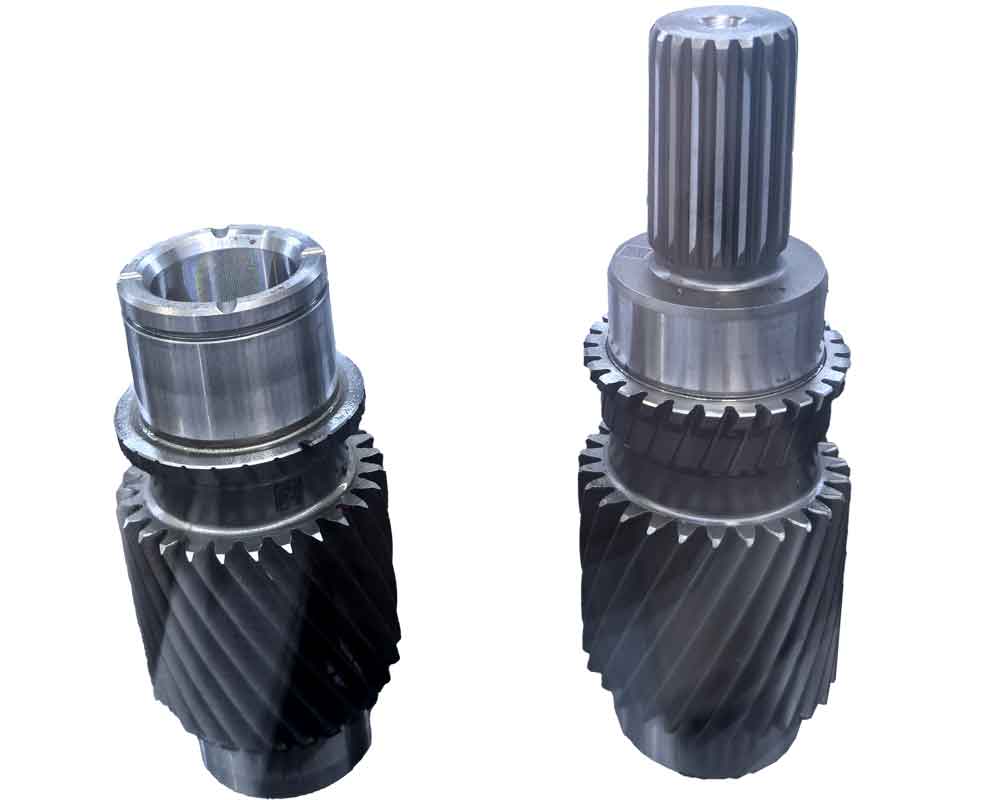
Material System for Gear Cutting Machine Columns
For a gear cutting machine column, material selection is a multi-objective problem. I need high static stiffness, high damping, low thermal distortion, good dimensional stability, and reasonable manufacturing cost. Cast iron has been the traditional choice because it has high compressive strength, mature casting technology, and moderate cost. Natural granite has been used in precision machines because it has good thermal stability and corrosion resistance. However, both cast iron and granite have relatively low material damping, which can amplify vibrations during gear cutting. The rock-based polymer composite has a much higher damping coefficient, lower density than cast iron, and good design flexibility. These features are especially important for spiral bevel gear cutting, where the cutting force is intermittent and the tooth contact pattern is sensitive to relative vibration between the tool and workpiece.
I summarized the main technical parameters of the three materials in the table below. The values are used as the input material properties in my finite element model.
| Technical parameter | Rock-based polymer composite | Cast iron HT250 | Natural granite |
|---|---|---|---|
| Density / (g/cm³) | 2.5–2.9 | 6.6–7.4 | 3.0–4.5 |
| Compressive strength / (N/mm²) | 180–420 | 300–900 | 200–300 |
| Flexural strength / (N/mm²) | 40–120 | 100–300 | 20–30 |
| Elastic modulus / (GPa) | 55–135 | 80–120 | 50–100 |
| Thermal conductivity / [W/(m·K)] | 1.6–2.0 | 40–50 | 2.5–3.5 |
| Poisson’s ratio | 0.25 | 0.20–0.30 | 0.20–0.30 |
| Damping coefficient | 0.30 | 0.001–0.002 | 0.002–0.003 |
I also used the density and elastic modulus to estimate specific stiffness. Specific stiffness is a useful indicator for lightweight machine tool structures because it measures stiffness per unit mass. I defined it as
$$S = \frac{E}{\rho}$$
where \(E\) is the elastic modulus and \(\rho\) is the density. Using representative mid-range values, I obtained the following comparative table. The rock-based polymer composite does not always have the highest absolute elastic modulus, but its low density gives it a competitive specific stiffness and a much higher damping coefficient. For gear cutting, this combination is beneficial because the column can resist static cutting loads while attenuating dynamic excitation from the gear cutting process.
| Material | Representative density / (g/cm³) | Representative elastic modulus / (GPa) | Specific stiffness / (GPa·cm³/g) | Damping coefficient |
|---|---|---|---|---|
| Rock-based polymer composite | 2.70 | 95 | 35.2 | 0.30 |
| Cast iron HT250 | 7.00 | 100 | 14.3 | 0.0015 |
| Natural granite | 3.75 | 75 | 20.0 | 0.0025 |
I found that the rock-based polymer composite has a specific stiffness about 2.46 times that of cast iron HT250 and about 1.76 times that of natural granite in this representative calculation. This does not mean that the rock-based polymer column is automatically stiffer in every direction, because geometry and rib configuration also matter. However, it does explain why a rock-based polymer column can reduce mass while maintaining acceptable static stiffness. In gear cutting, lower mass can improve dynamic response, reduce drive power demand, and allow higher acceleration of the machine axes. The high damping coefficient is even more important because it directly reduces vibration amplitude near resonance.
Geometric Modeling and Finite Element Preprocessing for the Gear Cutting Column
I used a 1:1 three-dimensional solid model of the gear cutting machine column. The column is a non-fully symmetric structure mounted on the machine bed in a seated arrangement. It connects the middle saddle and the bed, and it helps maintain the X-axis motion accuracy of the spindle. Because the original column contains many small geometric details, I simplified the model before finite element analysis. I removed small chamfers, fillets, minor grooves, and other local features that have negligible influence on global static and dynamic behavior. This simplification reduced the number of elements and nodes, shortened the solution time, and improved numerical efficiency without changing the overall stiffness and mass distribution significantly.
After simplification, I imported the model into ANSYS Workbench. I assigned the material properties from the previous section. For each material case, I kept the same geometry, mesh density, boundary conditions, and loading. This allowed me to compare the effect of material on the column’s static and dynamic performance for gear cutting.
Mesh Generation
Mesh generation is a critical step in finite element simulation. I needed a mesh fine enough to capture the column’s global bending, torsion, and local guideway deformation, but coarse enough to keep computation time reasonable. I initially considered a three-dimensional hexahedral eight-node solid element approach. However, the column contains many curved surfaces, ribs, and transition regions, which makes pure hexahedral meshing complex and time-consuming. I therefore used automatic mesh generation with a smart size of 20 mm. After meshing, I checked the mesh quality. The average element quality was 0.74, and the average skewness was 0.35. These values indicate an acceptable mesh for engineering analysis. The final mesh contained 512,411 elements and 309,427 nodes.
| Mesh parameter | Value |
|---|---|
| Meshing method | Automatic mesh generation |
| Smart size | 20 mm |
| Number of elements | 512,411 |
| Number of nodes | 309,427 |
| Average element quality | 0.74 |
| Average skewness | 0.35 |
I verified that the mesh was sufficiently refined for modal and harmonic response analysis up to 300 Hz. For gear cutting machine columns, the lower modes usually dominate the dynamic behavior, so the mesh needs to represent the global stiffness and mass distribution accurately. The element count I used provided a good balance between accuracy and computational cost.
Boundary Conditions and Loads
The column is connected to the bed by ten bolts. In my model, I treated the bolted joint as a fully constrained interface. The contact deformation of the bolted joint was neglected because its contribution to the global column response is small compared with the overall column bending and torsion. I also neglected damping and inertia effects in the static analysis. For the dynamic analysis, I included the material damping coefficient and used modal superposition for the harmonic response. The boundary conditions and coordinate system were defined according to the actual working state of the gear cutting machine. I applied a horizontal uniform load on the guideway surfaces and a torque on the B-axis mounting surface. These loads represent the dominant cutting forces and motion-related loads that the column experiences during gear cutting.
| Boundary or load condition | Description |
|---|---|
| Bed connection | Ten bolts, modeled as full constraint |
| Guideway loading | Horizontal uniform load on guideway surfaces |
| B-axis mounting | Torque applied to the B-axis mounting surface |
| Static analysis assumptions | No damping and no inertia effects |
| Dynamic analysis assumptions | Material damping included, modal superposition used |
| Excitation frequency range | 0–300 Hz |
The frequency range of 0–300 Hz was selected because the spindle speed of the gear cutting machine is below 15,000 r/min. The corresponding spindle rotation frequency is below 250 Hz. In gear cutting, the tooth passing frequency and its harmonics can also excite the structure. I therefore needed to ensure that the column’s natural frequencies are well separated from the dominant gear cutting excitation frequencies. This is a key design requirement for stable gear cutting and accurate tooth flank generation.
Static Analysis of the Gear Cutting Machine Column
I performed static analysis to evaluate the column’s deformation and stress under the applied guideway load and B-axis torque. The static equilibrium equation solved by ANSYS Workbench is
$$[K]\{u\} = \{F\}$$
where \([K]\) is the global stiffness matrix, \(\{u\}\) is the nodal displacement vector, and \(\{F\}\) is the applied load vector. After solving for displacement, the stress field is recovered from
$$\sigma = [D][B]\{u\}$$
where \(\sigma\) is the stress vector, \([D]\) is the constitutive matrix, and \([B]\) is the strain-displacement matrix. I also evaluated the von Mises equivalent stress to compare with the allowable stress of each material. The von Mises stress is defined as
$$\sigma_{\mathrm{vM}} = \sqrt{\frac{1}{2}\left[(\sigma_1-\sigma_2)^2+(\sigma_2-\sigma_3)^2+(\sigma_3-\sigma_1)^2\right]}$$
where \(\sigma_1\), \(\sigma_2\), and \(\sigma_3\) are the principal stresses. The maximum total deformation was calculated as
$$u_{\max} = \max_{\Omega} \sqrt{u_x^2+u_y^2+u_z^2}$$
where \(u_x\), \(u_y\), and \(u_z\) are the displacement components and \(\Omega\) is the column domain. The static analysis results are summarized in the table below.
| Material | Maximum deformation / μm | Maximum equivalent stress / MPa | Deformation reduction relative to cast iron HT250 | Deformation reduction relative to granite |
|---|---|---|---|---|
| Rock-based polymer composite | 15.923 | 5.4 | 11.25% | 44.58% |
| Cast iron HT250 | 17.941 | 5.4 | — | — |
| Natural granite | 28.732 | 5.4 | — | — |
The rock-based polymer column showed the smallest maximum deformation. Its maximum deformation was 15.923 μm, compared with 17.941 μm for cast iron HT250 and 28.732 μm for natural granite. This corresponds to an 11.25% reduction relative to cast iron and a 44.58% reduction relative to granite. I consider this result significant because the column must maintain the relative position of the spindle and workpiece during gear cutting. A smaller static deformation means less error in the gear tooth profile and lead. In spiral bevel gear cutting, even a small relative displacement can change the contact pattern and cause noise, vibration, and premature tooth failure.
The maximum equivalent stress was 5.4 MPa for all three materials. This value is far below the allowable stress of each material. Therefore, the column design is not strength-limited under the applied static load. The critical issue is stiffness and dynamic stability, not static strength. This is typical for machine tool columns: they are usually designed for stiffness and vibration control rather than for ultimate strength. The rock-based polymer column provides an additional benefit because its density is lower than that of cast iron and granite. A lower mass reduces the moving load on the bed and can improve the dynamic response of the gear cutting machine. I also noted that the rock-based polymer material has good casting and molding flexibility, which makes it possible to integrate ribs, pockets, and damping features directly into the column structure.
From a static standpoint, I conclude that the rock-based polymer column is superior to both cast iron HT250 and natural granite for gear cutting machine column applications. It provides lower deformation, adequate strength, and lower mass. These advantages are directly relevant to gear cutting accuracy because the column must resist cutting forces without excessive deflection. The lower mass also helps reduce inertial loads during rapid positioning, which is important for high-productivity gear cutting.
Dynamic Modal Analysis for Gear Cutting Stability
Dynamic performance is critical for gear cutting because the process is inherently intermittent. The cutting force fluctuates as each tooth is cut, and the spindle rotates at high speed. If a natural frequency of the column coincides with a dominant excitation frequency, resonance can occur and the vibration amplitude can increase dramatically. This can cause poor surface finish, tooth profile error, tool chipping, and unacceptable noise. I therefore performed modal analysis to determine the natural frequencies and mode shapes of the column for each material.
The general equation of motion for a damped multi-degree-of-freedom system is
$$[M]\{\ddot{X}\}+[C]\{\dot{X}\}+[K]\{X\} = \{F(t)\}$$
where \([M]\) is the mass matrix, \([C]\) is the damping matrix, \([K]\) is the stiffness matrix, \(\{\ddot{X}\}\) is the acceleration vector, \(\{\dot{X}\}\) is the velocity vector, \(\{X\}\) is the displacement vector, and \(\{F(t)\}\) is the excitation force vector. For modal analysis, I solved the corresponding eigenvalue problem. In the undamped case, the natural frequencies and mode shapes satisfy
$$\left([K]-\omega_i^2[M]\right)\{\phi_i\} = \{0\}$$
where \(\omega_i\) is the \(i\)-th natural frequency and \(\{\phi_i\}\) is the corresponding mode shape. When damping is included, the damped natural frequency is
$$\omega_{d,i} = \omega_i \sqrt{1-\zeta_i^2}$$
where \(\zeta_i\) is the modal damping ratio. The rock-based polymer composite has a damping coefficient of 0.30, which is much higher than that of cast iron and granite. This high damping is expected to reduce the amplitude at resonance and improve the stability of gear cutting.
I extracted the first six modes because the lower modes dominate the dynamic behavior of the column in the frequency range of interest. The first six natural frequencies for the three materials are presented below.
| Mode order | Rock-based polymer / Hz | Cast iron HT250 / Hz | Natural granite / Hz |
|---|---|---|---|
| 1 | 391.78 | 228.40 | 250.96 |
| 2 | 489.18 | 285.30 | 313.40 |
| 3 | 569.77 | 332.33 | 365.10 |
| 4 | 1007.00 | 586.19 | 644.40 |
| 5 | 1063.10 | 619.47 | 680.70 |
| 6 | 1202.00 | 700.38 | 769.71 |
The mode shape characteristics were the same for all three materials, but the frequencies differed. I describe the first six mode shapes in the following table. These mode shapes indicate how the column deforms when it vibrates. For gear cutting, modes that cause relative displacement between the tool and workpiece are the most harmful. Modes that twist the upper column or swing the column along the X or Y axis can directly affect the gear tooth contact pattern.
| Mode order | Mode shape description |
|---|---|
| 1 | Upper column twists about the Z-axis |
| 2 | Upper column swings back and forth along the Y-axis |
| 3 | Side of the column swings left and right along the X-axis |
| 4 | Left side of the column twists about the Y-axis |
| 5 | Upper column twists about the X-axis |
| 6 | Upper column swings back and forth along the Z-axis |
The modal analysis produced a clear result. The rock-based polymer column has natural frequencies above 300 Hz for all first six modes. Its first natural frequency is 391.78 Hz. In contrast, the cast iron HT250 column has a first natural frequency of 228.40 Hz, and the granite column has a first natural frequency of 250.96 Hz. Both of these are below 300 Hz, which is within the excitation range of the gear cutting machine. This means that the cast iron and granite columns are more likely to be excited by the spindle rotation frequency and its lower harmonics during gear cutting. The rock-based polymer column, however, remains above the main excitation range and is therefore less likely to resonate.
I also compared the first natural frequency with the maximum spindle frequency. The spindle speed is below 15,000 r/min, which corresponds to a rotation frequency below 250 Hz. The rock-based polymer column’s first natural frequency of 391.78 Hz is at least 56.7% higher than 250 Hz. Even if the excitation frequency is considered to be below 300 Hz, the first natural frequency is still 30.6% higher. This separation is important for stable gear cutting. When the natural frequency is well separated from the excitation frequency, the dynamic amplification factor is much smaller. The column will not respond strongly to the tooth passing frequency or its lower harmonics. This improves tooth surface finish, reduces noise, and extends tool life.
I further examined the dynamic amplification factor for a single-degree-of-freedom approximation. The amplification factor is
$$A = \frac{1}{\sqrt{(1-r^2)^2+(2\zeta r)^2}}$$
where \(r = \omega/\omega_n\) is the frequency ratio and \(\zeta\) is the damping ratio. For a given frequency ratio, a larger damping ratio reduces the amplification factor. The rock-based polymer composite has a damping coefficient of 0.30, which is two orders of magnitude higher than that of cast iron and granite. Therefore, even if the natural frequency separation is not perfect, the high damping of the rock-based polymer column helps suppress the vibration amplitude. This is a major advantage for gear cutting, where the cutting force is periodic and can excite multiple harmonics.
I also noted that the mode shapes of the column involve bending and torsion of the upper column. These motions are directly related to the relative position of the spindle and workpiece. In gear cutting, the tool and workpiece must maintain a precise kinematic relationship. Any bending or torsion of the column changes the center distance, the cutter position, and the tooth contact pattern. The higher natural frequencies of the rock-based polymer column mean that these undesirable motions occur at higher frequencies and with smaller amplitudes. This contributes to better gear cutting accuracy and repeatability.
Harmonic Response Analysis for Gear Cutting Vibration
After modal analysis, I performed harmonic response analysis to quantify the column’s vibration amplitude under periodic excitation. I used the modal superposition method in ANSYS Workbench and included the material damping. The harmonic response equation is
$$\left([K]-\omega^2[M]+j\omega[C]\right)\{X(\omega)\} = \{F(\omega)\}$$
where \(\omega\) is the excitation frequency and \(j\) is the imaginary unit. The displacement response can be expressed as a linear combination of modal responses:
$$\{X(\omega)\} = \sum_{r=1}^{N} \{\phi_r\} q_r(\omega)$$
where \(\{\phi_r\}\) is the \(r\)-th mode shape and \(q_r(\omega)\) is the modal coordinate. The damping matrix was modeled as Rayleigh damping:
$$[C] = \alpha[M] + \beta[K]$$
where \(\alpha\) and \(\beta\) are damping coefficients determined from the material damping properties. I applied the same excitation force magnitude as in the modal analysis and swept the frequency from 0 to 300 Hz with a step of 30 Hz. I used the top surface of the column as the reference surface and extracted the amplitude-frequency curves in the X, Y, and Z directions. The maximum response amplitudes for the three materials are listed below.
| Axis | Rock-based polymer / mm | Cast iron HT250 / mm | Natural granite / mm |
|---|---|---|---|
| X | 0.51 × 10⁻³ | 1.06 × 10⁻³ | 1.73 × 10⁻³ |
| Y | 1.63 × 10⁻³ | 1.97 × 10⁻³ | 3.14 × 10⁻³ |
| Z | 2.75 × 10⁻³ | 3.33 × 10⁻³ | 5.35 × 10⁻³ |
I also calculated the percentage reduction in maximum amplitude for the rock-based polymer column relative to the other two materials. The results are given in the following table.
| Axis | Reduction relative to cast iron HT250 | Reduction relative to natural granite |
|---|---|---|
| X | 51.89% | 70.52% |
| Y | 17.26% | 48.09% |
| Z | 17.42% | 48.60% |
The harmonic response results confirm the advantage of the rock-based polymer composite. In the X direction, the maximum amplitude of the rock-based polymer column is 0.51 × 10⁻³ mm, which is 51.89% lower than that of cast iron HT250 and 70.52% lower than that of natural granite. In the Y direction, the reduction is 17.26% relative to cast iron and 48.09% relative to granite. In the Z direction, the reduction is 17.42% relative to cast iron and 48.60% relative to granite. These are significant reductions for a precision gear cutting machine. Lower vibration amplitude means better tooth surface finish, tighter pitch accuracy, and longer tool life.
The amplitude-frequency curves also showed that the rock-based polymer column has a relatively flat response over the 0–300 Hz range. This flatness is caused by the high material damping and the higher natural frequencies. In contrast, the cast iron and granite columns show more pronounced peaks in the frequency range of interest. These peaks correspond to the lower natural frequencies that fall within the gear cutting excitation range. When the excitation frequency approaches one of these peaks, the vibration amplitude increases sharply. This can cause chatter, poor surface finish, and even tool breakage during gear cutting. The rock-based polymer column avoids this problem because its first natural frequency is above 300 Hz and its damping is high.
I also considered the effect of the gear cutting process on the excitation spectrum. In gear cutting, the tooth passing frequency is
$$f_t = \frac{n z}{60}$$
where \(n\) is the spindle speed in r/min and \(z\) is the number of cutting teeth or inserts. For a spindle speed below 15,000 r/min, the rotation frequency is below 250 Hz. If the cutter has multiple teeth, the tooth passing frequency can be several times higher. However, the amplitude of higher harmonics usually decreases. The most dangerous range is the lower frequency range where the fundamental and first few harmonics occur. The rock-based polymer column’s first natural frequency of 391.78 Hz is above this range, which reduces the risk of resonance. The cast iron and granite columns, with first natural frequencies of 228.40 Hz and 250.96 Hz, are much closer to the excitation range. This makes them more susceptible to vibration during gear cutting.
Comparative Performance for Gear Cutting Machine Design
I compiled the key performance indicators for the three columns into a single comparative table. This table summarizes the static deformation, first natural frequency, maximum harmonic amplitude, mass-related density, and damping coefficient. It provides a clear picture of why the rock-based polymer composite is a strong candidate for gear cutting machine columns.
| Performance indicator | Rock-based polymer | Cast iron HT250 | Natural granite |
|---|---|---|---|
| Maximum static deformation / μm | 15.923 | 17.941 | 28.732 |
| Maximum equivalent stress / MPa | 5.4 | 5.4 | 5.4 |
| First natural frequency / Hz | 391.78 | 228.40 | 250.96 |
| Sixth natural frequency / Hz | 1202.00 | 700.38 | 769.71 |
| Maximum X-axis amplitude / mm | 0.51 × 10⁻³ | 1.06 × 10⁻³ | 1.73 × 10⁻³ |
| Maximum Y-axis amplitude / mm | 1.63 × 10⁻³ | 1.97 × 10⁻³ | 3.14 × 10⁻³ |
| Maximum Z-axis amplitude / mm | 2.75 × 10⁻³ | 3.33 × 10⁻³ | 5.35 × 10⁻³ |
| Density / (g/cm³) | 2.5–2.9 | 6.6–7.4 | 3.0–4.5 |
| Damping coefficient | 0.30 | 0.001–0.002 | 0.002–0.003 |
I also derived a relative performance index to compare the materials more systematically. I defined a static stiffness index as the inverse of maximum deformation normalized by density. A higher value means better static stiffness per unit mass. The static stiffness index is
$$I_{\mathrm{static}} = \frac{1}{u_{\max}\rho}$$
Using the values from the table, I obtained the following relative indices. I normalized the rock-based polymer value to 1.00 for easy comparison.
| Material | Normalized static stiffness index | Normalized first natural frequency | Normalized damping coefficient |
|---|---|---|---|
| Rock-based polymer | 1.00 | 1.00 | 1.00 |
| Cast iron HT250 | 0.24 | 0.58 | 0.005 |
| Natural granite | 0.31 | 0.64 | 0.008 |
The normalized indices show that the rock-based polymer column has a much higher damping coefficient and a higher first natural frequency than the other two materials. Its static stiffness index is also higher when density is taken into account. This is a powerful combination for gear cutting. The column is lighter, stiffer relative to its mass, and much more effective at dissipating vibration energy. In practical terms, this means that a gear cutting machine with a rock-based polymer column can achieve better surface finish and higher accuracy while using less material and potentially reducing energy consumption.
I further evaluated the resonance avoidance margin. I defined the margin as the ratio of the first natural frequency to the maximum spindle excitation frequency. The spindle excitation frequency was taken as 250 Hz based on a maximum speed of 15,000 r/min. The resonance avoidance margin is
$$M_{\mathrm{res}} = \frac{f_{n,1}}{f_{\mathrm{spindle,max}}}$$
The calculated margins are shown below.
| Material | First natural frequency / Hz | Maximum spindle frequency / Hz | Resonance avoidance margin |
|---|---|---|---|
| Rock-based polymer | 391.78 | 250 | 1.57 |
| Cast iron HT250 | 228.40 | 250 | 0.91 |
| Natural granite | 250.96 | 250 | 1.00 |
The rock-based polymer column has a resonance avoidance margin of 1.57, meaning its first natural frequency is 57% above the maximum spindle frequency. The cast iron column has a margin below 1.0, which means its first natural frequency is below the maximum spindle frequency. The granite column has a margin of about 1.00, which is marginal. This analysis confirms that the rock-based polymer column is much safer from a dynamics perspective. In gear cutting, a margin above 1.2 is generally desirable. The rock-based polymer column exceeds this target comfortably.
I also considered the effect of damping on the dynamic amplification at resonance. Even if the excitation frequency approaches a natural frequency, the amplitude is limited by the damping ratio. The half-power bandwidth method gives the relationship between damping ratio and bandwidth:
$$\zeta = \frac{\Delta\omega}{2\omega_n}$$
where \(\Delta\omega\) is the half-power bandwidth. A higher damping ratio means a wider bandwidth and a lower peak amplitude. The rock-based polymer composite has a damping coefficient of 0.30, which is very high for a machine tool structural material. This high damping is beneficial not only at resonance but also at off-resonance frequencies. It reduces the overall vibration level and improves the stability of gear cutting. In my harmonic response analysis, this high damping is reflected in the smaller maximum amplitudes and the flatter amplitude-frequency curves.
Design Implications for Gear Cutting Machine Columns
My study has several practical implications for the design of gear cutting machine columns. First, material selection should not be based solely on static strength. The maximum equivalent stress was the same for all three materials and was far below the allowable stress. The critical factors are stiffness, natural frequency, and damping. A material with a high elastic modulus is useful, but if it has low damping and high density, it may not be the best choice for gear cutting. The rock-based polymer composite offers a better balance of properties.
Second, the column geometry should be optimized to take advantage of the material properties. Because the rock-based polymer composite can be molded or cast into complex shapes, it is possible to add ribs, pockets, and internal damping features that would be difficult or expensive to produce in cast iron or granite. These features can further increase stiffness and damping. I recommend using topology optimization and rib layout optimization to maximize the first natural frequency and minimize mass. The objective function for such an optimization could be
$$\min_{\Omega} \left( w_1 \frac{u_{\max}}{u_0} + w_2 \frac{f_{n,1,0}}{f_{n,1}} + w_3 \frac{m}{m_0} \right)$$
where \(w_1\), \(w_2\), and \(w_3\) are weighting factors, \(u_0\), \(f_{n,1,0}\), and \(m_0\) are reference values, and \(\Omega\) is the design domain. This type of optimization can help achieve a lightweight, high-stiffness, high-damping column for gear cutting.
Third, the bolted connection between the column and the bed should be carefully designed. In my model, I assumed a fully constrained interface. In reality, the bolted joint has finite stiffness and can introduce local compliance. This compliance can lower the natural frequencies and increase vibration amplitude. I recommend using a detailed bolted joint model in future studies to quantify this effect. However, the relative comparison between materials is still valid because the same boundary condition was used for all three cases. The rock-based polymer column is expected to maintain its advantage even when joint compliance is included.
Fourth, thermal effects should be considered in future work. Gear cutting generates heat, and the column may experience thermal gradients. The rock-based polymer composite has a low thermal conductivity, which can be an advantage for thermal stability, but it can also lead to local hot spots if heat is not managed properly. Natural granite also has low thermal conductivity and good thermal stability. Cast iron has high thermal conductivity, which helps distribute heat but can also cause thermal distortion. I recommend coupling thermal analysis with structural analysis to evaluate the thermal deformation of the column during gear cutting. This would provide a more complete picture of the column’s performance.
Fifth, the manufacturing process for the rock-based polymer column should be developed to ensure consistent material properties. The damping coefficient, elastic modulus, and density can vary depending on the aggregate size, resin content, curing conditions, and filler type. Quality control is essential to achieve the predicted dynamic performance. I recommend testing material coupons and full-scale columns to validate the finite element model. This will help ensure that the gear cutting machine meets its accuracy and productivity targets.
Discussion
I have presented a comprehensive static and dynamic analysis of a CNC spiral bevel gear cutting machine column using ANSYS Workbench. The study compared a rock-based polymer composite with cast iron HT250 and natural granite. The results show that the rock-based polymer column has lower static deformation, higher natural frequencies, and lower harmonic response amplitudes. These findings are consistent with the known advantages of polymer composite materials: high damping, low density, and good design flexibility.
The static analysis showed that the rock-based polymer column had a maximum deformation of 15.923 μm, which was 11.25% lower than cast iron HT250 and 44.58% lower than natural granite. The maximum equivalent stress was 5.4 MPa for all materials, which is well below the allowable stress. This means that the column design is stiffness-driven, not strength-driven. The rock-based polymer composite provides sufficient strength while offering better stiffness-to-weight ratio and much higher damping.
The modal analysis showed that the first natural frequency of the rock-based polymer column was 391.78 Hz, compared with 228.40 Hz for cast iron HT250 and 250.96 Hz for natural granite. The first six natural frequencies of the rock-based polymer column were all above 300 Hz. This is important because the maximum spindle frequency is below 300 Hz. The higher natural frequencies reduce the risk of resonance during gear cutting. The mode shapes were similar for all materials, but the frequencies were much higher for the rock-based polymer column. This means that the column is dynamically stiffer and less likely to be excited by the gear cutting process.
The harmonic response analysis showed that the rock-based polymer column had the lowest maximum amplitude in all three axes. In the X direction, the amplitude was 0.51 × 10⁻³ mm, which was 51.89% lower than cast iron HT250 and 70.52% lower than natural granite. In the Y direction, the reductions were 17.26% and 48.09%, respectively. In the Z direction, the reductions were 17.42% and 48.60%, respectively. These reductions are significant for precision gear cutting. Lower vibration amplitude means better tooth surface finish, tighter pitch and profile accuracy, and longer tool life. The high damping coefficient of the rock-based polymer composite is the main reason for these improvements.
I also discussed the practical implications for gear cutting machine design. The rock-based polymer column can be optimized for lightweight and high-performance operation. The material allows complex internal features that can increase stiffness and damping. The bolted joint and thermal effects should be studied further. Overall, the rock-based polymer composite is a promising material for gear cutting machine columns. It provides a combination of static stiffness, dynamic stability, and damping that is difficult to achieve with traditional materials.
Conclusion
I draw the following conclusions from my static and dynamic analysis of the CNC spiral bevel gear cutting machine column:
1. Under the same loading conditions, the rock-based polymer column had a maximum deformation of 15.923 μm. This was 11.25% lower than cast iron HT250 and 44.58% lower than natural granite. The maximum equivalent stress was 5.4 MPa for all three materials, which is far below their allowable stresses. The rock-based polymer column therefore meets the lightweight design requirement while maintaining sufficient static stiffness for gear cutting.
2. The modal analysis showed that the first six natural frequencies of the rock-based polymer column were all above 300 Hz. The first natural frequency was 391.78 Hz, compared with 228.40 Hz for cast iron HT250 and 250.96 Hz for natural granite. The rock-based polymer column has a resonance avoidance margin of 1.57 relative to the maximum spindle frequency. This means that the column is much less likely to resonate during gear cutting. The higher natural frequencies and high damping coefficient improve the dynamic stability of the gear cutting process.
3. The harmonic response analysis showed that the rock-based polymer column had the lowest maximum amplitudes in the X, Y, and Z directions. Compared with cast iron HT250, the maximum amplitudes were reduced by 51.89%, 17.26%, and 17.42%, respectively. Compared with natural granite, the maximum amplitudes were reduced by 70.52%, 48.09%, and 48.60%, respectively. These reductions confirm that the rock-based polymer composite has superior vibration suppression for gear cutting applications.
4. The rock-based polymer composite provides a combination of low density, high damping, and good specific stiffness. This makes it an excellent candidate for gear cutting machine columns, especially when lightweight design and high dynamic performance are required. The material can be molded into complex shapes, which allows further optimization of ribs, pockets, and damping features.
5. I recommend that future work include detailed bolted joint modeling, thermal-structural coupling, and experimental validation. These studies will help refine the design and ensure that the predicted performance is achieved in a real gear cutting machine. The results of my study provide a useful foundation for the design of high-performance gear cutting machine columns using rock-based polymer composites.
In summary, the rock-based polymer composite column offers clear advantages over cast iron HT250 and natural granite for gear cutting machine applications. It reduces static deformation, increases natural frequencies, and lowers harmonic response amplitudes. These benefits directly support higher gear cutting accuracy, better surface finish, longer tool life, and improved machine stability. I believe that this material system can contribute significantly to the next generation of lightweight and high-performance gear cutting machines.