
In the realm of high-power, high-torque transmission systems, the herringbone gear stands out due to its exceptional load-carrying capacity, superior stability, and the unique ability to cancel out axial thrust forces. This distinctive double-helical design, however, imposes stringent requirements on manufacturing and assembly precision to prevent issues such as uneven load distribution, axial runout, and single-flank engagement, which can lead to increased noise, vibration, and reduced operational lifespan. While specialized gear-cutting machines have traditionally been used, the advent of free-form milling on multi-axis CNC (Computer Numerical Control) machine tools has emerged as a flexible and cost-effective alternative. This process utilizes standard end mills and universal machine kinematics to envelope the complex herringbone gear tooth surface, breaking free from the constraints of dedicated form tools. Nevertheless, achieving the requisite high precision, particularly the crucial symmetry between the left-hand and right-hand helical halves, remains a significant challenge, largely influenced by unavoidable errors in workpiece setup.
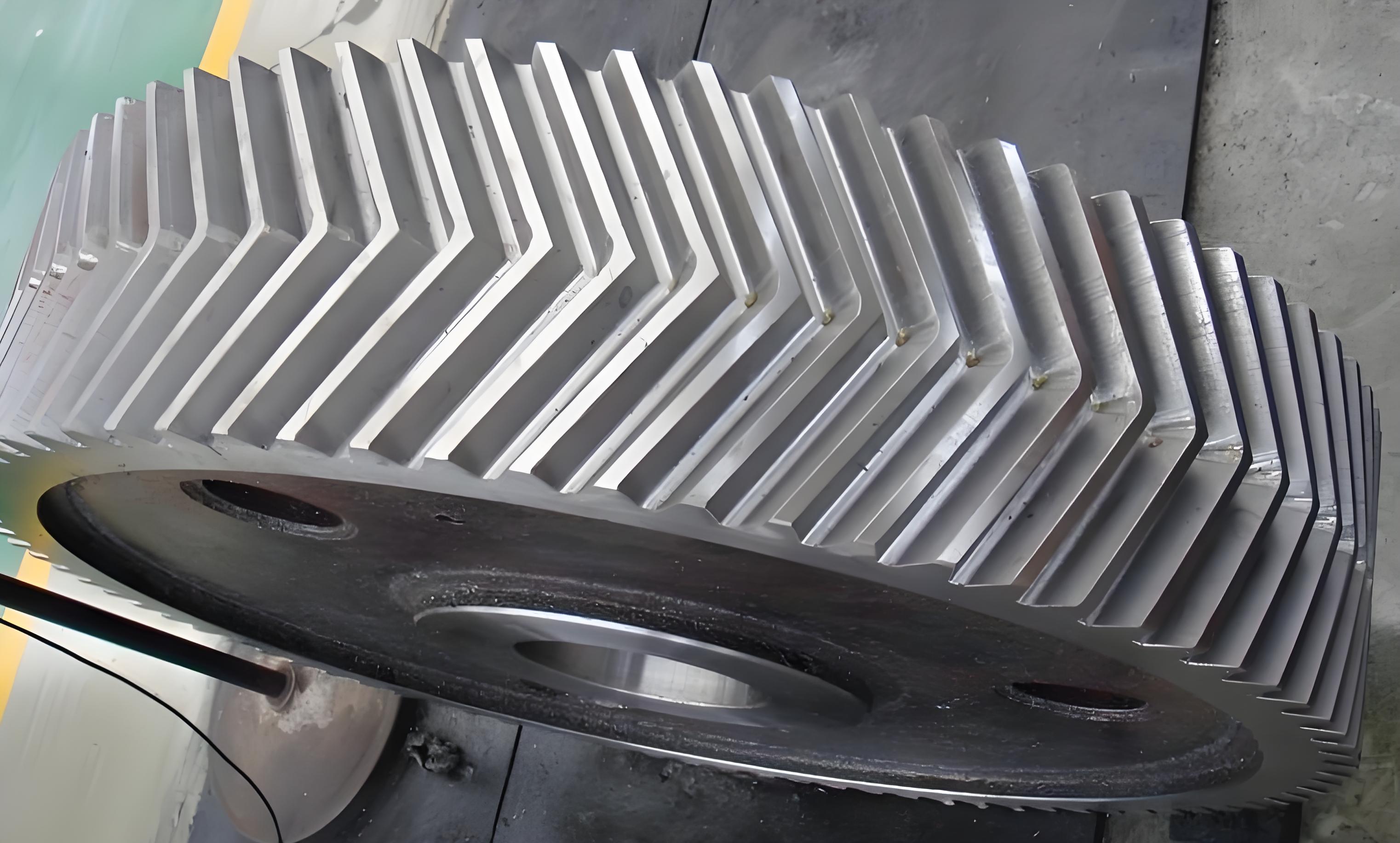
This article delves into the critical relationship between workpiece clamping pose errors and the resultant tooth deviations in herringbone gears manufactured via free-form flank milling. I will develop a comprehensive mathematical model to analyze this influence, propose a straightforward yet effective error compensation method based on multi-body system theory, and validate its efficacy through practical machining experiments. The ultimate goal is to provide a systematic approach for significantly enhancing the machining accuracy and symmetry of herringbone gears, thereby improving their meshing performance and dynamic characteristics in demanding applications.
1. Fundamentals of Herringbone Gear Manufacturing and Accuracy Assessment
The free-form milling of a herringbone gear involves the synchronized movement of a standard end mill along a pre-calculated toolpath relative to the rotating gear blank. The side-cutting edges of the tool perform a helical motion, gradually enveloping the involute tooth surface across the gear’s face width. The core of this process lies in the accurate generation of Cutter Location (CL) data, which defines the tool tip position and axis orientation for each machining step. This data is derived from the mathematical model of the involute gear geometry and the principles of surface envelope generation. For a standard involute profile, the coordinates of a point on the tooth flank can be expressed as a function of the base circle radius $r_b$ and the involute parameter $u$:
$$ x = r_b (\cos(u + \sigma_0) + u \sin(u + \sigma_0)) $$
$$ y = r_b (\sin(u + \sigma_0) – u \cos(u + \sigma_0)) $$
Here, $\sigma_0$ is the half-space angle on the base circle. The CL data generation algorithm computes these points and determines the corresponding tool center positions and axis vectors to avoid gouging while ensuring the specified surface finish, typically controlled by a residual cusp height parameter (e.g., 1 µm for finishing).
To quantify machining accuracy, gear standards such as ISO 1328-1 provide a suite of evaluation parameters. The key deviations for a herringbone gear are categorized into profile, helix, and pitch deviations.
- Profile Deviations: Measured in a transverse section, they describe errors in the tooth profile shape. Let $G'(x’, y’)$ be a point on the actual profile and $G(x, y)$ the corresponding point on the design profile along the common normal (line of action). The profile deviation $f$ at that point is the distance between $G’$ and $G$. The primary indicators are:
- Profile Form Deviation $(f_{f\alpha})$: Distance between two lines parallel to the mean profile line enclosing the actual profile over the evaluation range.
- Profile Slope Deviation $(f_{H\alpha})$: Distance between two design profile lines intersecting the mean profile line at the start and end of the evaluation range.
- Total Profile Deviation $(F_{\alpha})$: The absolute sum of $f_{f\alpha}$ and $|f_{H\alpha}|$.
- Helix (Lead) Deviations: Measured along the tooth trace, they describe errors in the helical path. Similar to profile deviations, they include Helix Form Deviation $(f_{f\beta})$, Helix Slope Deviation $(f_{H\beta})$, and Total Helix Deviation $(F_{\beta})$.
- Pitch Deviations: Measure the accuracy of angular spacing between teeth.
- Single Pitch Deviation $(f_{pt})$: Algebraic difference between the actual and theoretical pitch between two adjacent teeth.
- Pitch Accumulation Deviation $(f_{pk})$: Algebraic sum of $k$ successive single pitch deviations.
- Total Cumulative Pitch Deviation $(F_p)$: Maximum range of the pitch accumulation deviation curve over all teeth.
For a herringbone gear, the symmetry of these deviation values between the left-hand (LH) and right-hand (RH) helical sections is as critical as their absolute magnitude, directly influencing axial force balance.
2. Modeling and Analysis of Workpiece Setup Error Influence
The accuracy of the machined herringbone gear is highly sensitive to the precise alignment of the gear blank relative to the machine tool’s axes. Any deviation from the ideal setup, defined in the machine’s coordinate system, acts as a systematic error source propagated through the entire machining kinematics chain. I define these workpiece clamping pose errors with respect to the machine’s rotary table coordinate system $(o_C – x_C y_C z_C)$. The ideal workpiece coordinate system $(o_g – x_g y_g z_g)$ coincides with $(o_C)$ at setup. Four primary error components are considered, as illustrated in the following model:
$$ \text{Error Transform Matrix: } ^iE^{a}_{g} = \text{Trans}(\delta x_g, \delta y_g, 0) \cdot \text{Rot}_y(\epsilon y_g) \cdot \text{Rot}_x(\epsilon x_g) $$
where:
- $\delta x_g$: Tangential (X-direction) positioning error.
- $\delta y_g$: Radial (Y-direction) positioning error.
- $\epsilon x_g$: Tilt error about the X-axis (affecting helix angle).
- $\epsilon y_g$: Roll error about the Y-axis (affecting symmetry).
The complete kinematic chain for a 5-axis RTTTR-type machine tool (two rotary axes on the table) is modeled using homogeneous transformation matrices (HTM) based on multi-body system theory. The transformation from the tool coordinate system $(o_T)$ to the actual workpiece coordinate system $(o_g^a)$ is given by:
$$ [\mathbf{P}_g]^T = (^iE^{a}_{g})^{-1} \cdot [\mathbf{T}_{C}] \cdot [\mathbf{T}_{A}] \cdot [\mathbf{P}_T]^T $$
where $[\mathbf{T}_{C}]$ and $[\mathbf{T}_{A}]$ are HTMs for the C-axis (rotation about Z) and A-axis (rotation about X), respectively, and $[\mathbf{P}_T]$ is the tool point in the tool coordinate system. This model allows for the simulation of machining outcomes under the influence of the defined setup errors.
To analyze the sensitivity, I consider a specific herringbone gear with parameters: module $m_n=4$ mm, teeth $z=13$, pressure angle $\alpha=20^\circ$, helix angle $\beta=30^\circ$, face width $b=50$ mm. By introducing one error component at a time into the model, the resulting tooth deviations can be calculated. The following table summarizes the key relationships observed from the simulation analysis.
| Error Type | Profile Slope $f_{H\alpha}$ | Helix Slope $f_{H\beta}$ | Profile Form $f_{f\alpha}$ | Helix Form $f_{f\beta}$ | Pitch Deviations ($f_{pt}$, $F_p$) | Effect on LH/RH Symmetry |
|---|---|---|---|---|---|---|
| Tangential $\delta x_g = 0.05$ mm | Highly sensitive $\approx \delta x_g / 2$ | Highly sensitive $\approx \delta x_g / 2$ (sign reversed for LH/RH due to measurement direction) | Low sensitivity | Low sensitivity | Significant influence | Negligible impact on symmetry of form deviations. |
| Radial $\delta y_g = 0.05$ mm | Highly sensitive $\approx \delta y_g / 2$ | Highly sensitive $\approx \delta y_g / 2$ | Low sensitivity | Low sensitivity | Significant influence | Negligible impact on symmetry. |
| Tilt $\epsilon x_g = 0.03^\circ$ | Sensitive | Very sensitive (Greater impact than on $f_{H\alpha}$) | Low sensitivity | Low sensitivity | Moderate influence | Major impact. Induces significant asymmetry in helix slope and form deviations between LH and RH sections. |
| Roll $\epsilon y_g = 0.03^\circ$ | Sensitive | Very sensitive | Low sensitivity | Low sensitivity | Moderate influence | Major impact. Similar to tilt error, critically degrades the symmetry of the herringbone gear. |
Key Insights from the Analysis:
- Slope vs. Form Sensitivity: The slope deviations ($f_{H\alpha}$, $f_{H\beta}$) are highly sensitive to all setup errors, effectively acting as linear amplifiers. In contrast, the form deviations ($f_{f\alpha}$, $f_{f\beta}$) show relatively low sensitivity to these errors.
- Position vs. Angle Errors: While both position ($\delta x_g$, $\delta y_g$) and angle ($\epsilon x_g$, $\epsilon y_g$) errors severely affect slope and pitch accuracy, the angle errors are particularly detrimental to the symmetry of the herringbone gear. They create a systematic bias between the two helical halves, which can lead to uneven load sharing and axial vibration.
- Helix Sensitivity: The helix-related deviations ($f_{H\beta}$, $f_{f\beta}$) generally exhibit greater sensitivity to angular errors compared to profile deviations, underscoring the challenge in controlling the helical path accuracy.
This analysis confirms that uncompensated workpiece setup errors are a primary source of accuracy loss, especially for the critical symmetry of a herringbone gear. Therefore, an effective compensation strategy is essential.
3. A Multi-Body Theory Based Error Compensation Methodology
To counteract the influence of workpiece setup errors, I propose a compensation method integrated directly into the NC code generation post-processor. The core idea is to inversely solve the machine tool’s kinematic model to find the corrected axis commands (X, Y, Z, A, C) that will produce the desired tool motion relative to the actual (misaligned) workpiece position, rather than the ideal one.
The process begins with the “ideal” CL data, $[\mathbf{Q} \; 1]^T = [Q_x, Q_y, Q_z, 1]^T$ for tool tip position and $[\mathbf{K} \; 0]^T = [K_x, K_y, K_z, 0]^T$ for tool axis vector, generated for a perfectly aligned workpiece. These vectors are defined in the ideal workpiece coordinate system $(o_g)$. The goal is to find the machine axes positions that satisfy the following equation, which equates the CL data to the tool pose expressed through the kinematic chain including the error matrix $^iE^{a}_{g}$:
$$ [\mathbf{K} \; 0]^T = (^iE^{a}_{g})^{-1} \cdot \mathbf{R}_z(-C) \cdot ^C_B\mathbf{A} \cdot \mathbf{R}_x(A) \cdot ^A_B\mathbf{T} \cdot [0, -1, 0, 0]^T $$
$$ [\mathbf{Q} \; 1]^T = (^iE^{a}_{g})^{-1} \cdot \mathbf{R}_z(-C) \cdot ^C_B\mathbf{A} \cdot \mathbf{R}_x(A) \cdot ^A_B\mathbf{T} \cdot [0, 0, 0, 1]^T $$
Here, $\mathbf{R}_z(-C)$ and $\mathbf{R}_x(A)$ are rotation matrices for the C and A axes, and $^C_B\mathbf{A}$, $^A_B\mathbf{T}$ are constant transformation matrices describing the machine structure (e.g., offsets between axes). By analytically solving this system of equations for the unknown axis commands $A$, $C$, $X$, $Y$, $Z$, we obtain the compensation algorithm.
Assuming a simplified but common kinematic structure where tool offsets are incorporated, the analytical solution can be derived as:
$$ A = -\arcsin(K_x \epsilon y_g – K_y \epsilon x_g + K_z) $$
$$ C = \arctan\left( \frac{K_x – K_z \epsilon y_g}{K_y + K_z \epsilon x_g} \right) $$
$$ X = \cos(C)(Q_x – \delta x_g – Q_z \epsilon y_g) – \sin(C)(Q_y – \delta y_g + Q_z \epsilon x_g) – L_x $$
$$ Y = \sin(C)(Q_x – \delta x_g – Q_z \epsilon y_g) + \cos(C)(Q_y – \delta y_g + Q_z \epsilon x_g) + L_y \cos(A) – L_z \sin(A) – L_y $$
$$ Z = Q_z + L_z \cos(A) + L_y \sin(A) – L_z + Q_x \epsilon y_g – Q_y \epsilon x_g $$
where $L_x, L_y, L_z$ are components of the fixed tool offset vector. This set of equations is the cornerstone of the compensation method. For every CL point generated by the herringbone gear machining software, these equations are evaluated using the measured values of $\delta x_g, \delta y_g, \epsilon x_g, \epsilon y_g$. The output is a compensated NC code that directs the machine tool to move in a way that perfectly compensates for the measured setup misalignment.
The method’s advantage lies in its simplicity and computational efficiency, as it provides an analytical, decoupled solution for the compensation values. It can be seamlessly integrated as a post-processing step after CL data generation. For machines with only 4 axes (lacking a second rotary axis like A), the compensation for angular errors ($\epsilon x_g, \epsilon y_g$) is limited; in such cases, the formulas can be applied by setting the unsupported axis commands to zero, but physical minimization of angular misalignment during setup becomes paramount.
4. Experimental Validation and Results
To validate the proposed compensation methodology, a practical machining and measurement experiment was conducted. The target was the herringbone gear with the parameters listed earlier. The setup errors on a 5-axis machining center were meticulously measured using dial indicators: $\delta x_g = 0.009$ mm, $\delta y_g = 0.020$ mm, $\epsilon x_g = -0.007^\circ$, $\epsilon y_g = 0.019^\circ$.
Procedure:
- Tool Path Generation: CL data was generated using in-house software for the herringbone gear.
- NC Code Generation (Uncompensated): A standard post-processor created the initial NC code assuming perfect alignment.
- NC Code Generation (Compensated): The measured error values were fed into the derived compensation algorithm to create a modified NC code.
- Machining: Two identical gear blanks were machined—one with the uncompensated code and one with the compensated code—using a Ø4 mm flat-end mill. The process included roughing, root grooving, and finishing passes.
- Measurement: A high-precision coordinate measuring machine (CMM), WENZEL LH1512, was used to measure the gears according to ISO 1328-1 standards. Four teeth (numbers 1, 4, 7, 10 from the machining sequence) were measured on both the left-hand (LH) and right-hand (RH) helical sections.
Results and Discussion:
The measurement results clearly demonstrate the effectiveness of the compensation strategy. The following table summarizes the key accuracy grades before and after compensation.
| Gear Section & Condition | Total Profile Dev. $F_{\alpha}$ (Grade) | Total Helix Dev. $F_{\beta}$ (Grade) | Cumulative Pitch Dev. $F_{p}$ (Grade) | Symmetry Observation |
|---|---|---|---|---|
| Upper (RH) Helix – Uncompensated | 12.3 µm (Grade 8) | 18.5 µm (Grade 8) | 44.6 µm (Grade 8) | |
| Lower (LH) Helix – Uncompensated | 8.5 µm (Grade 7) | 5.2 µm (Grade 5) | 48.5 µm (Grade 8) | |
| Upper (RH) Helix – Compensated | ~5.5 µm (Grade 5) | ~4.8 µm (Grade 5) | ~15.2 µm (Grade 5) | |
| Lower (LH) Helix – Compensated | ~5.1 µm (Grade 5) | ~5.0 µm (Grade 5) | ~16.1 µm (Grade 5) |
The experimental findings confirm the theoretical analysis:
- Overall Accuracy Improvement: The proposed method successfully elevated the overall herringbone gear accuracy from Grade 8 to Grade 5 or better across all critical parameters ($F_{\alpha}$, $F_{\beta}$, $F_p$).
- Symmetry Enhancement: Most importantly, the pronounced asymmetry between the two helical halves observed in the uncompensated gear was virtually eliminated. After compensation, both the upper and lower sections exhibited nearly identical and high-precision grades. This is crucial for the balanced performance of the herringbone gear.
- Form Deviation Behavior: As predicted by the sensitivity analysis, the profile and helix form deviations ($f_{f\alpha}$, $f_{f\beta}$) showed less dramatic improvement compared to slope deviations, as they are inherently less sensitive to setup errors. Their residual values are more influenced by other factors like tool deflection or machine vibration.
- Validation of Compensation Algorithm: The successful outcome validates the mathematical model and the reverse kinematic solution encapsulated in the compensation formulas. The method effectively decouples and negates the influence of the measured setup errors.
5. Conclusion and Future Perspectives
In this comprehensive study, I have systematically addressed the critical issue of workpiece setup errors in the free-form milling of high-precision herringbone gears. Through detailed modeling and analysis, I established clear sensitivity relationships: while all pose errors significantly impact tooth slope and pitch accuracy, angular misalignments ($\epsilon x_g$, $\epsilon y_g$) are particularly detrimental to the essential symmetry of the herringbone gear. To counteract these effects, I developed and experimentally validated a straightforward yet powerful compensation method based on multi-body system theory.
The core contribution of this work is the derivation of an analytical, reverse kinematic solution that calculates compensated NC code directly from the measured setup errors. This method is computationally efficient and easily integrable into existing post-processing chains. The切削 experiments provided conclusive evidence of its efficacy, demonstrating an improvement in herringbone gear accuracy from ISO Grade 8 to Grade 5 and, more importantly, a dramatic restoration of symmetry between the left-hand and right-hand helical sections.
This advancement holds significant practical value for manufacturers utilizing multi-axis CNC platforms for gear production. By implementing this compensation strategy, the demanding quality requirements for herringbone gears can be met more consistently, leading to improved meshing performance, reduced noise and vibration, and enhanced longevity of the transmission systems in which they are deployed.
Future work will focus on expanding this error compensation framework. The immediate next step involves integrating a model for cutting force-induced errors, which constitute another major source of inaccuracy, especially in finishing operations. A coupled model accounting for both setup errors and quasi-static force errors will be developed. Furthermore, the real-time identification of setup errors using on-machine probing, followed by automatic compensation, will be investigated to create a closed-loop, intelligent machining system for herringbone gears and other complex components. This will push the boundaries of achievable precision in flexible, free-form manufacturing.