
In the intricate world of mechanical power transmission, gear systems stand as foundational components, ubiquitous across industries from automotive to heavy machinery and precision robotics. Among various gear types, the spur gears represent the most fundamental and widely used configuration due to their straightforward design and ease of manufacturing. The dynamic performance, noise, vibration, and longevity of a gear transmission system are profoundly governed by a single, critical parameter: the mesh stiffness. This stiffness is not a constant but varies with the rotational position of the gears—a phenomenon known as time-varying mesh stiffness (TVMS). The TVMS acts as a primary internal excitation source, dictating the system’s dynamic response. My research focuses on building a sophisticated analytical model to understand how several key factors—profile shift, tooth surface friction, and geometric eccentricity—collectively and individually influence the TVMS of spur gears. This deep dive is essential for advancing the design of quieter, more efficient, and more reliable gear drives.
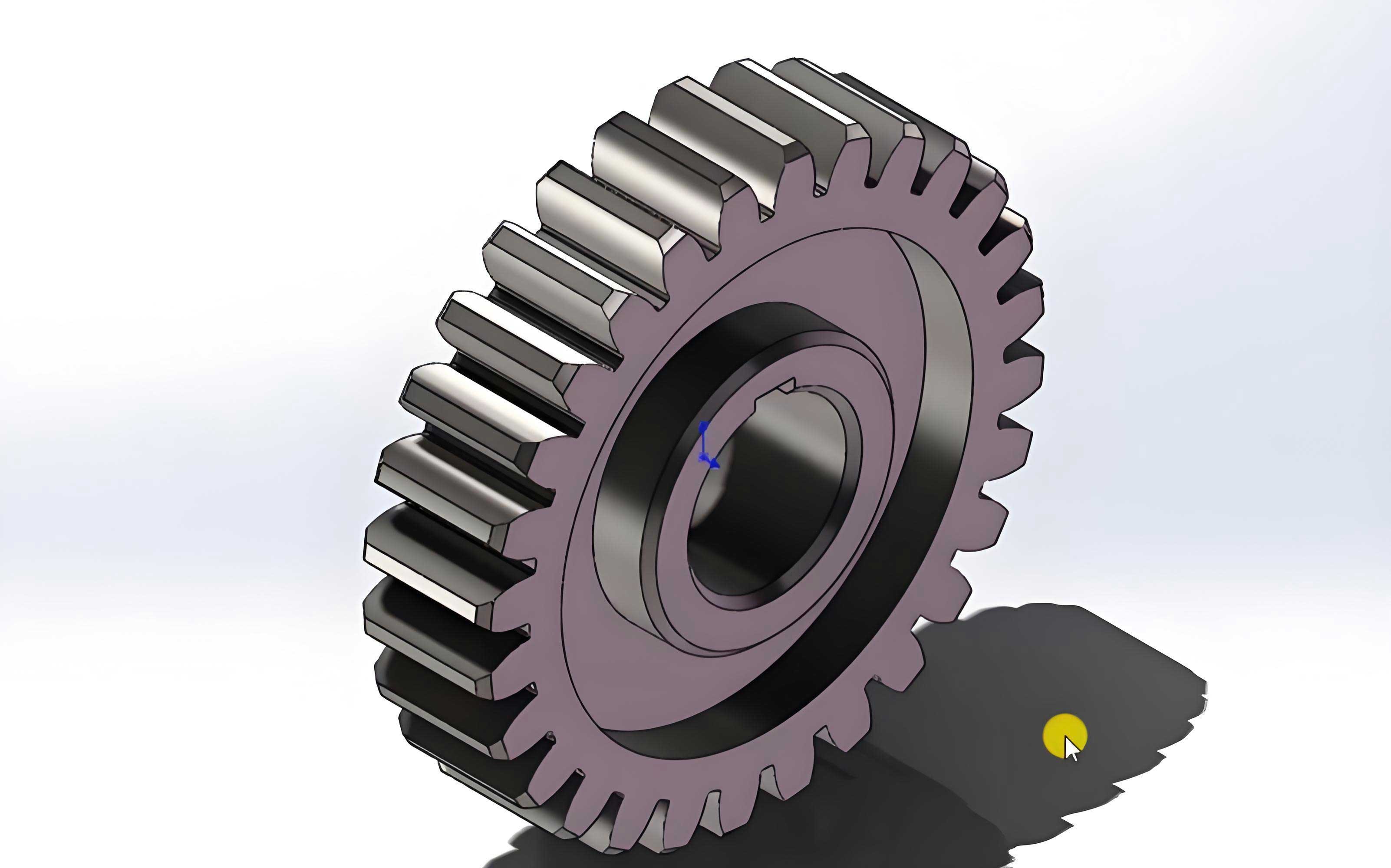
The accurate calculation of TVMS has been a central topic in gear dynamics. While finite element analysis (FEA) and experimental methods offer high fidelity, they are computationally expensive or resource-intensive. The potential energy method, grounded in material mechanics and gear geometry, provides an efficient and insightful analytical alternative. The cornerstone model considers the energy stored in a tooth due to bending, axial compression, shear, and Hertzian contact, leading to corresponding stiffness components. However, this model requires continuous refinement to capture real-world complexities. For instance, the nonlinear Hertzian contact stiffness for a pair of spur gears is given by:
$$
\frac{1}{k_H} = \frac{1.275}{E^{*0.9} B^{0.8} F_m^{0.1}}
$$
where $E^{*} = \frac{E_1 E_2}{E_1 + E_2}$ is the equivalent elastic modulus, $B$ is the face width, and $F_m$ is the mesh force at the contact point. Furthermore, the classic energy method was enhanced by incorporating the gear body’s deflection using an elastic foundation model and, crucially, by accounting for the structural coupling effect between adjacent teeth during double-tooth contact. This coupling effect prevents the overestimation of mesh stiffness that occurs when simply summing individual tooth stiffnesses in parallel.
Advanced Modeling of Spur Gears Mesh Stiffness
My work builds upon these foundations by integrating several critical aspects often treated in isolation. The first major consideration is tooth surface friction. In real spur gears operating under load, a friction force acts tangential to the tooth profile, opposing the sliding motion. This friction force changes direction at the pitch point. I have integrated this force into the stiffness calculation, modifying the expressions for bending, shear, and axial compression stiffness to include the friction coefficient $\mu$. For the driving gear, the radial and tangential force components at the meshing point, where $\beta$ is the angle between the force direction and a reference axis and $\theta_p$ is the angle at the pitch point, are:
$$
F_r = \begin{cases}
F \sin \beta + \mu F \cos \beta & \beta < \theta_p \\
F \sin \beta & \beta = \theta_p \\
F \sin \beta – \mu F \cos \beta & \beta > \theta_p
\end{cases}
$$
$$
F_t = \begin{cases}
F \cos \beta – \mu F \sin \beta & \beta < \theta_p \\
F \cos \beta & \beta = \theta_p \\
F \cos \beta + \mu F \sin \beta & \beta > \theta_p
\end{cases}
$$
This directional change of friction fundamentally alters the internal stress distribution within the tooth. Consequently, the bending stiffness formula, for example, is revised to account for friction across both the involute profile and the fillet curve segments. Similar corrections are applied to the foundation stiffness models to include the effect of friction on the tangential load component inducing gear body deflection.
The second cornerstone of my model is the comprehensive inclusion of profile shift. Profile-shifted, or “corrected,” spur gears are essential for adjusting center distances, avoiding undercutting in pinions with low tooth counts, and improving strength and wear characteristics. A positive profile shift ($x > 0$) effectively thickens the tooth near the root and thins it near the tip, while a negative shift ($x < 0$) does the opposite. This modification changes key geometric parameters used in stiffness calculations. I have revised the formulas for the tooth profile curve, the half-tooth angle on the base circle $\theta_b$, and the half-tooth angle on the root circle $\theta_f$ to incorporate the shift coefficient $x$. For a gear with module $m$, pressure angle $\alpha_0$, and tooth count $Z$, these become:
$$
\theta_b = \frac{\pi}{2Z} + \tan \alpha_0 – \alpha_0 + \frac{2x \tan \alpha_0}{Z}
$$
$$
\theta_f = \frac{1}{Z} \left[ \frac{\pi}{2} + 2(h_a^* – r_c^*) \tan \alpha_0 + \frac{2r_c^*}{\cos \alpha_0} \right] + \frac{2x \tan \alpha_0}{Z}
$$
where $h_a^*$ is the addendum coefficient and $r_c^*$ is the tool tip radius coefficient. Furthermore, the installation parameters for a pair of profile-shifted spur gears, such as the operating center distance $a_w$ and the working pressure angle $\alpha_w$, are calculated based on the sum of the shift coefficients ($x_1 + x_2$). This determines whether the gear pair is “high-shifted” (zero sum, standard center distance) or “angle-shifted” (non-zero sum, modified center distance).
Effect of Profile Shift on Mesh Stiffness Characteristics
Profile shift significantly alters the TVMS signature. To systematically analyze this, I investigated three scenarios: shifting only the pinion (driving gear), shifting only the wheel (driven gear), and high-shift pairs (equal and opposite shifts). The base parameters for the spur gears pair are detailed in the table below.
| Parameter | Pinion (Driving) | Gear (Driven) |
|---|---|---|
| Number of Teeth, $Z$ | 55 | 75 |
| Module, $m$ (mm) | 2 | 2 |
| Face Width, $B$ (mm) | 20 | 20 |
| Pressure Angle, $\alpha_0$ | 20° | 20° |
| Elastic Modulus, $E$ (GPa) | 206 | 206 |
For angle-shifted pairs, shifting only one gear (either pinion or wheel) from a negative to a positive coefficient leads to a consistent trend: the mesh stiffness amplitude increases across both single- and double-tooth contact regions. This is primarily because a positive shift increases the effective tooth thickness at the critical root section, enhancing its resistance to deflection. Concurrently, the operating center distance increases, and the contact ratio decreases. A lower contact ratio means a shorter double-tooth engagement interval and a longer single-tooth engagement interval within one mesh cycle, as reflected in the stiffness waveform. The first harmonic amplitude of the TVMS shows a strong positive correlation with the shift coefficient.
For high-shifted pairs where $x_1 = -x_2$, the center distance remains constant. An interesting observation is that pairs with larger absolute shift values (e.g., $x_1=1.0, x_2=-1.0$) exhibit lower mesh stiffness amplitudes than those with smaller absolute shifts (e.g., $x_1=0.2, x_2=-0.2$), despite the former having thicker teeth on the positively shifted gear. This counterintuitive result highlights the complex interplay between individual tooth stiffness and the altered load sharing and contact conditions due to the shift.
| Shift Case | $x_1$ | $x_2$ | Center Dist. $a_w$ (mm) | Contact Ratio | Stiffness Trend |
|---|---|---|---|---|---|
| Pinion Shift (Neg. to Pos.) | -1.0 to 1.0 | 0 | Increases | Decreases | Amplitude Increases |
| Wheel Shift (Neg. to Pos.) | 0 | -1.0 to 1.0 | Increases | Decreases | Amplitude Increases |
| High-Shift (Large |x|) | 1.0 | -1.0 | Constant | Lower | Lower Amplitude |
| High-Shift (Small |x|) | 0.2 | -0.2 | Constant | Higher | Higher Amplitude |
Interplay Between Profile Shift and Tooth Surface Friction
The inclusion of tooth surface friction introduces a nuanced effect that is powerfully modulated by profile shift. In standard (non-shifted) spur gears, the friction force changes direction at the pitch point, which typically lies within the single-tooth contact region. This causes a characteristic “kink” or discontinuity in the slope of the single-tooth stiffness curve at that point. However, profile shift changes the relative position of the operating pitch point within the path of contact. My analysis reveals that as the shift coefficient varies, the pitch point can transition from being located in the double-tooth zone (near the pinion tip or root) to the single-tooth zone, and back to the double-tooth zone. This geometric shift fundamentally changes how friction affects the TVMS.
When the pitch point is located in the double-tooth region near the pinion root (e.g., with a highly positive pinion shift), the friction force over the majority of the single-tooth meshing interval acts in a direction that increases the apparent mesh stiffness. Conversely, when the pitch point is in the double-tooth region near the pinion tip (e.g., with a highly negative pinion shift), friction acts to reduce the mesh stiffness over most of the single-tooth interval. This explains why the harmonic amplitudes of TVMS can be either higher or lower than the frictionless case depending on the specific shift configuration. The key insight is that profile shift dictates the meshing phase during which friction’s stiffening or softening effect is dominant.
Impact of Geometric Eccentricity on Mesh Stiffness
Geometric eccentricity, a common manufacturing or assembly error where the geometric center of the gear does not coincide with its rotational center, introduces a dynamic disturbance. This eccentricity causes the actual center distance between the pair of spur gears to vary periodically with rotation. The instantaneous center distance $L(t)$ for a pair with eccentricities $e_1$ and $e_2$, and initial phases $\theta_p$ and $\theta_g$, is:
$$
L(t) = \sqrt{[a_w – e_1 \cos(\omega_p t + \theta_p) – e_2 \cos(\omega_g t + \theta_g)]^2 + [e_2 \sin(\omega_g t + \theta_g) – e_1 \sin(\omega_p t + \theta_p)]^2}
$$
where $\omega_p$ and $\omega_g$ are the rotational speeds. This time-varying center distance directly alters the working pressure angle $\alpha(t)$ and the pressure angles at the start and end of contact, leading to a modulation of the TVMS waveform.
The primary effect of eccentricity is an increase in the peak-to-peak variation of the TVMS, making the waveform appear amplitude-modulated. The severity of this modulation increases with the magnitude of the eccentricity. A more profound effect is observed in the frequency domain. The TVMS, which normally has strong harmonics at the mesh frequency $f_m$ and its multiples, now exhibits sidebands around these harmonics. If only the pinion has eccentricity, sidebands appear at $f_m \pm nf_p$ (where $f_p$ is the pinion rotational frequency and $n=1,2,…$). If both gears have eccentricity, the spectrum becomes richer, showing sidebands at $f_m \pm nf_p$, $f_m \pm nf_g$, and also at $f_m \pm n(f_p – f_g)$. This spectral signature is a direct consequence of the periodic perturbation introduced by the rotating eccentricities.
$$
\text{Spectrum with Eccentricity} \Rightarrow \text{Peaks at } f_m, f_m \pm f_p, f_m \pm f_g, f_m \pm (f_p – f_g), …
$$
Synthesized Effects: Shift, Friction, and Eccentricity
The true behavior of a practical gear system emerges from the confluence of all these factors. My integrated model allows for the simulation of this complex interaction. Consider a high-shift gear pair ($x_1=1.0, x_2=-1.0$) operating with a friction coefficient $\mu=0.1$ and a pinion eccentricity $e_1=0.1$ mm. The resulting TVMS is a composite waveform exhibiting several distinct features inherited from each factor.
- Profile Shift Foundation: The base waveform has the amplitude and contact ratio characteristics of the high-shift pair.
- Friction Effect: The location and nature of the friction-induced stiffness change depend on where the pitch point falls due to the specific shift. In some configurations, the entire effective mesh cycle may occur on one side of the pitch point, causing friction to act monolithically to either increase or decrease stiffness throughout.
- Eccentricity Modulation: Superimposed on this is a low-frequency amplitude modulation at the rotational frequency, caused by the varying center distance. This modulates both the high-stiffness (double-tooth) and low-stiffness (single-tooth) plateaus of the waveform.
The interplay can be significant. For instance, eccentricity-induced variations in center distance can momentarily alter the pressure angle enough to shift the pitch point location relative to the mesh interval, thereby dynamically changing the effective role of friction during operation. This creates a highly non-linear and time-dependent TVMS excitation.
Conclusion and Implications for Spur Gears Design
Through the development and application of this comprehensive analytical model, I have elucidated the critical, and often interacting, roles that profile shift, tooth surface friction, and geometric eccentricity play in defining the time-varying mesh stiffness of spur gears. The key findings underscore the importance of a holistic view in gear dynamics:
- Profile shift is a powerful design tool that directly controls mesh stiffness amplitude, contact ratio, and the load-sharing characteristics between teeth. It also repositions the pitch point, which in turn governs how tooth surface friction influences stiffness.
- Tooth surface friction is not a secondary effect; it can meaningfully increase or decrease mesh stiffness depending on the engagement phase. Its impact is not universal but is critically dependent on the gear geometry defined by the profile shift.
- Geometric eccentricity acts as a dynamic perturbator, introducing periodic modulation in the TVMS. This manifests as increased peak-to-peak variation in the time domain and distinctive sideband families in the frequency domain, which can serve as diagnostic fingerprints for such faults.
The synthesized model demonstrates that these factors do not operate in isolation. Their combined effect can lead to complex TVMS behavior that deviates substantially from the idealized, frictionless, non-shifted, and concentric case. For engineers, this means that accurate dynamic prediction and diagnosis for high-performance spur gears transmissions—especially those using profile shifting for optimization—must account for these coupled factors. This work provides the refined analytical tools and fundamental insights necessary to advance the design, analysis, and condition monitoring of gear systems, steering towards higher precision, reliability, and efficiency in mechanical power transmission.