
The precision measurement of bevel gears remains a significant challenge within advanced manufacturing, directly impacting the performance, noise, vibration, and longevity of power transmission systems in automotive, aerospace, and industrial machinery. While coordinate measuring machines (CMMs) and specialized gear measuring centers offer high accuracy, their application for bevel gears often involves complex setup procedures, intricate probe path planning, and time-consuming radius compensation calculations inherent to tactile methods. Furthermore, access to such high-end equipment is limited, leading many manufacturers to rely on manual or less sophisticated inspection techniques, which compromise both efficiency and consistency. This work presents a novel, integrated measurement methodology and apparatus designed to streamline the inspection process for bevel gears. By employing a non-contact laser displacement sensor, the system rapidly acquires high-density point cloud data of the gear tooth flanks. Through a series of mathematical transformations and coordinate-based geometric analyses, this data is used to calculate critical quality parameters, specifically the single pitch deviation, the cumulative pitch deviation, and the radial runout of the tooth ring. This approach effectively simplifies the measurement workflow, eliminates probe compensation errors, and enhances overall inspection throughput and precision.
The core principle of the developed measurement system is based on coordinate metrology. A laser displacement sensor is mounted on a precision motion platform capable of linear movement along three orthogonal axes (X, Y, Z). The sensor can also be rotated to adjust its angle relative to the workpiece. The bevel gear under test is mounted on a high-precision rotary axis equipped with a high-resolution angular encoder. The system operates by positioning the laser spot at the mid-face width of the gear tooth. The gear is then rotated at a constant speed while the laser displacement sensor continuously records the distance to the tooth surface. Simultaneously, the rotary encoder records the corresponding angular position for each sampled data point. This synchronized acquisition results in a dense set of discrete data points representing the tooth profile contour at the mid-face cone section.
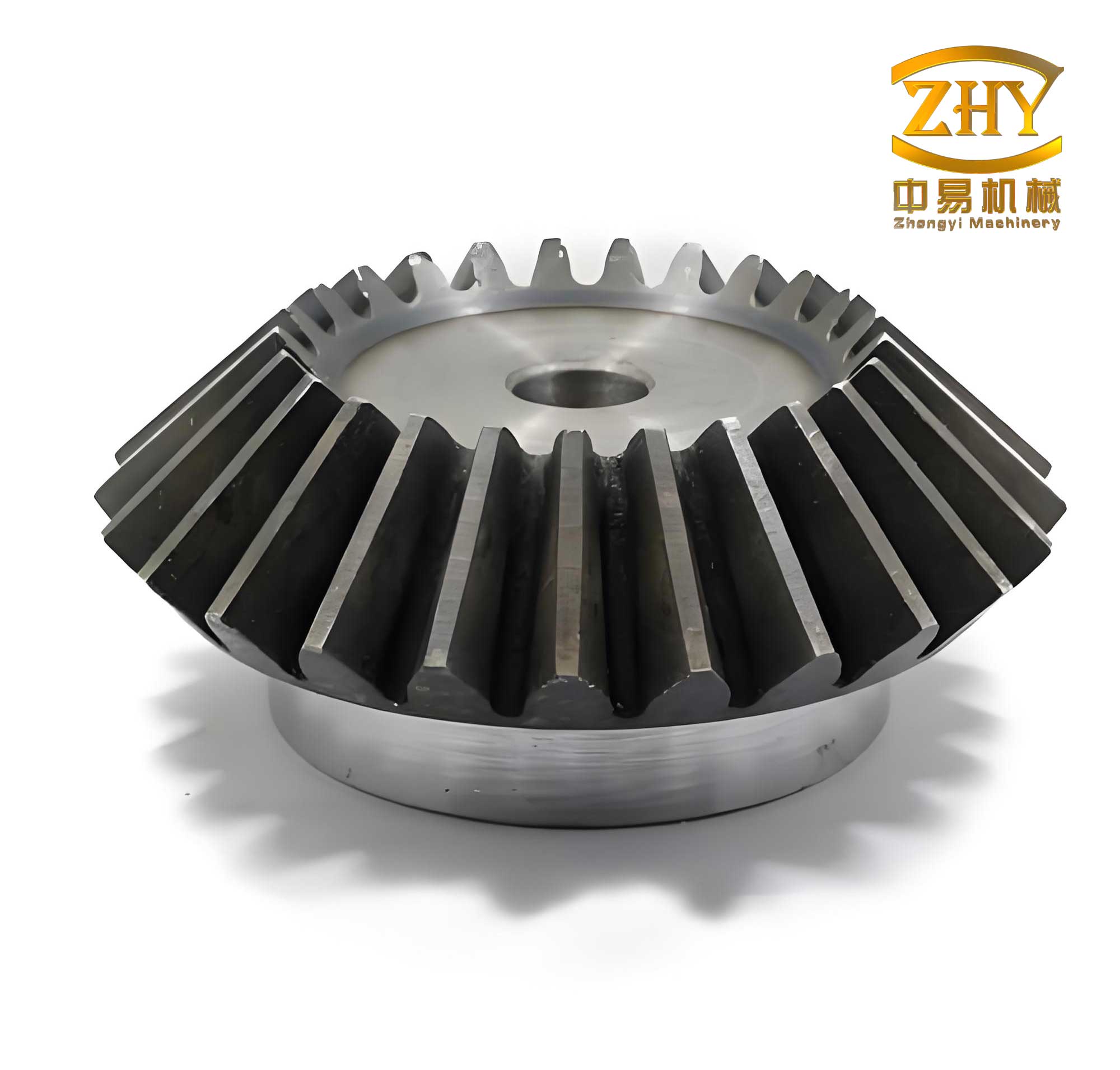
The raw data from the sensor consists of tuples \( (H_i, \theta_i) \), where \( H_i \) is the measured distance value and \( \theta_i \) is the angular position from the encoder. To prepare this data for geometric analysis, it must be transformed from a polar-like measurement space into a Cartesian coordinate system representing the developed tooth profile. This requires knowledge of the bevel gear’s basic geometric parameters: the outer module \( m_e \), the number of teeth \( z \), the face width \( b \), the outer cone distance \( R_e \), and the pitch angle \( \delta \). The face width ratio is defined as \( \phi_R = b / R_e \). From these, key mid-face parameters are calculated:
- Mid-face cone distance: \( R_m = R_e (1 – 0.5 \phi_R) \).
- Mid-face pitch radius: \( r_m = \frac{m_e z}{2} (1 – 0.5 \phi_R) \).
- Mid-face module: \( m_m = m_e (1 – 0.5 \phi_R) \).
The slant distance from the apex to the mid-face pitch line is \( L = R_m \tan \delta \). When the conical surface at the mid-face is developed onto a plane, it forms a sector. The central angle \( \alpha \) of this sector corresponding to the full gear circumference is:
$$
\alpha = \frac{2\pi r_m}{L} = \frac{2\pi r_m}{R_m \tan \delta}
$$
For any sampled data point with angular position \( \theta_i \) (normalized from the encoder data), the corresponding angle \( \beta_i \) on the developed plane is:
$$
\beta_i = \frac{\theta_i – \theta_{\text{start}}}{\theta_{\text{end}} – \theta_{\text{start}}} \cdot \alpha
$$
Finally, the Cartesian coordinates \( (x_i, y_i) \) of the point on the developed tooth profile plane are given by:
$$
x_i = (L + H_i) \sin \beta_i, \quad y_i = (L + H_i) \cos \beta_i
$$
This transformation is foundational, as it allows for the application of planar coordinate geometry techniques to analyze the three-dimensional bevel gear tooth form. The following table summarizes the key coordinate transformation parameters and formulas.
| Parameter | Symbol | Formula |
|---|---|---|
| Outer Module | \( m_e \) | Given |
| Mid-face Module | \( m_m \) | \( m_m = m_e (1 – 0.5 \phi_R) \) |
| Mid-face Pitch Radius | \( r_m \) | \( r_m = \dfrac{m_e z}{2} (1 – 0.5 \phi_R) \) |
| Slant Distance to Mid-face | \( L \) | \( L = R_m \tan \delta = R_e (1 – 0.5 \phi_R) \tan \delta \) |
| Development Sector Angle | \( \alpha \) | \( \alpha = \dfrac{2\pi r_m}{L} \) |
| Point Angle on Developed Plane | \( \beta_i \) | \( \beta_i = \alpha \cdot (\theta_i – \theta_1)/(\theta_n – \theta_1) \) |
| Cartesian Coordinates | \( (x_i, y_i) \) | \( x_i = (L + H_i)\sin\beta_i, \quad y_i = (L + H_i)\cos\beta_i \) |
With the bevel gear tooth profile accurately mapped into a Cartesian coordinate system, the precise calculation of geometric deviations becomes feasible. The first critical parameter is the single pitch deviation \( \Delta f_{pt} \), defined as the difference between the actual and theoretical pitch at the mid-face pitch circle. The theoretical pitch \( p \) is simply \( p = \pi m_m \). To find the actual pitch, one must first locate the precise points on the left and right flanks that lie on the actual pitch circle (where the profile deviation \( H_i \) is nominally zero). This is achieved through numerical interpolation. For each flank, data points near \( H=0 \) are selected, and a high-order polynomial (e.g., cubic spline) is fitted. The intersection of this interpolated curve with the circle of radius \( L \) (the theoretical pitch line) is found using an iterative numerical method like the bisection method. Let these intersection points for successive teeth be \( P_{i}(x_i, y_i) \) and \( P_{i+1}(x_{i+1}, y_{i+1}) \). The actual arc distance (pitch) between them is calculated using the chord length and the radius \( r_m \):
$$
p_{\text{actual}, i} = 2 r_m \arcsin\left( \frac{\sqrt{(x_{i+1} – x_i)^2 + (y_{i+1} – y_i)^2}}{2 r_m} \right)
$$
The single pitch deviation for that tooth space is then \( \Delta f_{pt, i} = p_{\text{actual}, i} – p \). By calculating this for all teeth around the bevel gear, the maximum and minimum deviations are identified. The cumulative pitch deviation \( \Delta F_p \) is the maximum algebraic difference between the actual and theoretical cumulative pitches over a full revolution. The \( k \)-tooth cumulative pitch deviation \( \Delta F_{pk} \) is similarly calculated over \( k \) tooth intervals.
The measurement of radial runout \( F_r \) for a bevel gear presents a unique challenge because the measurement must be taken in the direction normal to the pitch cone. The traditional method uses a master ball or pin that makes dual-flank contact in the tooth space. The runout is the total variation in the position of this ball’s center relative to the gear axis during one complete revolution. In our coordinate-based method, we simulate this process mathematically without physical contact. For each tooth space, we identify the points \( A(x_1, y_1) \) and \( B(x_2, y_2) \) on the left and right flanks that lie on the actual pitch circle, as determined in the pitch deviation analysis. At these points, we construct the lines normal to the tooth profile. The direction of these normals depends on the local slope of the profile and the nominal pressure angle \( \alpha_n \) at the mid-face.
Let \( \psi_1 \) and \( \psi_2 \) be the angles of the radial lines \( OA \) and \( OB \) relative to the coordinate system. They can be found as \( \psi_1 = \arctan2(y_1, x_1) \) and \( \psi_2 = \arctan2(y_2, x_2) \). The direction angles \( \phi_1 \) and \( \phi_2 \) for the tooth profile normals at \( A \) and \( B \), pointing into the tooth space, are approximately \( \phi_1 = \psi_1 + (90^\circ + \alpha_n) \) and \( \phi_2 = \psi_2 – (90^\circ + \alpha_n) \), adjusted for the specific orientation. A more precise calculation uses the derivative of the interpolated profile curve at those points. The equations of the two normal lines are:
$$
\text{Line } n_1: y – y_1 = \tan(\phi_1)(x – x_1)
$$
$$
\text{Line } n_2: y – y_2 = \tan(\phi_2)(x – x_2)
$$
The intersection point \( Q(x_q, y_q) \) of these two lines represents the center of the simulated master ball that would simultaneously contact both flanks at the pitch line. Solving these two equations yields the coordinates of \( Q \). The distance from the gear center (origin \( O \)) to this simulated ball center is \( R_{Q,i} = \sqrt{x_q^2 + y_q^2} \). This process is repeated for every tooth space around the bevel gear. The radial runout \( F_r \) is defined as the difference between the maximum and minimum values of these distances over one full revolution:
$$
F_r = \max_{i}(R_{Q,i}) – \min_{i}(R_{Q,i})
$$
This mathematical simulation of the ball center position is a significant advantage of the coordinate method, as it removes the ambiguity and potential error associated with selecting a physically correct ball size and compensates for any profile form errors affecting the contact point.
| Measurement Task | Traditional Method Challenges | Proposed Laser-Based Coordinate Method Advantages |
|---|---|---|
| Pitch Measurement | Requires precise indexing and direct contact at the pitch line; sensitive to probe alignment and tooth form. | Derived mathematically from full profile data; less sensitive to local anomalies due to curve fitting. |
| Runout Measurement | Dependent on correct master ball size; contact point varies with tooth deviation; slow point-by-point acquisition. | Simulated ball center via normal intersection; independent of physical ball size; calculated from same rapid full-scan dataset. |
| General Process | Often requires multiple setups and different instruments for different errors. | Multiple errors (pitch, runout, and potentially form, helix) extracted from a single automated scanning procedure. |
| Speed & Automation | Sequential, manual or semi-automatic processes are time-consuming. | High-speed, continuous data acquisition enables rapid inspection of the entire bevel gear. |
To validate the proposed methodology, a practical test was conducted on a straight bevel gear, commonly used in mechanical transmissions. The key parameters of the test bevel gear were: outer module \( m_e = 2.5 \, \text{mm} \), number of teeth \( z = 36 \), face width \( b = 20 \, \text{mm} \), and pitch angle \( \delta = 60^\circ \). The gear was mounted on the instrument’s rotary axis. The laser displacement sensor was positioned at the mid-face width and aligned perpendicular to the pitch cone. A complete 360-degree scan was performed, capturing several thousand data points per tooth flank. The data was processed through the developed software algorithm, which executed the coordinate transformation, pitch point identification, and runout simulation calculations as described.
The analysis yielded the following results for the subject bevel gear:
- Single Pitch Deviation \( \Delta f_{pt} \): Maximum value was \( +0.0442 \, \text{mm} \), minimum value was \( -0.0011 \, \text{mm} \).
- Cumulative Pitch Deviation \( \Delta F_{p} \): Calculated value was \( -0.0459 \, \text{mm} \).
- Radial Runout \( F_{r} \): Calculated value was \( 0.0779 \, \text{mm} \).
By comparing these deviation values with the tolerance tables specified in international standards such as ISO 17485 or the referenced GB/T 11365, the overall accuracy grade of this particular bevel gear was assessed to be approximately Grade 9. This demonstrates the system’s capability to provide quantitative, standards-based evaluation of bevel gear quality. The non-contact nature of the measurement was confirmed to prevent any surface damage or influence on the result from probe force, and the entire measurement cycle was completed in a fraction of the time required for traditional tactile methods.
This paper has detailed the development and application of a non-contact measurement system for the evaluation of bevel gear precision, focusing on pitch-related deviations and tooth runout. The integration of a laser displacement sensor with a precision motion platform enables the rapid acquisition of high-resolution tooth profile data. The core innovation lies in the mathematical processing of this data: by transforming the conical tooth profile into a developed planar coordinate system, sophisticated geometric analyses become straightforward. The coordinate method allows for the precise numerical determination of the pitch points and the mathematical simulation of the master ball center for runout calculation, eliminating key sources of error inherent in traditional tactile methods. The experimental results confirm the practicality and effectiveness of this approach. The system offers a compelling alternative to complex and expensive gear measuring centers for many industrial applications, providing a simplified, efficient, and accurate solution for the quality control of bevel gears. Future work will focus on extending the analysis to other critical bevel gear error components such as profile form deviation and helix angle deviation, further enhancing the comprehensiveness of this non-contact inspection platform.