
In recent years, our research group has focused extensively on the development and optimization of spiral gear drives, particularly those combining steel pinions or worms with plastic gears. The use of spiral gears in applications ranging from heavy-duty vehicles to household appliances has grown significantly, driven by demands for cost-effectiveness, lightweight design, improved noise characteristics, and vibration damping. This article presents a comprehensive overview of our work, detailing the design methodologies, experimental investigations, and optimization strategies for steel/plastic spiral gear transmissions. We emphasize the critical role of spiral gears in modern engineering and explore how material combinations can enhance performance.
Spiral gears, also known as crossed helical gears, are essential components in many mechanical systems due to their ability to transmit motion between non-parallel shafts. The unique geometry of spiral gears allows for smooth engagement and reduced noise, making them ideal for auxiliary drives in advanced automobiles, where up to 100 such devices may be employed. Our research specifically targets spiral gear pairs where a steel element mates with a plastic gear, leveraging the strengths of both materials: steel for durability and plastic for weight reduction and damping properties. The design of these spiral gears requires careful consideration of factors such as load capacity, wear resistance, thermal management, and lubrication.
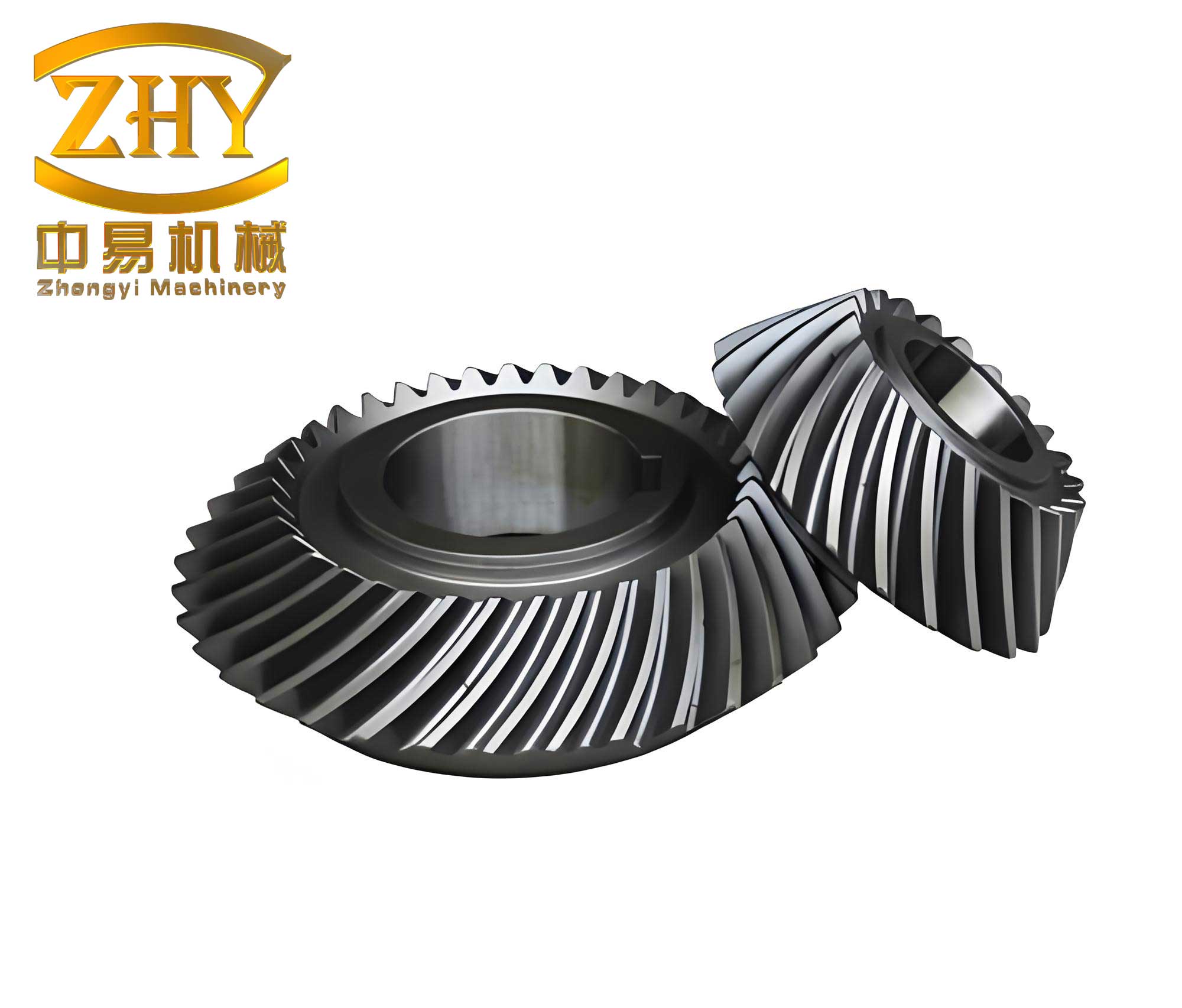
To address these challenges, we have developed a computational approach that enables designers to perform initial load capacity calculations and optimize steel/plastic spiral gear drives from the outset. This methodology integrates analytical models with empirical data, allowing for precise predictions of performance under various operating conditions. We conducted extensive bench tests on spiral gear assemblies with center distances ranging from 20 mm to 65 mm, investigating the influence of design and transmission parameters on load capacity. The test setups included cylindrical worms and spiral gears, as well as hourglass worms, with tooth surfaces ground from materials such as PEEK, PA4.6, and POM. Parameters varied included the number of teeth, torque levels, and lubrication types (e.g., grease vs. mineral oil).
A key aspect of our analysis is the thermal behavior of spiral gear drives. Frictional losses in the meshing of spiral gears generate heat, which can significantly affect material properties and longevity. We derived an approximate equation for the mean coefficient of friction, serving as the foundation for temperature calculations. The static evaluation of measured temperatures led to approximate equations for oil sump temperature, hub temperature, and meshing temperature. These temperatures depend on the power loss in the mesh, the relative output torque related to the center distance and gear ratio, and the sliding velocity at the pitch circle. For instance, the meshing temperature \( T_m \) can be expressed as:
$$ T_m = T_0 + k_1 \cdot P_{\text{loss}} \cdot \left( \frac{T_{\text{out}}}{a \cdot u} \right) + k_2 \cdot v_s $$
where \( T_0 \) is the ambient temperature, \( P_{\text{loss}} \) is the power loss due to friction, \( T_{\text{out}} \) is the output torque, \( a \) is the center distance, \( u \) is the gear ratio, \( v_s \) is the sliding velocity, and \( k_1 \), \( k_2 \) are material-specific constants. This equation highlights how spiral gear performance is intrinsically linked to thermal management.
Building on the temperature equations, we assessed tooth flank wear, which critically impacts the load capacity of spiral gears. Various wear mechanisms manifest in spiral gear and worm drives, necessitating specific techniques for measurement. Our studies show that the load capacity of these drives heavily depends on worm speed, torque, material pairing, lubrication method, and macro-geometry. These parameters not only cause wear but also lead to different failure modes, such as welding, pitting, and tooth fracture. For example, at low speeds, pitting and tooth breakage become more severe, while at high speeds, failure often results from exceeding the operational temperature limits of the plastic or lubricant. Materials like PA4.6 and POM generally exhibit lower load-bearing capabilities compared to PEEK-based spiral gears. However, substituting a spiral gear with an hourglass worm and using mineral oil instead of grease can enhance the load capacity.
To facilitate design optimization, we created a simulation program named “Schraubrad.de” (which translates to “Spiral Gear” in English). This tool allows users to eliminate potential failure modes and optimize spiral gear drives according to boundary conditions. The program incorporates our derived equations and experimental data, enabling dynamic analysis of spiral gear performance. For instance, it can compute speed-dependent limit torques for given configurations. As an illustration, consider a spiral gear mesh with a center distance of 30 mm and PEEK material; the program outputs the limit torque curve across speeds, ensuring designs avoid thermal or mechanical failure.
The following table summarizes key material properties for the plastics used in our spiral gear studies, highlighting their relevance to gear performance:
| Material | Density (g/cm³) | Tensile Strength (MPa) | Max Operating Temperature (°C) | Coefficient of Friction vs. Steel |
|---|---|---|---|---|
| PEEK | 1.32 | 90-100 | 250 | 0.2-0.3 |
| PA4.6 | 1.18 | 80-90 | 120 | 0.3-0.4 |
| POM | 1.41 | 60-70 | 100 | 0.2-0.35 |
In addition to material selection, the geometry of spiral gears plays a crucial role in performance. The helix angle, pressure angle, and module must be optimized to balance load capacity and efficiency. For spiral gears, the contact ratio and sliding velocity are particularly important due to the crossed-axis configuration. We derived formulas to calculate these parameters. The sliding velocity \( v_s \) at the pitch point is given by:
$$ v_s = \sqrt{v_{1t}^2 + v_{2t}^2 – 2 v_{1t} v_{2t} \cos \Sigma} $$
where \( v_{1t} \) and \( v_{2t} \) are the tangential velocities of the two gears, and \( \Sigma \) is the shaft angle. This velocity directly influences frictional heating and wear in spiral gears.
Our experimental results are summarized in the table below, showing how different parameters affect the load capacity of steel/plastic spiral gear drives. These findings underscore the complexity of designing reliable spiral gears.
| Parameter Varied | Effect on Load Capacity | Remarks |
|---|---|---|
| Worm Speed Increase | Decreases due to thermal limits | Critical for plastic spiral gears |
| Torque Increase | Decreases due to higher stress | Leads to wear and pitting |
| Material: PEEK vs. PA4.6 | PEEK offers higher capacity | Linked to temperature resistance |
| Lubrication: Oil vs. Grease | Oil improves capacity | Better heat dissipation |
| Gear Geometry: Hourglass vs. Cylindrical | Hourglass enhances capacity | Increased contact area |
Further analysis of wear mechanisms revealed that abrasive wear is dominant in spiral gears under high-sliding conditions. We modeled wear volume \( W \) using Archard’s law, modified for spiral gear applications:
$$ W = k \cdot \frac{F_n \cdot L}{H} $$
where \( k \) is a wear coefficient, \( F_n \) is the normal load, \( L \) is the sliding distance, and \( H \) is the material hardness. For plastic spiral gears, \( H \) is replaced by a measure of wear resistance derived from experimental data. This model helps predict the lifespan of spiral gear drives.
Optimization of spiral gears involves multi-objective criteria, including minimizing weight, maximizing load capacity, and reducing noise. We formulated an optimization problem using constraints from our temperature and wear equations. For example, the objective function for minimizing weight \( M \) of a plastic spiral gear can be expressed as:
$$ M = \rho \cdot V = \rho \cdot \frac{\pi}{4} \left( d_a^2 – d_f^2 \right) b $$
where \( \rho \) is density, \( V \) is volume, \( d_a \) is outside diameter, \( d_f \) is root diameter, and \( b \) is face width. Constraints include temperature limits \( T_m \leq T_{\text{max}} \) and wear limits \( W \leq W_{\text{max}} \). Our simulation program solves such problems iteratively, providing optimized geometries for spiral gears.
In terms of lubrication, we studied the impact of different lubricants on spiral gear performance. The viscosity and additive packages significantly affect the friction coefficient and heat dissipation. For steel/plastic spiral gears, we recommend using synthetic oils with high thermal stability. The friction coefficient \( \mu \) in spiral gear meshes can be approximated by:
$$ \mu = \mu_0 \cdot e^{-\alpha v_s} + \beta $$
where \( \mu_0 \), \( \alpha \), and \( \beta \) are constants dependent on lubricant and material pair. This equation is integrated into our thermal model to improve accuracy.
Noise reduction is another critical benefit of using plastic in spiral gears. The damping characteristics of plastics reduce vibration transmission, making spiral gear drives quieter. We measured sound pressure levels in various configurations, showing that steel/plastic spiral gears can achieve up to 10 dB reduction compared to all-steel pairs. This is particularly valuable in automotive applications where noise pollution is a concern.
The design process for spiral gears also involves manufacturing considerations. For plastic spiral gears, injection molding or machining from blanks is common, while steel worms are often ground or rolled. We developed guidelines for tolerances and surface finishes to ensure proper meshing of spiral gears. The table below outlines recommended tolerances for key dimensions in steel/plastic spiral gear pairs.
| Dimension | Tolerance for Steel Worm (mm) | Tolerance for Plastic Gear (mm) |
|---|---|---|
| Pitch Diameter | ±0.02 | ±0.05 |
| Tooth Thickness | ±0.01 | ±0.03 |
| Helix Angle | ±0.1° | ±0.2° |
Looking ahead, future work on spiral gears will focus on advanced materials such as carbon-fiber reinforced plastics and novel lubricants. We are also exploring the use of additive manufacturing for custom spiral gear geometries, which could revolutionize prototyping and small-batch production. Additionally, integrating IoT sensors for real-time monitoring of temperature and wear in spiral gear drives is a promising direction for predictive maintenance.
In conclusion, our research demonstrates that steel/plastic spiral gear drives offer significant advantages in terms of weight, cost, and noise, but require careful design to overcome challenges related to load capacity and thermal management. Through a combination of analytical models, experimental testing, and simulation tools, we have established a robust framework for optimizing these spiral gears. The key formulas and tables presented here provide practical guidance for engineers working with spiral gears. As technology advances, spiral gears will continue to play a vital role in efficient and quiet power transmission systems.
To further illustrate the optimization outcomes, consider the following equation for the limit torque \( T_{\text{lim}} \) of a spiral gear drive as a function of speed \( n \), based on our simulation results:
$$ T_{\text{lim}}(n) = \frac{C_1}{n} + C_2 \cdot e^{-C_3 n} $$
where \( C_1 \), \( C_2 \), and \( C_3 \) are constants derived from material and geometric properties. This equation helps designers quickly estimate the safe operating range for spiral gears.
Ultimately, the success of spiral gear applications hinges on a holistic approach that balances material science, mechanical design, and thermal analysis. We hope our contributions will inspire further innovation in the field of spiral gears, driving towards more sustainable and efficient engineering solutions.