
In my role at a manufacturing facility, I encountered a pressing challenge: the production of helical bevel gears for heavy machinery, such as tractor transmissions and rolling mill equipment. The traditional methods were time-consuming and required specialized machinery that was often unavailable. We needed a solution to produce helical bevel gears efficiently, with minimal resources, and within tight deadlines. This narrative details our journey in designing and implementing a novel, low-cost machine tool and a rapid carbon analysis instrument, which revolutionized our approach to helical bevel gear manufacturing.
The core of our innovation lay in repurposing and modifying existing equipment to handle helical bevel gear production. Helical bevel gears are critical components in power transmission systems, offering smooth operation and high load capacity. However, their complex geometry, with spirally curved teeth, makes machining challenging. Conventional processes involve expensive dedicated machines like large vertical milling machines or universal铣床, which were scarce in our plant. We decided to build a dedicated “soil machine” – a term we used for locally fabricated, low-cost equipment – from scratch using basic materials like cement, cast iron plates, and salvaged parts. The goal was to create a machine capable of machining helical bevel gears of any size, with a setup time of just seven days from sand casting to finished part, and with minimal material consumption.
The machine structure, as we designed it, consisted of a cement foundation supporting a large cast iron plate. On one end, a column was mounted, featuring a vertically adjustable slide. A tool post holding a cutter head and a large bevel gear was attached to this slide. The cutter head, driven by an electric motor through V-belts and a series of bevel gears, rotated clockwise. At the center of the iron plate, we installed a large rotary table, on which a standard milling head with a dividing head was fixed to hold the workpiece. The rotary table and the milling head were connected via a gear train, enabling both the rotation (indexing) and the generating motion required for cutting helical bevel gear teeth. A small motor drove a worm and worm wheel mechanism to rotate the large table, while through another bevel gear pair, it transmitted motion to the gear train on the milling head, causing the workpiece to rotate synchronously. This setup allowed for the continuous generation of helical teeth on the gear blank.
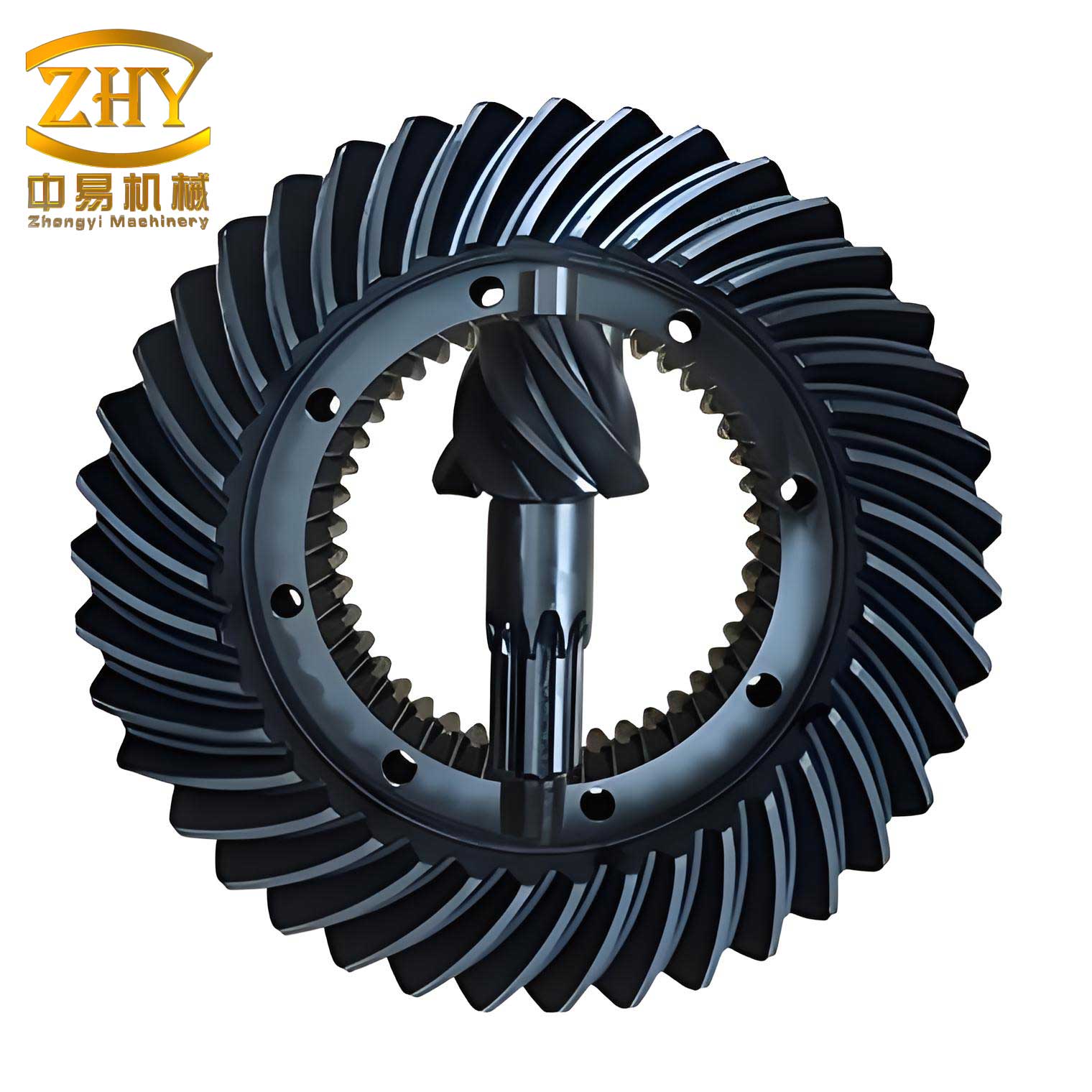
The kinematics of this helical bevel gear machining process can be summarized by the relationship between the cutter head rotation and the workpiece motion. The generating motion ensures that the cutter envelops the correct tooth profile. A key formula governing the setup is the gear ratio between the driving and driven elements, which determines the lead of the helical teeth. For a helical bevel gear, the lead $$ L $$ is related to the gear parameters and machine settings. If $$ N_c $$ is the number of cuts (or teeth) and $$ \beta $$ is the spiral angle, the machine adjustment must satisfy:
$$ L = \frac{\pi \cdot D \cdot \cot \beta}{N_c} $$
where $$ D $$ is the reference diameter of the helical bevel gear. In our machine, the gear train ratio $$ i $$ between the rotary table and the workpiece spindle was critical, calculated as:
$$ i = \frac{Z_w}{Z_t} \cdot \frac{Z_p}{Z_g} $$
where $$ Z_w $$ and $$ Z_t $$ are worm and worm wheel teeth, and $$ Z_p $$ and $$ Z_g $$ are the bevel gear teeth in the train. This ratio ensured proper indexing and helical motion. The following table summarizes the main specifications of our fabricated machine for helical bevel gear production:
| Parameter | Specification | Notes |
|---|---|---|
| Cutter Head Speed | Variable, up to 300 RPM | Controlled by motor and pulley system |
| Feed Rate | 0.1 – 0.5 mm/rev | Adjustable via lead screw mechanism |
| Maximum Cutting Depth | 10 mm per pass | For roughing operations on helical bevel gears |
| Workpiece Length Capacity | Up to 500 mm | For gears of various sizes |
| Power Source | 3-phase AC motor, 5.5 kW | Drives cutter head and feed motions |
| Machine Footprint | Approx. 2.5 m x 2 m | Compact design using cement base |
With this machine, we tackled a specific order: seven sets of helical bevel gears for轧钢机 (rolling mill machines). Previously, machining these helical bevel gears required two and a half months using conventional methods. Our new setup, combined with other minor equipment modifications, promised completion within one month. The efficiency gain was dramatic. The process for a typical helical bevel gear involved: 1) mounting the gear blank on the dividing head, 2) setting the cutter head at the correct spiral angle $$ \beta $$, 3) adjusting the gear train for the desired lead, and 4) performing roughing and finishing cuts. Each helical bevel gear was machined in multiple passes, with careful attention to tooth alignment and surface finish.
However, machining helical bevel gears is not merely about mechanical setup; material properties are equally crucial. The steel used for helical bevel gears must have precise carbon content to ensure hardness and durability. Traditionally, chemical analysis for carbon took hours, delaying production. To address this, we developed a magnetic carbon analysis instrument for rapid on-the-spot determination of carbon percentage in molten steel or finished gears. This instrument, based on the physical principle that the magnetic permeability $$ \mu $$ of steel varies with carbon content, allowed us to measure carbon in just three minutes from sampling to result.
The theoretical foundation stems from electromagnetic induction. When a sample of steel (like that for a helical bevel gear) is placed inside a coil carrying alternating current, the changing magnetic flux $$ \Phi $$ induces an electromotive force (EMF) in a secondary coil. According to Faraday’s law:
$$ \mathcal{E} = -N \frac{d\Phi}{dt} $$
where $$ \mathcal{E} $$ is the induced EMF, $$ N $$ is the number of turns, and $$ \frac{d\Phi}{dt} $$ is the rate of change of magnetic flux. The flux $$ \Phi $$ is related to the magnetic field $$ B $$ and the sample’s permeability $$ \mu $$. For a toroidal coil with the sample as core, $$ B = \mu H $$, where $$ H $$ is the magnetic field intensity from the primary current. If the primary current is sinusoidal with frequency $$ f $$, then the induced EMF magnitude is proportional to $$ \mu $$. Since $$ \mu $$ decreases with increasing carbon content in steel (for low-alloy steels), measuring $$ \mathcal{E} $$ allows direct reading of carbon percentage. Our instrument calibrated this relationship using standard samples.
The circuit design involved a primary coil fed by a stabilized 220V AC supply, a secondary pick-up coil, and a millivoltmeter for reading. A standardizing resistor and switch allowed zeroing and measurement. The operational procedure was: 1) power on and stabilize current to 2A, 2) zero the millivoltmeter with a standard sample (e.g., pure iron), 3) insert the steel sample (from helical bevel gear material), and 4) press the measure button to read carbon percentage directly. The relationship between EMF and carbon content $$ C $$ (in wt%) was empirically determined and could be approximated by:
$$ \mathcal{E} = k_1 – k_2 \cdot C $$
where $$ k_1 $$ and $$ k_2 $$ are calibration constants dependent on coil geometry and frequency. We validated this with samples of known carbon content, achieving accuracy within ±0.05% C. The following table contrasts the old and new methods for helical bevel gear production, highlighting the impact of our innovations:
| Aspect | Traditional Method | Our Innovative Approach | Improvement Factor |
|---|---|---|---|
| Machining Time for 7 Gear Sets | 2.5 months | 1 month | 2.5x faster |
| Setup and Fabrication Time | Weeks for machine procurement | 7 days for soil machine build | ~4x faster setup |
| Material Consumption | High, due to specialized tooling | Low, using local materials and repurposed parts | Significant cost reduction |
| Carbon Analysis Time | Several hours (chemical lab) | 3 minutes (magnetic analyzer) | ~60x faster |
| Flexibility for Gear Sizes | Limited to machine capacity | Adjustable for any helical bevel gear size | High adaptability |
| Capital Investment | High for new machines | Low, using existing resources | Substantial savings |
Beyond the dedicated soil machine, we successfully modified other conventional machines for helical bevel gear production. For instance, we adapted an old lathe, a universal milling machine, and a planer to perform helical bevel gear cutting operations. Each modification involved adding a generating mechanism similar to our soil machine’s principle. The key was to ensure precise synchronization between cutter rotation and workpiece motion. The general equation for generating helical bevel gear teeth on any machine can be expressed as a function of machine settings and gear parameters. If $$ \omega_c $$ is the cutter angular velocity and $$ \omega_w $$ is the workpiece angular velocity, the ratio must satisfy:
$$ \frac{\omega_w}{\omega_c} = \frac{Z_c}{Z_w} \cdot \frac{1}{\cos \beta} $$
where $$ Z_c $$ is the number of cutter blades (simulating a gear tooth) and $$ Z_w $$ is the number of teeth on the helical bevel gear. This ensures correct tooth spacing and helix form. For our modified machines, we used change gears to set this ratio accurately.
The challenges in helical bevel gear machining were numerous, particularly during initial trials. Calculations for machine settings are complex, involving spiral angle, pitch, pressure angle, and offset. We often had to adjust settings based on trial cuts. The alignment of machine, workpiece, and cutter required high precision, calibrated using dial indicators and test bars. However, once mastered, the process became routine. We documented the steps for machining a typical helical bevel gear:
- Design and Material Selection: Determine gear parameters: number of teeth $$ Z $$, module $$ m $$, spiral angle $$ \beta $$ (usually 25°-35° for helical bevel gears), and face width. Choose steel grade with appropriate carbon content (e.g., 0.2%-0.5% C for case-hardened gears).
- Blank Preparation: Forge or cast the gear blank, then rough machine to near-net shape via turning and facing.
- Machine Setup: Mount the blank on the dividing head. Set the cutter head at angle $$ \beta $$ relative to the gear axis. Install the correct cutter (e.g., a face mill cutter with inserted blades). Calculate and set the gear train ratios for generating motion and indexing.
- Cutting Process: Perform roughing cuts at high feed to remove bulk material, then finishing cuts at lower feed for accuracy. Use cutting fluid to dissipate heat. The cutter path generates the helical tooth profile incrementally.
- Inspection and Quality Control: Measure tooth profile using templates or coordinate measuring machines. Check surface hardness and carbon content with our magnetic analyzer. For helical bevel gears, tooth contact pattern testing is critical, often done with bearing blue.
To quantify the geometric relationships, we derived formulas for helical bevel gear dimensions. For example, the pitch diameter $$ d $$ is given by $$ d = m \cdot Z $$, but for bevel gears, the virtual number of teeth $$ Z_v $$ must be considered due to the spiral angle:
$$ Z_v = \frac{Z}{\cos^3 \beta} $$
This affects cutter selection and machining parameters. The tooth thickness $$ s $$ at the pitch circle is approximately $$ s = \frac{\pi m}{2} $$, but adjustments are made for backlash and hardening distortion. The following table provides typical values for helical bevel gears used in our applications:
| Gear Parameter | Symbol | Typical Range | Example Value |
|---|---|---|---|
| Number of Teeth | $$ Z $$ | 20 – 80 | 40 |
| Module | $$ m $$ (mm) | 3 – 10 mm | 5 mm |
| Spiral Angle | $$ \beta $$ | 25° – 35° | 30° |
| Face Width | $$ b $$ (mm) | 20% – 30% of cone distance | 50 mm |
| Pressure Angle | $$ \alpha $$ | 20° (standard) | 20° |
| Carbon Content | $$ C $$ (wt%) | 0.18% – 0.45% | 0.25% |
The magnetic carbon analyzer played a vital role in ensuring material quality for helical bevel gears. We integrated it into our production line, allowing real-time monitoring during steel melting and gear heat treatment. The instrument’s calibration curve was established using standard steel samples with known carbon percentages. For a given coil configuration with inductance $$ L $$ and resistance $$ R $$, the impedance $$ Z $$ changes with sample permeability. In our setup, we measured the voltage drop across a sensing resistor in series with the secondary coil. The relationship between voltage $$ V $$ and carbon content $$ C $$ was linear over the range of interest, expressed as:
$$ V = V_0 – \Delta V \cdot C $$
where $$ V_0 $$ is the voltage for zero carbon (pure iron) and $$ \Delta V $$ is the sensitivity factor. We ensured temperature compensation by maintaining samples at room temperature during testing. This rapid analysis enabled immediate adjustments in melting or heat treatment, reducing scrap and rework for helical bevel gears.
In summary, our innovations transformed helical bevel gear manufacturing from a bottleneck into a streamlined process. The soil machine demonstrated that with ingenuity, even complex components like helical bevel gears can be produced using low-cost, locally available resources. The magnetic carbon analyzer provided a swift quality control tool, essential for maintaining material specifications. These advancements not only met urgent production deadlines but also offered a scalable model for other manufacturing settings. The helical bevel gear, once a symbol of machining difficulty, became a testament to adaptive engineering and grassroots innovation. Future work could involve automating the soil machine with CNC controls or refining the carbon analyzer for broader alloy ranges, but the core principles remain: leverage physics, repurpose resources, and embrace simplicity to conquer complex challenges in helical bevel gear production.