
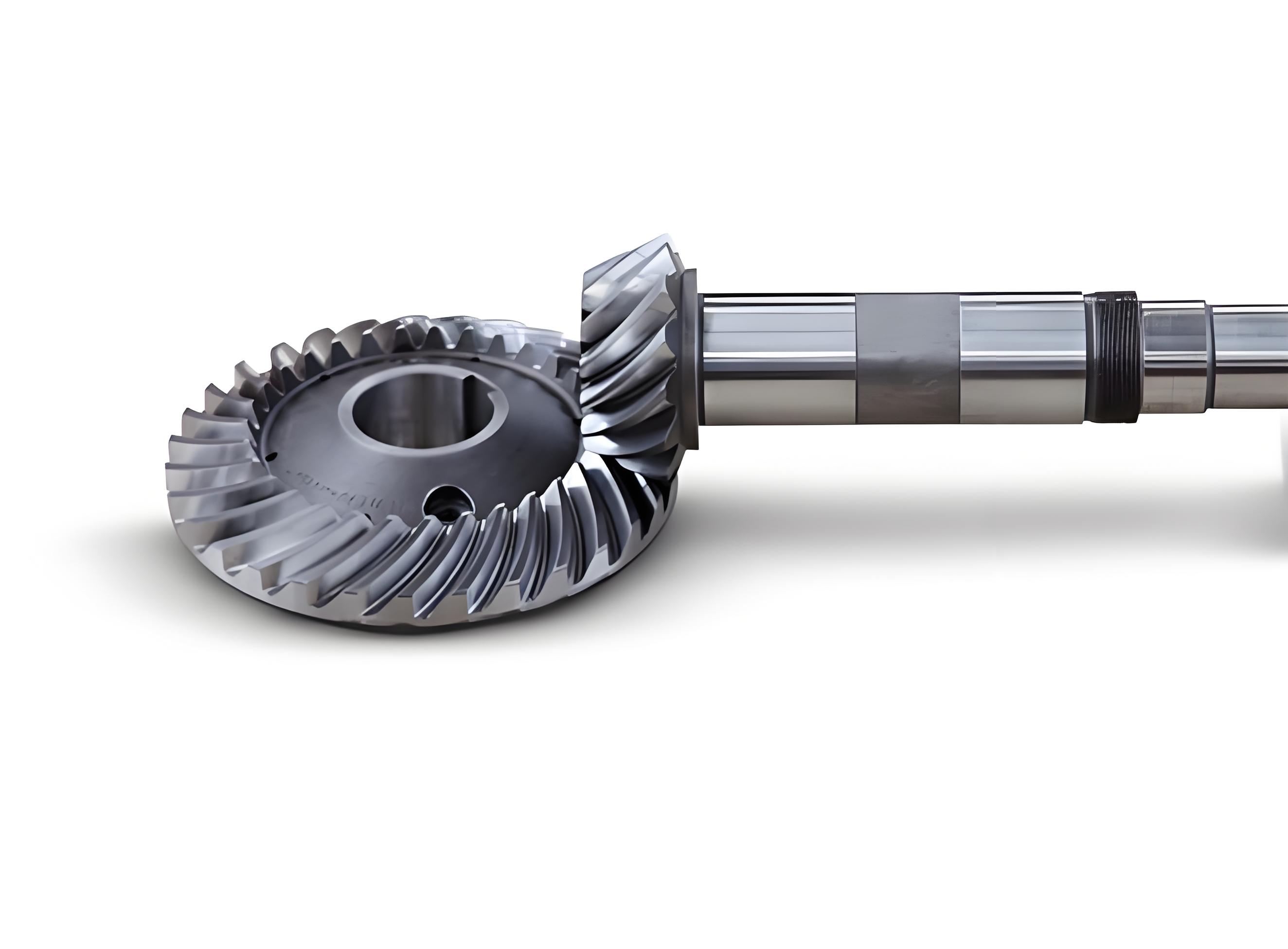
Spiral bevel gears are quintessential components in power transmission systems where shafts intersect, typically at a 90-degree angle. Their defining characteristic is the curved, oblique orientation of the teeth, which facilitates a gradual engagement and disengagement process. This leads to superior performance metrics, including high load-carrying capacity, smooth and quiet operation, and stable transmission ratios compared to straight bevel gears. Consequently, spiral bevel gears are extensively employed in demanding sectors such as aerospace, automotive (differentials), marine propulsion, and heavy machinery. The performance and longevity of these gears are critically dependent on their meshing quality, characterized by the transmission error (TE) pattern and the contact pattern (or bearing contact) on the tooth flanks.
However, the theoretical perfect meshing of spiral bevel gears is inevitably compromised in real-world applications due to the presence of various uncertainties. These uncertainties can be broadly categorized into two types: uncontrollable factors and controllable but variable factors. Uncontrollable factors primarily consist of assembly or installation errors arising from manufacturing tolerances, thermal deformations, and load-induced deflections. Controllable factors include design parameters like machine-tool settings (e.g., cutter radius, blade angle) and macro-geometry parameters, which have associated tolerances. These variations can significantly degrade meshing performance, leading to elevated noise, vibration, harshness (NVH), stress concentrations, and reduced fatigue life. Traditional deterministic optimization seeks the “best” design under ideal conditions, but this optimum is often highly sensitive to perturbations, rendering it impractical. This vulnerability underscores the necessity for robust optimization design (ROD).
The philosophy of ROD, significantly advanced by Genichi Taguchi, aims not to eliminate variations but to make the product’s performance insensitive or robust to them. For spiral bevel gears, the goal is to find a set of design parameters that yield excellent and consistent meshing quality (e.g., low and smooth TE, stable contact pattern) even when subjected to expected ranges of assembly errors and parameter deviations. This approach enhances reliability, reduces warranty costs, and allows for the use of wider, more economical manufacturing tolerances without sacrificing functional performance. This review synthesizes the methodologies and advancements in the robust optimization design of spiral bevel gears, focusing on mitigating the effects of assembly errors, and outlines future research directions.
Fundamentals of Robust Optimization Design
The core objective of robust design is to minimize the performance variation of a system or product caused by noise factors (uncontrollable variations) while bringing the mean performance close to the target value. This is typically achieved by optimizing the settings of control factors (design parameters). A general mathematical model for ROD can be formulated as:
Find $$\mathbf{x}$$ that:
$$\min_{\mathbf{x}} \left( \mu_{f(\mathbf{x}, \mathbf{z})}, \sigma_{f(\mathbf{x}, \mathbf{z})} \right)$$
$$\text{subject to: } g_j(\mathbf{x}, \mathbf{z}) \leq 0, \quad j = 1, 2, …, m$$
$$\mathbf{x}^L \leq \mathbf{x} \leq \mathbf{x}^U$$
where $$\mathbf{x}$$ is the vector of control/design variables, $$\mathbf{z}$$ is the vector of noise/uncontrollable variables (e.g., assembly errors), $$f$$ is the objective function (e.g., peak-to-peak TE, contact pressure), $$\mu_f$$ and $$\sigma_f$$ are its mean and standard deviation evaluated over the distribution of $$\mathbf{z}$$, and $$g_j$$ are the constraint functions. The solution is often a Pareto-optimal set trading off mean performance against robustness (minimized variance).
Over the years, numerous methodologies have been developed to solve robust design problems, each with distinct advantages and limitations. The following table provides a comparative summary of the primary methods relevant to mechanical and gear design.
| Methodology | Key Principle | Advantages | Disadvantages/Limitations |
|---|---|---|---|
| Taguchi’s Robust Design | Uses orthogonal arrays for experiments and Signal-to-Noise Ratios (SNR) to assess robustness. | Systematic, handles discrete variables well, reduces experimental cost. | Optimal solution is limited to predefined levels, assumes monotonicity, limited interaction analysis. |
| Response Surface Methodology (RSM) | Constructs meta-models (polynomials) relating responses to design and noise factors. | Efficient exploration of design space, enables visualization and gradient-based optimization. | Accuracy depends on model order and data points; poor for highly nonlinear systems. |
| Dual Response Surface (DRS) | Fits separate RSM models for the mean and standard deviation of the response. | Explicitly models performance mean and variation, good for process optimization. | Requires sufficient data, complexity increases with number of variables. |
| Sensitivity Analysis | Calculates gradients or derivatives of performance w.r.t. design/noise variables. | Directly identifies critical variables affecting robustness, guides design adjustments. | Local method; does not provide a direct optimal solution, only guidance. |
| Variation Simulation / Monte Carlo | Propagates input variations through the system model to estimate output statistics. | Accurate for any model, provides full distribution of response. | Computationally expensive, requires many simulations for accurate statistics. |
| 6-Sigma Robust Design | Integrates Monte Carlo simulation with optimization to ensure design performance within ±6σ. | High reliability focus, links design to process capability (Cp, Cpk). | Very high computational cost, requires definition of failure limits. |
In modern applications for complex systems like spiral bevel gears, these methods are rarely used in isolation. They are typically integrated with advanced optimization algorithms and high-fidelity simulation models, such as tooth contact analysis (TCA) and loaded tooth contact analysis (LTCA), to form a complete robust design framework.
Robust Design in Gear Transmission Systems: Foundational Work
The application of robust design principles in mechanical engineering, particularly in gear systems, has evolved significantly. Initial applications focused on simpler spur or helical gearboxes, establishing the paradigm for handling uncertainties. Researchers explored various formulations, moving from Taguchi’s experimental approach to model-based methods. A common challenge in deterministic gear optimization is that the optimal solution often lies on the constraint boundary, making it highly susceptible to failure under small parameter variations. Robust design explicitly addresses this by seeking a solution that remains feasible and performs well within a “robust zone” around the nominal point.
Key advancements in general gear robust design include the integration of RSM and DRS to manage the effect of noise factors, the use of sensitivity indices to reduce the influence of critical variations, and the application of reliability-based constraints. Furthermore, the computational complexity of solving robust optimization problems, which often involve nested loops (optimization over design variables and statistical estimation over noise variables), has driven the adoption of advanced algorithms. Metaheuristic algorithms such as Genetic Algorithms (GA), Non-dominated Sorting GA (NSGA-II), and Particle Swarm Optimization (PSO) have been widely used to handle the non-convex, multi-objective nature of these problems. More recently, hybrid algorithms and machine learning techniques like Artificial Neural Networks (ANN) have been employed to create fast surrogate models, replacing computationally intensive simulations like finite element analysis (FEA) within the optimization loop. These foundational studies on parallel-axis gears provided essential methodologies and insights, paving the way for their adaptation to the more geometrically complex case of spiral bevel gears.
Impact of Assembly Errors on Spiral Bevel Gear Meshing Performance
Among all uncertainty sources, assembly errors are paramount for spiral bevel gears due to their complex spatial geometry and sensitive conjugate tooth surfaces. The primary assembly errors, defined as deviations from the theoretical relative position of the pinion and gear, are:
- Axial Misalignment (ΔAp, ΔAg): Displacement of the pinion or gear along its own axis.
- Offset Misalignment (ΔE): Linear error in the shortest distance between the two shaft axes (also called vertical or horizontal misalignment).
- Shaft Angle Error (ΔΣ): Deviation from the nominal intersection angle of the two shafts.
The sensitivity of spiral bevel gear performance to these errors is exceptionally high. Even minor misalignments can drastically alter the contact pattern’s location, size, and shape, and induce significant changes in the function of transmission error, which is the primary excitation source for gear noise and vibration. For instance, an axial shift of the pinion might move the contact pattern towards the toe or heel, risking edge contact and stress concentration. Similarly, offset or shaft angle errors can cause bias in the contact pattern, leading to loaded conditions that differ vastly from the designed “full” pattern.
| Assembly Error Type | Primary Effect on Contact Pattern | Consequence for Transmission Error & Vibration |
|---|---|---|
| Pinion Axial (ΔAp) | Shifts pattern along face width (toe/heel). | Changes mesh stiffness sequence, modifies TE amplitude and waveform. |
| Gear Axial (ΔAg) | Shifts pattern along profile (root/top). | Alters load sharing, can induce geometric separations causing impacts. |
| Offset (ΔE) | Causes diagonal bias in the contact pattern. | Introduces asymmetric loading, significant increase in TE and vibration. |
| Shaft Angle (ΔΣ) | Changes the working pressure angle, distorting pattern shape. | Can lead to severe edge contact and a jump in TE, causing harshness. |
Therefore, a crucial step in the robust design of spiral bevel gears is the accurate and efficient simulation of meshing performance under misaligned conditions. This is achieved through sophisticated Tooth Contact Analysis (TCA) and Loaded Tooth Contact Analysis (LTCA) algorithms. The sensitivity of a given gear design to errors can be quantified using a sensitivity matrix $$\mathbf{S}$$, where elements $$S_{ij} = \partial P_i / \partial E_j$$ represent the change in a performance index $$P_i$$ (e.g., contact pattern center coordinates, TE amplitude) due to a unit change in an assembly error $$E_j$$. Minimizing the norms or eigenvalues of this matrix becomes a central goal in robustness optimization.
Robust Optimization of Spiral Bevel Gears for Minimal Sensitivity to Assembly Errors
The robust optimization of spiral bevel gears specifically targets the reduction of sensitivity to assembly errors. The process involves a closed-loop integration of geometry modeling, performance simulation, robustness assessment, and optimization search. The general workflow can be summarized as follows:
- Parameterization: Define the design variables $$\mathbf{x}$$. These are typically the machine-tool settings for generating the pinion tooth surface, such as cutter radius $$R_c$$, blade angle $$\alpha$$, spiral angle $$\beta$$, and modified roll coefficients ($$a_2, a_3, a_4$$) for higher-order corrections.
- Objective Formulation: Define robustness objectives. Common choices include:
- Minimize the statistical variance ($$\sigma^2$$) of a key performance indicator (KPI) like peak-to-peak TE over the expected distribution of assembly errors.
- Minimize the sum of squared sensitivities: $$\min \sum_j \sum_i S_{ij}^2$$.
- Multi-objective: Simultaneously minimize the mean of TE amplitude ($$\mu_{TE_{pp}}$$) and its standard deviation ($$\sigma_{TE_{pp}}$$).
- Constraint Definition: Impose functional constraints under both nominal and worst-case error scenarios. These ensure:
- Contact pattern remains within tooth boundaries (no edge contact).
- Transmission error curve remains continuous and low in amplitude.
- Contact pressure or bending stress limits are not exceeded.
- Optimization Execution: Employ a suitable algorithm (e.g., NSGA-II, PSO) to search the design space. At each candidate design $$\mathbf{x}$$, a robustness evaluation is performed, often requiring multiple TCA/LTCA runs for different error samples (via Monte Carlo simulation).
A representative multi-objective robust optimization problem can be mathematically stated as:
Find $$\mathbf{x} = [x_1, x_2, …, x_n]^T$$ (machine settings) to:
$$\min \quad \mathbf{F}(\mathbf{x}) = \left[ \mu_{TE_{pp}}(\mathbf{x}), \sigma_{TE_{pp}}(\mathbf{x}) \right]$$
$$\text{s.t. } \quad \text{Area}_{contact}(\mathbf{x}, \mathbf{z}_k) \geq A_{min}, \quad \forall \mathbf{z}_k \in Z$$
$$\quad \quad \text{Loc}_{center}(\mathbf{x}, \mathbf{z}_k) \in \text{Allowable Zone}, \quad \forall \mathbf{z}_k \in Z$$
$$\quad \quad \mathbf{x}^L \leq \mathbf{x} \leq \mathbf{x}^U$$
where $$\mathbf{z}_k$$ represents a sample from the set $$Z$$ of possible assembly error combinations.
Recent studies have demonstrated significant success with this approach. For example, integrating 6-sigma robust design with multi-island genetic algorithms has shown robustness improvements over 99% and sensitivity reductions over 30% for optimized second-order tooth surface parameters. Other research focuses on “ease-off” topography optimization, where the difference between the theoretical conjugate gear surface and the manufactured pinion surface is strategically modified. By optimizing the ease-off, designers can achieve a low and linear TE under load while making the contact pattern less prone to migration with misalignment, thereby improving robustness. The use of high-order polynomial modifications (beyond second-order) provides greater degrees of freedom to tailor the meshing behavior for both performance and robustness simultaneously.
Future Perspectives and Concluding Remarks
Despite significant progress, the robust optimization design of spiral bevel gears remains a vibrant area of research with several open challenges and promising directions:
- From Static to Dynamic Robustness: Current research predominantly focuses on static or quasi-static TCA/LTCA. Future work must integrate dynamic models to ensure robustness against vibrations and noise under operational conditions with time-varying loads and speeds. The robust design objectives would then include minimizing dynamic transmission error (DTE) and dynamic mesh forces.
- High-Fidelity and Efficient Uncertainty Propagation: Monte Carlo simulation is accurate but prohibitively expensive when coupled with high-fidelity FE-based LTCA. Advanced uncertainty quantification techniques, such as polynomial chaos expansion (PCE) or stochastic collocation, combined with machine learning surrogates, are needed to drastically reduce computational cost while maintaining accuracy.
- Multi-Disciplinary and Multi-Objective Trade-offs: Robustness often trades off against other objectives like weight, efficiency (minimizing friction losses), or manufacturing cost. A comprehensive framework is needed to manage the trade-offs between mean performance, robustness, contact ratio, stress levels, and cost within a true multi-disciplinary optimization setting.
- Inclusion of Other Uncertainty Sources: While assembly errors are critical, future models should also incorporate uncertainties in material properties, heat treatment distortions, bearing stiffness, and manufacturing errors (e.g., tooth profile deviations) in a unified probabilistic framework.
- Integration with Smart Manufacturing: The robust design paradigm could be linked with digital twins and adaptive manufacturing. The optimal robust design could be adjusted based on actual measured errors from the manufacturing line or assembly stage, creating a closed-loop, quality-by-design system.
In conclusion, robust optimization design represents a paradigm shift from seeking a fragile optimum to discovering a resilient design for spiral bevel gears. By systematically accounting for inevitable assembly errors and other variations, it delivers gears that perform consistently well in real-world conditions, enhancing reliability, reducing noise, and extending service life. The synergy of advanced geometric modeling, high-performance computing, sophisticated optimization algorithms, and comprehensive system modeling will continue to drive this field forward, enabling the next generation of high-performance, quiet, and durable power transmission systems for aerospace and other advanced engineering applications.