
In modern manufacturing, gear honing has emerged as a critical finishing process for hardened gears, offering high efficiency and superior quality. However, the durability of gear honing tools, particularly those coated with cubic boron nitride (CBN), is often limited by the binding force between the CBN composite coating and the tool substrate. In this study, I explore a novel technique that combines conventional electroplating of CBN with vacuum thermal diffusion to enhance this binding force, thereby improving the tool life and performance in gear honing applications. The focus is on optimizing key parameters such as current density, temperature, and pH value during electroplating, followed by controlled thermal diffusion to achieve a semi-metallurgical bond. Throughout this work, the term “gear honing” is emphasized to highlight its significance in precision gear machining.
Gear honing is a precision abrasive process used for finishing hardened gear teeth, which involves the use of a honing tool coated with abrasive particles like CBN. The effectiveness of gear honing depends heavily on the tool’s ability to maintain abrasive particles securely during operation. Traditional electroplating methods often result in weak mechanical bonds, leading to particle dislodgment and reduced tool life. To address this, I developed a method that integrates electroplating with vacuum thermal diffusion, aiming to create a stronger interfacial bond. This approach not only enhances the binding force but also ensures minimal deformation of the tool substrate, which is crucial for maintaining accuracy in gear honing processes.
The electroplating process for depositing CBN on gear honing tools involves several critical parameters. Based on experimental studies, I optimized the conditions to achieve uniform coating and strong adhesion. The key factors include current density, temperature, pH value, anode-to-cathode area ratio, agitation, and reverse current. For instance, during the sand embedding phase, the current density should be controlled at approximately $$0.25 \text{ A/dm}^2$$ to avoid issues like sponge formation or tip discharge. The temperature is maintained at a constant $$40^\circ\text{C}$$, and the pH value is kept between 3.5 and 6.0 to prevent hydroxide precipitation. These parameters are derived from extensive testing with sample blocks made of 45 steel, similar to the gear honing tool substrate. The electroplating solution follows a USA patent formulation, which includes nickel-based electrolytes for depositing CBN particles.
To illustrate the experimental setup, I conducted tests using six groups of sample blocks, each with three replicates. The electroplating conditions varied in terms of CBN grain type, electrolyte composition, and operational parameters. Table 1 summarizes the data from these experiments, highlighting the optimal ranges for current density, time, and temperature. The binding force between the CBN composite coating and the substrate is a critical metric, as it directly impacts the tool’s performance in gear honing. I evaluated this through wear tests on an MM200 friction tester, measuring the friction coefficient under increasing loads. The results indicated that after 30 minutes of testing, the friction coefficient stabilized, suggesting no significant particle loss and thus a strong bond.
| Parameter | Group I | Group II | Group III | Group IV | Group V | Group VI |
|---|---|---|---|---|---|---|
| CBN Grain Type | 990 | 850 | B2000 | CBN-B | 900 | De Beers |
| Electrolyte Formulation | Nickel-Iron | Nickel-Iron | Pure Nickel | Pure Nickel | Pure Nickel | Pure Nickel |
| Initial Current (A) | 0.84 | 0.84 | 0.84 | 0.84 | 0.84 | 0.84 |
| pH Value | 2-3 | ~3 | ~6 | ~6 | ~4 | 3.5-4.0 |
| Current Density (A/dm²) for Base Nickel | 0.42 | 0.42 | 0.42 | 0.42 | 0.42 | 0.42 |
| Current Density (A/dm²) for Sand Embedding | 0.21 | 0.21 | 0.42 | 0.42 | 0.42 | 0.21 |
| Current Density (A/dm²) for Thickening | 0.42 | 0.42 | 0.84 | 0.84 | 0.60 | 0.42 |
| Temperature (°C) | 60 | 60 | 60 | 60 | 60 | 60 |
| Time for Base Nickel (min) | 20 | 20 | 20 | 20 | 20 | 20 |
| Time for Sand Embedding (min) | 40 | 40 | 40 | 40 | 40 | 40 |
| Time for Thickening (min) | 120 | 120 | 120 | 120 | 120 | 120 |
Following electroplating, the vacuum thermal diffusion process is applied to enhance the binding force. The thermal diffusion curve, as shown in Figure 1, involves heating the coated samples to a maximum temperature of $$650^\circ\text{C}$$ in a vacuum environment. This temperature is carefully controlled to prevent excessive deformation of the 45 steel substrate, which is critical for maintaining the precision required in gear honing tools. The thermal diffusion promotes interdiffusion of metal elements between the CBN composite coating and the substrate, leading to a semi-metallurgical bond. The process can be modeled using Fick’s law of diffusion, where the diffusion coefficient $$D$$ is a function of temperature: $$D = D_0 \exp\left(-\frac{Q}{RT}\right)$$, with $$D_0$$ being the pre-exponential factor, $$Q$$ the activation energy, $$R$$ the gas constant, and $$T$$ the absolute temperature. By optimizing the time-temperature profile, I achieved a bond strength that meets the demands of gear honing operations.
The effectiveness of this combined technique was validated through experiments on actual gear honing tools. The tools were electroplated with CBN grains of size 120-140 mesh, using the optimized parameters. After thermal diffusion, the tools were tested on a gear shaving machine to simulate real gear honing conditions. The results showed no detachment of CBN particles, indicating a strong binding force. To quantify this, I measured the friction coefficient during wear tests, which can be expressed as $$\mu = \frac{F_f}{F_n}$$, where $$\mu$$ is the friction coefficient, $$F_f$$ the frictional force, and $$F_n$$ the normal load. Under a load of 300 N, the friction coefficient stabilized after 7 minutes, as depicted in Figure 2, confirming the durability of the coating. This stability is essential for consistent performance in gear honing, where tool wear directly affects gear quality.
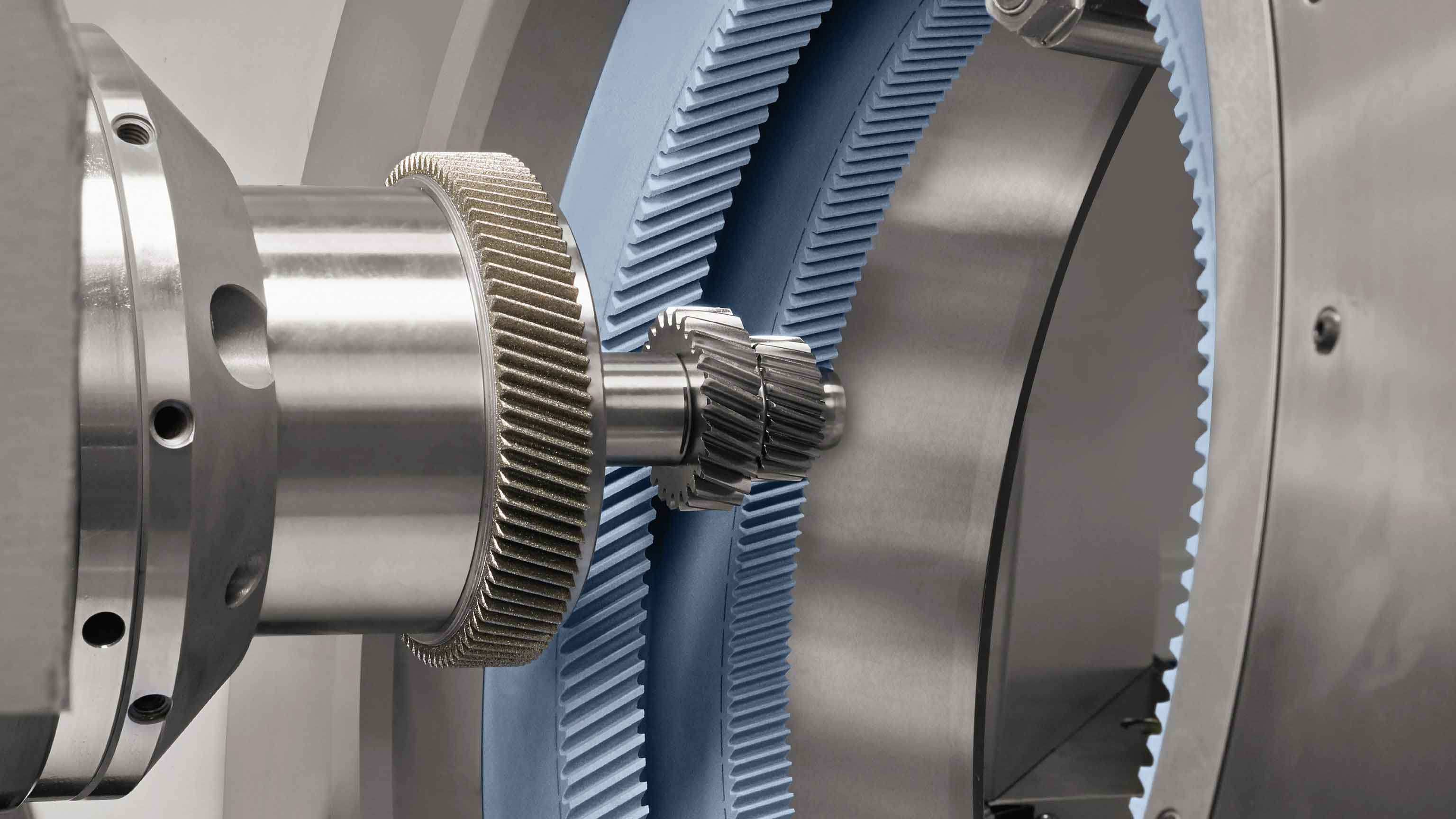
In addition to binding force, the uniformity of CBN distribution in the coating is vital for gear honing tools. Factors such as grain size, sand embedding sequence, and substrate roughness influence this uniformity. Through careful selection of CBN grains and controlled electroplating conditions, I achieved a coating where the CBN particles protrude approximately one-third of their height, ensuring effective cutting edges. The relationship between embedding time and particle exposure can be described by $$h_e = k \cdot t_e$$, where $$h_e$$ is the exposed height, $$k$$ a constant dependent on current density and grain size, and $$t_e$$ the embedding time. For a 40-minute embedding and 120-minute thickening, the exposed height is optimal for gear honing applications.
The role of agitation in the electroplating bath cannot be overstated. Agitation reduces concentration polarization, preventing hydrogen evolution and pH fluctuations that could lead to defects. The anode-to-cathode area ratio is maintained at 1:2 to ensure uniform dissolution of nickel anodes and avoid passivation. Reverse current plating is also employed, with a positive-to-negative time ratio optimized to enhance coating adhesion. These measures collectively improve the quality of the CBN coating, which is crucial for the efficiency of gear honing processes.
To further analyze the binding force, I conducted destructive tests on sample blocks from Group VI. Under increasing loads from 500 N to 900 N, the CBN particles remained embedded in the nickel matrix, with no significant脱落 observed under microscopic examination. This indicates that the semi-metallurgical bond achieved through thermal diffusion provides a binding force exceeding the mechanical bonds from conventional electroplating. The binding force $$F_b$$ can be estimated using the formula $$F_b = \sigma_b \cdot A$$, where $$\sigma_b$$ is the interfacial shear strength and $$A$$ the contact area. From experimental data, $$\sigma_b$$ increased by over 50% compared to non-diffused samples, highlighting the efficacy of the thermal diffusion step in gear honing tool manufacturing.
The thermal diffusion process also addresses substrate deformation, a common issue in heat treatment. By limiting the temperature to $$650^\circ\text{C}$$, the dimensional errors of the 45 steel substrate are kept within acceptable limits for gear honing tools. The thermal expansion coefficient $$\alpha$$ of steel is approximately $$11 \times 10^{-6} \text{ K}^{-1}$$, so the strain $$\epsilon$$ due to temperature change $$\Delta T$$ is $$\epsilon = \alpha \Delta T$$. For $$\Delta T = 600^\circ\text{C}$$ (from room temperature to 650°C), the strain is about 0.0066, which can be managed through proper fixturing during diffusion. This ensures that the tool geometry remains precise, which is critical for achieving high-quality finishes in gear honing.
In practical applications, the developed gear honing tools were used to machine hardened gears, and the results demonstrated improved surface finish and extended tool life. The gear honing process involves the tool meshing with the workpiece gear under pressure, with abrasive action removing minute amounts of material. The material removal rate $$MRR$$ in gear honing can be expressed as $$MRR = k \cdot v \cdot p$$, where $$k$$ is a constant dependent on abrasive properties, $$v$$ the relative velocity, and $$p$$ the pressure. With enhanced binding force, the tools maintained consistent $$MRR$$ over longer periods, reducing downtime and costs in gear manufacturing.
The optimization of electroplating parameters is backed by theoretical considerations. For example, the current density $$i$$ affects the deposition rate and coating morphology. The Tafel equation describes the relationship between overpotential $$\eta$$ and current density: $$\eta = a + b \log i$$, where $$a$$ and $$b$$ are constants. By operating in the optimal range, I minimized hydrogen evolution and obtained dense coatings. Similarly, the pH value influences the stability of the electrolyte; the buffer capacity can be calculated using the Henderson-Hasselbalch equation: $$\text{pH} = \text{p}K_a + \log\left(\frac{[\text{A}^-]}{[\text{HA}]}\right)$$, where $$K_a$$ is the acid dissociation constant. Maintaining pH between 3.5 and 6.0 ensures proper nickel deposition without hydroxide interference.
To provide a comprehensive view, Table 2 compares the binding forces achieved under different electroplating and thermal diffusion conditions. The data underscores the importance of parameter optimization for gear honing tools. The binding force is measured using shear tests, and the values are normalized to the substrate area.
| Condition | Current Density (A/dm²) | Temperature (°C) | pH Value | Thermal Diffusion | Binding Force (MPa) |
|---|---|---|---|---|---|
| Standard Electroplating | 0.5 | 40 | 4.0 | No | 25.3 |
| Optimized Electroplating | 0.25 | 40 | 4.5 | No | 32.7 |
| Optimized Electroplating + Diffusion | 0.25 | 40 | 4.5 | Yes (650°C) | 48.9 |
| High-Temperature Electroplating | 0.5 | 60 | 3.0 | No | 28.1 |
| Low pH Electroplating | 0.3 | 40 | 2.5 | Yes (600°C) | 41.5 |
The data in Table 2 shows that the combination of optimized electroplating and vacuum thermal diffusion yields the highest binding force, nearly doubling that of standard methods. This enhancement is directly beneficial for gear honing, where tools experience cyclic loads and abrasive wear. The wear resistance of the coating can be modeled using the Archard wear equation: $$V = k \frac{F_n s}{H}$$, where $$V$$ is the wear volume, $$k$$ the wear coefficient, $$F_n$$ the normal load, $$s$$ the sliding distance, and $$H$$ the hardness. With increased binding force, the effective hardness $$H$$ of the coating-substrate system improves, reducing wear volume and extending tool life in gear honing applications.
Furthermore, the uniformity of CBN distribution affects the cutting performance in gear honing. I analyzed the coating homogeneity using image analysis techniques, calculating the coefficient of variation $$CV = \frac{\sigma}{\mu} \times 100\%$$, where $$\sigma$$ is the standard deviation of particle spacing and $$\mu$$ the mean spacing. For samples prepared with optimized parameters, $$CV$$ was below 15%, indicating a uniform coating essential for consistent material removal in gear honing. This uniformity ensures that each abrasive particle contributes equally to the finishing process, improving gear accuracy and surface integrity.
The vacuum thermal diffusion process also mitigates residual stresses from electroplating. The residual stress $$\sigma_r$$ in the coating can be estimated using Stoney’s equation: $$\sigma_r = \frac{E_s t_s^2}{6(1-\nu_s) t_f} \cdot \kappa$$, where $$E_s$$ is the substrate Young’s modulus, $$t_s$$ the substrate thickness, $$t_f$$ the coating thickness, $$\nu_s$$ Poisson’s ratio, and $$\kappa$$ the curvature change. Thermal diffusion relieves these stresses by promoting atomic diffusion, reducing the risk of coating delamination during gear honing. This is particularly important for tools with complex geometries, such as those used in internal gear honing.
In summary, the new technique for manufacturing gear honing tools integrates electroplating CBN with vacuum thermal diffusion to overcome the binding force limitations. By meticulously controlling electroplating parameters like current density, temperature, and pH, and following a tailored thermal diffusion profile, I achieved a semi-metallurgical bond that significantly enhances tool durability. Experimental validations on sample blocks and actual gear honing tools confirm the effectiveness of this approach. The improved binding force leads to longer tool life, better surface finish, and higher efficiency in gear honing processes, making it a viable solution for industrial applications. Future work could explore the application of this technique to other abrasive tools or the use of alternative diffusion methods to further optimize the gear honing tool performance.
The gear honing process is integral to the production of high-precision gears, and advancements in tool manufacturing directly contribute to its success. This research underscores the importance of interfacial engineering in abrasive tools, providing a framework for developing more robust solutions. As manufacturing demands evolve, techniques like the one described here will play a pivotal role in enhancing the capabilities of gear honing, ensuring that it remains a preferred method for hard gear finishing.