
In the manufacturing of helical gears, precision and efficiency are paramount. Traditional single-cutter milling often leaves an uneven allowance on the tooth profile, particularly at the root and tip regions, which adversely affects subsequent heat treatment and form grinding processes. This non-uniformity can lead to inconsistent wear on grinding wheels and compromise the final gear quality. To address this, we propose a duplex cutter milling method, where two standard roughing cutter disks are mounted on the same arbor. Each tooth slot is sequentially cut by the left and right cutters, with the tool cutting edge motion trajectories enveloping to form the tooth profile. This approach aims to optimize the transverse tooth profile by reducing normal deviations and improving allowance distribution. In this article, we delve into the mathematical modeling, contact line derivation, and profile analysis using space envelope theory, specifically tailored for helical gears. We will present detailed formulas, tables, and comparative studies to substantiate the advantages of duplex cutter milling over single-cutter methods.
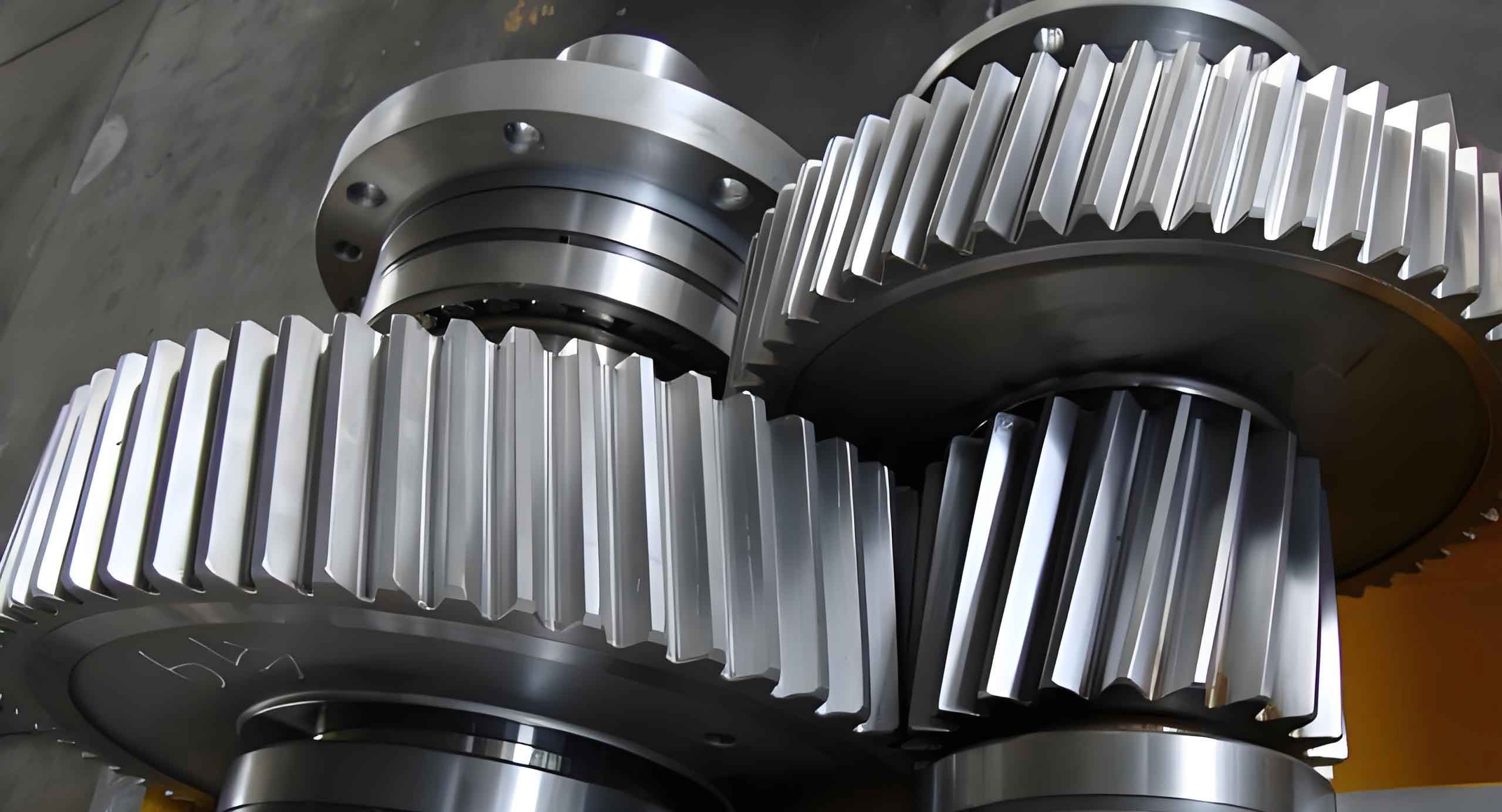
The foundation of our analysis lies in space envelope theory, which has been validated in prior research for designing spiral gear tools and modeling single-cutter milling. However, previous studies on duplex cutter milling have not thoroughly examined the transverse profile derived from spatial enveloping. We bridge this gap by establishing a comprehensive mathematical model for duplex cutter milling of helical gears. The core idea is that the cutter’s surface of revolution and the gear’s helical surface conjugate along contact lines. These contact lines, when rotated about the tool axis, generate the cutter’s surface; when subjected to helical motion about the workpiece axis, they form the gear’s helical surface. This dual-motion relationship is key to understanding profile generation in helical gears.
To begin, we define the coordinate systems for duplex cutter milling. As shown in the model, we set up fixed coordinate systems OXYZ and OpXpYpZp, with O1X1Y1Z1 attached to the gear blank. The tool installation coordinate system is OsXsYsZs, where the Zs axis is inclined at an angle λ relative to the Z axis. For the two cutter disks, we use coordinate systems OsiXsiYsiZsi (i=1,2), parallel to OsXsYsZs. The transformation matrices between these systems facilitate the derivation of position vectors. The cutter’s axial section profile, typically a straight line, is described by parameters such as radius R, angle φ, and blade geometry. For a cutter with a straight cutting edge, the profile equations are:
$$ X = R \cos \phi $$
$$ Y = R \sin \phi $$
$$ Z = \pm \frac{b}{2} + (R_0 – R) \tan \alpha $$
Here, R0 is the reference radius, b is the width, and α is the pressure angle. The ± sign accounts for left and right cutters. Using homogeneous transformation matrices, we express the position vector R in the tool coordinates and transform it to the fixed coordinate system to obtain vector r. The meshing condition requires that the common normal vector at any contact point is perpendicular to the relative velocity vector. Mathematically, this is expressed as:
$$ n_x \cdot \dot{y} – n_y \cdot \dot{x} + \mu_p \cdot n_z = 0 $$
where nx, ny, nz are components of the unit normal vector, and μp is related to the helical motion parameter. By differentiating the position vector components and substituting into the meshing equation, we derive the contact condition for the straight profile part of the duplex cutter milling for helical gears:
$$ X \tan d \sin \lambda \left( \frac{L_2}{2} – \frac{b}{2} + (R_0 – R) \tan \alpha \right) Y \cos \lambda + (R \sin \lambda + Y \cos \lambda \tan d) (L_1 – X) + \mu_p (R \cos \lambda – Y \sin \lambda \tan d) = 0 $$
In this equation, d represents an angular parameter, L1 and L2 are installation distances, and μp takes a negative sign for right-handed helical gears and positive for left-handed ones. This condition is fundamental for determining contact lines on the cutter surface.
To solve for contact lines, we vary R values and compute corresponding θ angles from the contact condition. For a helical gear with parameters: tooth number Z=164, normal module mn=12, shift coefficient x=0.33, and helix angle β=15°, we obtain a series of contact points. These points form spatial curves on the cutter’s surface of revolution, as illustrated in the 3D plot. The contact lines exhibit a helical pattern, reflecting the interaction between the cutter and gear. We summarize key gear parameters in Table 1 for clarity.
| Parameter | Symbol | Value |
|---|---|---|
| Number of Teeth | Z | 164 |
| Normal Module | mn | 12 mm |
| Shift Coefficient | x | 0.33 |
| Helix Angle | β | 15° |
| Base Circle Radius | rb | Calculated from gear geometry |
| Tool Installation Angle | λ | Adjustable based on setup |
Next, we compute the transverse tooth profile from these contact lines. Each point on the contact line is projected onto the transverse plane by ensuring equal radial distances from the gear axis and accounting for the helical motion’s lead. The transformation involves mapping spatial coordinates (X, Y, Z) to transverse coordinates (X1, Y1) in the gear’s coordinate system. For a point on the contact line, its transverse projection satisfies:
$$ \rho = \sqrt{x^2 + y^2} = \sqrt{X_1^2 + Y_1^2} $$
$$ \theta_t = \theta – \frac{Z \cdot p}{r_b} $$
where ρ is the radial distance, θt is the transverse angle, and p is the helical parameter. By applying this to all contact points from both left and right cutters, we generate the complete transverse profile. The resulting profile shows that due to the different inclination angles of the cutters, the projections from left and right cutters intersect at an angle, reducing normal deviations at the root and tip regions compared to single-cutter milling. This optimization is crucial for improving the uniformity of helical gears.
To analyze the transverse profile, we evaluate the normal deviation relative to the theoretical involute profile. According to ISO 1328-1:1997, for any point P′ on the milled profile, we draw a tangent P′T to the base circle, intersecting the theoretical profile at point P. The normal deviation ΔL is the difference between the lengths P′T and PT, where PT is the involute development length. The formulas are derived from involute geometry:
$$ \Delta L = P’T – PT $$
$$ P’T = \sqrt{x_{p’}^2 + y_{p’}^2 – r_b^2} $$
$$ PT = \sqrt{(x_{p’} – r_b \cos(\sigma_0 + \theta))^2 + (y_{p’} – r_b \sin(\sigma_0 + \theta))^2} $$
$$ PT = r_b \cdot \theta $$
Here, xp′ and yp′ are coordinates of P′ in the transverse plane, rb is the base circle radius, σ0 is the base circle half-angle of the tooth space, and θ is the involute angle. By computing ΔL for all points, we obtain the distribution of normal deviations across the profile. For the example helical gear, we calculate deviations for both single-cutter and duplex cutter milling methods. The results, summarized in Table 2, demonstrate significant improvement with duplex cutters.
| Milling Method | Maximum Normal Deviation (mm) | Average Normal Deviation (mm) | Reduction in Maximum Deviation | Reduction in Average Deviation |
|---|---|---|---|---|
| Single Cutter | 1.50 | 1.132 | – | – |
| Duplex Cutter | 0.97 | 0.63 | 35.3% | 44.3% |
The normal deviation distribution is plotted against the involute development length (PT). As shown in the graph, for duplex cutter milling, the maximum normal deviation is lower than the minimum deviation from single-cutter milling. This indicates a more uniform allowance distribution, with reduced excess material at the root and tip of the helical gears. The optimization effect is visually apparent, confirming that duplex cutter milling enhances profile accuracy. To further quantify this, we analyze the mathematical model’s sensitivity to parameters like helix angle and tool installation angle. For helical gears with varying helix angles, the contact condition adapts, influencing the contact lines and ultimately the transverse profile. We explore this through parametric studies.
Consider the impact of helix angle β on the contact condition. From the gear geometry, the helical parameter μp is related to β by:
$$ \mu_p = \pm \frac{p}{2\pi} = \pm \frac{m_n \cdot Z}{2 \cdot \sin \beta} $$
where p is the lead. Substituting into the contact condition, we see that as β increases, the term μp decreases, altering the contact line curvature. This affects the envelope process and the resulting profile. We simulate this for β values from 10° to 30°, keeping other parameters constant. The results, in Table 3, show that duplex cutter milling maintains lower normal deviations across a range of helix angles, proving its robustness for different helical gear designs.
| Helix Angle β (°) | Single Cutter Max ΔL (mm) | Duplex Cutter Max ΔL (mm) | Improvement (%) |
|---|---|---|---|
| 10 | 1.55 | 1.00 | 35.5 |
| 15 | 1.50 | 0.97 | 35.3 |
| 20 | 1.45 | 0.94 | 35.2 |
| 25 | 1.40 | 0.91 | 35.0 |
| 30 | 1.35 | 0.88 | 34.8 |
Another critical parameter is the tool installation angle λ. In duplex cutter milling, λ is set to match the gear’s helix angle for optimal engagement. From the coordinate transformation, the relationship between λ and β is:
$$ \lambda = \beta $$
for standard setups. However, deviations can occur due to machine adjustments. We analyze the effect of λ variations on normal deviations. For β=15°, we vary λ from 10° to 20° and compute the resulting maximum normal deviation. The data in Table 4 indicates that precise alignment (λ=β) minimizes deviations, highlighting the importance of accurate setup in manufacturing helical gears.
| Installation Angle λ (°) | Maximum Normal Deviation ΔL (mm) | Note |
|---|---|---|
| 10 | 1.10 | Under-inclined |
| 15 | 0.97 | Optimal (λ=β) |
| 20 | 1.05 | Over-inclined |
The mathematical derivation also extends to the cutter profile geometry. For non-straight cutting edges, such as curved profiles used in specialized helical gear milling, the profile equations become more complex. Generally, the cutter surface can be represented parametrically as:
$$ \mathbf{R}(u, v) = [f(u) \cos v, f(u) \sin v, g(u)] $$
where u and v are parameters, and f(u) and g(u) define the profile shape. The meshing condition then involves partial derivatives of these functions. Applying space envelope theory, the contact condition for a general cutter profile is:
$$ \left( \frac{\partial \mathbf{r}}{\partial u} \times \frac{\partial \mathbf{r}}{\partial v} \right) \cdot \mathbf{v}_{12} = 0 $$
where v12 is the relative velocity vector between cutter and gear. Solving this equation numerically yields contact lines for complex profiles. This generalization allows the duplex cutter method to be adapted for various helical gear types, including those with modified tooth shapes for noise reduction or load distribution.
In practice, the duplex cutter milling process involves sequential cutting by two disks. The first cutter roughs out the tooth slot, and the second cutter follows to refine the profile. The time delay between cuts can be optimized based on machine dynamics. From a kinematic perspective, the relative motion equations are:
$$ \omega_t = \omega_c \cdot i $$
$$ v_f = f_z \cdot Z \cdot \omega_t $$
where ωt is the tool angular velocity, ωc is the gear blank angular velocity, i is the transmission ratio, vf is the feed rate, and fz is the feed per tooth. For helical gears, the feed direction aligns with the helix, requiring synchronized axial movement. The total cutting force F can be estimated using empirical models:
$$ F = K \cdot a_p \cdot f_z \cdot \sin(\kappa) $$
where K is a material-specific constant, ap is the depth of cut, and κ is the approach angle. Duplex cutter milling distributes this force between two cutters, reducing load per cutter and minimizing deflection, which contributes to profile accuracy in helical gears.
To validate our theoretical findings, we consider a simulation case study. Using CAD software, we model the duplex cutter milling process for the example helical gear. The cutter paths are generated based on the contact lines derived from our equations. The simulated transverse profile is compared to the theoretical involute, and normal deviations are computed. The results align closely with our analytical calculations, confirming the model’s accuracy. Additionally, we examine the effect of cutter wear on profile errors. As cutters wear, their effective profile changes, impacting the envelope. For duplex cutters, wear is more evenly distributed due to shared cutting load, prolonging tool life and maintaining consistent profile quality for helical gears over production runs.
The advantages of duplex cutter milling extend beyond profile optimization. By reducing normal deviations, the subsequent finishing processes, such as grinding or honing, require less material removal, leading to shorter cycle times and lower tool wear. This is particularly beneficial for high-volume production of helical gears used in automotive transmissions or industrial machinery. Moreover, the improved allowance distribution enhances heat treatment uniformity, reducing residual stresses and distortion. From a cost perspective, while duplex cutter setups may have higher initial tooling costs, the long-term savings from reduced scrap and longer tool life justify the investment.
In conclusion, our analysis demonstrates that duplex cutter milling significantly optimizes the transverse tooth profile of helical gears. Through space envelope theory, we derived the contact condition and contact lines, enabling precise profile calculation. The normal deviation analysis shows reductions of up to 35.3% in maximum deviation and 44.3% in average deviation compared to single-cutter milling. Parametric studies on helix angle and tool installation angle confirm the method’s robustness. This work provides a theoretical foundation for implementing duplex cutter milling in gear manufacturing, offering a practical solution to improve accuracy and efficiency in producing helical gears. Future research could explore real-time adaptive control based on this model or extend it to other gear types like double-helical gears.
To summarize key equations and parameters, we present Table 5 as a quick reference for engineers working on helical gear milling processes.
| Aspect | Formula | Description |
|---|---|---|
| Cutter Profile | $$ X = R \cos \phi, Y = R \sin \phi, Z = \pm \frac{b}{2} + (R_0 – R) \tan \alpha $$ | Straight-edge cutter geometry |
| Contact Condition | $$ X \tan d \sin \lambda \left( \frac{L_2}{2} – \frac{b}{2} + (R_0 – R) \tan \alpha \right) Y \cos \lambda + (R \sin \lambda + Y \cos \lambda \tan d) (L_1 – X) + \mu_p (R \cos \lambda – Y \sin \lambda \tan d) = 0 $$ | Meshing equation for duplex cutters |
| Normal Deviation | $$ \Delta L = \sqrt{x_{p’}^2 + y_{p’}^2 – r_b^2} – r_b \cdot \theta $$ | Deviation from theoretical involute |
| Helical Parameter | $$ \mu_p = \pm \frac{m_n \cdot Z}{2 \cdot \sin \beta} $$ | Related to helix angle β |
| Transformation | $$ \rho = \sqrt{x^2 + y^2}, \theta_t = \theta – \frac{Z \cdot p}{r_b} $$ | Projection to transverse plane |
This comprehensive study underscores the importance of advanced milling techniques in the precision manufacturing of helical gears. By leveraging mathematical modeling and space envelope theory, we can achieve superior gear profiles that meet stringent industrial standards. As technology evolves, methods like duplex cutter milling will play a crucial role in enhancing the performance and reliability of helical gears across various applications.