
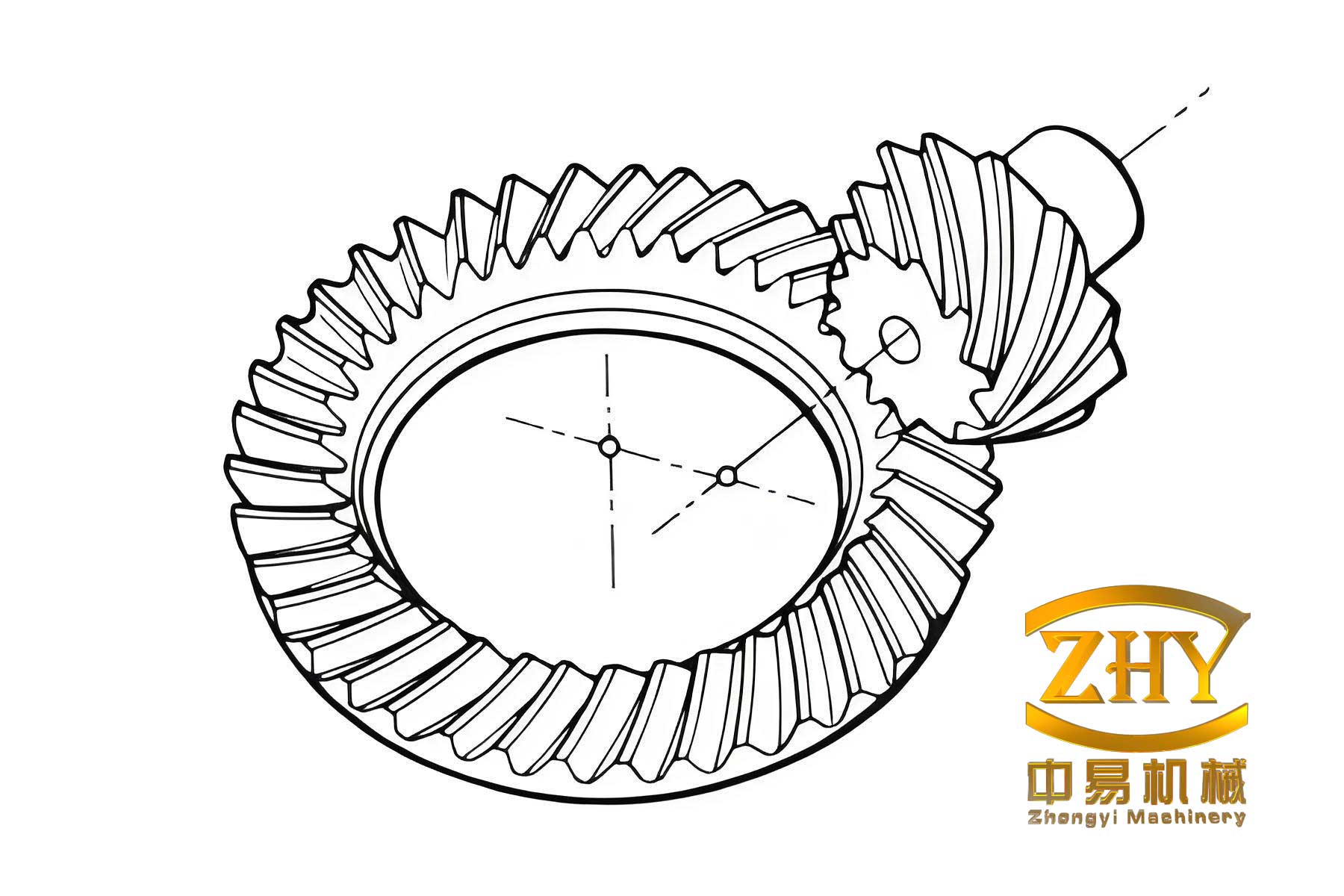
The precise definition of blank geometry, often termed “gear blank calculation,” is a foundational step in the design and manufacturing of hypoid gears. This process determines the critical dimensions of the gear and pinion blanks before the complex tooth surfaces are generated. While established methods, such as those traditionally provided in calculation cards or software by Gleason Works, have been widely used, they often incorporate approximations and iterative corrections that can introduce inherent mathematical model errors. In this article, I present a refined, more direct methodology for calculating the geometric parameters of a hypoid gear set. This new approach specifically improves the calculation of the reference cone geometry for both members and the pinion blank parameters. Its defining characteristics are the elimination of mathematical approximations in the core model and the derivation of formulas that are both precise and easier to comprehend and apply in engineering practice. The reliable performance of a hypoid gear drive is deeply dependent on the accuracy of these initial geometric definitions.
Fundamental Geometry of the Hypoid Gear Reference Cones
At the design reference point, typically located at the mid-face of the gear, a pair of reference (or pitch) cones can be conceptually defined for the hypoid gear set. The key geometric parameters for these cones are the pinion and gear mean cone distances (or pitch radii) $r_1$ and $r_2$, the reference cone angles $\delta_1$ and $\delta_2$, and the spiral angles $\beta_1$ and $\beta_2$. The established relationships between these parameters, derived from spatial gearing theory, are given by the following three equations:
$$
\cos \beta_{12} = \tan \delta_1 / \tan \delta_2 \tag{1}
$$
$$
a_{12} = \sin \beta_{12} (r_1 \cos \delta_1 + r_2 \cos \delta_2) \tag{2}
$$
$$
i_{12} = \frac{z_1}{z_2} = \frac{r_2 \cos \delta_2}{r_1 \cos \beta_1} \tag{3}
$$
Here, $\beta_{12} = \beta_1 – \beta_2$ is the spiral angle difference, $a_{12}$ is the offset (hypoid distance), and $i_{12}$ is the gear ratio. To ensure the reference point $P$ is at the mid-face of the gear, the gear mean cone distance must satisfy:
$$
r_2 = 0.5 (d_{e2} – b_2 \sin \delta_2) \tag{4}
$$
where $d_{e2}$ is the gear outer pitch diameter and $b_2$ is the gear face width.
A final condition is based on the established practice of setting the nominal cutter radius $r_0$ for generating the gear equal to the limit curvature radius $\rho_j$ at point $P$ for optimal tooth contact. This condition is expressed as:
$$
r_0 = \rho_j \tag{5}
$$
The limit curvature $\kappa_j = 1/\rho_j$ is calculated from the gear geometry at point $P$. The traditional method involves an initial approximation for the gear reference cone angle, $\delta_2 \approx \arctan(z_2 / z_1)$, which can lead to a computed pinion spiral angle $\beta_1$ that differs from the desired input value, constituting a model error from the outset.
Refined Calculation of Hypoid Gear Reference Cone Parameters
The new method proposes to solve the system of equations (1) through (5) directly and precisely for the six primary unknowns ($\beta_2$, $\delta_1$, $\delta_2$, $r_1$, $r_2$) given six input parameters: the offset $a_{12}$, gear ratio $i_{12}$ (or tooth numbers $z_1$, $z_2$), desired pinion mean spiral angle $\beta_1$, gear outer pitch diameter $d_{e2}$, gear face width $b_2$, and the cutter radius $r_0$. This eliminates the need for the initial approximation of $\delta_2$.
The efficient solution procedure is as follows:
- Begin with an initial estimate for the gear reference cone angle, typically $\delta_2^{(0)} = \arctan(z_2 / z_1)$.
- Use equation (4) to calculate the corresponding gear mean cone distance $r_2$.
- Let $x = \cos \beta_2$. The following function $f(x)$ is derived by manipulating equations (1), (2), and (3):
$$
f(x) = a_{12} – \left( \frac{z_2}{i_{12}} \sin \beta_1 – \cos \beta_1 \sqrt{1-x^2} \right) \left[ \frac{r_2 \tan \delta_2}{(x \cos \beta_1 + \sin \beta_1 \sqrt{1-x^2})^2 + \tan^2 \delta_2} \right]
$$
Solve $f(x)=0$ iteratively (e.g., using the Newton-Raphson method) to find the precise $x$, and hence $\beta_2 = \arccos(x)$. - With $\beta_2$ known, calculate $\delta_1$ from equation (1) and $r_1$ from equation (2) or (3).
- Calculate the limit curvature radius $\rho_j$ based on the current geometry. Check the convergence condition $|r_0 – \rho_j| \leq \epsilon$, where $\epsilon$ is a small tolerance (e.g., $10^{-6}$).
- If the condition is not met, apply a correction $\Delta \delta_2$ to the gear reference cone angle using a root-finding method (like the Newton method) on the function $F(\delta_2) = r_0 – \rho_j(\delta_2)$, and repeat from step 2.
This iterative loop converges to a set of reference cone parameters that simultaneously satisfy all five fundamental equations exactly, ensuring the input $\beta_1$ is preserved and the cutter radius condition is met.
Precise Determination of Hypoid Gear Pinion Blank Geometry
The geometry of the pinion blank—defined by its root and face angles, and the location of its apex—must be calculated to provide the specified clearance at the mid-face of the gear. The traditional method uses perpendiculars from the gear reference point to the gear root and face cone lines, which are not in the direction of the gear tooth height measurement. This leads to an approximate pinion geometry that does not guarantee the standard clearance along the correct direction.
The new method ensures the standard clearance $c$ is maintained along the line perpendicular to the gear reference cone at the mid-point. The principle is illustrated in the figure below and involves two auxiliary reference points, $Q$ and $F$, on the gear.
Pinion Face Cone Parameters: Point $Q$ is the intersection of the line through the gear reference point $P_2$ perpendicular to the gear reference cone element and the gear face cone element. The corresponding pinion root cone parameters are then calculated by solving a system analogous to (1)-(3) for the gear face cone and the pinion root cone, ensuring the same offset and ratio.
Let $\delta_{f1}$ be the pinion root angle and $X_{f1}$ the distance from its apex to the perpendicular foot on the pinion axis. The equivalent “mean” radius for the gear face cone at $Q$ is:
$$
r_{2Q} = r_2 – (h_{a2} – c) \cos \delta_2
$$
$$
Z_{2Q} = \frac{r_1 \sin \delta_2}{\cos \delta_1} + (h_{a2} – c) \sin \delta_2
$$
where $h_{a2}$ is the gear mean addendum. The equivalent pinion “mean” radius for its root cone is $r_{1Q} = r_{f1} \sin \delta_{f2} / \cos \delta_{f1}$, where $\delta_{f2}$ is the gear face angle. Solving the system yields:
$$
\sin \delta_{f1} = \cos \delta_{f2} \sqrt{1 – a_{12}^2 \left( \frac{Z_{2Q}}{\tan \delta_{f2}} + r_{2Q} \right)^{-2} }
$$
$$
r_{f1} = Z_{2Q} \cos \delta_{f1} / \sin \delta_{f2}
$$
$$
X_{f1} = r_{f1} \cot \delta_{f1} – r_{2Q} \sin \delta_{f1} / \cos \delta_{f2}
$$
Pinion Root Cone Parameters: Point $F$ is the intersection of the same perpendicular with the gear root cone element. The corresponding pinion face cone parameters are calculated similarly. The equivalent gear root cone radius at $F$ is:
$$
r_{2F} = r_2 + (h_{f2} + c) \cos \delta_2
$$
$$
Z_{2F} = \frac{r_1 \sin \delta_2}{\cos \delta_1} – (h_{f2} + c) \sin \delta_2
$$
where $h_{f2}$ is the gear mean dedendum. With $r_{1F} = r_{a1} \sin \delta_{a2} / \cos \delta_{a1}$, the pinion face angle $\delta_{a1}$ and its apex location $X_{a1}$ are found by:
$$
\sin \delta_{a1} = \cos \delta_{a2} \sqrt{1 – a_{12}^2 \left( Z_{2F} \tan \delta_{a2} + r_{2F} \right)^{-2} }
$$
$$
r_{a1} = Z_{2F} \cos \delta_{a1} / \sin \delta_{a2}
$$
$$
X_{a1} = r_{a1} \cot \delta_{a1} – r_{2F} \sin \delta_{a1} / \cos \delta_{a2}
$$
Pinion Face Width: An accurate yet simple formula for the pinion face width $b_1$, ensuring full contact on the gear tooth surface, is derived from spatial geometry:
$$
b_1 = \frac{b_2}{\cos \beta_{12}} + 0.01 d_{e2}
$$
The term $b_2 / \cos \beta_{12}$ approximates the theoretical boundary, while the addition of $0.01 d_{e2}$ provides a practical margin for manufacturing and alignment errors. This formula is significantly simpler than traditional complex calculations and yields functionally equivalent results.
Summary of Hypoid Gear and Pinion Geometry Formulas
The following tables summarize the key calculation formulas for the hypoid gear and the pinion after the reference cone parameters are determined.
Table 1: Hypoid Gear Blank Geometry Formulas
| Parameter | Symbol | Formula |
|---|---|---|
| Mean Working Depth | $h$ | $h = K \cdot m_t$ where $m_t = \frac{2r_2 \cos \beta_2}{z_2}$ |
| Gear Mean Addendum | $h_{a2}$ | $h_{a2} = K_a \cdot h$ |
| Clearance | $c$ | $c = 0.15h + 0.05$ (inch) or a specified value |
| Gear Mean Dedendum | $h_{f2}$ | $h_{f2} = h + c – h_{a2}$ |
| Gear Face Angle | $\delta_{a2}$ | $\delta_{a2} = \delta_2 + \theta_{a2}$ |
| Gear Root Angle | $\delta_{f2}$ | $\delta_{f2} = \delta_2 – \theta_{f2}$ |
| Gear Addendum Angle | $\theta_{a2}$ | $\theta_{a2} = \arctan(h_{a2} / R_{m2})$ where $R_{m2}=r_2/\sin\delta_2$ |
| Gear Dedendum Angle | $\theta_{f2}$ | $\theta_{f2} = \sigma – \theta_{a2}$ For uniform depth teeth: $\sigma = \theta_{a2}+\theta_{f2}$. For dual-depth teeth: $\sigma = \frac{3.07178 \tan \alpha}{\sqrt{r_0}} \cdot \frac{\sin \delta_2 \cos \beta_2}{r_2}$ |
| Gear Outer Pitch Diameter | $d_{e2}$ | Given as input. |
| Gear Outer Addendum | $h_{ae2}$ | $h_{ae2} = h_{a2} + 0.5 b_2 \tan \theta_{a2}$ |
| Gear Outer Dedendum | $h_{fe2}$ | $h_{fe2} = h_{f2} + 0.5 b_2 \tan \theta_{f2}$ |
Table 2: Hypoid Pinion Blank Geometry Formulas
| Parameter | Symbol | Formula |
|---|---|---|
| Pinion Face Width | $b_1$ | $b_1 = b_2 / \cos \beta_{12} + 0.01 d_{e2}$ |
| Pinion Face Angle | $\delta_{a1}$ | Calculated via Point $F$ method (see above). |
| Pinion Root Angle | $\delta_{f1}$ | Calculated via Point $Q$ method (see above). |
| Pinion Outer Pitch Diameter | $d_{e1}$ | $d_{e1} = 2 \left[ r_{a1} + 0.5 b_1 \sin \delta_{a1} / \cos(\delta_{a1} – \delta_1) \right]$ |
| Pinion Apex Location (Face) | $X_{a1}$ | Calculated via Point $F$ method. |
| Pinion Apex Location (Root) | $X_{f1}$ | Calculated via Point $Q$ method. |
Comparison and Advantages of the New Method
The practical impact of this refined calculation method is best illustrated by comparing its results with those from the traditional approach for a given hypoid gear set. The table below shows a comparison for a sample gear design. All linear dimensions are in mm and angles in degrees.
Table 3: Calculation Results Comparison
| Parameter | Symbol | Traditional Method | New Method | Note |
|---|---|---|---|---|
| Pinion Spiral Angle | $\beta_1$ | 49.9800 | 50.00000 | Input preserved exactly. |
| Gear Spiral Angle | $\beta_2$ | 26.3176 | 26.29793 | Adjusted for exact solution. |
| Pinion Ref. Cone Angle | $\delta_1$ | 30.4507 | 30.42958 | Slight refinement. |
| Gear Ref. Cone Angle | $\delta_2$ | 89.5392 | 89.45318 | Slight refinement. |
| Pinion Mean Radius | $r_1$ | 13.9667 | 13.94232 | – |
| Gear Mean Radius | $r_2$ | 74.8000 | 74.83013 | – |
| Pinion Face Angle | $\delta_{a1}$ | 19.8667 | 19.86990 | Ensures correct clearance. |
| Pinion Root Angle | $\delta_{f1}$ | 20.3377 | 20.26410 | Ensures correct clearance. |
The key observations from this comparison and the methodological analysis are:
- Preservation of Design Intent: The new method rigorously maintains the specified input value for the pinion mean spiral angle ($\beta_1$), whereas the traditional method results in a slight deviation. This eliminates a fundamental source of design error.
- Guaranteed Standard Clearance: By constructing the pinion root and face cones based on points $Q$ and $F$ along the correct tooth height direction of the gear, the new method ensures the specified clearance $c$ is achieved precisely at the mid-face of the gear.
- Practical Equivalence with Acceptable Refinements: While the numerical differences in results are generally small (demonstrating the robustness of the traditional approximations), they represent a move toward mathematical exactness. These refinements are beneficial for high-precision applications and digital manufacturing processes.
- Conceptual Clarity and Applicability: The derivation of formulas is based directly on the fundamental spatial geometry of the hypoid gear pair. This makes the logic of the calculation more transparent and easier for engineers to understand, validate, and potentially modify for specialized cases.
In conclusion, the refined methodology for hypoid gear geometry calculation presented here offers a more mathematically precise and conceptually clear framework. By solving the exact set of governing equations for the reference cones and by determining pinion blank geometry based on the correct clearance vector, it removes inherent approximations found in traditional methods. This approach is particularly valuable in the context of modern computer-aided design and manufacturing, where precision, repeatability, and a clear digital thread are paramount. The reliable performance of any hypoid gear drive begins with an accurate and unambiguous definition of its basic geometry, making such refinements in calculation methodology a worthwhile pursuit for advanced gear engineering.