
The pursuit of high-performance, quiet, and durable gear transmissions is a perpetual focus in mechanical engineering. Among various gear types, the helical gear is prized for its smooth engagement, high load capacity, and reduced noise compared to spur gears. This performance is further enhanced through deliberate modifications to the ideal tooth form, a process known as gear tooth modification. Axial modification, or lead crowning, is specifically designed to correct for potential misalignments and deflections under load, ensuring a more favorable contact pattern along the tooth face width and mitigating edge loading and stress concentrations.
However, the manufacturing of a helically ground or hobbed gear with intentional axial modification introduces a complex geometrical challenge: the inherent generation of a twisted tooth surface. This twist is a systematic deviation from the intended crowned profile, where the amount of material removed is not symmetric about the tooth centerline at a given height. This phenomenon is not a random machining error but a fundamental consequence of the kinematics between the generating tool (a worm grinding wheel or a hob) and the workpiece during the gear cutting or grinding process. The presence of this twist can significantly detract from the benefits of the intended modification, altering the contact pattern, increasing transmission error, and potentially elevating dynamic loads and noise. Therefore, a profound understanding of the twisting mechanism, its quantitative relationship with process parameters, and its subsequent impact on meshing performance is crucial for the design and manufacturing of precision helical gear drives.
This article presents a comprehensive, first-principles analysis of the tooth surface twist generated during the diagonal grinding or hobbing of a helical gear with axial modification. I will construct a precise mathematical model of the generated tooth surface, define a geometrically meaningful metric for twist severity, and elucidate the kinematic conditions that govern its formation. Furthermore, I will demonstrate a methodology to mitigate this twist by optimizing the machine tool kinematics. Finally, through a coupled CAD/CAE workflow, I will quantify the influence of varying degrees of tooth surface twist on critical meshing performance indicators such as loaded transmission error, mesh stiffness, and contact stress.
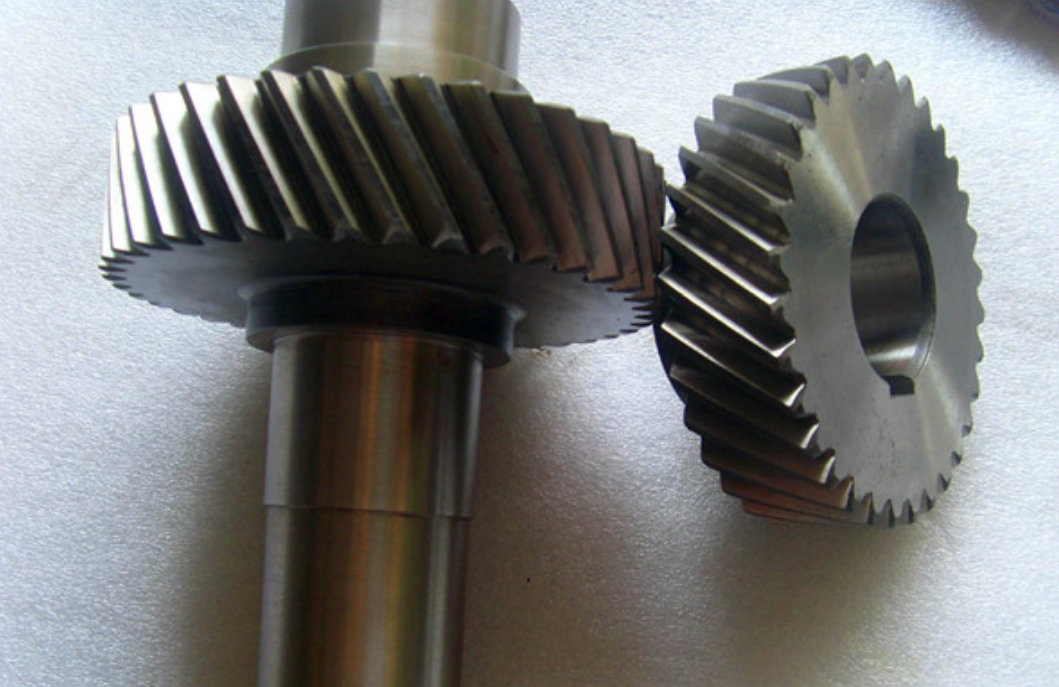
1. Geometrical Modeling of the Manufacturing Process
An accurate 3D representation of the manufactured tooth surface is the cornerstone of this analysis. I model the process based on the diagonal hobbing or grinding method, where the tool executes both an axial feed along the workpiece and a synchronized diagonal (tangential) feed.
1.1 Generating Tool (Hob/Worm Wheel) Surface
The axial modification is introduced via the profile of the imaginary rack cutter from which the hob or worm wheel is derived. A parabolic axial modification is applied to this rack. In the rack coordinate system \( S_5(O_5-x_5, y_5, z_5) \), the position vector \( \mathbf{r}_5 \) and unit normal vector \( \mathbf{n}_5 \) of the modified rack surface are defined by parameters \( l_1 \) and \( l_2 \):
$$ \mathbf{r}_5(l_1, l_2) = \begin{bmatrix} l_1 \cos \alpha_n \\ l_2 \\ -l_1 \sin \alpha_n + b l_2^2 / 2 + p/4 \\ 1 \end{bmatrix} $$
$$ \mathbf{n}_5(l_1, l_2) = \frac{\partial \mathbf{r}_5}{\partial l_1} \times \frac{\partial \mathbf{r}_5}{\partial l_2} $$
where \( \alpha_n \) is the normal pressure angle, \( b \) is the parabolic modification coefficient (positive for crowning), and \( p \) is the circular pitch.
This rack surface is then used to generate the thread surface of the hob or worm wheel (index 1). Applying coordinate transformations from \( S_5 \) to the tool coordinate system \( S_1 \), the tool surface and its normal are obtained:
$$ \mathbf{r}_1(l_1, l_2, \phi_1) = \mathbf{M}_{15}(\phi_1) \cdot \mathbf{r}_5(l_1, l_2) $$
$$ \mathbf{n}_1(l_1, l_2, \phi_1) = \mathbf{L}_{15}(\phi_1) \cdot \mathbf{n}_5(l_1, l_2) $$
Here, \( \phi_1 \) is the rotation angle of the generating tool, and \( \mathbf{M}_{15} \) and \( \mathbf{L}_{15} \) are the coordinate and vector transformation matrices, respectively. The meshing condition between the rack and the tool provides the relation between parameters:
$$ f_1(l_1, l_2, \phi_1) = \mathbf{n}_1 \cdot \frac{\partial \mathbf{r}_1}{\partial \phi_1} = 0 $$
1.2 Workpiece (Helical Gear) Generated Surface
The manufacturing setup involves the rotating tool and the rotating workpiece (helical gear, index 2). In diagonal machining, the tool has an axial feed displacement \( \Delta_1 \) along the workpiece axis and a diagonal feed displacement \( \Delta_2 \) along the workpiece’s tangential direction, related by the diagonal ratio \( c \): \( \Delta_2 = c \Delta_1 \).
The fundamental kinematic relations are given by:
- Rotation Relation: $$ \phi_2(\phi_1, \Delta_1) = \frac{N_1}{N_2} \phi_1 + \frac{\tan \beta_2 + c \tan \beta_2 \sin \beta_1}{r_2} \Delta_1 $$
- Modified Center Distance: To achieve axial modification, the center distance \( E \) is varied as a function of the axial feed, typically in a parabolic manner: $$ E = E_0 – a \Delta_1^2 $$ where \( E_0 = r_1 + r_2 \) is the standard center distance, \( a \) is the modification generation coefficient, and \( r_1, r_2 \) are tool and workpiece pitch radii.
The surface of the manufactured helical gear in its own coordinate system \( S_2 \) is derived through transformation from the tool surface:
$$ \mathbf{r}_2(l_1, l_2, \phi_1, \Delta_1) = \mathbf{M}_{21}(\phi_1, \Delta_1) \cdot \mathbf{r}_1(l_1, l_2) $$
$$ \mathbf{n}_2(l_1, l_2, \phi_1, \Delta_1) = \mathbf{L}_{21}(\phi_1, \Delta_1) \cdot \mathbf{n}_1(l_1, l_2) $$
Since the process involves two independent motions (\( \phi_1 \) and \( \Delta_1 \)), two separate meshing conditions must be satisfied simultaneously for a point to belong to the generated envelope (tooth surface):
$$ f_2(l_1, l_2, \phi_1) = \mathbf{n}_2 \cdot \frac{\partial \mathbf{r}_2}{\partial \phi_1} = 0 $$
$$ f_3(l_1, l_2, \Delta_1) = \mathbf{n}_2 \cdot \frac{\partial \mathbf{r}_2}{\partial \Delta_1} = 0 $$
The system of equations formed by \( \mathbf{r}_2(l_1, l_2, \phi_1, \Delta_1) \), \( f_2=0 \), and \( f_3=0 \) completely defines the manufactured tooth surface of the axially modified helical gear.
2. Tooth Surface Twist: Mechanism and Quantification
2.1 The Twist Generation Mechanism
The root cause of twist lies in the relative motion between the tool and the workpiece. During generation, the line of contact between the tool thread and the gear tooth is not parallel to the gear axis; it is inclined due to the helix angle. As the tool feeds axially (\( \Delta_1 \)) to create the modification, this inclined contact line sweeps across the tooth flank. Consequently, points symmetric about the tooth centerline at the same radial height are generated at different instants, under slightly different center distances (as \( E \) varies with \( \Delta_1 \)). This results in asymmetric material removal, manifesting as a twist of the crowned surface.
2.2 Defining a Twist Severity Coefficient
To quantify the twist, I define a Tooth Surface Twist Coefficient, \( R \). Consider a tooth flank and a transverse section at a reference radius. On this section line, measure the normal deviation \( \delta \) between the twisted surface and the perfect involute surface at several points across the face width. Let points \( A_1, A_3, A_5 \) be at the left end, center, and right end of the face width, respectively. The twist coefficient is defined as:
$$ R = \min \left( \frac{\min(\delta_{A_1} – \delta_{A_3},\ \delta_{A_5} – \delta_{A_3})}{\max(\delta_{A_1} – \delta_{A_3},\ \delta_{A_5} – \delta_{A_3})},\ \frac{\min(\delta_{E_1} – \delta_{E_3},\ \delta_{E_5} – \delta_{E_3})}{\max(\delta_{E_1} – \delta_{E_3},\ \delta_{E_5} – \delta_{E_3})} \right) $$
where \( E_1, E_3, E_5 \) are corresponding points at a different radial section (e.g., near the tip). The coefficient \( R \) ranges from 0 to 1. A value of \( R = 1 \) indicates perfect symmetry and no twist (i.e., \( \delta_{A_1}-\delta_{A_3} = \delta_{A_5}-\delta_{A_3} \)), while values closer to 0 indicate severe asymmetry and high twist.
2.3 Parametric Influence on Twist
Using the derived model, the influence of key parameters on \( R \) can be analyzed.
Helix Angle (\( \beta \)): The twist is inherently linked to the helix of the gear. For a spur gear (\( \beta = 0^\circ \)), the contact line is axial and no twist occurs (\( R=1 \)). As the helix angle increases, the inclination of the contact line increases, exacerbating the asymmetry of the generation process and reducing \( R \). This relationship is monotonic.
Modification Amount (\( a \) or \( b \)): Interestingly, the magnitude of the parabolic modification coefficient \( a \) (or \( b \)) does not affect the twist coefficient \( R \). It scales the deviation profile uniformly but preserves the relative asymmetry between the two sides. Therefore, a lightly crowned and a heavily crowned gear, machined with the same kinematics, will exhibit the same degree of twist.
| Helix Angle \( \beta \) (deg) | Twist Coefficient \( R \) |
|---|---|
| 0 (Spur) | 1.000 |
| 10 | 0.724 |
| 20 | 0.490 |
| 30 | 0.310 |
2.4 Mitigating Twist via Diagonal Ratio Optimization
The diagonal machining parameter \( c \) (ratio of diagonal to axial feed) offers a powerful degree of freedom to counteract the twist. By properly selecting \( c \), the direction of the tool’s additional tangential motion can be tuned to “straighten” the effective contact path. There exists an optimal diagonal ratio \( c_{opt} \)** that minimizes twist (maximizes \( R \)). Theoretical analysis of the generation kinematics yields the relation:
$$ c_{opt} = \mp \frac{1}{\cos(\beta_1 + \beta_2)} $$
where \( \beta_1 \) and \( \beta_2 \) are the tool and workpiece helix angles, respectively. The sign depends on the relative hand of the tool and gear (positive for same hand, negative for opposite hand).
The effect of varying \( c \) around \( c_{opt} \) is pronounced. As shown in the data below, \( R \) reaches a clear maximum at the optimal setting.
| Case | Diagonal Ratio \( c \) | Twist Coefficient \( R \) |
|---|---|---|
| 1 | -4.456 | 0.615 |
| 2 | -4.056 | 0.724 |
| 3 | -3.656 | 0.867 |
| 4 (Optimal) | -3.256 | 0.951 |
| 5 | -2.856 | 0.840 |
| 6 | -2.456 | 0.712 |
3. CAD/CAE Modeling and Meshing Performance Analysis
To assess the practical impact of twist, I establish a workflow to create and analyze 3D gear pairs with controlled levels of twist.
3.1 CAD Model Generation
- Surface Point Calculation: The mathematical model from Section 1 is implemented in MATLAB. For a given set of parameters (including a specific diagonal ratio \( c \)), points \( \mathbf{r}_2 \) on the tooth surface are calculated.
- 3D Solid Modeling: The point cloud is imported into CATIA (or similar CAD software) to generate a precise parametric surface. This surface is then used to create a solid model of one helical gear tooth, which is patterned to form the full gear.
- Gear Pair Assembly: A mating helical gear with conjugate geometry (or its own manufactured surface) is modeled and assembled at the theoretical center distance.
3.2 Finite Element Analysis Setup
The 3D CAD models are imported into Abaqus for Finite Element Analysis (FEA). A quasi-static contact analysis is performed to simulate the meshing process under load.
- Mesh: High-quality hexahedral elements (e.g., C3D8R) are used to discretize a segment of the gear pair containing 5-6 tooth pairs to ensure periodic steady-state conditions.
- Boundary Conditions & Load: The pinion (driver) is rotated through a small angle increment per analysis step. The gear (driven) has its rotational degree of freedom constrained, and a constant braking torque \( T \) is applied to simulate the load.
- Contact Definition: Surface-to-surface contact with finite sliding is defined between all potential contacting tooth flanks, using a penalty friction formulation.
I analyze several gear pairs, identical except for the diagonal ratio \( c \) used in their theoretical generation, leading to different twist coefficients \( R \). The base parameters for the helical gear pair are:
| Parameter | Pinion | Gear |
|---|---|---|
| Number of Teeth, \( N \) | 29 | 49 |
| Normal Module, \( m_n \) (mm) | 3 | |
| Normal Pressure Angle, \( \alpha_n \) (deg) | 25 | |
| Helix Angle, \( \beta \) (deg) | 20 (Right Hand) | 20 (Left Hand) |
| Face Width (mm) | 15 | |
| Axial Modification (Parabolic) | Applied | |
3.3 Performance Metrics and Results
The FEA results are post-processed to extract key performance indicators.
1. Loaded Transmission Error (LTE): LTE is the deviation of the driven gear’s actual rotational position from its theoretical position under load. It is a primary excitation source for gear vibration and noise. The results consistently show that reduced twist (higher \( R \)) leads to lower LTE amplitude. The peak-to-peak LTE decreases as the tooth flank geometry becomes more symmetric and conforms better to the intended modified profile under load.
2. Mesh Stiffness: The time-varying mesh stiffness \( k_m(t) \) is calculated from the simulated torque and the relative angular displacement. A higher, more uniform mesh stiffness is desirable. The analysis reveals that gear pairs with less twist exhibit higher average mesh stiffness and a more favorable stiffness curve. This is because the twisted flank causes a non-uniform load distribution along the contact lines, effectively reducing the total contact length and compliance.
3. Maximum Contact Stress (\( \sigma_{Hmax} \)): The primary goal of axial modification is to avoid stress concentrations at the edges. While all modified gears avoid extreme edge loading, the peak contact stress in the central region of the face width is significantly lower for gears with minimal twist. The twisted surface creates a biased contact pattern, leading to higher local pressures.
| Case (Ref. Table 2) | Twist Coeff. \( R \) | Peak-to-Peak LTE (μm) | Avg. Mesh Stiffness \( \bar{k}_m \) (N/m) | Max Contact Stress \( \sigma_{Hmax} \) (MPa) |
|---|---|---|---|---|
| 1 (High Twist) | 0.615 | 12.83 | 1.829 × 10⁸ | 1498.8 |
| 2 | 0.724 | 11.95 | 1.942 × 10⁸ | 1423.8 |
| 3 | 0.867 | 11.02 | 2.051 × 10⁸ | 1335.9 |
| 4 (Low Twist) | 0.951 | 10.79 | 2.118 × 10⁸ | 1283.1 |
The trends are clear: improving the twist coefficient \( R \) from 0.615 to 0.951 in this example resulted in a ~16% reduction in LTE, a ~16% increase in mesh stiffness, and a ~14% reduction in peak contact stress.
4. Conclusion
This investigation provides a thorough, quantitative understanding of the tooth surface twist phenomenon in the manufacture of axially modified helical gears via generating processes like diagonal hobbing or grinding. The key findings are:
- Twist is an Inherent Kinematic Effect: The twist in a helically ground or hobbed gear with axial modification arises fundamentally from the inclined line of contact between the tool and the workpiece during the feed motion. It is not a random error but a predictable consequence of the generation kinematics.
- Helix Angle is the Primary Driver: The severity of twist increases monotonically with the helix angle of the workpiece helical gear. A spur gear exhibits no such twist.
- Modification Magnitude Does Not Affect Twist Severity: The amount of crowning (parabolic coefficient) scales the deviation profile but does not change the relative asymmetry characterized by the twist coefficient \( R \).
- Twist Can Be Effectively Mitigated: The diagonal ratio \( c \) is a critical process parameter. An optimal value \( c_{opt} \) exists, derived from the tool and gear geometry \( ( \beta_1, \beta_2 ) \), which can minimize the twist, bringing the coefficient \( R \) close to 1.
- Twist Degrades Meshing Performance: Finite element analysis of gear pairs with varying twist levels conclusively demonstrates that increased twist leads to higher loaded transmission error (increased vibration potential), lower mesh stiffness (reduced rigidity), and higher maximum contact stress (reduced pitting resistance and load capacity).
- Integrated Modeling Methodology: The workflow combining mathematical surface generation (MATLAB), precise solid modeling (CAD), and advanced structural analysis (FEA) forms a powerful CAD/CAE一体化 toolset. This methodology is essential for researching, predicting, and optimizing the manufactured geometry and performance of high-precision helical gear drives.
In summary, for engineers designing and specifying precision helical gear transmissions, accounting for and minimizing tooth surface twist is not merely a geometric refinement but a necessary step to fully realize the performance benefits of axial modification. By applying the kinematic models and optimization principles outlined here, the manufacturing process can be tuned to produce helical gear tooth flanks that deliver superior static and dynamic performance.