
In the field of power transmission, hypoid gears play a pivotal role in efficiently transmitting motion and torque between non-intersecting, offset axes. This unique geometry grants them significant advantages, including high load-bearing capacity, smooth and quiet operation, and the ability to achieve compact design configurations with a high reduction ratio. Consequently, hypoid gears are indispensable components in critical applications such as automotive rear axles, aerospace systems, and heavy machinery. The quality of their meshing performance, characterized by the contact pattern and transmission error, is directly linked to the longevity, efficiency, and noise-vibration-harshness (NVH) characteristics of the entire transmission system. However, the sophisticated geometry of hypoid gears necessitates complex manufacturing processes involving numerous machine tool adjustment parameters. Slight deviations in these parameters can lead to suboptimal tooth contact, premature failure, and increased operational noise. Therefore, a profound understanding of the relationship between these adjustment parameters and the resulting meshing performance is crucial for both the design optimization and the precise manufacturing of high-performance hypoid gear sets.
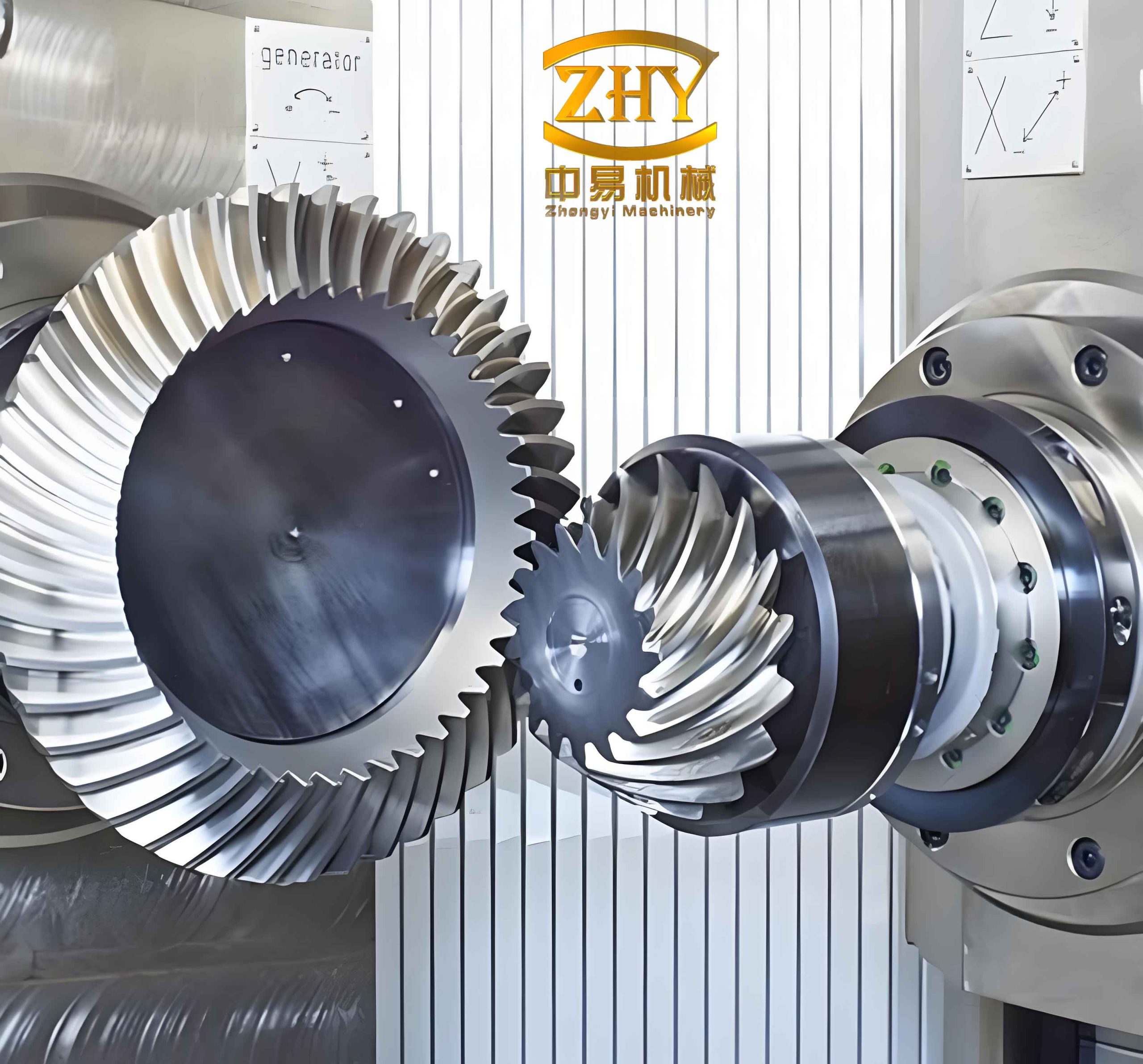
This article delves into a systematic investigation of how specific machine tool adjustment parameters affect the meshing characteristics of hypoid gears. We begin by establishing a precise mathematical model for the tooth surface generation based on the duplex helical method and the kinematics of a modern 5-axis CNC machine tool. Subsequently, the mathematical framework for Tooth Contact Analysis (TCA) is formulated to simulate the meshing of the pinion and gear under no-load conditions. Using this framework, we analyze the influence of variations in nine key machine settings on the contact path location and the transmission error (TE) curve. Finally, to provide a more intuitive geometric understanding, we construct tooth surface mismatch (ease-off) topography maps to visualize how these parameter changes modify the pinion tooth flank geometry. The findings offer a theoretical foundation for diagnosing contact pattern issues on the testing machine and for strategically adjusting processing parameters to achieve desired meshing performance in hypoid gear manufacturing.
Mathematical Model of Hypoid Gear Tooth Surface Generation
The accurate prediction of meshing behavior starts with a precise mathematical description of the tooth flanks. For hypoid gears, the pinion is typically generated via a cradle-style process simulated on a 5-axis machine, while the gear is often form-cut. We focus on modeling the pinion tooth surface as it is usually the member subject to modifications for conjugate action.
The generation process involves several coordinate systems. The cutter surface (a conical surface representing the cutting tool blade) is defined in its own coordinate system \( S_p \). The position vector \( \mathbf{r}_p \) of a point on the cutter surface and its unit normal vector \( \mathbf{n}_p \) can be expressed as:
$$ \mathbf{r}_p = \begin{bmatrix} (r_{g1} + u_1 \sin \alpha_1) \cos \beta_1 \\ (r_{g1} + u_1 \sin \alpha_1) \sin \beta_1 \\ -u_1 \cos \alpha_1 \\ 1 \end{bmatrix}, $$
$$ \mathbf{n}_p = \begin{bmatrix} \cos \alpha_1 \cos \beta_1 \\ \cos \alpha_1 \sin \beta_1 \\ \sin \alpha_1 \\ 0 \end{bmatrix}. $$
Here, \( u_1 \) and \( \beta_1 \) are the surface parameters, \( r_{g1} \) is the cutter point radius, and \( \alpha_1 \) is the cutter blade pressure angle (cutter profile angle).
The machine kinematics transform this cutter surface through a series of rotations and translations to generate the pinion tooth surface as an envelope of the tool family. The key machine tool adjustment parameters (\( \mathbf{X} \)) for the pinion in the duplex helical method include:
- Positional Parameters: Machine center to back (\( X_b \)), sliding base (\( S_{r1} \)), vertical offset (\( e_1 \)), and axial offset (\( x_{g1} \)).
- Angular Parameters: Cutter head swivel angle (\( q_1 \)), cutter head tilt angle (\( i \)), cutter head rotation angle (\( j \)), and machine root angle (\( \gamma_{m1} \)).
- Motion Parameters: Ratio of roll (\( R_{a1} \)) and helical motion coefficient (\( H_1 \)).
The coordinate transformation from \( S_p \) to the pinion coordinate system \( S_1 \) is represented by the matrix \( \mathbf{M}_{1p}(\phi, \mathbf{X}) \), where \( \phi \) is the roll angle of the generating motion. The generated pinion tooth surface \( \mathbf{r}_1 \) and its unit normal \( \mathbf{n}_1 \) in \( S_1 \) are given by:
$$ \mathbf{r}_1 (u_1, \beta_1, \phi, \mathbf{X}) = \mathbf{M}_{1p}(\phi, \mathbf{X}) \cdot \mathbf{r}_p(u_1, \beta_1), $$
$$ \mathbf{n}_1 (u_1, \beta_1, \phi, \mathbf{X}) = \mathbf{L}_{1p}(\phi, \mathbf{X}) \cdot \mathbf{n}_p(u_1, \beta_1). $$
The matrix \( \mathbf{L}_{1p} \) is the 3×3 orthogonal rotation sub-matrix of \( \mathbf{M}_{1p} \). The equation of meshing between the cutter and the generating pinion is:
$$ f_1(u_1, \beta_1, \phi, \mathbf{X}) = \mathbf{n}_1 \cdot \frac{\partial \mathbf{r}_1^{(v)}}{\partial \phi} = 0, $$
where \( \mathbf{r}_1^{(v)} \) denotes the velocity vector. Equations (1), (2), and (3) simultaneously define the pinion tooth surface with parameters \( u_1, \beta_1, \phi \). In a manufacturing context, an error \( \Delta \mathbf{X} \) in the nominal machine setting \( \mathbf{X}_0 \) leads to a modified tooth surface \( \mathbf{r}_1(u_1, \beta_1, \phi, \mathbf{X}_0 + \Delta \mathbf{X}) \). The gear tooth surface, often produced by a form-cutting process with a separate set of parameters, is modeled similarly and denoted as \( \mathbf{r}_2(u_2, \beta_2) \).
Mathematical Model for Tooth Contact Analysis (TCA)
Tooth Contact Analysis is the computational simulation of the meshing of two gear tooth surfaces. The fundamental requirement for contact is that the position vectors and the surface normals coincide at the instantaneous point of contact in a fixed reference coordinate system \( S_h \).
The pinion and gear surfaces are transformed into the fixed assembly space \( S_h \), considering their respective rotation angles \( \phi_1 \) and \( \phi_2 \), and the offset distance \( E \). The transformed surfaces and normals are:
$$ \mathbf{r}_{h1}(u_1, \beta_1, \phi, \phi_1, \mathbf{X}) = \mathbf{M}_{h1}(\phi_1) \cdot \mathbf{r}_1(u_1, \beta_1, \phi, \mathbf{X}), $$
$$ \mathbf{n}_{h1}(\beta_1, \phi, \phi_1, \mathbf{X}) = \mathbf{L}_{h1}(\phi_1) \cdot \mathbf{n}_1(\beta_1, \phi, \mathbf{X}), $$
$$ \mathbf{r}_{h2}(u_2, \beta_2, \phi_2, E) = \mathbf{M}_{h2}(\phi_2, E) \cdot \mathbf{r}_2(u_2, \beta_2), $$
$$ \mathbf{n}_{h2}(\beta_2, \phi_2, E) = \mathbf{L}_{h2}(\phi_2, E) \cdot \mathbf{n}_2(\beta_2). $$
The conditions for continuous tangency are expressed by the following system of vector equations:
$$ \begin{cases}
\mathbf{r}_{h1}(u_1, \beta_1, \phi, \phi_1, \mathbf{X}) = \mathbf{r}_{h2}(u_2, \beta_2, \phi_2, E), \\
\mathbf{n}_{h1}(\beta_1, \phi, \phi_1, \mathbf{X}) = \mathbf{n}_{h2}(\beta_2, \phi_2, E), \\
f_1(u_1, \beta_1, \phi, \mathbf{X}) = 0.
\end{cases} $$
This system has seven scalar unknowns (\( u_1, \beta_1, \phi, \phi_1, u_2, \beta_2, \phi_2 \)) and six independent scalar equations (three from the first vector equation and two from the second, as unit normals have only two independent directional components, plus the equation of meshing). By choosing one parameter, say \( \phi_1 \), as the input, the system can be solved numerically (e.g., using the Newton-Raphson method) for the remaining six. By incrementing \( \phi_1 \) through a mesh cycle, a discrete set of contact points is obtained on the gear tooth surface, forming the contact path.
The transmission error (TE) is defined as the deviation from the ideal, perfectly conjugate motion. For a given pinion rotation \( \phi_1 \), the theoretical conjugate gear rotation is \( \phi_{2,ideal} = -(N_1/N_2)\phi_1 \), where \( N_1 \) and \( N_2 \) are the tooth numbers. The actual gear rotation \( \phi_2 \) found from the TCA solution yields the transmission error:
$$ \text{TE}(\phi_1) = \phi_2 – \phi_{2,ideal} = \phi_2 + \frac{N_1}{N_2}\phi_1. $$
By calculating the principal curvatures and directions of both surfaces at the contact point, the instantaneous contact ellipse can also be determined, approximating the area of contact under light load.
Analysis of Machine Parameter Influence on Contact Path and Transmission Error
We apply the developed TCA model to analyze the sensitivity of meshing performance to individual machine tool adjustment parameters. A specific hypoid gear pair is used as an example, with its basic design and nominal machine settings shown in the tables below.
| Parameter | Pinion | Gear |
|---|---|---|
| Number of Teeth | 7 | 43 |
| Mean Spiral Angle (°) | 45.0 | 33.45 |
| Shaft Angle (°) | 90.0 | |
| Offset Distance \( E \) (mm) | 25.4 | |
| Mean Pressure Angle (°) | 22.5 | |
| Hand of Spiral | Left | Right |
| Parameter | Symbol | Value |
|---|---|---|
| Cutter Profile Angle (°) | \( \alpha_1 \) | 20.0 |
| Cutter Point Radius (mm) | \( r_{g1} \) | 114.8409 |
| Vertical Offset (mm) | \( e_1 \) | 27.3700 |
| Cutter Radial Setting (mm) | \( S_{r1} \) | 117.1353 |
| Axial Offset (mm) | \( x_{g1} \) | 0.0730 |
| Cutter Swivel Angle (°) | \( q_1 \) | 65.6224 |
| Cutter Tilt Angle (°) | \( i \) | 16.3882 |
| Cutter Phase Angle (°) | \( j \) | -25.6862 |
| Machine Root Angle (°) | \( \gamma_{m1} \) | -6.4576 |
| Helical Motion Coefficient (mm/rad) | \( H_1 \) | 7.1860 |
We systematically introduce small perturbations (e.g., +0.1 mm for length parameters, +0.1° for angular parameters) to each of the nine key pinion machine settings listed in Table 2, one at a time, while keeping all others at their nominal values. The TCA is then performed for both the drive-side (concave) and coast-side (convex) flanks of the pinion. The results are summarized in Table 3 and discussed in categories.
Influence of Positional Machine Parameters
Positional parameters include Vertical Offset (\( e_1 \)), Cutter Radial Setting (\( S_{r1} \)), Axial Offset (\( x_{g1} \)), and Machine Center to Back (\( X_b \)). Their primary effect is to shift the contact path along the lengthwise (face width) direction of the tooth.
- Vertical Offset (\( e_1 \)): An increase shifts the drive-side contact towards the toe (outer end) and the coast-side contact towards the heel (inner end). Its effect is more pronounced on the drive side.
- Cutter Radial Setting (\( S_{r1} \)): This is one of the most sensitive parameters. An increase shifts the drive-side contact towards the heel and the coast-side contact towards the toe and the tip edge, risking edge contact if the error is large.
- Axial Offset (\( x_{g1} \)): An increase shifts the contact path on both flanks towards the toe, with a slightly greater influence on the coast side.
- Machine Center to Back (\( X_b \)): An increase shifts the contact path on both flanks towards the heel.
Influence of Angular Machine Parameters
Angular parameters include Cutter Profile Angle (\( \alpha_1 \)), Cutter Tilt Angle (\( i \)), Cutter Phase Angle (\( j \)), Cutter Swivel Angle (\( q_1 \)), and Machine Root Angle (\( \gamma_{m1} \)). These affect both the lengthwise and profile (heightwise) directions of the contact path.
- Cutter Profile Angle (\( \alpha_1 \)): Primarily influences the profile direction. An increase shifts the drive-side contact towards the toe and tip, and the coast-side contact towards the heel and root. It significantly affects the amplitude of the coast-side transmission error.
- Cutter Tilt Angle (\( i \)): Mainly affects the lengthwise direction. An increase shifts the contact on both flanks towards the toe.
- Cutter Phase Angle (\( j \)): Affects the lengthwise direction. An increase shifts the drive-side contact towards the heel and the coast-side contact towards the heel as well.
- Cutter Swivel Angle (\( q_1 \)): This parameter showed negligible influence on the contact path location and transmission error amplitude for the studied hypoid gear pair under small perturbations.
- Machine Root Angle (\( \gamma_{m1} \)): Affects both directions. An increase shifts the contact on both flanks towards the heel and the root, with a very strong influence on the coast-side contact pattern.
| Parameter & Change | Primary Effect Direction | Drive-Side Contact Shift | Coast-Side Contact Shift | Relative Impact on TE Amplitude |
|---|---|---|---|---|
| \( \Delta e_1 = +0.1 \) mm | Lengthwise | Toe | Heel | Low |
| \( \Delta S_{r1} = +0.1 \) mm | Lengthwise / Profile | Heel | Toe & Tip | Very High |
| \( \Delta x_{g1} = +0.1 \) mm | Lengthwise | Toe | Toe | Low |
| \( \Delta X_{b} = +0.1 \) mm | Lengthwise | Heel | Heel | Medium |
| \( \Delta \alpha_1 = +0.1^\circ \) | Profile / Lengthwise | Toe & Tip | Heel & Root | High |
| \( \Delta i = +0.1^\circ \) | Lengthwise | Toe | Toe | Medium |
| \( \Delta j = +0.1^\circ \) | Lengthwise | Heel | Heel | Low-Medium |
| \( \Delta q_1 = +0.1^\circ \) | Negligible | Minimal | Minimal | Very Low |
| \( \Delta \gamma_{m1} = +0.1^\circ \) | Profile / Lengthwise | Heel & Root | Heel & Root | Medium (High on Coast) |
The analysis clearly shows that parameters like the Cutter Radial Setting and the Cutter Profile Angle have a dominant influence on the meshing of the hypoid gear pair. The coast-side flank often exhibits greater sensitivity in terms of transmission error amplitude changes. Understanding these individual effects is the first step towards controlled contact pattern tuning.
Influence of Machine Parameters on Tooth Flank Topography (Ease-Off)
To complement the TCA results and gain geometric insight, we analyze the tooth surface mismatch, or ease-off. The ease-off is defined as the normal distance between a theoretical reference pinion surface (generated with nominal settings \( \mathbf{X}_0 \)) and a modified pinion surface (generated with settings \( \mathbf{X}_0 + \Delta \mathbf{X} \)) after their mean points are aligned. For a grid of points on the surface, the ease-off value \( m_{ij} \) is calculated as:
$$ m_{ij}^{k} = (\mathbf{r}_{1,ij}^{k} – \mathbf{r}_{1,ij}^{0}) \cdot \mathbf{n}_{1,ij}^{0}, $$
where \( \mathbf{r}_{1,ij}^{0} \) and \( \mathbf{n}_{1,ij}^{0} \) are the position and unit normal vectors of the reference surface grid point (i,j), and \( \mathbf{r}_{1,ij}^{k} \) is the position vector of the corresponding point on the modified surface \( k \).
Positive ease-off indicates material removal (undercut) relative to the reference, while negative ease-off indicates added material (overcut). The resulting ease-off topographies for changes in Cutter Profile Angle (\( \alpha_1 \)), Cutter Radial Setting (\( S_{r1} \)), and Machine Root Angle (\( \gamma_{m1} \)) are highly informative:
- Cutter Profile Angle (\( \Delta \alpha_1 \)): On the drive-side flank, a positive change induces a negative ease-off (material addition) in the profile direction, effectively reducing the local pressure angle. This correlates with the TCA result of the contact shifting towards the tip. The pattern is symmetric for a negative change.
- Cutter Radial Setting (\( \Delta S_{r1} \)): A positive change creates a significant gradient in the lengthwise direction on the drive side, adding material at the heel and removing it at the toe, which corresponds to the observed heel-ward shift of the contact path. The coast-side flank shows a complex, combined lengthwise and profile change.
- Machine Root Angle (\( \Delta \gamma_{m1} \)): A positive change introduces a strong profile-wise gradient, adding material at the root and removing it at the tip on the drive side, explaining the root-ward contact shift. The effect on the coast side is even more pronounced across both directions.
A consistent observation is that the magnitude of ease-off change is generally larger at the toe than at the heel. Crucially, the ease-off analysis visually confirms and geometrically explains the contact path movement trends predicted by the TCA. For instance, the parameter identified as most influential by TCA (\( S_{r1} \)) also produces the most significant ease-off distortion. This confirms that the primary mechanism by which machine parameters alter the meshing of hypoid gears is through systematic modification of the pinion tooth flank topography.
Conclusion
This study has presented a comprehensive analysis of the influence of key machine tool adjustment parameters on the meshing performance of hypoid gears. By establishing a rigorous mathematical model for tooth surface generation and TCA, we were able to simulate and quantify the effects of individual parameter deviations. The results demonstrate that positional parameters like the Cutter Radial Setting (\( S_{r1} \)) primarily cause lengthwise shifts of the contact path, while angular parameters like the Cutter Profile Angle (\( \alpha_1 \)) and Machine Root Angle (\( \gamma_{m1} \)) induce shifts in both the lengthwise and profile directions, with the latter having a particularly strong effect on the coast-side flank. The analysis of transmission error revealed that certain parameters, notably \( \alpha_1 \) and \( S_{r1} \), cause significant changes in its amplitude, which is directly related to NVH performance.
The construction of ease-off topography maps provided a valuable geometric perspective, directly linking the changes in machine settings to the resulting modifications on the physical tooth flank. The patterns observed in the ease-off maps fully corroborated the contact path movements predicted by TCA, validating the entire analytical approach.
This work provides a foundational theoretical framework for diagnosing contact pattern issues observed during hypoid gear testing. By understanding the specific “fingerprint” of each machine parameter error on the contact pattern, manufacturers can make informed, targeted adjustments to the process settings to steer the contact to its desired central location and shape. Furthermore, this sensitivity analysis is a prerequisite for robust design and manufacturing process optimization, helping to determine which parameters require tighter tolerances to ensure consistent, high-quality meshing performance in mass production of hypoid gear sets.