
In mechanical transmission systems, worm gears reducers are pivotal components widely employed for speed reduction and torque multiplication. The unique geometry of worm gears enables high transmission ratios, smooth operation, low noise, and self-locking capabilities, making them indispensable in applications such as conveyor systems, elevators, and industrial machinery. However, a significant drawback associated with worm gears is the substantial wear on the worm wheel, primarily due to high sliding velocities between the worm and wheel teeth. This wear necessitates the use of expensive, wear-resistant materials like tin bronze for the worm wheel rim, driving up costs and limiting lifespan. Therefore, optimizing the design of worm gears to minimize material usage while maintaining performance is a critical engineering challenge. This article delves into a nonlinear programming approach to optimize the volume of the worm wheel rim, thereby reducing cost and enhancing durability. The methodology is implemented using MATLAB, leveraging its robust optimization toolbox to solve the constrained nonlinear problem. Throughout this discussion, the term ‘worm gears’ will be frequently emphasized to underscore the focus of this optimization study.
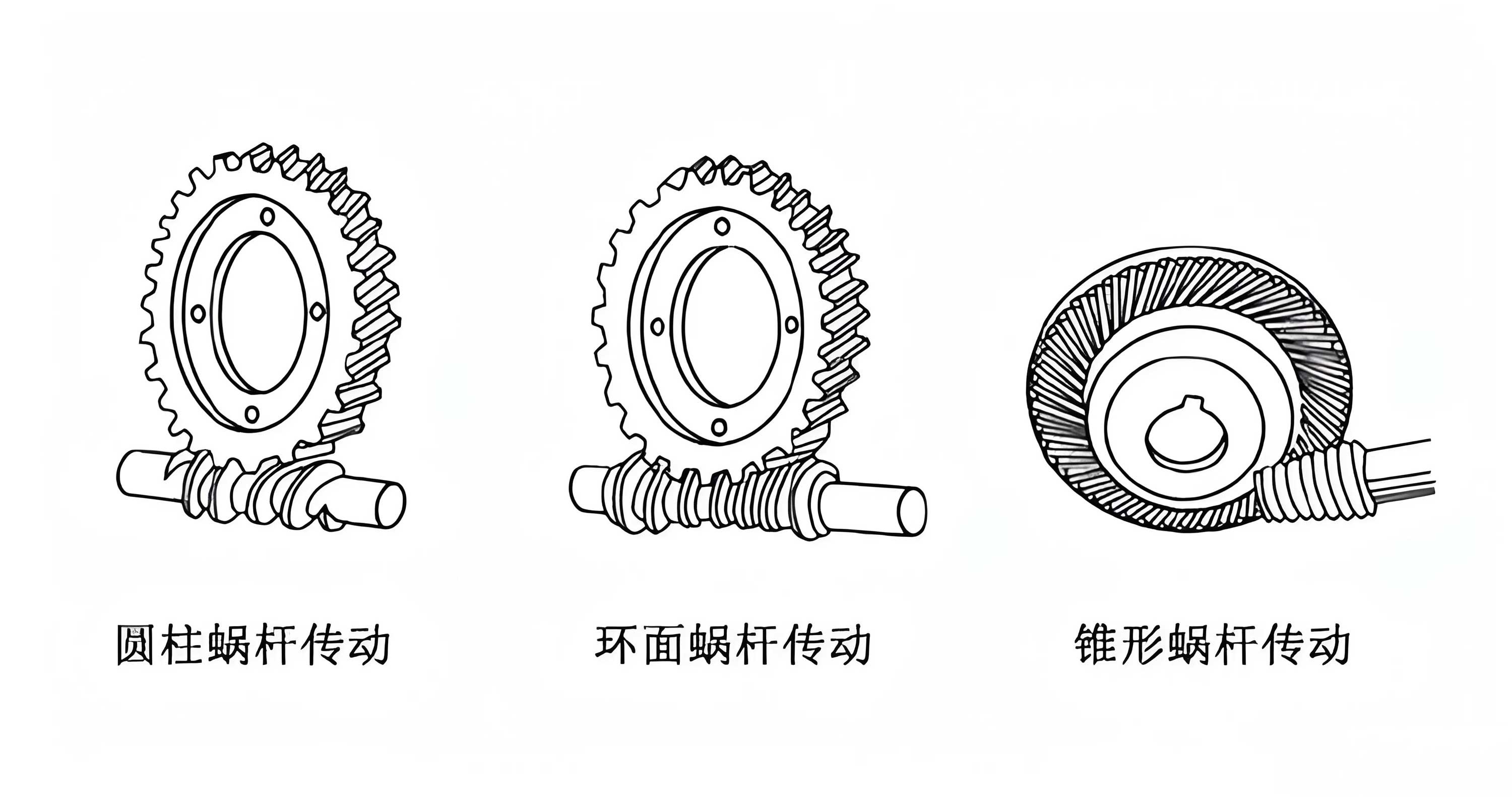
The core objective is to formulate the design of worm gears as a nonlinear programming problem. For a given set of operational parameters—input power, speed, transmission ratio, and material properties—we aim to find the optimal combination of design variables that minimizes the volume of the worm wheel rim. This volume minimization directly correlates with reduced material cost and weight, contributing to more economical and compact worm gears assemblies. The design variables are the number of worm threads (or starts) $z_1$, the module $m$, and the diameter factor $q$. The transmission ratio $i$ is typically specified. The mathematical model comprises an objective function representing the rim volume and a set of constraints ensuring mechanical integrity, such as contact stress limits, shaft rigidity, and practical design boundaries.
The geometric relationships governing worm gears are foundational to building the optimization model. The key dimensions for the worm and worm wheel are derived from the module $m$, the number of worm threads $z_1$, the worm wheel teeth count $z_2 = i \cdot z_1$, and the diameter factor $q$, which relates the pitch diameter of the worm to the module. The following table summarizes the primary geometric formulas essential for worm gears design.
| Component | Dimension | Formula |
|---|---|---|
| Worm | Pitch Diameter | $d_1 = m \cdot q$ |
| Tip Diameter | $d_{a1} = m (q + 2)$ | |
| Root Diameter | $d_{f1} = m (q – 2.4)$ | |
| Worm Wheel | Pitch Diameter | $d_2 = m \cdot z_2 = m \cdot i \cdot z_1$ |
| Tip Diameter | $d_{a2} = m (z_2 + 2)$ | |
| Root Diameter | $d_{f2} = m (z_2 – 2.4)$ | |
| Rim Outer Diameter | $d_e \leq d_{a2} + \phi_e m$ | |
| – | Face Width | $b \leq \phi_b d_{a1}$ |
| – | Rim Inner Diameter | $d_0 = d_{f2} – 2m$ |
In the table, $\phi_e$ is the rim coefficient and $\phi_b$ is the face width coefficient, typically chosen based on design standards. For the optimization, we assume $\phi_e = 1.5$ and $\phi_b = 0.75$. The volume $V$ of the worm wheel rim, which is our objective to minimize, is calculated as the volume of a cylindrical ring:
$$ V = \frac{\pi b (d_e^2 – d_0^2)}{4} $$
Substituting the expressions for $b$, $d_e$, and $d_0$ from Table 1, the volume can be expressed explicitly in terms of the design variables $z_1$, $m$, and $q$:
$$ V = \frac{\pi \phi_b (q + 2) m^3}{4} \left[ (i z_1 + 2 + \phi_e)^2 – (i z_1 – 4.4)^2 \right] $$
This equation forms the basis of our objective function. To formalize the nonlinear programming problem, we define the design vector $X$:
$$ X = \begin{bmatrix} x_1 \\ x_2 \\ x_3 \end{bmatrix} = \begin{bmatrix} z_1 \\ m \\ q \end{bmatrix} $$
Thus, the objective function $f(X)$ is:
$$ f(X) = \frac{\pi \phi_b (x_3 + 2) x_2^3}{4} \left[ (i x_1 + 2 + \phi_e)^2 – (i x_1 – 4.4)^2 \right] $$
The minimization of $f(X)$ is subject to several constraints that ensure the worm gears operate reliably under specified loads. These constraints stem from contact stress theory, shaft deflection limits, and practical design ranges for the variables.
1. Contact Stress Constraint: The contact stress between the worm and wheel teeth must not exceed the allowable stress $\sigma_H$ of the worm wheel material (tin bronze, ZCuSn10Pb1, with $\sigma_H = 220 \text{ MPa}$). The condition from gear design theory is:
$$ m^3 q \geq \left( \frac{15150}{z_2 \sigma_H} \right)^2 K T_2 $$
Where $K=1.1$ is the load factor (no shock load), and $T_2$ is the output torque on the worm wheel. Rearranging as an inequality constraint $g_1(X) \leq 0$:
$$ g_1(X) = K T_2 \left( \frac{15150}{i x_1 \sigma_H} \right)^2 – x_2^3 x_3 \leq 0 $$
The torque $T_2$ is derived from the input power $P=10 \text{ kW}$, input speed $n_1=1450 \text{ rpm}$, transmission ratio $i=20$, and estimated efficiency $\eta$. For worm gears, efficiency is approximated by:
$$ \eta = 1 – 0.035 \sqrt{i} $$
Thus,
$$ T_1 = 9550 \frac{P}{n_1}, \quad T_2 = i \cdot \eta \cdot T_1 $$
2. Worm Shaft Rigidity Constraint: Excessive deflection of the worm shaft can lead to misalignment and uneven load distribution in worm gears. The maximum deflection $y$ at the worm mid-span should satisfy $y \leq 0.001 d_1$. The deflection formula, considering the resultant force, is:
$$ y = \frac{\sqrt{F_{t1}^2 + F_{r1}^2} \cdot L^3}{48 E J} \leq 0.001 m q $$
Where:
- $F_{t1} = 2T_1 / (m q)$ is the tangential force on the worm.
- $F_{r1} = 2T_2 \tan(20^\circ) / (i z_1 m)$ is the radial force.
- $L \approx 0.9 d_2 = 0.9 m i z_1$ is the approximate bearing span.
- $E = 2.1 \times 10^5 \text{ MPa}$ is the elastic modulus of steel.
- $J = \frac{\pi}{64} d_{f1}^4 = \frac{\pi}{64} m^4 (q – 2.4)^4$ is the moment of inertia of the worm root section.
Substituting and rearranging gives the second constraint $g_2(X) \leq 0$:
$$ g_2(X) = 0.729 i^3 x_1^3 \sqrt{ \left( \frac{2T_1}{x_2 x_3} \right)^2 + \left( \frac{2T_2 \tan(20^\circ)}{i x_1 x_2} \right)^2 } – 157.5 \pi x_2^2 x_3 (x_3 – 2.4)^4 \leq 0 $$
Note that $\tan(20^\circ)$ is used, assuming a pressure angle of $20^\circ$ common in worm gears.
3. Boundary Constraints: These define practical limits for the design variables based on standard worm gears design practices.
- For power transmission, the number of worm starts is typically $2 \leq z_1 \leq 4$: $g_3(X)=x_1 – 4 \leq 0$, $g_4(X)=2 – x_1 \leq 0$.
- The module for medium-duty applications often ranges $3 \leq m \leq 5$: $g_5(X)=x_2 – 5 \leq 0$, $g_6(X)=3 – x_2 \leq 0$.
- The diameter factor usually lies in $5 \leq q \leq 18$: $g_7(X)=x_3 – 18 \leq 0$, $g_8(X)=5 – x_3 \leq 0$.
The complete nonlinear programming model for optimizing worm gears is thus:
$$
\begin{aligned}
& \text{minimize} \quad f(X) = \frac{\pi \phi_b (x_3 + 2) x_2^3}{4} \left[ (i x_1 + 2 + \phi_e)^2 – (i x_1 – 4.4)^2 \right] \\
& \text{subject to} \quad g_1(X) \leq 0, \quad g_2(X) \leq 0, \\
& \quad \quad \quad \quad g_3(X) \leq 0, \quad g_4(X) \leq 0, \quad g_5(X) \leq 0, \quad g_6(X) \leq 0, \quad g_7(X) \leq 0, \quad g_8(X) \leq 0.
\end{aligned}
$$
This is a constrained nonlinear optimization problem with three variables and eight inequality constraints. To solve it, we employ MATLAB’s `fmincon` function, which is designed for such problems. The process involves writing the objective and constraint functions as MATLAB files and calling the solver with an initial guess and bounds.
Before optimization, we compute the necessary torque values. Using the given parameters:
$$ \eta = 1 – 0.035 \sqrt{20} \approx 0.8435, \quad T_1 = 9550 \times \frac{10}{1450} \approx 65.8621 \text{ N·m}, \quad T_2 = 20 \times 0.8435 \times 65.8621 \approx 1110.5 \text{ N·m} $$
In MATLAB, we define the objective function in a file `wg_f.m`:
function f = wg_f(x)
    i = 20; psi_e = 1.5; psi_b = 0.75;
    a1 = pi * psi_b * x(2)^3 * (x(3) + 2) / 4;
    a2 = (i * x(1) + psi_e + 2)^2;
    a3 = (i * x(1) - 4.4)^2;
    f = a1 * (a2 - a3);
end
The constraint function is defined in `wg_g.m`:
function [g, geq] = wg_g(x)
    K = 1.1; P1 = 10; n1 = 1450; i = 20; sigma_HP = 220;
    eta = 1 - 0.035 * sqrt(i);
    T1 = 9550 * P1 / n1;
    T2 = i * eta * T1;

    g = zeros(8,1);
    g(1) = K * T2 * (15150 / (i * x(1) * sigma_HP))^2 - x(2)^3 * x(3);

    term1 = (2 * T1 / (x(2) * x(3)))^2;
    term2 = (2 * T2 * tan(deg2rad(20)) / (i * x(1) * x(2)))^2;
    g2_1 = 0.729 * i^3 * x(1)^3 * sqrt(term1 + term2);
    g2_2 = 157.5 * pi * x(2)^2 * x(3) * (x(3) - 2.4)^4;
    g(2) = g2_1 - g2_2;

    g(3) = x(1) - 4;
    g(4) = 2 - x(1);
    g(5) = x(2) - 5;
    g(6) = 3 - x(2);
    g(7) = x(3) - 18;
    g(8) = 5 - x(3);

    geq = [];
end
The optimization is executed from a script with an initial guess, lower bounds, and upper bounds:
x0 = [2; 5; 18];
lb = [2; 3; 5];
ub = [3; 5; 18];
options = optimoptions('fmincon', 'Display', 'iter', 'Algorithm', 'interior-point');
[x_opt, fval_opt] = fmincon(@wg_f, x0, [], [], [], [], lb, ub, @wg_g, options);
Running this optimization yields the optimal design vector. For the given parameters, the solver typically converges to a point near $X_{opt} = [3.000, 5.000, 7.7277]^T$, with a minimized objective function value $f_{min} \approx 673921.34 \text{ mm}^3$. However, in practice, design variables are often rounded to standard values for manufacturability of worm gears. A practical choice is $z_1=3$, $m=5$, $q=8$ (or $q=10$ per some standards). Let’s analyze both the optimized and initial designs.
The initial design, often a conservative starting point, used $X_0 = [2, 5, 18]^T$. The corresponding worm wheel rim volume is:
$$ V_0 = f(X_0) = \frac{\pi \times 0.75 \times (18+2) \times 5^3}{4} \left[ (20 \times 2 + 2 + 1.5)^2 – (20 \times 2 – 4.4)^2 \right] $$
$$ V_0 \approx 920226.48 \text{ mm}^3 $$
For the optimized value $X_{opt} = [3, 5, 7.7277]$, the volume is $V_{opt} \approx 673921.34 \text{ mm}^3$. If we round $q$ to a standard value of 8, the volume becomes:
$$ V_{round} = f([3, 5, 8]) \approx 692787.45 \text{ mm}^3 $$
And for $q=10$, a common standard value:
$$ V_{std} = f([3, 5, 10]) \approx 831344.94 \text{ mm}^3 $$
The comparison is summarized in the table below:
| Design Scenario | Design Vector $[z_1, m, q]$ | Rim Volume $V$ (mm³) | Volume Ratio (vs. Initial) |
|---|---|---|---|
| Initial Design | [2, 5, 18] | 920,226.48 | 1.0000 |
| Theoretical Optimum | [3, 5, 7.7277] | 673,921.34 | 0.7324 |
| Rounded Design (q=8) | [3, 5, 8] | 692,787.45 | 0.7529 |
| Standardized Design (q=10) | [3, 5, 10] | 831,344.94 | 0.9034 |
The results clearly demonstrate the effectiveness of nonlinear programming in optimizing worm gears. Even after rounding to practical values, a significant volume reduction of about 10% to 25% is achieved. This reduction directly translates to material savings and potentially lower inertia. The primary mechanism behind this improvement is the increase in the number of worm starts from 2 to 3 and the decrease in the diameter factor $q$. A higher $z_1$ increases the lead angle, which can improve efficiency slightly and allows for a smaller worm wheel face width $b$ (since $b \propto d_{a1} = m(q+2)$). A lower $q$ reduces the worm pitch diameter, further decreasing $d_{a1}$ and consequently $b$. Since the rim volume is proportional to $b$, this leads to substantial savings.
It is crucial to verify that the optimized design satisfies all constraints. For the rounded design $[3, 5, 8]$, we can compute the constraint functions. The contact stress constraint $g_1$ becomes negative, indicating the contact stress is within limits. The rigidity constraint $g_2$ is also satisfied (negative). All boundary constraints are naturally met. Therefore, the optimized worm gears design is both feasible and improved.
Beyond the specific case, this nonlinear programming framework is highly adaptable. For different input powers, speeds, transmission ratios, or material properties, one simply updates the parameters in the constraint functions. This makes the approach valuable for customizing worm gears reducers across various applications. Furthermore, the model could be extended to multi-objective optimization, perhaps simultaneously minimizing volume and maximizing efficiency, though that adds complexity.
The implementation in MATLAB highlights the power of computational tools in mechanical design. The `fmincon` solver handles the intricate nonlinear constraints efficiently, searching the design space for a local optimum. For worm gears, where design choices are interdependent and nonlinear, such automated optimization is far superior to traditional trial-and-error or handbook-based sizing.
In conclusion, the application of nonlinear programming to the design of worm gears reducers presents a robust methodology to achieve material efficiency and cost reduction without compromising performance. By formulating the rim volume minimization as an objective function subject to mechanical and geometric constraints, we derive an optimal set of design parameters. The MATLAB-based solution demonstrates a tangible volume reduction, validating the approach. This optimization strategy contributes to the development of more economical, compact, and durable worm gears transmissions, which are essential components in countless industrial systems. Future work could explore incorporating thermal constraints (as worm gears generate significant heat) or investigating advanced materials, further pushing the boundaries of worm gears performance and design optimization.
Throughout this exploration, the central role of worm gears in mechanical power transmission has been underscored. The intricate interplay between geometry, material, and load in worm gears necessitates sophisticated design techniques. Nonlinear programming offers a precise and effective avenue to navigate this complexity, ensuring that worm gears continue to be reliable and efficient workhorses in machinery. As computational tools advance, the potential for even more comprehensive optimization of worm gears systems grows, promising continued innovation in this fundamental area of mechanical engineering.