
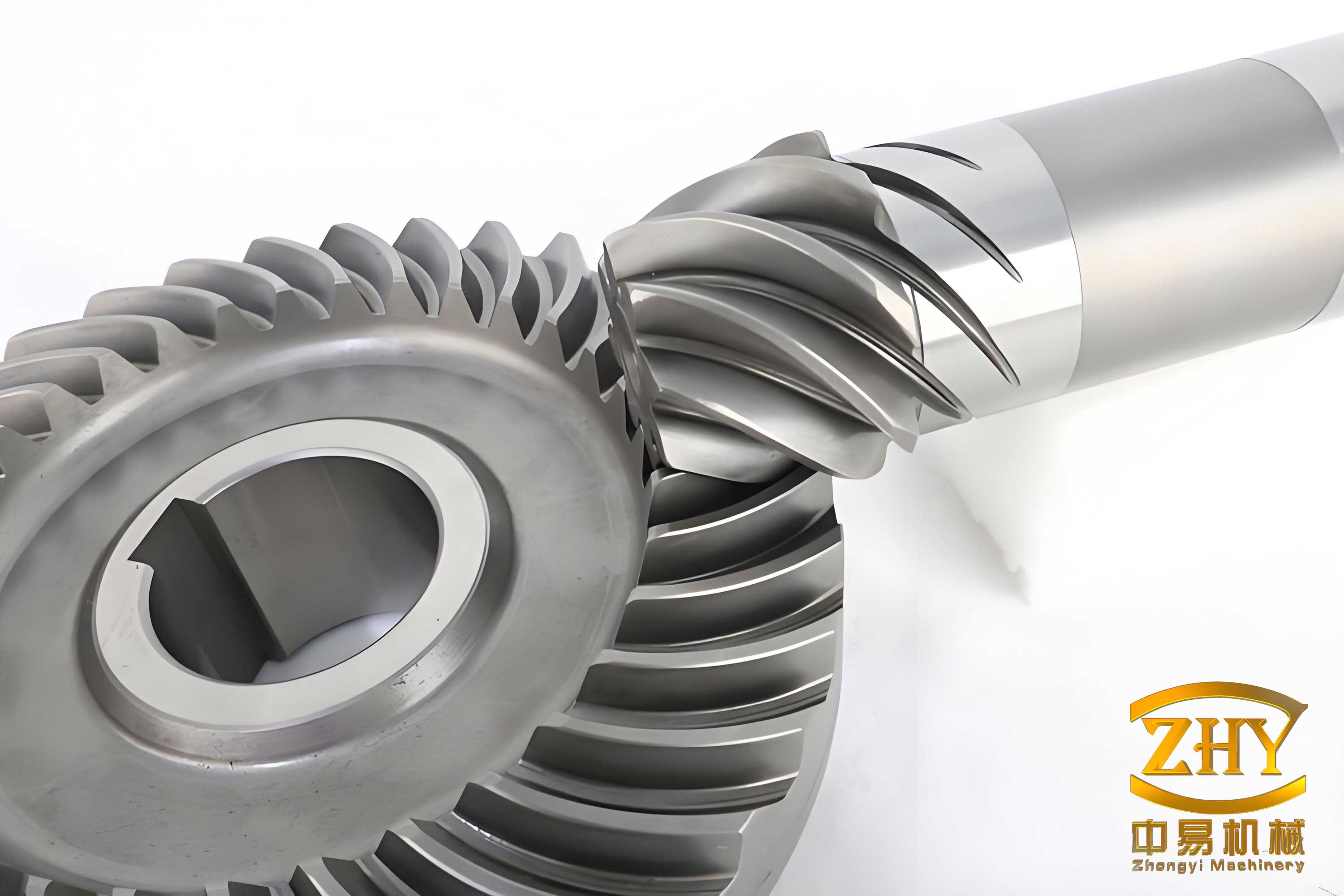
In the realm of precision mechanical engineering, the manufacturing of spiral bevel gears holds significant importance due to their widespread application in critical systems such as helicopter main transmissions, automotive drive axles, and aerospace power transfer units. The traditional mechanical methods for machining spiral bevel gears involve complex machine structures and cumbersome adjustment processes, which often lead to inefficiencies and limitations in flexibility. With the advent of numerical control (NC) technology, the machining of spiral bevel gears has been revolutionized, enabling simplified machine architectures and more straightforward computational adjustments. This article delves into an advanced NC machining methodology for spiral bevel gears, focusing on the integration of parametric curve interpolation with adaptive acceleration-deceleration control. The goal is to achieve high-precision, smooth motion trajectories that minimize mechanical shocks while ensuring contour accuracy, thereby enhancing the overall quality and performance of spiral bevel gear production.
The core challenge in spiral bevel gear NC machining lies in accurately replicating the generation motion between the cutting tool and the workpiece gear. In conventional mechanical gear cutting machines, this motion is achieved through intricate kinematic chains. However, in NC systems, this can be realized via coordinated movements of multiple axes, expressed as parametric functions. Specifically, the generation motion is represented as quintic parametric spline functions with the workpiece gear rotation angle as the parameter. This representation facilitates efficient interpolation and control. Nevertheless, the interpolation of parametric curves often introduces feed rate fluctuations due to contour error constraints, leading to abrupt changes in acceleration and jerk (the rate of change of acceleration). These abrupt changes can induce severe mechanical vibrations, wear, and reduced machining accuracy. To address this, we propose an adaptive acceleration-deceleration control method for parametric curve interpolators. This method dynamically adjusts the feed rate profile based on system limits for acceleration and jerk, ensuring smooth transitions while adhering to contour error tolerances. The application of this control strategy to spiral bevel gear NC machining demonstrates its efficacy in real-world settings, as validated through simulations and experimental trials on a self-developed spiral bevel gear NC milling machine.
The foundation of our approach begins with establishing the linkage functions for the NC axes in spiral bevel gear machining. Consider a six-axis NC milling machine configuration, comprising three linear axes (X, Y, Z) and three rotational axes (A, B, C). The objective is to derive the coordinated motion of these axes to emulate the generation motion found in traditional mechanical machines. Using vector transformation techniques, we map the tool-workpiece relationship from a mechanical setup to the NC environment. In the mechanical system, the tool axis is not parallel to the generation gear axis, but in the NC machine, the tool axis is maintained perpendicular to the machine plane. Through a series of rotational transformations, we align the tool axis appropriately. Let \(\mathbf{k}_t\) be the unit vector of the tool axis, \(\mathbf{i}_w\) be the unit vector of the workpiece rotation axis, and \(\mathbf{j}_0\) be the unit vector of the machine’s vertical axis. The required rotation angles \(\Delta \alpha\) and \(\Delta \gamma\) are determined via vector dot and cross products:
$$\tan \Delta \alpha = \frac{\mathbf{k}_t \cdot \mathbf{j}_0}{(\mathbf{k}_t \times \mathbf{i}_w) \cdot \mathbf{j}_0}$$
Subsequently, the tool center position vector \(\mathbf{R}_t\) after transformation is given by:
$$\mathbf{R}_t = \mathbf{M}(\Delta \gamma) \mathbf{M}(-\delta_f) \mathbf{M}(\Delta \alpha) \begin{bmatrix} S \cos \theta_c \\ S \sin \theta_c \\ 0 \end{bmatrix}$$
where \(\mathbf{M}(\cdot)\) denotes the rotation matrix, \(S\) is the radial tool position, \(\delta_f\) is the installation angle, and \(\theta_c\) is the rotation angle of the generation gear. The workpiece rotation angle \(\phi\) in the NC system is then:
$$\phi = \theta_w + \Delta \alpha$$
with \(\theta_w\) being the workpiece angle in the mechanical system. After compensating for the horizontal workpiece offset \(\Delta A\), the actual tool center coordinates \((x, y, z)\) relative to the machine center \((x_0, y_0, z_0)\) are:
$$
\begin{cases}
x = x_0 + \Delta A \cos \gamma \\
y = y_0 \\
z = z_0 + \Delta A \sin \gamma
\end{cases}
$$
Given the complexity of direct computation during real-time control, we approximate the coordinated axis motions as quintic parametric spline functions of the workpiece rotation angle \(\phi\). For the spiral bevel gear machining process without tool tilt (i.e., \(i = j = 0\)), the motions are expressed as:
$$
\begin{cases}
x(\phi) = a_0 + a_1 \phi + a_2 \phi^2 + a_3 \phi^3 + a_4 \phi^4 + a_5 \phi^5 \\
y(\phi) = b_0 + b_1 \phi + b_2 \phi^2 + b_3 \phi^3 + b_4 \phi^4 + b_5 \phi^5 \\
z(\phi) = c_0 + c_1 \phi + c_2 \phi^2 + c_3 \phi^3 + c_4 \phi^4 + c_5 \phi^5
\end{cases}
$$
The coefficients \(a_i, b_i, c_i\) (for \(i = 0, 1, \dots, 5\)) are derived from the NC transformation relations using Taylor series expansion around \(\phi = 0\). This parametric representation enables the application of advanced interpolation algorithms for smooth and precise tool path generation in spiral bevel gear machining.
With the parametric curves defined, the next step involves the interpolation control algorithm. In parametric curve interpolation, the curve is defined as \(\mathbf{P}(u) = x(u)\mathbf{i} + y(u)\mathbf{j} + z(u)\mathbf{k}\), where \(u\) is the parameter. The interpolation aims to compute successive parameter values \(u_i\) at each sampling period \(T\) such that the tool follows the curve at a desired feed rate \(F(u)\). However, due to curvature variations, maintaining a constant feed rate may exceed the allowable contour error \(\Delta\). The maximum allowable feed rate \(F_\delta(u_i)\) at point \(u_i\) with curvature radius \(\rho_i\) is:
$$F_\delta(u_i) = \frac{2}{T} \sqrt{2 \Delta \rho_i – \Delta^2}$$
Thus, the instantaneous feed rate \(F(u_i)\) is set to \(\min\{F_c(u_i), F_\delta(u_i)\}\), where \(F_c(u_i)\) is the commanded feed rate. This results in feed rate variations, particularly in high-curvature regions, forming what we term “feed rate sensitive zones.” These zones induce abrupt changes in acceleration \(a_i\) and jerk \(J_i\), defined as:
$$
\begin{cases}
a_i = \frac{F_i – F_{i-1}}{T} \\
J_i = \frac{a_i – a_{i-1}}{T}
\end{cases}
$$
where \(F_i = F(u_i)\). To prevent mechanical shocks, the system imposes limits on acceleration and jerk: \(|a_i| \leq D\) and \(|J_i| \leq J_{\text{max}}\), where \(D\) and \(J_{\text{max}}\) are the maximum allowed acceleration and jerk, respectively. When these limits are violated, adaptive acceleration-deceleration control is employed.
Our proposed adaptive control method adjusts the feed rate profile by shifting the start points of deceleration and acceleration phases. Consider a feed rate sensitive zone where the feed rate drops from \(F_s\) to \(F_d\) over time. We design four acceleration-deceleration modes (a, b, c, d) as illustrated in motion graphs. Modes a and c are used when the maximum acceleration \(a_{\text{max}}\) during transition is within the limit \(D\); otherwise, modes b and d are applied. For deceleration, if at interpolation cycle \(t_i\) the computed \(a_i\) or \(J_i\) exceeds limits, the deceleration start time \(t_h\) is shifted backward such that \(t_h = t_i – T_s\), where \(T_s\) is the required transition time. Similarly, for acceleration, the start time is shifted forward if needed. This iterative process ensures that the feed rate, acceleration, and jerk profiles remain within bounds throughout the interpolation.
For spiral bevel gear machining, the interpolation must also account for the workpiece rotation angle \(\phi\). The angular velocity \(\omega_i\), angular acceleration \(\alpha_i\), and angular jerk \(\beta_i\) of the workpiece must satisfy constraints:
$$
\begin{cases}
|\omega_i| \leq \omega_{\text{max}} \\
|\alpha_i| \leq \alpha_{\text{max}} \\
|\beta_i| \leq \beta_{\text{max}}
\end{cases}
$$
where \(\omega_{\text{max}}, \alpha_{\text{max}}, \beta_{\text{max}}\) are system limits. The interpolation algorithm concurrently controls the tool center feed rate and the workpiece angular motion. The parameter increment \(\Delta \phi_i\) is computed using the second-order Taylor expansion:
$$\Delta \phi_i = \frac{F(\phi_i) T}{\sqrt{x'(\phi_i)^2 + y'(\phi_i)^2 + z'(\phi_i)^2}} – \frac{F(\phi_i)^2 T^2 (x'(\phi_i) x”(\phi_i) + y'(\phi_i) y”(\phi_i) + z'(\phi_i) z”(\phi_i))}{2 (x'(\phi_i)^2 + y'(\phi_i)^2 + z'(\phi_i)^2)^{3/2}}$$
where primes denote derivatives with respect to \(\phi\). The workpiece angle is updated as \(\phi_i = \phi_{i-1} + \min\{\Delta \phi_i, \omega_{\text{max}} T\}\). The feed rate sequence \(\{F(\phi_i)\}\) is then adjusted using the adaptive control method, and the angular motion sequence \(\{\omega_i\}\) is verified for compliance. This iterative loop continues until both tool and workpiece motions meet all constraints.
The overall algorithm for high-precision parametric interpolation in spiral bevel gear NC machining is summarized as follows:
- Preprocess: Generate quintic parametric spline functions for axis motions based on gear geometry and machine parameters.
- Interpolation preprocessing: Compute the feed rate profile \(\{F(\phi_i)\}\) considering contour error limits, and apply adaptive acceleration-deceleration control to ensure acceleration and jerk limits are respected.
- Real-time interpolation: At each sampling period, output axis increments based on the preprocessed sequences, driving servo motors for coordinated motion.
To validate our method, we first conducted simulations on a general parametric curve—a cubic NURBS curve—with control points and weights as specified. The system parameters were: interpolation period \(T = 0.001 \, \text{s}\), allowable contour error \(\Delta = 0.001 \, \text{mm}\), commanded feed rate \(F_c = 210 \, \text{mm/s}\), maximum acceleration \(D = 2000 \, \text{mm/s}^2\), and maximum jerk \(J_{\text{max}} = 40,000 \, \text{mm/s}^3\). Without adaptive control, the feed rate sensitive zones caused acceleration peaks up to \(-26,356 \, \text{mm/s}^2\) and jerk peaks up to \(-1.5551 \times 10^7 \, \text{mm/s}^3\), far exceeding limits. With adaptive control, the maximum acceleration was reduced to \(1240 \, \text{mm/s}^2\) and jerk to \(40,000 \, \text{mm/s}^3\), ensuring smooth motion.
Next, we applied the method to actual spiral bevel gear machining. The gear pair had a shaft angle of \(90^\circ\), with geometric parameters as listed in Table 1. The machining parameters for the gear members are provided in Tables 2-5, derived from the principle of a flat-top generation gear. The large gear (right-hand spiral) was cut using the duplex method, while the small gear (left-hand spiral) was cut using the single-side method.
| Parameter | Large Gear | Small Gear |
|---|---|---|
| Number of teeth, \(z\) | 28 | 21 |
| Spiral angle, \(\beta\) (°) | 35 | 35 |
| Pressure angle, \(\alpha\) (°) | 20 | 20 |
| Outer cone distance, \(a_L\) (mm) | 19.058 | 19.058 |
| Face width, \(b\) (mm) | 5.75 | 5.75 |
| Pitch cone angle, \(\delta\) (°) | 53.13 | 36.87 |
| Face cone angle, \(\delta_a\) (°) | 56.733 | 41.117 |
| Root cone angle, \(\delta_f\) (°) | 48.883 | 33.267 |
| Whole depth, \(h\) (mm) | 2.14 | 2.14 |
| Parameter | Large Gear | Small Gear (Concave) | Small Gear (Convex) |
|---|---|---|---|
| Cutter blade angle, \(\alpha_0\) (°) | 20.000 | 17.750 | 22.250 |
| Cutter tip radius, \(r_u\) (mm) | 16.510 | 14.532 | 17.327 |
| Radial tool position, \(S_r\) (mm) | 15.099 | 13.753 | 18.753 |
| Angular tool position, \(q\) (°) | 65.711 | 67.476 | 55.820 |
| Horizontal workpiece offset, \(X_p\) (mm) | 0 | -0.826 | 1.354 |
| Vertical workpiece offset, \(E\) (mm) | 0 | 2.131 | -1.451 |
| Machine center to back, \(B_X\) (mm) | 0 | 0.453 | -0.743 |
| Machine root angle, \(\beta_m\) (°) | 48.883 | 33.267 | 33.267 |
| Ratio of roll, \(I\) | 1.250 | 1.667 | 1.764 |
The coefficients for the quintic parametric spline functions are summarized in Tables 3-5. These coefficients enable the explicit representation of axis motions for NC interpolation.
| Coefficient | Value for \(x(\phi)\) | Value for \(y(\phi)\) | Value for \(z(\phi)\) |
|---|---|---|---|
| \(a_0, b_0, c_0\) | 8.482624 | 13.524200 | 1.210000 |
| \(a_1, b_1, c_1\) | -10.819360 | 5.370202 | -0.052000 |
| \(a_2, b_2, c_2\) | -2.148081 | -4.327744 | 0 |
| \(a_3, b_3, c_3\) | 1.154065 | -0.572822 | 0 |
| \(a_4, b_4, c_4\) | 0.114564 | 0.230813 | 0 |
| \(a_5, b_5, c_5\) | -0.036930 | 0.018330 | 0 |
| Coefficient | Value for \(x(\phi)\) | Value for \(y(\phi)\) | Value for \(z(\phi)\) |
|---|---|---|---|
| \(a_0, b_0, c_0\) | 7.567707 | 12.703910 | 1.493000 |
| \(a_1, b_1, c_1\) | -7.622346 | 3.161020 | -0.025000 |
| \(a_2, b_2, c_2\) | -0.948306 | -2.286704 | 0 |
| \(a_3, b_3, c_3\) | 0.457341 | -0.189661 | 0 |
| \(a_4, b_4, c_4\) | 0.028449 | 0.068601 | 0 |
| \(a_5, b_5, c_5\) | -0.008232 | 0.003414 | 0 |
| Coefficient | Value for \(x(\phi)\) | Value for \(y(\phi)\) | Value for \(z(\phi)\) |
|---|---|---|---|
| \(a_0, b_0, c_0\) | 12.835087 | 15.514325 | 0.954000 |
| \(a_1, b_1, c_1\) | -9.306268 | 6.319868 | -0.017000 |
| \(a_2, b_2, c_2\) | -1.895486 | -2.791182 | 0 |
| \(a_3, b_3, c_3\) | 0.558097 | -0.379003 | 0 |
| \(a_4, b_4, c_4\) | 0.056836 | 0.083694 | 0 |
| \(a_5, b_5, c_5\) | -0.010041 | 0.006819 | 0 |
For the machining trials, the interpolation period was set to \(T = 1 \, \text{ms}\), the generation gear feed rate to \(100 \, \text{mm/min}\), and the interpolation accuracy to \(1 \, \mu\text{m}\). The limits for tool center motion were: maximum acceleration \(D = 900 \, \text{mm/s}^2\) and maximum jerk \(J_{\text{max}} = 20,000 \, \text{mm/s}^3\). For the workpiece rotation, the limits were: maximum angular velocity \(\omega_{\text{max}} = 50 \, \text{rad/s}\), maximum angular acceleration \(\alpha_{\text{max}} = 400 \, \text{rad/s}^2\), and maximum angular jerk \(\beta_{\text{max}} = 9,000 \, \text{rad/s}^3\). Using the high-precision parametric interpolation algorithm with adaptive acceleration-deceleration control, we successfully machined the spiral bevel gear pair on our self-developed NC milling machine. The gears exhibited excellent tooth profiles and surface finish. Subsequent roll testing confirmed proper contact patterns and meshing performance, indicating that the method meets the stringent requirements for spiral bevel gear production.
In conclusion, the integration of parametric curve interpolation with adaptive acceleration-deceleration control offers a robust solution for the NC machining of spiral bevel gears. By representing axis motions as quintic parametric splines and dynamically adjusting feed rates based on contour error, acceleration, and jerk constraints, we achieve smooth and precise tool paths. This approach not only enhances machining accuracy but also mitigates mechanical shocks, prolonging machine life and improving gear quality. The effectiveness of the method has been validated through simulations and practical machining trials, demonstrating its feasibility for industrial applications. Future work may explore extensions to other gear types or complex free-form surfaces, further advancing the capabilities of NC systems in precision manufacturing.
The spiral bevel gear, with its curved teeth and high load-carrying capacity, remains a cornerstone in power transmission systems. Our research contributes to the ongoing evolution of manufacturing technologies for these critical components, leveraging advanced NC strategies to overcome traditional limitations. The adaptive control method presented here ensures that the machining process is not only accurate but also efficient and reliable, paving the way for more sophisticated gear production methodologies. As industries demand higher performance and tighter tolerances, such innovations in NC machining will play a pivotal role in meeting these challenges, particularly for complex geometries like spiral bevel gears.