
In this article, I explore the geometric modeling of involute beveloid helical gears, focusing on intersecting axes configurations. Helical gears are fundamental components in mechanical transmissions due to their smooth operation and high load capacity. The beveloid helical gear, characterized by a conical shape with linearly varying tooth thickness along the axis, presents unique challenges in design and analysis. My approach centers on deriving the tooth surface equations from the transverse profile of a hypothetical generating rack, which simplifies the modeling process and enhances clarity. This method leverages spatial meshing theory to establish accurate gear geometries, facilitating the creation of solid models for applications in parallel, intersecting, and skew axis systems. Throughout this discussion, I will emphasize the role of helical gears in advancing transmission efficiency and reliability.
The significance of helical gears lies in their ability to transmit motion between non-parallel shafts with minimal noise and vibration. For beveloid helical gears, the tooth geometry varies axially, leading to a tapered appearance that accommodates misalignments and dynamic loads. I begin by defining the generating rack, which serves as a virtual cutting tool. The rack’s transverse profile is derived from its normal profile through coordinate transformations, incorporating key parameters such as helix angle and cone angle. This derivation forms the basis for subsequent meshing and tooth surface equations. I will use numerous formulas and tables to summarize these relationships, ensuring a comprehensive understanding of the underlying principles. The integration of software tools like MATLAB, Imageware, and UG enables the generation of point clouds and solid models, validating the theoretical framework.
To derive the transverse profile of the generating rack, I start with its normal profile in the coordinate system \(S_n(X_n, Y_n, Z_n)\), where the \(Y_nZ_n\) plane represents the rack’s pitch plane. The normal profile consists of a straight segment (BC) for the involute flank and a circular segment (AB) for the fillet. The parametric equations for these segments are as follows. For the straight segment BC, the position vector in \(S_n\) is given by:
$$ \mathbf{R}_n^z(l) = \begin{bmatrix} l \cos \alpha_n – h_{an}^* m_n \\ \pm \left( -l \sin \alpha_n + h_{an}^* m_n \tan \alpha_n + \frac{\pi m_n}{4} \right) \\ 0 \end{bmatrix}, $$
where \(l\) is the distance from point B, \(\alpha_n\) is the normal pressure angle, \(m_n\) is the normal module, \(h_{an}^*\) is the addendum coefficient, and the \(\pm\) sign denotes left and right flanks. For the circular segment AB, the equation is:
$$ \mathbf{R}_n^j(\theta) = \begin{bmatrix} -h_{an}^* m_n – \rho \cos \theta + \rho \sin \alpha_n \\ \pm \left( h_{an}^* m_n \tan \alpha_n + \frac{\pi m_n}{4} + \rho \cos \alpha_n – \rho \sin \theta \right) \\ 0 \end{bmatrix}, $$
with \(\theta\) as the central angle and \(\rho\) as the fillet radius. To obtain the transverse profile, I apply two rotations: first by the helix angle \(\beta\) around the \(X_n\)-axis to get system \(S_t(X_t, Y_t, Z_t)\), and then by the cone angle \(\delta\) around the \(Y_t\)-axis to get system \(S_d(X_d, Y_d, Z_d)\). The transformed equations in \(S_d\) are:
$$ \mathbf{R}_d^z(l) = \begin{bmatrix} \frac{\mathbf{R}_{nx}^z}{\cos \delta} \\ \frac{\mathbf{R}_{ny}^z}{\cos \beta} + \mathbf{R}_{nx}^z \tan \beta \tan \delta \\ 0 \end{bmatrix}, \quad \mathbf{R}_d^j(\theta) = \begin{bmatrix} \frac{\mathbf{R}_{nx}^j}{\cos \delta} \\ \frac{\mathbf{R}_{ny}^j}{\cos \beta} + \mathbf{R}_{nx}^j \tan \beta \tan \delta \\ 0 \end{bmatrix}, $$
where \(\mathbf{R}_{nx}\) and \(\mathbf{R}_{ny}\) are components from the normal profile equations. This transformation directly incorporates the helical gear parameters, simplifying the modeling of beveloid helical gears. The transverse profile equations are crucial for subsequent meshing analysis, as they define the rack geometry in a plane perpendicular to the gear axis.
Next, I establish the coordinate systems for meshing between the generating rack and the gear blank. The rack is fixed in system \(S_d\), which is translated along the negative \(Z_d\)-direction by distance \(u\) and rotated to align with the gear system. The transformation matrix from \(S_d\) to \(S_c(X_c, Y_c, Z_c)\) is:
$$ \mathbf{M}_{cd} = \begin{bmatrix} 1 & 0 & 0 & u \cos \beta \sin \delta \\ 0 & 1 & 0 & u \sin \beta \\ 0 & 0 & 1 & u \cos \beta \cos \delta \\ 0 & 0 & 0 & 1 \end{bmatrix}. $$
The rack surface in \(S_c\) becomes:
$$ \mathbf{R}_c^z = \begin{bmatrix} \mathbf{R}_{dx}^z + u \cos \beta \sin \delta \\ \mathbf{R}_{dy}^z + u \sin \beta \\ u \cos \beta \cos \delta \end{bmatrix}, \quad \mathbf{R}_c^j = \begin{bmatrix} \mathbf{R}_{dx}^j + u \cos \beta \sin \delta \\ \mathbf{R}_{dy}^j + u \sin \beta \\ u \cos \beta \cos \delta \end{bmatrix}. $$
The unit normal vectors on the rack surface are derived from partial derivatives. For the straight segment:
$$ \mathbf{n}_c^z = \frac{\frac{\partial \mathbf{R}_c^z}{\partial l} \times \frac{\partial \mathbf{R}_c^z}{\partial u}}{\left\| \frac{\partial \mathbf{R}_c^z}{\partial l} \times \frac{\partial \mathbf{R}_c^z}{\partial u} \right\|} = \begin{bmatrix} n_{cx}^z \\ n_{cy}^z \\ n_{cz}^z \end{bmatrix}, $$
and similarly for the circular segment with \(\theta\). These normals are essential for formulating the meshing condition. The meshing equation ensures that the relative velocity between the rack and gear is perpendicular to the common normal at the contact point. In system \(S_b(X_b, Y_b, Z_b)\), the gear rotates with angular velocity \(\omega_1\) about the \(Z_j\)-axis, while the rack translates with speed \(\omega_1 r’\), where \(r’\) is the pitch radius. The relative velocity at point \(K\) on the rack is:
$$ \mathbf{v}_K^{12} = \omega_1 \begin{bmatrix} y_c – r’ \phi_1 \\ x_c \\ 0 \end{bmatrix}, $$
where \(\phi_1\) is the rotation angle of the gear. The meshing condition \(\mathbf{n}_K \cdot \mathbf{v}_K^{12} = 0\) yields:
$$ \phi_1 = \frac{y_c}{r’} + \frac{n_{cy} x_c}{n_{cx} r’}. $$
Substituting the rack coordinates and normals gives explicit expressions for \(\phi_1^z\) and \(\phi_1^j\) for the straight and circular segments, respectively. This derivation highlights the interplay between helical gear geometry and kinematic parameters.
The tooth surface of the beveloid helical gear in the gear coordinate system \(S_j(X_j, Y_j, Z_j)\) is obtained by transforming the rack surface using the rotation angle \(\phi_1\). The transformation matrix from \(S_c\) to \(S_j\) is:
$$ \mathbf{M}_{jc} = \begin{bmatrix} \cos \phi_1 & \sin \phi_1 & 0 & r’ \cos \phi_1 \\ -\sin \phi_1 & \cos \phi_1 & 0 & r’ \sin \phi_1 \\ 0 & 0 & 1 & 0 \\ 0 & 0 & 0 & 1 \end{bmatrix}. $$
Thus, the gear tooth surface equations are:
$$ \mathbf{R}_j^z = \begin{bmatrix} (\mathbf{R}_{cx}^z + r’) \cos \phi_1^z + (r’ \phi_1^z – \mathbf{R}_{cy}^z) \sin \phi_1^z \\ (\mathbf{R}_{cx}^z + r’) \sin \phi_1^z – (r’ \phi_1^z – \mathbf{R}_{cy}^z) \cos \phi_1^z \\ \mathbf{R}_{cz}^z \end{bmatrix}, $$
and similarly for the fillet segment with \(\phi_1^j\). These equations fully define the involute beveloid helical gear tooth geometry, accounting for axial variations in tooth thickness. To illustrate the parameters involved, I summarize key variables in Table 1, which are essential for designing helical gears with intersecting axes.
| Parameter | Symbol | Description |
|---|---|---|
| Normal Module | \(m_n\) | Module in the normal plane |
| Helix Angle | \(\beta\) | Angle of tooth inclination |
| Cone Angle | \(\delta\) | Taper angle along the axis |
| Normal Pressure Angle | \(\alpha_n\) | Pressure angle in normal section |
| Addendum Coefficient | \(h_{an}^*\) | Factor for tooth addendum height |
| Fillet Radius | \(\rho\) | Radius of root fillet |
| Pitch Radius | \(r’\) | Radius of pitch cylinder |
| Axial Translation | \(u\) | Parameter along gear axis |
For practical implementation, I use MATLAB to generate point clouds based on the derived tooth surface equations. The point clouds represent discrete points on the gear tooth, which can be imported into CAD software for surface fitting and solid modeling. The advantage of starting from the transverse profile is evident in the alignment of points with gear cross-sections, simplifying the modeling of axial variations. In contrast, approaches based on the normal profile require additional steps to account for helix and cone angles. To visualize the helical gear geometry, I include an image that depicts a typical helical gear configuration, emphasizing its helical teeth and tapered form.
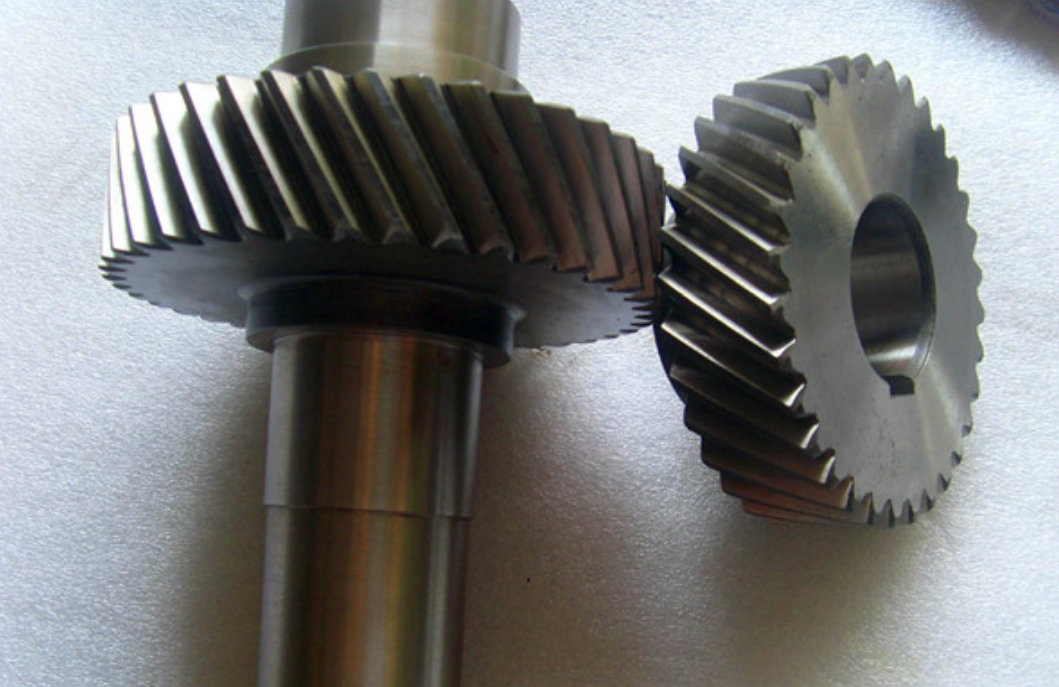
The modeling process involves integrating point clouds into Imageware for surface reconstruction, followed by UG for solid model creation. For a gear pair with intersecting axes, I define parameters such as number of teeth, helix angles, and cone angles. Table 2 provides an example set for an intersecting axis helical gear pair, demonstrating how design parameters influence meshing.
| Parameter | Input Gear | Output Gear |
|---|---|---|
| Number of Teeth, \(z\) | 26 | 51 |
| Normal Module, \(m_n\) (mm) | 5 | 5 |
| Normal Pressure Angle, \(\alpha_n\) (°) | 17.5 | 17.5 |
| Helix Angle, \(\beta\) (°) | 20.97 | 21 |
| Cone Angle, \(\delta\) (°) | 3.11 | 7.75 |
| Hand of Helix | Left | Right |
| Axis Angle, \(\Sigma\) (°) | 10 | |
Using these parameters, I compute the tooth surface points and generate solid models. The meshing of helical gears is validated through virtual assembly in UG, checking for interference and contact patterns. The resulting model shows smooth engagement, confirming the accuracy of the derived equations. The helical gear design ensures load distribution across multiple teeth, reducing stress concentrations. The beveloid shape accommodates axial misalignments, making it suitable for applications in automotive and industrial transmissions.
To further analyze the gear geometry, I derive additional formulas for critical dimensions. The transverse pressure angle \(\alpha_t\) is related to the normal pressure angle by:
$$ \tan \alpha_t = \frac{\tan \alpha_n}{\cos \beta}. $$
The pitch diameter \(d\) is given by \(d = m_n z / \cos \beta\), and the axial pitch \(p_a\) is \(p_a = \pi m_n / \sin \beta\). For beveloid helical gears, the tooth thickness varies linearly along the axis. The variation in addendum and dedendum can be expressed as functions of axial position \(u\):
$$ h_a(u) = h_{an}^* m_n + u \tan \delta, \quad h_d(u) = (h_{an}^* + c^*) m_n – u \tan \delta, $$
where \(c^*\) is the clearance coefficient. These equations highlight the tapered nature of helical gears in beveloid configurations. The contact ratio, a key performance metric for helical gears, is enhanced due to the helical teeth, leading to quieter operation. The total contact ratio \(m_t\) is the sum of the transverse contact ratio \(m_{\alpha}\) and the overlap ratio \(m_{\beta}\):
$$ m_t = m_{\alpha} + m_{\beta}, \quad \text{where} \quad m_{\alpha} = \frac{\sqrt{r_{a1}^2 – r_{b1}^2} + \sqrt{r_{a2}^2 – r_{b2}^2} – a \sin \alpha_t}{p_t \cos \alpha_t}, \quad m_{\beta} = \frac{b \tan \beta}{p_a}. $$
Here, \(r_a\) and \(r_b\) are addendum and base radii, \(a\) is the center distance, \(p_t\) is the transverse pitch, and \(b\) is the face width. For intersecting axis helical gears, the center distance is zero, but the axis angle \(\Sigma\) modifies the meshing conditions. The effective contact ratio ensures continuous torque transmission, vital for high-power applications.
In the context of manufacturing, the generating rack method simulates gear cutting processes like hobbing or shaping. The rack parameters correspond to tool geometry, and the derived equations facilitate CNC programming for precise gear production. The transverse profile approach reduces computational complexity in tool path generation. For quality control, tooth surface deviations can be analyzed using the point cloud data, comparing theoretical and measured geometries. Helical gears require careful consideration of backlash and tooth modifications to compensate for deflections under load. The beveloid design allows for adjustable backlash by varying the axial position during assembly.
The dynamic behavior of helical gears is influenced by tooth stiffness and damping. The mesh stiffness varies periodically as teeth engage and disengage, potentially exciting vibrations. For beveloid helical gears, the axial variation in tooth thickness modulates stiffness, affecting dynamic response. The fundamental frequency of mesh excitation \(f_m\) is:
$$ f_m = \frac{z n}{60}, $$
where \(n\) is the rotational speed in rpm. Helical gears exhibit lower vibration levels compared to spur gears due to gradual tooth engagement. The overlap ratio \(m_{\beta}\) contributes to this smoothing effect. In intersecting axis configurations, the relative sliding between teeth increases, necessitating proper lubrication to prevent wear. The contact stress \(\sigma_H\) can be estimated using the Hertzian formula:
$$ \sigma_H = \sqrt{\frac{F_t}{b d_1} \cdot \frac{u+1}{u} \cdot \frac{E}{2\pi(1-\nu^2)} \cdot \frac{1}{\cos^2 \beta \tan \alpha_t}}, $$
where \(F_t\) is the tangential force, \(d_1\) is the pitch diameter of the pinion, \(u\) is the gear ratio, \(E\) is Young’s modulus, and \(\nu\) is Poisson’s ratio. This stress must be kept below material limits to ensure durability. Helical gears made from hardened steels or composites can withstand high stresses, making them suitable for heavy-duty transmissions.
The efficiency of helical gear transmissions depends on friction losses at the tooth contacts. The sliding friction coefficient \(\mu\) affects power loss, especially in intersecting axis setups where sliding velocities are higher. The efficiency \(\eta\) can be approximated as:
$$ \eta = 1 – \frac{\mu \pi}{z} \left( \frac{1}{r_{b1}} + \frac{1}{r_{b2}} \right) v_s, $$
where \(v_s\) is the sliding velocity. Optimizing tooth profiles and surface finishes minimizes losses. Helical gears often incorporate profile modifications such as tip relief to reduce impact forces at engagement. The beveloid shape allows for customized modifications along the axis, tailoring performance to specific load conditions.
In summary, I have presented a comprehensive method for modeling involute beveloid helical gears with intersecting axes, based on the transverse profile of a generating rack. The derivation of tooth surface equations through spatial meshing theory provides a clear and intuitive approach to gear design. The use of tables and formulas encapsulates key parameters and relationships, facilitating practical applications. Helical gears, with their helical teeth and tapered forms, offer significant advantages in terms of smooth operation, load capacity, and misalignment tolerance. The integration of CAD software enables accurate solid model generation, supporting virtual prototyping and testing. Future work could explore dynamic simulations and experimental validation to further refine the design of helical gears for advanced mechanical systems. This methodology underscores the importance of helical gears in modern engineering, driving innovations in transmission technology.