
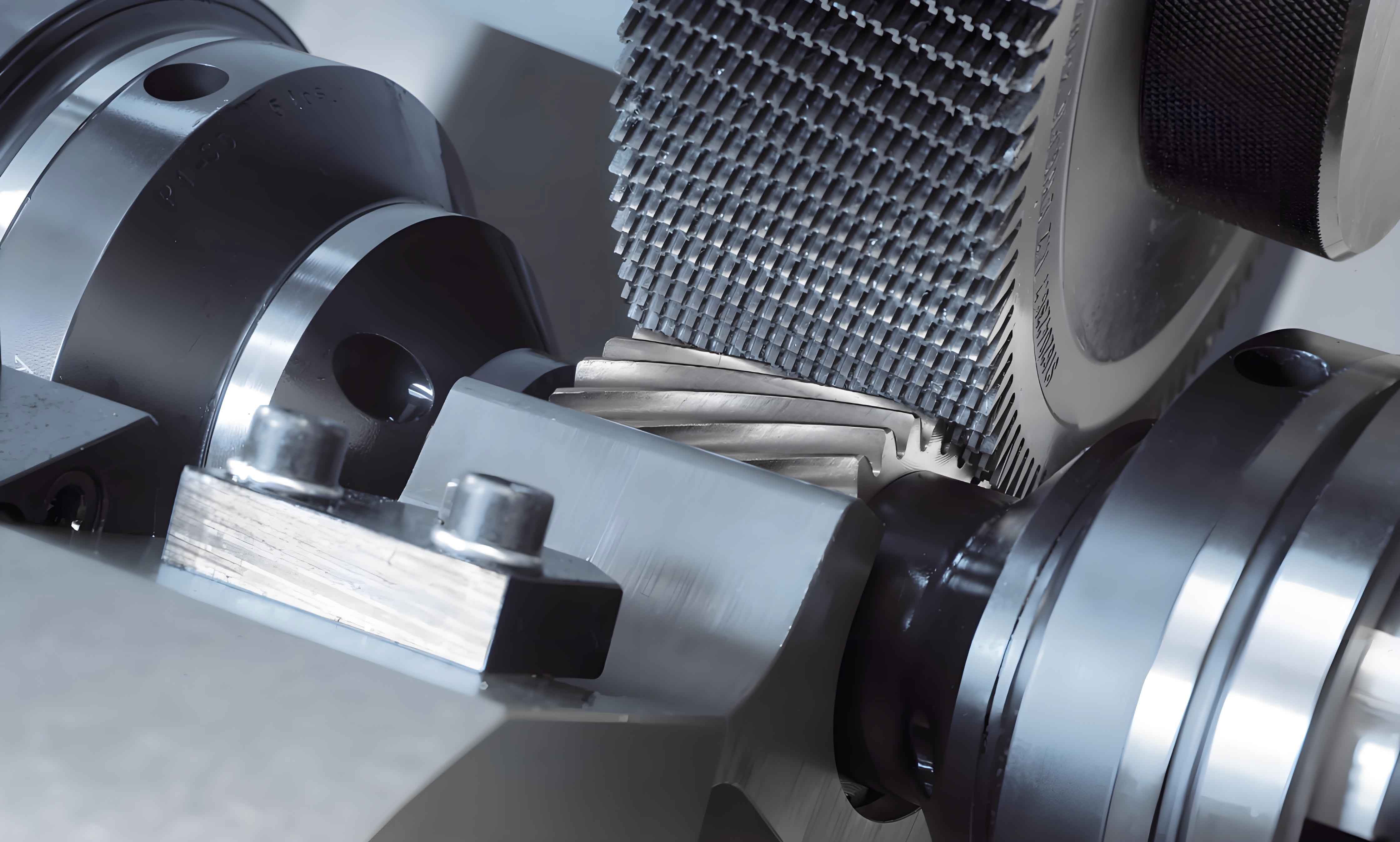
During my work in gear manufacturing, I encountered a critical issue in the production of a fifth-speed drive gear. On August 25, 2016, while processing the gear through gear shaving, I observed that the root undercut was completely absent after the gear shaving operation. This was alarming because a proper undercut of 0.01–0.05 mm is essential for gear root strength—too little or too much increases the risk of tooth fracture. The root had been entirely removed by the shaving cutter, severely compromising integrity. Visual inspection confirmed this defect, as depicted below:
Initial attempts to resolve this involved adjusting the hobbing and gear shaving parameters, such as minimizing hobbed M-values while maximizing shaved M-values within tolerances to reduce cutting depth during gear shaving. However, this yielded no significant improvement. Through detailed analysis, I identified root causes and developed targeted solutions centered on optimizing the gear shaving process.
Root Cause Analysis
The primary issue stemmed from insufficient undercut from hobbing, exacerbated by mismatched parameters in gear shaving. I analyzed three key factors:
| Factor | Description | Impact on Gear Shaving |
|---|---|---|
| Insufficient Hobbing Undercut | Hobbed undercut measured less than 0.04 mm, below the required 0.05–0.08 mm due to tool manufacturing defects. | Left minimal material for gear shaving, causing the cutter to remove the entire root zone. |
| Pressure Angle Mismatch | Gear shaving pressure angle (fHα) was approximately 17.8 μm, near the upper limit of 15±0.03 μm, while hobbing pressure angle averaged 0 μm, exceeding the 5±10 μm tolerance. | Created excessive root cutting during gear shaving, as the shaving pressure angle was too small relative to hobbing. |
| Excessive Crown Amount | Crown amount (Cα) in gear shaving was 6.5 μm (left flank) and 7.2 μm (right flank), surpassing the 4±3 μm specification. | Amplified root removal in gear shaving, especially when combined with pressure angle issues, to achieve full flank contact. |
The relationship between pressure angle and crown amount can be expressed mathematically. For a standard gear, the pressure angle deviation \(\Delta \alpha\) influences root cutting depth \(d_r\) during gear shaving:
$$ \Delta \alpha = \alpha_{\text{hob}} – \alpha_{\text{shave}} $$
where \(\alpha_{\text{hob}}\) is the hobbed pressure angle and \(\alpha_{\text{shave}}\) is the gear shaving pressure angle. The root cutting depth increases as \(\Delta \alpha\) grows, leading to undercut loss. Similarly, crown amount \(C_\alpha\) correlates with root removal:
$$ d_r \propto C_\alpha \cdot \Delta \alpha $$
This synergy explained why minor adjustments failed—fundamental parameter mismatches in gear shaving had to be addressed.
Corrective Measures
I implemented two core measures to refine the gear shaving process, focusing on cutter modifications to counteract the hobbing deficiency.
| Measure | Implementation | Rationale |
|---|---|---|
| Increase Shaving Pressure Angle | Regrind the shaving cutter to achieve a workpiece pressure angle of 7.5 μm, deviating from the standard 15±3 μm but ensuring post-heat treatment conformity. | Better matches hobbing pressure angle, reducing root cutting during gear shaving while maintaining flank integrity. |
| Reduce Crown Amount | Regrind the cutter to limit crown amount to 0–2 μm, down from 6.5–7.2 μm. | Minimizes root removal in gear shaving; smaller \(C_\alpha\) decreases \(d_r\) for a given \(\Delta \alpha\). |
After regrinding, gear shaving produced noticeable improvements—root undercut began to form, though a slight step remained. I verified this using profile reports, confirming that gear shaving now partially preserved the root. The crown amount reduction was critical, as:
$$ d_r = k \cdot C_\alpha $$
where \(k\) is a proportionality constant dependent on pressure angle. For \(C_\alpha = 2 \mu m\), \(d_r\) decreased by over 50% compared to the original 7.2 μm.
Adjustment Methodology
To eliminate residual root steps and ensure symmetry, I fine-tuned the gear shaving setup through hobbing-shaving pairing and helical angle adjustments.
Hobbing-Shaving Pairing Optimization
In gear shaving, small root imperfections often stem from cutting allowance mismatches. For the fifth-speed gear, standard gear shaving used a unilateral allowance of 0.03 mm, with an M-value allowance of 0.18 mm. The M-value adjustment \(\Delta M\) relates to thickness reduction \(\Delta s\) as:
$$ \Delta M = 6 \cdot \Delta s $$
I reduced hobbed M-value by 0.05 mm (to mid-tolerance) and increased shaved M-value by 0.01 mm, yielding:
$$ \Delta s = 0.01 \, \text{mm} \quad \Rightarrow \quad \Delta M = 0.06 \, \text{mm} $$
This cut root cutting depth during gear shaving by approximately 30%, enhancing undercut formation.
Helical Angle Adjustment for Symmetry and Crown Control
Asymmetric undercut persisted after pairing, so I modulated the shaving machine’s helix deviation (fHβ). Adjusting fHβ by ±5 μm iteratively balanced left-right undercut and fine-tuned crown amount. The optimal fHβ setting satisfied:
$$ \Delta fHβ = \min \left( |C_{\alpha,\text{left}} – C_{\alpha,\text{right}}| \right) $$
where \(C_{\alpha,\text{left}}\) and \(C_{\alpha,\text{right}}\) are crown amounts for left and right flanks. Post-adjustment, crown amount stabilized at 3–4 μm, and root symmetry improved drastically. Final gear shaving results showed consistent undercut of 0.03–0.04 mm, with all post-heat treatment parameters within spec.
Conclusion
This experience underscored that in gear shaving processes, root profile is paramount for strength and noise performance. When hobbing undercut is deficient, gear shaving adjustments—such as pressure angle alignment, crown reduction, allowance pairing, and helical tuning—can salvage quality without tool replacement. I emphasize proactive monitoring of fHα, fHβ, Cα, and Cβ in gear shaving to preempt root issues, ensuring robust gear manufacturing.