
The reliable operation of power transmission systems is paramount across industries such as aerospace, automotive, and manufacturing. At the heart of many such systems lie cylindrical gears, specifically spur cylindrical gears, prized for their design simplicity and efficiency in parallel shaft applications. However, their performance is inherently tied to the health of their tooth meshing action. The experimental simulation of various gear failure types and their progression is often prohibitively expensive and technically challenging. Consequently, developing high-fidelity dynamic models that can accurately replicate the vibration signatures of faulty cylindrical gears becomes a critical tool for understanding failure mechanisms and building diagnostic databases. This article presents a comprehensive methodology for the dynamic modeling, parameter correction, and experimental validation of spur cylindrical gears operating under different health states.
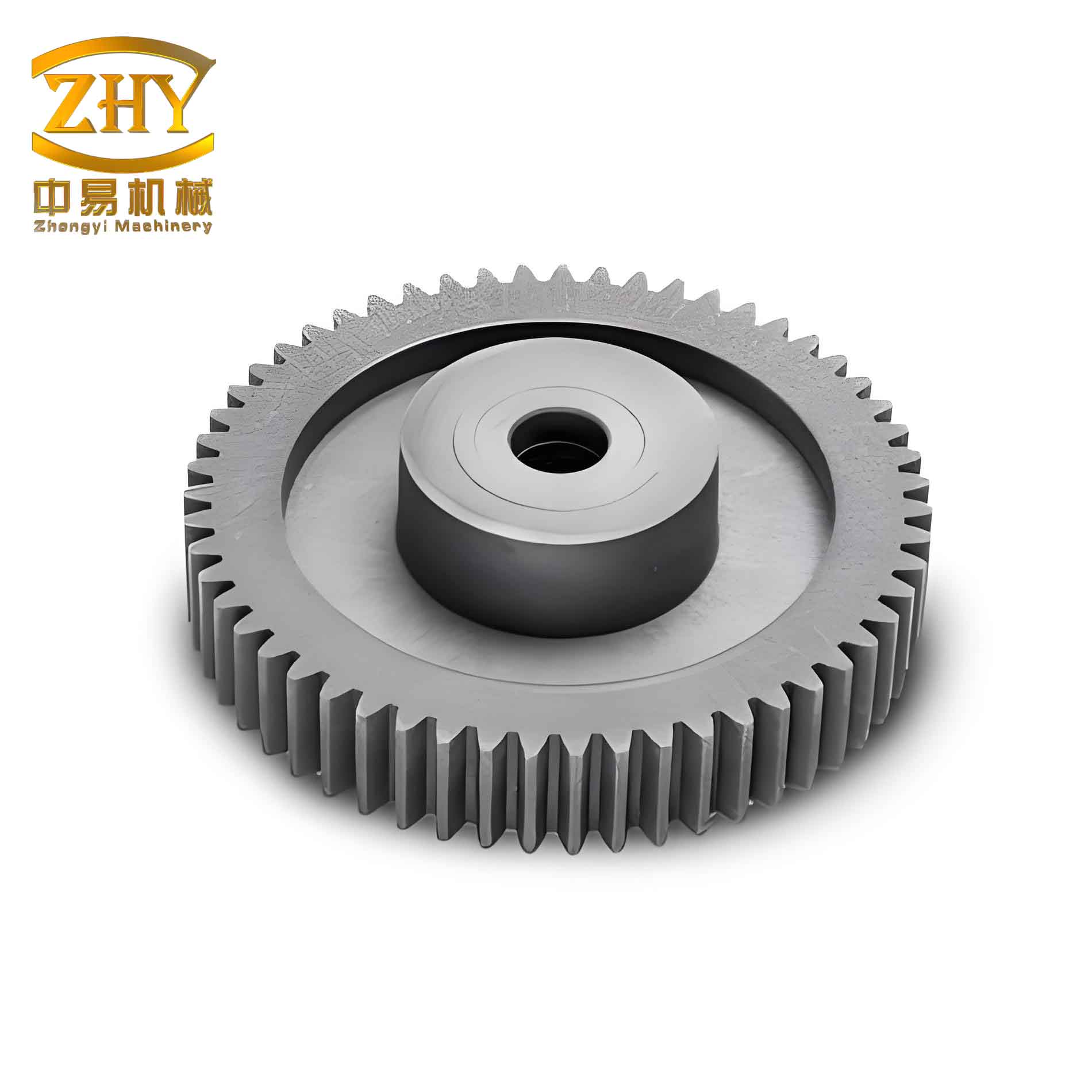
The dynamic behavior of a gear pair is primarily governed by the time-varying mesh stiffness (TVMS), which acts as a fundamental internal excitation. For perfectly healthy spur cylindrical gears, this stiffness varies periodically due to the changing number of tooth pairs in contact (single vs. double contact zones). Any fault, such as a crack or pitting, locally alters the gear tooth’s geometry and compliance, thereby modifying the TVMS profile. This modification, in turn, uniquely influences the system’s dynamic response, producing characteristic vibration signatures. Accurately calculating the TVMS for both healthy and faulty states is therefore the cornerstone of predictive dynamics modeling for cylindrical gears.
Mathematical Formulation of Gear System Dynamics
To capture the essential dynamics, a six-degree-of-freedom (6-DOF) lumped-parameter model considering both translational (bending) and rotational (torsional) motions is employed for a pair of spur cylindrical gears. The model accounts for the elasticity of supporting shafts and bearings, as well as the damping present in the system. The generalized displacement vector is defined as:
$$\{\delta\} = \{x_p, y_p, \theta_p, x_g, y_g, \theta_g\}^T$$
where $x_p, y_p$ and $x_g, y_g$ are the translational displacements of the pinion and gear in the horizontal and vertical directions, respectively, and $\theta_p, \theta_g$ are their torsional displacements. The relative displacement along the line of action $y$ is given by:
$$y = y_p + R_p\theta_p – y_g + R_g\theta_g$$
Here, $R_p$ and $R_g$ are the base circle radii. The dynamic mesh force $F_d$ can be expressed as:
$$F_d = c_m \dot{y} + k_m(t) y$$
where $c_m$ is the mesh damping and $k_m(t)$ is the time-varying mesh stiffness. An approximate representation of tooth friction $F_f$ is included as $F_f = f F_d$, where $f$ is an equivalent friction coefficient. Applying Newton’s second law leads to the system of equations of motion:
$$
\begin{aligned}
m_p \ddot{x}_p + c_{px} \dot{x}_p + k_{px} x_p &= F_f \\
m_p \ddot{y}_p + c_{py} \dot{y}_p + k_{py} y_p &= F_d \\
I_p \ddot{\theta}_p &= T_p – F_d R_p + F_f (R_p \tan\beta – H) \\
m_g \ddot{x}_g + c_{gx} \dot{x}_g + k_{gx} x_g &= -F_f \\
m_g \ddot{y}_g + c_{gy} \dot{y}_g + k_{gy} y_g &= -F_d \\
I_g \ddot{\theta}_g &= -T_g – F_d R_g + F_f (R_g \tan\beta – H)
\end{aligned}
$$
In these equations, $m$, $I$, $k_{ij}$, $c_{ij}$ represent mass, mass moment of inertia, support stiffness, and support damping coefficients, respectively. $T_p$ and $T_g$ are the input and output torques, $\beta$ is the pressure angle, and $H$ is the distance from the mesh point to the pitch point. These equations can be compactly written in matrix form:
$$\mathbf{M}\ddot{\{\delta\}} + \mathbf{C}\dot{\{\delta\}} + \mathbf{K}(t)\{\delta\} = \{F\}$$
where $\mathbf{M}$, $\mathbf{C}$, and $\mathbf{K}(t)$ are the global mass, damping, and stiffness matrices, and $\{F\}$ is the force vector. The stiffness matrix $\mathbf{K}(t)$ contains the time-varying mesh stiffness $k_m(t)$, making the system parametrically excited.
Computing Time-Varying Mesh Stiffness for Cylindrical Gears
The potential energy method, founded on elasticity theory, provides a robust analytical framework for calculating the TVMS of spur cylindrical gears. The total elastic potential energy stored in a meshing tooth pair comprises several components:
| Energy Component | Symbol | Governing Formula |
|---|---|---|
| Hertzian Contact Energy | $U_h$ | $U_h = F^2 / (2K_h)$ |
| Bending Energy | $U_b$ | $U_b = F^2 / (2K_b)$ |
| Shear Energy | $U_s$ | $U_s = F^2 / (2K_s)$ |
| Axial Compressive Energy | $U_a$ | $U_a = F^2 / (2K_a)$ |
| Gear Body (Fillet Foundation) Energy | $U_f$ | $U_f = F^2 / (2K_f)$ |
The corresponding stiffnesses are derived from these energy expressions. For a tooth segment at a distance $x$ from the root, with variable thickness $h_x$ and assuming a unit gear face width $W$, the formulas are:
$$
\begin{aligned}
\frac{1}{K_b} &= \int_{0}^{d} \frac{[(d-x)\cos\alpha_1 – h\sin\alpha_1]^2}{E I_x} dx, \quad I_x = \frac{1}{12} h_x^3 \\
\frac{1}{K_s} &= \int_{0}^{d} \frac{1.2 \cos^2\alpha_1}{G A_x} dx, \quad A_x = h_x \\
\frac{1}{K_a} &= \int_{0}^{d} \frac{\sin^2\alpha_1}{E A_x} dx \\
\frac{1}{K_h} &= \frac{4(1-\nu^2)}{\pi E W} \\
\frac{1}{K_f} &= \frac{\cos^2\alpha_1}{WE} \left[ L^*\left(\frac{u_f}{s_f}\right)^2 + M^*\left(\frac{u_f}{s_f}\right) + P^* (1 + Q^* \tan^2\alpha_1) \right]
\end{aligned}
$$
Here, $E$, $G$, and $\nu$ are Young’s modulus, shear modulus, and Poisson’s ratio, respectively. $\alpha_1$ is the pressure angle at the load application point. $L^*, M^*, P^*, Q^*$ are coefficients dependent on the tooth geometry. The total mesh stiffness for one tooth pair at a given contact position is the sum of these stiffnesses in series for both pinion and gear:
$$\frac{1}{k_{pair}} = \sum_{i=p,g} \left( \frac{1}{K_{h,i}} + \frac{1}{K_{b,i}} + \frac{1}{K_{s,i}} + \frac{1}{K_{a,i}} + \frac{1}{K_{f,i}} \right)$$
The total TVMS $k_m(t)$ for the gear pair is the sum of the stiffnesses of all tooth pairs in simultaneous contact:
$$k_m(t) = \sum_{n=1}^{N(t)} k_{pair}^{(n)}(t)$$
where $N(t)$ is the time-varying number of contact pairs (1 or 2 for spur cylindrical gears).
Fault Modeling in Cylindrical Gears
Faults manifest as localized changes in the gear tooth geometry, directly affecting the area moment of inertia $I_x$ and the cross-sectional area $A_x$ used in the bending, shear, and axial stiffness calculations. The formulas below detail these modifications for two common faults in spur cylindrical gears.
Root Crack Fault
A root crack is modeled as a straight-line propagation starting from the root fillet. It is characterized by its depth $q_c$ and angle $\alpha_c$. The presence of the crack reduces the effective tooth thickness $h_{x,eff}$ at a given cross-section $x$:
$$
h_{x,eff} =
\begin{cases}
h_x – \Delta h(x), & \text{if within crack region} \\
h_x, & \text{otherwise}
\end{cases}
$$
where $\Delta h(x)$ is a function of $q_c$ and $\alpha_c$. The modified area and moment of inertia become:
$$
A_x^{crack} = W \cdot h_{x,eff}, \quad I_x^{crack} = \frac{1}{12} W \cdot (h_{x,eff})^3
$$
These modified values $A_x^{crack}$ and $I_x^{crack}$ are substituted into the integrals for $1/K_b$, $1/K_s$, and $1/K_a$ to compute the stiffness of the cracked tooth. The Hertzian contact and fillet foundation stiffnesses are generally considered unaffected by a root crack.
Surface Pitting Fault
Pitting is modeled as a rectangular spall on the tooth flank, defined by its length $L_s$ (along the tooth profile), width $W_s$ (across the face width), and depth $h_s$. This defect affects multiple stiffness components. The effective face width for contact and foundation stiffness is reduced:
$$W_{eff} = W – W_s \quad \text{(for the pitted section)}$$
The effective area and moment of inertia for the bending, shear, and axial stiffness calculations in the pitted section are also reduced:
$$
\begin{aligned}
A_x^{pitted} &= W \cdot h_x – W_s \cdot h_s \\
I_x^{pitted} &\approx \frac{1}{12}W h_x^3 – \frac{1}{12}W_s h_s^3
\end{aligned}
$$
These modifications are applied only when the contact point traverses the pitted region on the tooth profile. The resultant TVMS shows a distinct drop specifically during that segment of the meshing cycle.
The impact of different fault types and severities on the TVMS of a sample spur cylindrical gear pair is summarized below. The gear parameters are: Pinion Teeth $Z_p=23$, Gear Teeth $Z_g=84$, Module $m=2$ mm, Pressure Angle $\alpha=20^\circ$, Face Width $W=20$ mm.
| Fault Type | Severity Parameter | Effect on TVMS | Key Feature in $k_m(t)$ |
|---|---|---|---|
| Healthy | N/A | Periodic, symmetric pattern | Consistent peaks in single/double contact zones |
| Root Crack | $q_c = 1.0$ mm | Moderate reduction | Noticeable dip when cracked tooth is in the low-stiffness region of mesh. |
| $q_c = 1.5$ mm | Significant reduction | Pronounced dip, increased asymmetry. | |
| $q_c = 2.0$ mm | Severe reduction | Deep, localized collapse of stiffness during faulted tooth engagement. | |
| Surface Pitting | $W_s/W = 20\%$, $L_s=0.5$mm | Localized minor reduction | Small, brief reduction in $k_m(t)$ as contact passes over pit. |
| $W_s/W = 40\%$, $L_s=0.5$mm | Clear localized reduction | More defined step-like decrease in stiffness profile. | |
| $W_s/W = 20\%$, $L_s=0.9$mm | Broader localized reduction | Wider duration of reduced stiffness per mesh cycle. |
Model Correction via Experimental Parameter Identification
A significant challenge in achieving a predictive model is the accurate determination of system parameters, particularly the support stiffness $\mathbf{k_{ij}}$ and damping $\mathbf{c_{ij}}$ matrices for the gear shafts. These parameters are often not known a priori and significantly influence how vibrations from the gear mesh are transmitted to the housing where sensors are typically mounted. A model correction procedure based on experimental modal analysis is employed.
The shaft-bearing-housing assembly at each gear is modeled as a 2-DOF system (coupled $x$ and $y$ directions) with a symmetric cross-coupling assumption ($k_{xy}=k_{yx}$, $c_{xy}=c_{yx}$). The frequency response function (FRF) matrix $\mathbf{R}(\omega)$ relates input force $\{F\}$ to output acceleration $\{\ddot{X}\}$:
$$\{\ddot{X}\} = \mathbf{R}(\omega) \{F\}$$
where, for example, the direct FRF $R_{xx}$ and cross FRF $R_{yx}$ for an $x$-direction force are:
$$
R_{xx}(\omega) = \frac{\ddot{X}}{F_x}, \quad R_{yx}(\omega) = \frac{\ddot{Y}}{F_x}
$$
The theoretical expressions for these FRFs are derived from the 2-DOF system equations and are functions of the unknown parameters $k_{xx}, k_{yy}, k_{xy}, c_{xx}, c_{yy}, c_{xy}$ and the known mass $m$. An impact hammer test is performed on the actual gearbox structure to measure the experimental FRFs, $\mathbf{R}^e(\omega)$.
The correction process involves solving an optimization problem to find the parameter set that minimizes the discrepancy between the simulated FRFs $\mathbf{R}^s(\omega)$ and the experimental ones:
$$\min_{\mathbf{k}, \mathbf{c}} \sum_{i,j \in \{x,y\}} \sum_{\omega} \left\| R^s_{ij}(\omega; \mathbf{k}, \mathbf{c}) – R^e_{ij}(\omega) \right\|$$
The identified support stiffness and damping parameters are then integrated into the global system matrices $\mathbf{K}$ and $\mathbf{C}$ of the 6-DOF dynamic model. This crucial step ensures the model’s vibration transmission path aligns with reality, allowing simulated housing vibrations to be directly comparable to experimental measurements.
Dynamic Response Analysis and Experimental Validation
With the corrected model and the fault-inclusive TVMS, the system of equations is solved numerically (e.g., using the Runge-Kutta method) to obtain the dynamic response. The analysis focuses on the vibration acceleration, which is the typical measured quantity.
The simulated responses for healthy and faulty spur cylindrical gears show distinct characteristics:
- Healthy Gears: The time-domain signal is predominantly periodic with minor modulation. The frequency spectrum is dominated by the gear mesh frequency $f_m$ and its harmonics, with no significant sidebands.
- Cracked Gears: A periodic impulse appears in the time domain, synchronized with the rotation period of the faulty gear ($1/f_r$). In the frequency domain, this manifests as sidebands around the mesh frequency harmonics, spaced at the shaft rotational frequency $f_r$. The amplitude and spread of these sidebands increase with crack depth.
- Pitted Gears: The time-domain signal shows a less severe but periodic amplitude modulation. The frequency spectrum shows mesh harmonics, with emerging sidebands that are often lower in amplitude and more localized compared to the crack case, reflecting the more localized nature of the stiffness loss.
Experimental validation was conducted on a gearbox test rig using specifically manufactured spur cylindrical gears with seeded faults (crack and pitting). Vibration data was collected under identical operating conditions (e.g., 1800 RPM input speed). The experimental signals were processed using time-synchronous averaging (TSA) to enhance the gear-related components.
A comparison between the simulated and experimental TSA vibration signals for the sample gear pair reveals strong agreement:
- The periodicity of impacts in the cracked gear case matched closely.
- The characteristic frequency patterns (dominant mesh harmonics and sideband structures) were successfully reproduced by the model.
- The relative changes in response amplitude between healthy and faulty states were consistent.
This validation confirms the ability of the proposed modeling framework—combining accurate fault-based TVMS calculation, a multi-DOF dynamic model, and experimentally corrected support parameters—to generate realistic vibration signatures for faulty spur cylindrical gears.
Discussion and Implications for Fault Databases
The primary value of this validated modeling approach lies in its ability to systematically generate a vast and controlled dataset of gear dynamic responses. Experimentally obtaining data for every conceivable fault type and progression level in spur cylindrical gears is impractical. The model, however, can simulate scenarios that are difficult or dangerous to replicate physically, such as very early-stage cracks or specific patterns of distributed pitting.
The generated datasets, encompassing time-domain waveforms, frequency spectra, and derived condition indicators (like sideband energy or kurtosis), are essential for:
- Developing and Training Diagnostic Algorithms: Machine learning models, especially deep learning networks, require large, labeled datasets. The model can provide abundant “synthetic” data to supplement limited experimental data, improving algorithm robustness and generalization.
- Understanding Fault Progression Signatures: By simulating faults at incremental severity levels, one can study how specific features in the vibration signal evolve. This knowledge is critical for prognostics and health management (PHM), aiming to predict remaining useful life.
- Designing Robust Systems: The dynamic model allows engineers to assess how different gear design parameters (module, pressure angle, face width) influence the vibration signature of a fault, potentially guiding designs that are less sensitive to certain failure modes or whose faults are more easily detectable.
In conclusion, the integration of high-fidelity analytical modeling for stiffness calculation, comprehensive system dynamics, and empirical parameter correction presents a powerful and validated tool for the analysis of spur cylindrical gears. It successfully bridges the gap between complex physical phenomena and actionable vibration-based condition monitoring data. By enabling the efficient creation of extensive and accurate fault response libraries, this methodology provides indispensable data support for advancing the state of the art in gear fault diagnosis, prognosis, and the design of more reliable mechanical transmission systems.