
The advent of “Industry 4.0” signifies a societal shift towards intelligent automation, where robotic systems are central. The development and production of high-performance robots are therefore paramount. At the core of many industrial robots lies a critical component: the Rotary Vector (RV) reducer. This type of speed reducer employs a 2K-V transmission form, combining involute gear transmission with cycloidal pin wheel planetary drive.
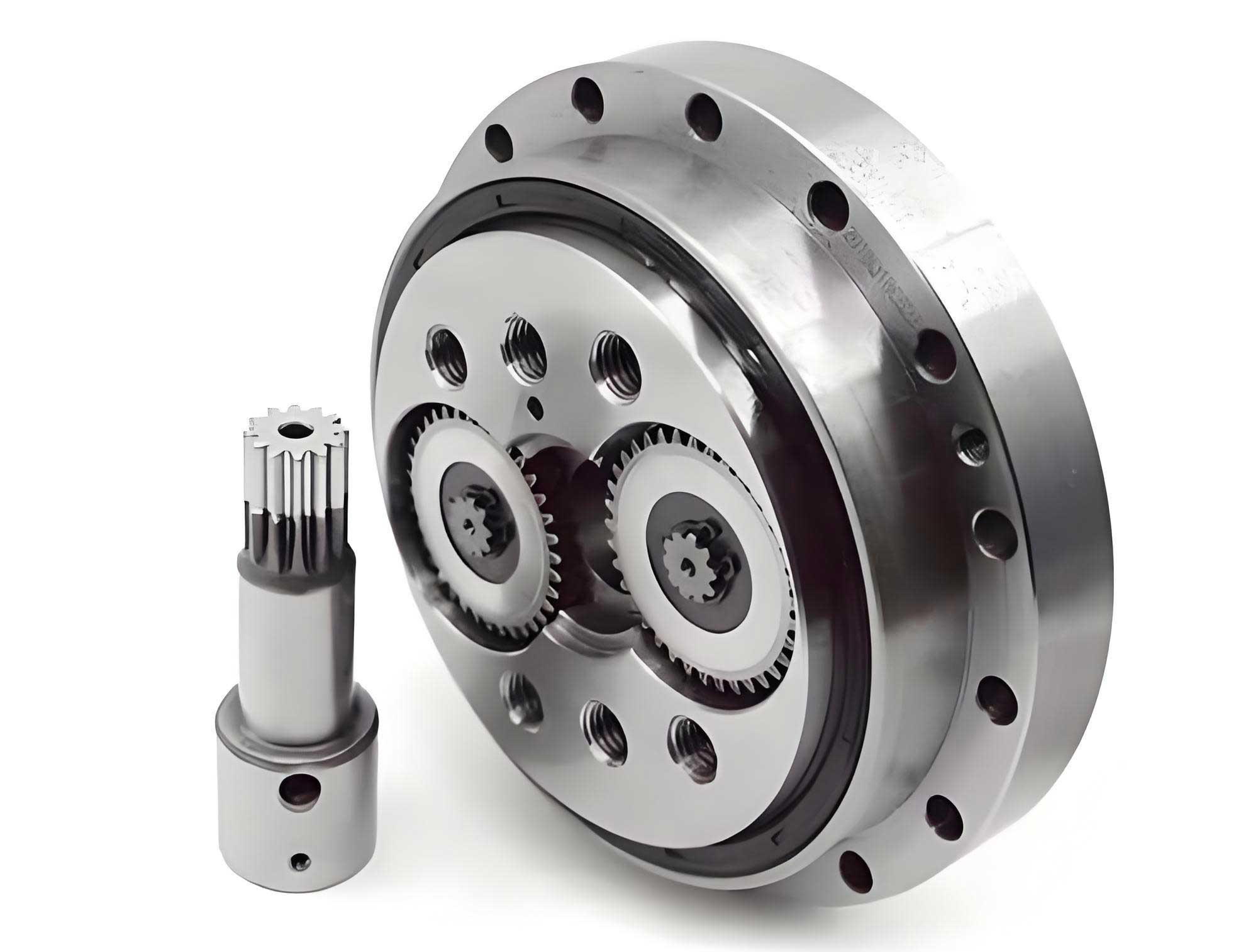
The primary characteristics of the rotary vector reducer are its compact size, high structural rigidity, and exceptionally high reduction ratio, making it indispensable in precision fields such as robotics and aerospace for accurate motion transmission.
The rotary vector reducer features a two-stage reduction mechanism. The first stage involves speed reduction between the sun gear and the planetary gears, known as the involute gear stage. The second stage, which is more complex and critical for overall transmission accuracy, utilizes a cycloidal pin wheel mechanism to achieve high-ratio reduction through a differential motion. This second-stage cycloidal drive is a multi-tooth engagement system, leading to a statically indeterminate force distribution problem. Accurately determining the meshing stiffness of the tooth pairs is therefore the key to understanding load sharing among the simultaneously engaged teeth and forms the essential foundation for dynamic analysis and strength calculation of the rotary vector reducer.
This article focuses on investigating the influence of fundamental tooth profile parameters of the cycloidal drive on its meshing stiffness. A meshing stiffness model for the cycloidal pin pair is constructed based on Hertz contact theory. The validity of the model is confirmed through theoretical calculations and finite element simulation analysis, obtaining time-varying meshing stiffness curves. Subsequently, by applying this methodology and systematically altering key design parameters of the cycloidal pin wheel, transient dynamic simulations are performed. The results are processed to derive the influence laws of critical parameters, such as pin radius and eccentricity, on the meshing stiffness of the rotary vector reducer.
Cycloidal Wheel Tooth Profile Generation and Force Analysis
Mathematical Formulation of the Tooth Profile
The tooth profile of a cycloidal wheel that meshes conjugate with standard pins without backlash is termed the standard or theoretical profile. Using the geometric center of the cycloidal wheel as the coordinate origin and the axis coinciding with the symmetry axis of a tooth space as the x-axis, the parametric equations for the standard cycloidal tooth profile are derived as follows:
$$x_e = \left[r_p – r_{rp} \cdot \Phi^{-1}(K_1, \varphi)\right]\cos\left[(1-i_H)\varphi\right] – \left[e – K_1 \cdot r_{rp} \cdot \Phi^{-1}(K_1, \varphi)\right]\cos(i_H\varphi)$$
$$y_e = \left[r_p – r_{rp} \cdot \Phi^{-1}(K_1, \varphi)\right]\sin\left[(1-i_H)\varphi\right] + \left[e – K_1 \cdot r_{rp} \cdot \Phi^{-1}(K_1, \varphi)\right]\sin(i_H\varphi)$$
Where:
$r_p$ = Radius of the pin circle (mm)
$r_{rp}$ = Radius of the pin (mm)
$i_H$ = Transmission ratio between the cycloidal wheel and the pin wheel, $i_H = \frac{z_p}{z_c}$
$z_p$ = Number of pins
$z_c$ = Number of cycloidal wheel teeth (typically $z_c = z_p – 1$)
$\varphi$ = Engagement phase angle (angle of the rotating arm relative to a pin center vector)
$e$ = Eccentricity (mm)
$K_1$ = Shortening coefficient, $K_1 = \frac{e \cdot z_p}{r_p}$
$\Phi(K_1, \varphi) = \sqrt{1 + K_1^2 – 2K_1\cos\varphi}$
In practical applications, meshing clearance is necessary to compensate for manufacturing errors, facilitate assembly, and ensure proper lubrication. Therefore, the actual cycloidal wheel profile is modified from the theoretical one. The two primary modification methods are the equidistant modification and the profile shift modification (or a combination of both). By substituting $(r_{rp} + \Delta r_{rp})$ and $(r_p – \Delta r_p)$ for $r_{rp}$ and $r_p$ in the standard equations, respectively, the modified tooth profile equations are obtained:
$$x_e = \left[(r_p – \Delta r_p) – (r_{rp} + \Delta r_{rp}) \cdot \Phi^{-1}(K’_1, \varphi)\right]\cos\left[(1-i_H)\varphi – \delta\right] – \frac{a}{r_p – \Delta r_p}\left[(r_p – \Delta r_p) – z_p (r_{rp} + \Delta r_{rp}) \cdot \Phi^{-1}(K’_1, \varphi)\right]\cos(i_H\varphi + \delta)$$
$$y_e = \left[(r_p – \Delta r_p) – (r_{rp} + \Delta r_{rp}) \cdot \Phi^{-1}(K’_1, \varphi)\right]\sin\left[(1-i_H)\varphi – \delta\right] – \frac{a}{r_p – \Delta r_p}\left[(r_p – \Delta r_p) – z_p (r_{rp} + \Delta r_{rp}) \cdot \Phi^{-1}(K’_1, \varphi)\right]\sin(i_H\varphi + \delta)$$
Where $K’_1 = \frac{e \cdot z_p}{r_p – \Delta r_p}$ is the modified shortening coefficient. The signs of $\Delta r_p$ and $\Delta r_{rp}$ determine the direction of the modification. The modified profile is crucial for realistic modeling and analysis of the rotary vector reducer.
Load Distribution Model in Cycloidal-Pin Meshing
The motion within the rotary vector reducer’s second stage is complex. The cycloidal wheels are mounted on eccentric crankshafts. As the input torque drives the crankshaft, it causes the cycloidal wheels to orbit around the center of the pin wheel (revolution). The pins are fixed within the pin housing. The contact between the cycloidal wheel teeth and the pins causes the cycloidal wheel to rotate on its own axis (rotation). Thus, the cycloidal wheel exhibits both revolution and rotation. The pins are uniformly distributed on a circle of radius $r_p$. The cycloidal wheel has one less tooth ($z_c = z_p – 1$), making it a small tooth difference transmission.
A force analysis model can be established considering this motion. The force exerted by the $i$-th pin is denoted as $F_i$. The effective moment arm $l_i$ for this force about the cycloidal wheel’s center of revolution ($O_p$) is a function of the engagement phase angle $\varphi_i$ and is given by:
$$l_i = \frac{e \cdot \sin\varphi_i}{\sqrt{1 + K_1^2 – 2K_1\cos\varphi_i}}$$
This relationship is fundamental for calculating the torque transmission and the equivalent torsional stiffness of the rotary vector reducer assembly.
Meshing Contact Model Based on Hertz Theory
Derivation of Single-Pair Tooth Meshing Stiffness
Theoretically, the cycloidal wheel and pin mesh via line contact. Considering elastic deformation, the contact area becomes a narrow rectangular region. For analysis, the contacting bodies can be approximated as two parallel cylinders. According to Hertz contact theory, the half-length $L$ of the contact area for two cylinders in contact under a load $F$ per unit width $b$ is:
$$L = \sqrt{\frac{8 F_i a_i (1-\mu^2)}{\pi b E}}$$
Where $a_i$ is the equivalent radius of curvature at the $i$-th contact point. For the cycloid-pin pair, the equivalent radius $a_{bi}$ at the cycloid tooth and the pin radius $r_{rp}$ are used. Assuming both components are made of the same material (e.g., steel), with Young’s modulus $E$ and Poisson’s ratio $\mu$, the radial compression of the pin, $\delta_{zi}$, can be derived. Assuming $L$ is much smaller than the pin radius, a simplified expression is obtained:
$$\delta_{zi} \approx \frac{L^2}{r_{rp}} = \frac{8 F_i a_i (1-\mu^2)}{\pi b E r_{rp}}$$
This leads to the contact stiffness for a single pin, $k_{1i}$:
$$k_{1i} = \frac{F_i}{\delta_{zi}} = \frac{\pi b E r_{rp}}{8 a_i (1-\mu^2)}$$
Similarly, the radial compression of the cycloidal tooth at the $i$-th contact point, $\delta_{bi}$, and its contact stiffness, $k_{2i}$, are:
$$\delta_{bi} \approx \frac{8 F_i a_i (1-\mu^2)}{\pi b E a_{bi}}$$
$$k_{2i} = \frac{F_i}{\delta_{bi}} = \frac{\pi b E a_{bi}}{8 a_i (1-\mu^2)}$$
In the above, $a_{bi}$ is the equivalent curvature radius of the cycloid tooth at the contact point, which can be expressed as $a_{bi} = \frac{r_z \cdot \Phi^{3/2}(K_1, \varphi_i)}{T_i + \rho_z}$, where $r_z$ is the pin circle radius, $\rho_z$ is the pin radius, and $T_i$ is a geometric function of $K_1$, $z_p$, and $\varphi_i$.
For a single tooth pair in contact, the combined meshing stiffness $k_i$ is the series combination of the pin stiffness and the cycloid tooth stiffness, analogous to springs in series:
$$\frac{1}{k_i} = \frac{1}{k_{1i}} + \frac{1}{k_{2i}}$$
$$k_i = \frac{k_{1i} \cdot k_{2i}}{k_{1i} + k_{2i}} = \frac{\pi b E}{8(1-\mu^2)} \cdot \frac{r_{rp} \cdot a_{bi}}{a_i (r_{rp} + a_{bi})}$$
Substituting the expressions for $a_{bi}$ and simplifying, the single-pair meshing stiffness can be written in a more compact form as a function of the phase angle $\varphi_i$ and the fundamental parameters of the rotary vector reducer:
$$k_i(\varphi_i) = \frac{\pi b E r_z \Phi^{3/2}(K_1, \varphi_i)}{8(1-\mu^2) \left( r_z \Phi^{3/2}(K_1, \varphi_i) + 2 r_{rp} T_i \right)}$$
Time-Varying Composite Meshing Stiffness Model
A defining feature of cycloidal drives is their high theoretical contact ratio, which can approach half the number of pins. The composite torsional stiffness of the entire rotary vector reducer stage is not a simple sum of individual tooth pair stiffnesses because the number of teeth in simultaneous contact varies with the rotation angle (phase). Furthermore, the intentional profile modifications mentioned earlier introduce initial clearance $\Delta(\varphi_i)$, which reduces the actual number of contacting tooth pairs below the theoretical maximum.
The initial clearance function for a modified profile is:
$$\Delta(\varphi_i) = \Delta r_{rp} \left(1 – \frac{\sin\varphi_i}{\sqrt{1+K_1^2-2K_1\cos\varphi_i}}\right) – \frac{\Delta r_p \left(1 – K_1\cos\varphi_i – \sqrt{1-K_1^2}\sin\varphi_i \right)}{\sqrt{1+K_1^2-2K_1\cos\varphi_i}}$$
Under an applied torque $T_{in}$, the cycloidal wheel rotates through a small angle $\beta$. The normal approach (displacement) along the line of action at the $i$-th potential contact point is approximately $\delta_i = l_i \beta$. Actual contact occurs only where this displacement exceeds the initial clearance: $\delta_i > \Delta(\varphi_i)$. The range of phase angles $[\varphi_a, \varphi_b]$ satisfying this condition defines the set of simultaneously engaged teeth. The number of contacting teeth is $z = \frac{\varphi_b – \varphi_a}{2\pi / z_p}$.
Considering factors like manufacturing and assembly errors, an empirical coefficient $\lambda$ (typically around 0.7) is introduced. The equivalent torsional stiffness $K_{eq}$ of the cycloidal drive stage in the rotary vector reducer is the sum of the stiffness contributions from all engaged teeth, weighted by the square of their moment arms:
$$K_{eq} = \lambda \sum_{i \in \text{engaged}} k_i(\varphi_i) \cdot l_i^2$$
This stiffness is inherently time-varying (or angle-varying) due to the changing set of engaged teeth as the cycloidal wheel rotates, making it a critical dynamic parameter for the rotary vector reducer.
Finite Element Analysis of Time-Varying Meshing Stiffness
Parametric 3D Model Development
Given the complex higher-order surface of the cycloidal tooth, a parametric 3D model was developed using CAD software (SolidWorks). The model was based on the modified tooth profile equations. The assembly includes two cycloidal wheels (phase-shifted by 180° for balance), 40 pins, a pin housing, and eccentric shafts. Key initial design parameters are summarized in Table 1.
| Parameter | Symbol | Value | Unit |
|---|---|---|---|
| Number of Pins | $z_p$ | 40 | – |
| Pin Circle Radius | $r_p$ | 110.0 | mm |
| Pin Radius | $r_{rp}$ | 3.0 | mm |
| Number of Cycloid Teeth | $z_c$ | 39 | – |
| Eccentricity | $e$ | 2.2 | mm |
| Face Width | $b$ | 16 | mm |
| Shortening Coefficient | $K_1$ | 0.675 | – |
| Equidistant Modification | $\Delta r_{rp}$ | +0.025 | mm |
| Profile Shift Modification | $\Delta r_p$ | -0.025 | mm |
To enhance computational efficiency in the finite element analysis (FEA), non-essential features like small fillets and bearings were omitted. The model was then imported into ANSYS Workbench for transient structural analysis.
Simulation Setup and Material Properties
The materials were assigned as shown in Table 2. A structured hex-dominant mesh was generated, with refinements in the tooth contact regions to ensure accuracy. The pin housing and pins were fixed together, with appropriate constraints applied to the cycloidal wheels and input crankshaft. A constant input torque of 3 Nm was applied to the crankshaft, simulating a steady-state operating condition for the rotary vector reducer.
| Component | Material | Young’s Modulus, $E$ (GPa) | Poisson’s Ratio, $\mu$ |
|---|---|---|---|
| Cycloidal Wheel | 20CrMnTi | 212 | 0.3 |
| Pin | 20CrMnTi | 212 | 0.3 |
| Pin Housing | QT450 | 173 | 0.3 |
Verification of the Meshing Stiffness Model
The transient dynamic simulation was solved to obtain contact forces over a complete engagement cycle. The reaction forces on the pins were extracted and used to calculate the instantaneous composite torsional stiffness $K_{eq}^{FEA}$ using the relationship between torque and the sum of moments from contact forces. This result was compared with the theoretical stiffness $K_{eq}^{Theory}$ calculated from the Hertz-based model (Eq. 10) using the same geometric and material parameters.
The comparison, shown conceptually in the results, revealed that the trend and magnitude of the time-varying meshing stiffness from the FEA closely matched those from the theoretical model. The minor discrepancies can be attributed to the simplifications in the Hertz model (e.g., treating contact as semi-infinite cylinders) versus the more accurate 3D contact simulation in FEA. This agreement validates the correctness of the established theoretical approach for the rotary vector reducer’s cycloidal stage.
Parametric Study: Influence of Key Design Parameters
With the model verified, a parametric study was conducted to investigate the influence of two critical tooth profile parameters on the meshing stiffness of the rotary vector reducer: the pin radius ($r_{rp}$) and the eccentricity ($e$). The base model (Table 1) was used as a reference. Each parameter was varied independently while keeping all others constant, and new FEA simulations were run for each configuration. The resulting stiffness curves were analyzed.
Effect of Pin Radius ($r_{rp}$)
The pin radius was varied from 2.8 mm to 3.2 mm. The time-averaged meshing stiffness values were computed from the simulation results, as summarized in Table 3.
| Pin Radius, $r_{rp}$ (mm) | Shortening Coefficient, $K_1$ | Average Meshing Stiffness, $\bar{K}_{eq}$ (MN·m/rad) | Change Relative to Base |
|---|---|---|---|
| 2.8 | 0.675 | 5.72 | -1.9% |
| 3.0 (Base) | 0.675 | 5.83 | 0% |
| 3.2 | 0.675 | 5.91 | +1.4% |
The results indicate that changes in pin radius have a relatively minor effect on the overall meshing stiffness of the rotary vector reducer. A 6.7% decrease in radius led to only a 1.9% decrease in stiffness, while a 6.7% increase led to a 1.4% increase. This can be explained by the series stiffness formula (Eq. 9). While a larger pin increases its own contact stiffness $k_1$, it also slightly alters the curvature relationship at the contact point, affecting the equivalent radius $a_i$. The net effect on the combined single-pair stiffness $k_i$ and consequently on the composite stiffness $K_{eq}$ is limited. Therefore, the pin radius in a rotary vector reducer is typically determined more by strength and durability considerations than by a primary desire to modulate stiffness.
Effect of Eccentricity ($e$)
The eccentricity, a fundamental design parameter, was varied from 2.0 mm to 2.4 mm. This change directly affects the shortening coefficient $K_1 = e z_p / r_p$ and the force transmission arm $l_i$. The impact on stiffness was significant, as shown in Table 4.
| Eccentricity, $e$ (mm) | Shortening Coefficient, $K_1$ | Average Meshing Stiffness, $\bar{K}_{eq}$ (MN·m/rad) | Change Relative to Base |
|---|---|---|---|
| 2.0 | 0.614 | 4.95 | -15.1% |
| 2.2 (Base) | 0.675 | 5.83 | 0% |
| 2.4 | 0.736 | 6.88 | +18.0% |
The data demonstrates that eccentricity has a profound influence on the meshing stiffness of the rotary vector reducer. A 9% decrease in eccentricity caused a 15.1% drop in stiffness, while a 9% increase led to an 18% increase. This strong correlation stems from two main factors embedded in Eq. (10) for composite stiffness. First, the force arm $l_i$ is directly proportional to eccentricity ($l_i \propto e$). Since the composite stiffness sums terms proportional to $k_i \cdot l_i^2$, a change in $e$ affects the result quadratically through $l_i^2$. Second, eccentricity changes the shortening coefficient $K_1$, which alters the tooth profile curvature (affecting $\Phi(K_1, \varphi_i)$ and $T_i$) and consequently the single-pair stiffness $k_i$. The combined effect makes precise control and selection of eccentricity paramount for achieving the desired torsional rigidity in a rotary vector reducer design.
Conclusion
This investigation into the cycloidal drive stage of the rotary vector reducer has yielded several important conclusions regarding the relationship between tooth profile parameters and meshing stiffness. The necessity of profile modification (equidistant and/or profile shift) to introduce controlled clearance was confirmed, as it directly influences the number of teeth in simultaneous contact and must be accounted for in any accurate stiffness model.
A robust methodology was established, combining a Hertz contact theory-based analytical model for single-pair and composite meshing stiffness with detailed 3D finite element analysis. The close agreement between the theoretical predictions and FEA simulation results validated the correctness of this approach for analyzing the rotary vector reducer.
The parametric study clearly delineated the impact of two key design variables. The pin radius ($r_{rp}$) was found to have a relatively minor effect on the overall meshing stiffness of the rotary vector reducer. In contrast, the eccentricity ($e$) proved to be a dominant parameter, with even small changes producing significant variations in stiffness. This is due to its direct, squared influence on the force transmission arm length and its effect on the tooth profile geometry via the shortening coefficient.
Therefore, in the practical engineering design and manufacturing of high-performance rotary vector reducers, stringent control over the eccentricity and its associated tolerances is critical for ensuring predictable and high torsional stiffness. The findings provide a quantitative basis for designers to optimize the cycloidal drive parameters of a rotary vector reducer to meet specific stiffness requirements, contributing to the development of more precise and reliable robotic drive systems.