
In modern manufacturing, the axial roll-forming process for gears has gained significant attention due to its advantages in material utilization, efficiency, and enhanced mechanical properties. However, at room temperature, the cold rolling of spur and pinion gears faces challenges, particularly when processing large-modulus gears, where poor material flow leads to high rolling forces and suboptimal tooth quality. To address this, we investigate the axial warm rolling process, which involves pre-heating the gear blank to improve plasticity and reduce forming resistance. This study combines finite element simulation using DEFORM-3D software with experimental validation to analyze the characteristics of rolling force, temperature field, and stress field during the warm rolling of spur and pinion gears. The goal is to provide theoretical insights and practical guidance for optimizing the roll-forming process, enabling the production of high-quality spur and pinion gears with larger moduli.
The axial roll-forming of spur and pinion gears is based on the generating motion between the rolling die and the gear blank, following the principles of gear meshing. During the process, the rolling die applies force to the workpiece, gradually forming the involute tooth profile. The process typically involves three stages: initial indexing, forming, and exit. In the initial indexing stage, the rolling die contacts the blank, creating tooth impressions for division. The forming stage sees increased axial feed, where material flows under pressure to shape the teeth. Finally, in the exit stage, the tooth profile is fully formed without further penetration. For spur and pinion gears, this method ensures precise tooth geometry while minimizing material waste. The initial diameter of the gear blank is determined using the volume constancy principle, where the cross-sectional area of the formed gear equals that of the blank. For a target spur and pinion gear with 44 teeth and a modulus of 2.5 mm, the cross-sectional area \( S \) is measured via 3D modeling. The initial diameter \( D_0 \) is calculated as:
$$ D_0 = 2 \times \sqrt{\frac{S}{\pi}} $$
Considering material flow and oxidation during heating, the practical initial diameter \( D \) is adjusted:
$$ D = D_0 + (0.2 \text{ to } 0.4) \times m $$
where \( m \) is the modulus. For this study, \( m = 2.5 \, \text{mm} \), so \( D \) is slightly larger to account for real-world factors. The gear blank material is 40Cr steel, whose plasticity varies with temperature. To avoid issues like blue brittleness (200–400°C) and hot brittleness (800–950°C), the pre-heating temperature is set around 700°C. This range enhances material flow without causing overheating or burning, making it ideal for warm rolling of spur and pinion gears.
We conducted finite element simulations using DEFORM-3D to model the axial warm rolling process for spur and pinion gears. The simulation setup included a simplified gear blank, treated as a plastic body, with rigid components such as backing plates, a mandrel, and the rolling die. To replicate the actual motion, the blank’s rotation and axial movement were converted into equivalent motions of the rolling die: a rotational speed of \( \pi \, \text{rad/s} \) and an axial feed rate of 0.6 mm/s. Friction coefficients were set at 0.3 between the blank and die, and 0 between the blank and plates. The simulation comprised two parts: induction heating and rolling. The induction heating module in DEFORM-3D was used to heat the blank surface to approximately 700°C, exhibiting a skin effect with temperature decreasing from the surface inward. The rolling process was then simulated, capturing the three stages of axial feed. The tooth formation progressed smoothly, with material flowing axially at the ends due to lack of constraints. The simulation results provided insights into the deformation mechanics, particularly for spur and pinion gears.
A key aspect of this study is the comparison between cold and warm rolling for spur and pinion gears. We extracted rolling force data over time, as shown in Table 1, which summarizes the maximum rolling forces during different stages. The rolling force exhibits periodic fluctuations due to intermittent contact between the die and blank.
| Process Stage | Cold Rolling Max Force (kN) | Warm Rolling Max Force (kN) | Reduction (%) |
|---|---|---|---|
| Initial Indexing | 45 | 15 | 66.7 |
| Forming | 140 | 55 | 60.7 |
| Exit | Gradual decrease | Gradual decrease | N/A |
The data indicates that warm rolling reduces rolling forces by 50–65%, which can significantly extend the life of rolling dies and machinery. This reduction is crucial for processing large-modulus spur and pinion gears, where high forces often lead to equipment wear. The stress field during warm rolling was analyzed by examining the mid-cross-section of the workpiece. As the axial feed increases, stress concentrates in the tooth-forming regions, with maximum values near the tooth roots. For instance, at 25% feed, the maximum stress is around 360 MPa; at 50% feed, it drops to 300 MPa with stress spreading to adjacent tooth slots; and at 75% feed, the stress distribution becomes more symmetric. The stress \( \sigma \) can be related to material flow using the yield criterion:
$$ \sigma = \sqrt{\frac{3}{2} \sigma_{ij}’ \sigma_{ij}’} $$
where \( \sigma_{ij}’ \) is the deviatoric stress tensor. This highlights the localized deformation in spur and pinion gear formation. The temperature field, as depicted in Table 2, shows a gradual decline during rolling due to heat loss from conduction and convection, despite heat generation from friction and deformation.
| Axial Feed (%) | Surface Temperature (°C) | Core Temperature (°C) | Notes |
|---|---|---|---|
| 0 (Heated) | 750 | 650 | After induction heating |
| 25 | 720 | 640 | Stress peaks at tooth roots |
| 50 | 690 | 630 | Material flow intensifies |
| 75 | 670 | 620 | Tooth profile near completion |
| 100 | 630 | 610 | Final成形 temperature |
The temperature remains above the recrystallization threshold (around 600°C for 40Cr steel), promoting plasticity and reducing flow stress. This is beneficial for the成形 of spur and pinion gears, as it ensures proper material filling at tooth tips and roots. The heat transfer during rolling can be modeled using Fourier’s law:
$$ q = -k \nabla T $$
where \( q \) is the heat flux, \( k \) is thermal conductivity, and \( \nabla T \) is the temperature gradient. For spur and pinion gears, maintaining an optimal temperature range is essential to avoid defects and achieve high accuracy.
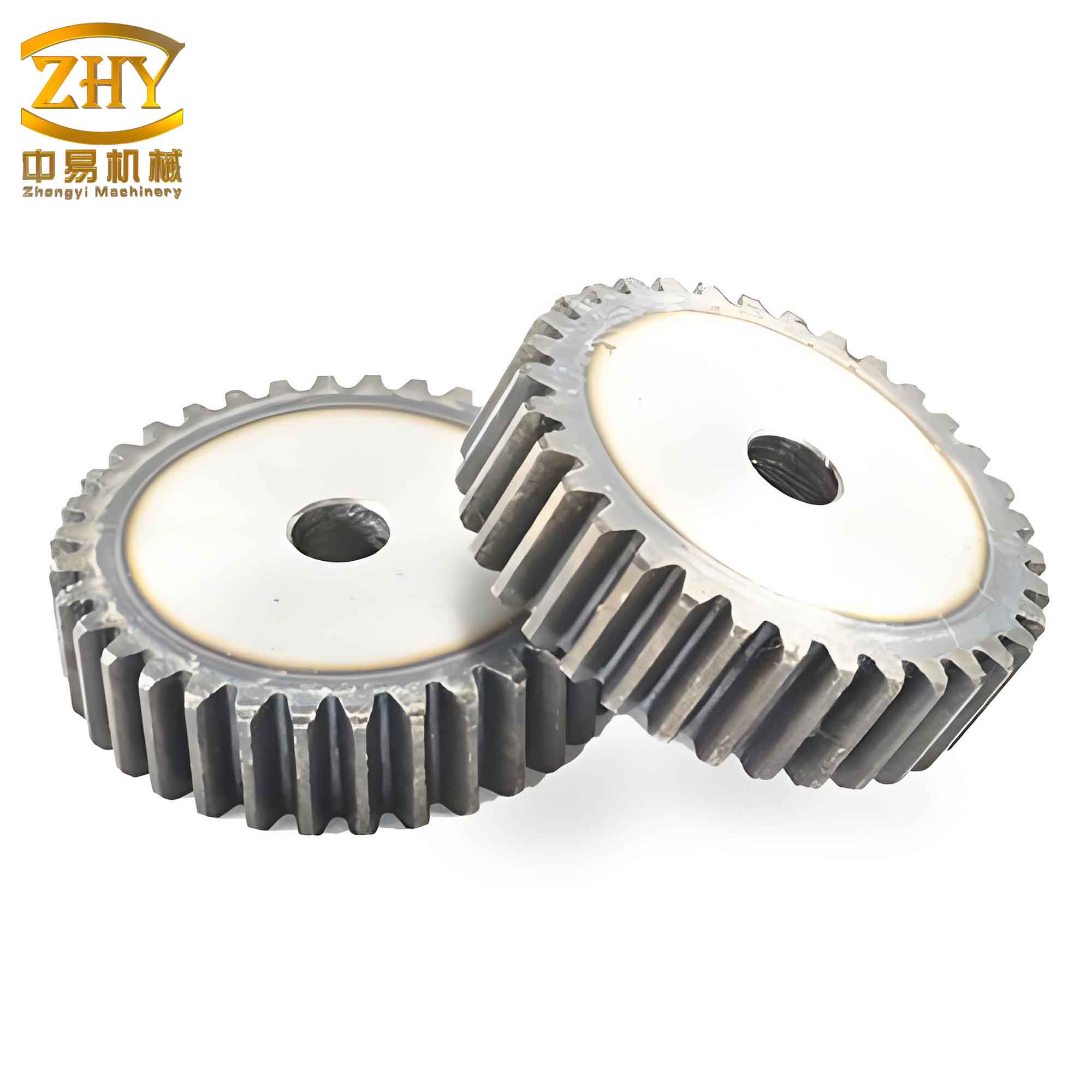
The experimental phase involved using an electromagnetic induction heating system to pre-heat 40Cr steel blanks to about 800°C, accounting for heat loss before rolling. A laser thermometer monitored surface temperatures. The warm rolling was performed on a dedicated axial roll-forming machine, with parameters matching the simulation: rolling die speed of \( \pi \, \text{rad/s} \) and axial feed rate of 0.6 mm/s. We successfully produced spur and pinion gears with 44 teeth and a modulus of 2.5 mm. The formed gears exhibited well-defined involute tooth profiles, with minimal defects and good material filling at the齿顶 and齿根. To prevent axial material flow in practical applications, multiple gear blanks can be rolled simultaneously with end plates. The experimental results closely aligned with the simulation predictions, validating the finite element model. For instance, the tooth geometry from experiments matched the simulated profiles, confirming the accuracy of stress and temperature analyses. This consistency underscores the reliability of warm rolling for manufacturing spur and pinion gears, especially for larger moduli where cold rolling falls short.
Further analysis of the warm rolling process for spur and pinion gears involves examining material behavior under combined thermal-mechanical loads. The effective strain \( \bar{\epsilon} \) during deformation can be expressed as:
$$ \bar{\epsilon} = \sqrt{\frac{2}{3} \epsilon_{ij} \epsilon_{ij}} $$
where \( \epsilon_{ij} \) is the strain tensor. In warm rolling, the strain distribution is more uniform compared to cold rolling, reducing the risk of cracking in spur and pinion gears. We also studied the influence of process parameters on tooth quality. Table 3 summarizes key factors and their effects, derived from simulation and试验 data.
| Parameter | Range | Effect on Tooth Formation | Optimal Value |
|---|---|---|---|
| Pre-heating Temperature | 650–750°C | Higher temperature improves flow but risks oxidation; lower temperature increases force | 700°C |
| Axial Feed Rate | 0.4–0.8 mm/s | Slower rate allows better material filling but increases cycle time; faster rate may cause incomplete forming | 0.6 mm/s |
| Rolling Die Speed | 2–4 rad/s | Higher speed reduces contact time, affecting heat transfer; lower speed may lead to uneven deformation | π rad/s |
| Friction Coefficient | 0.2–0.4 | Higher friction enhances grip but increases wear; lower friction may cause slipping | 0.3 |
These parameters are critical for optimizing the warm rolling of spur and pinion gears. For example, the axial feed rate directly affects the rolling force \( F \), which can be estimated using the slab method for plastic deformation:
$$ F = \sigma_y \cdot A \cdot \mu $$
where \( \sigma_y \) is the yield stress, \( A \) is the contact area, and \( \mu \) is the friction factor. In warm rolling, \( \sigma_y \) decreases with temperature, explaining the force reduction. Additionally, the tooth profile accuracy of spur and pinion gears depends on the die design and alignment. The involute curve can be described mathematically:
$$ r_b = \frac{m \cdot z}{2} \cos(\alpha) $$
where \( r_b \) is the base radius, \( z \) is the number of teeth, and \( \alpha \) is the pressure angle (typically 20°). During rolling, the material must conform to this geometry, which is facilitated by the warm temperature’s enhanced ductility. We also evaluated the microstructural changes in 40Cr steel after warm rolling. The heating promotes dynamic recovery and recrystallization, leading to finer grains and improved toughness—a key advantage for spur and pinion gears in demanding applications. The grain size \( d \) can be related to the Zener-Hollomon parameter \( Z \):
$$ Z = \dot{\epsilon} \exp\left(\frac{Q}{RT}\right) $$
where \( \dot{\epsilon} \) is the strain rate, \( Q \) is the activation energy, \( R \) is the gas constant, and \( T \) is the absolute temperature. For spur and pinion gears, a lower \( Z \) value (achieved through warm rolling) results in larger recrystallized grains, balancing strength and ductility.
In conclusion, the axial warm rolling process offers a viable solution for manufacturing large-modulus spur and pinion gears, overcoming the limitations of cold rolling. Through finite element simulation, we demonstrated significant reductions in rolling forces—up to 65%—and analyzed the stress and temperature fields that promote uniform deformation. The experimental validation confirmed the simulation accuracy, with successfully rolled gears exhibiting excellent tooth profiles. Key parameters such as pre-heating temperature, feed rate, and die speed were optimized to enhance process efficiency and gear quality. This study provides a comprehensive framework for advancing the roll-forming of spur and pinion gears, emphasizing the benefits of warm processing in terms of equipment longevity, material savings, and mechanical performance. Future work could explore advanced materials or real-time temperature control to further refine the成形 of spur and pinion gears for industrial applications.