
In the field of mechanical transmission, helical gears play a crucial role due to their superior load-bearing capacity and efficiency. Planetary gear systems, which often incorporate helical gears, are widely used in industries such as automotive, aerospace, and chemical processing. Among these, internal helical gears offer advantages over internal spur gears, including reduced motion errors and smoother operation. However, to further enhance performance, tooth surface modification, or profiling, is essential to improve load distribution and reduce noise. In this study, we focus on the form-grinding process for modified internal helical gears, specifically optimizing the grinding wheel profile to minimize tooth profile errors. The accuracy of the grinding wheel profile directly impacts the final gear quality, making this optimization critical for high-precision applications.
Our research begins by establishing a mathematical model for the grinding wheel profile used in form-grinding modified internal helical gears. We derive the equation for the modified involute helical surface of the gear, incorporating a parabolic modification function to account for radial corrections. For a standard internal helical gear, the left tooth surface can be expressed in parametric form. Let \(r_b\) be the base radius, \(\beta\) the helix angle, \(\alpha_n\) the normal pressure angle, and \(p\) the spiral parameter where \(p = r_b / \tan(\beta_b)\) with \(\beta_b\) as the base helix angle. The modification function \(\Delta L\) is simplified as a second-order parabolic curve:
$$ \Delta L = a_c (L – L_0)^2 $$
where \(L\) is the length of the generating line at any given point, \(L_0\) is the initial length, and \(a_c\) is the modification coefficient. Combining this with the standard helical gear equation, the modified tooth surface vector \(\mathbf{r}(u, \theta)\) in the gear coordinate system is:
$$ \mathbf{r}(u, \theta) = \begin{bmatrix}
r_b \cos(\tau) + (r_b u + \Delta L) \sin(\tau) \\
r_b \sin(\tau) – (r_b u + \Delta L) \cos(\tau) \\
p \theta
\end{bmatrix} $$
where \(\tau = u + \theta – \delta\), with \(u\) as the involute expansion angle, \(\theta\) as the rotation angle around the gear axis, and \(\delta\) as the angle between the x-axis and the line from the origin to the start of the involute. This model forms the basis for our grinding wheel profile optimization.
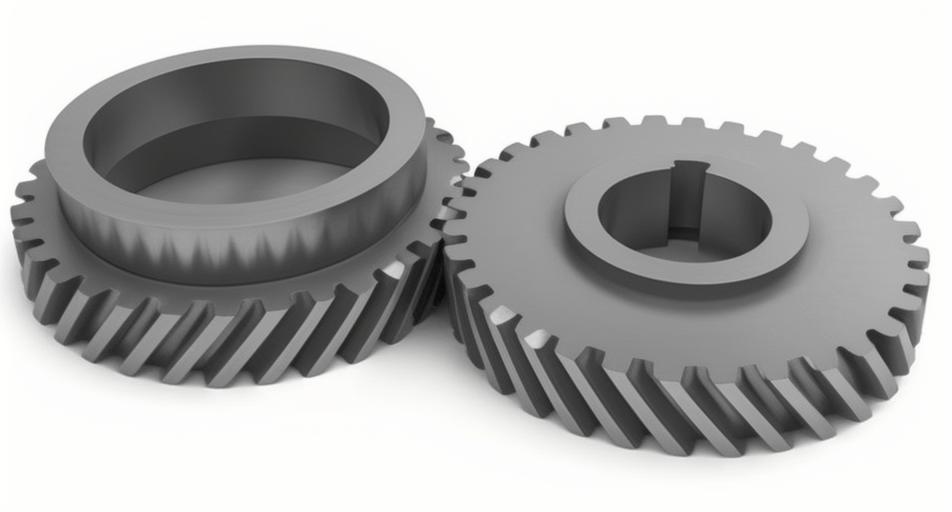
To solve for the grinding wheel profile, we employ a form-grinding setup where the wheel and gear are positioned relative to each other. Let the gear coordinate system be \(O-XYZ\) and the grinding wheel coordinate system be \(O_0-X_0Y_0Z_0\), with a distance \(E\) between their origins. The grinding wheel axis \(Y_0\) is inclined at an angle \(\Sigma\) relative to the gear axis \(Z\). The transformation matrix from the gear to the wheel coordinate system is:
$$ \mathbf{M}_{O_0O} = \begin{bmatrix}
1 & 0 & 0 & -E \\
0 & \sin\Sigma & -\cos\Sigma & 0 \\
0 & \cos\Sigma & \sin\Sigma & 0 \\
0 & 0 & 0 & 1
\end{bmatrix} $$
Applying this transformation to the modified tooth surface equation yields the wheel surface coordinates \(\mathbf{r}_0(u, \theta)\). We then use the truncated circle method to determine the contact conditions between the grinding wheel and the gear tooth surface. By intersecting the wheel with a plane \(y = c_1\) (a constant), we obtain a curve of intersection, and from the tangency condition, we derive a nonlinear equation that must be satisfied at the contact points:
$$ \tan\beta_b \left( \frac{E}{r_b} \cot\Sigma + \tan\beta_b \cos\tau \right) – \tan\beta_b \left( \cot\Sigma + \tan\beta_b \frac{E}{r_b} \right) \sin\tau + \tan^2\beta_b \left( u + \frac{\Delta L}{r_b} \right) – \theta = 0 $$
This equation is solved iteratively using a binary approximation algorithm. Given a set of parameter \(u\) values selected based on gear parameters and equal-error principles, we compute corresponding \(\theta\) values, which are then substituted back to obtain the grinding wheel profile coordinates \((x_0, y_0, z_0)\). This approach ensures an accurate representation of the wheel profile for grinding modified internal helical gears.
Next, we reverse the process to verify the ground tooth profile. By transforming coordinates from the grinding wheel back to the gear, we can simulate the actual grinding process and compare it with the theoretical involute profile. The transformation matrix from the wheel to the gear coordinate system involves rotations and translations, accounting for the wheel installation angle \(\Phi\). The resulting equations allow us to generate a family of curves representing the wheel’s grinding path, whose envelope defines the simulated tooth profile. This step is crucial for evaluating tooth profile errors and optimizing the wheel installation angle to avoid grinding interference.
To illustrate our methodology, we present a case study with specific parameters for an internal helical gear. The key parameters are summarized in the table below:
| Parameter | Symbol | Value |
|---|---|---|
| Number of Teeth | \(z\) | 50 |
| Normal Module | \(m_n\) | 5 mm |
| Helix Angle | \(\beta\) | 15° |
| Normal Pressure Angle | \(\alpha_n\) | 20° |
| Base Radius | \(r_b\) | Calculated from \(m_n\) and \(\alpha_n\) |
| Grinding Wheel Radius | \(R\) | 50 mm |
| Modification Coefficient | \(a_c\) | 0.001 (example value) |
Using these parameters, we implemented our mathematical models in MATLAB to simulate the grinding process. Through numerical analysis, we optimized the grinding wheel installation angle \(\Sigma\) to eliminate interference. Our results show that at \(\Sigma = 75.2^\circ\), the grinding wheel profile produces a tooth shape that closely matches the theoretical involute. The simulation output includes the grinding wheel trajectory and the resulting tooth profile, which we compare against the ideal profile to quantify errors. For modified internal helical gears, the maximum tooth profile error was found to be approximately 6–7 μm, whereas for unmodified helical gears, using a reference method, the error was about 13–15 μm. This represents a reduction of around 50%, demonstrating the effectiveness of our optimization approach for helical gears.
The mathematical formulations involved in this study are extensive. Below, we list key equations used in the modeling process:
1. Modified Tooth Surface Equation:
$$ \mathbf{r}(u, \theta) = \begin{bmatrix}
r_b \cos(\tau) + (r_b u + \Delta L) \sin(\tau) \\
r_b \sin(\tau) – (r_b u + \Delta L) \cos(\tau) \\
p \theta
\end{bmatrix}, \quad \tau = u + \theta – \delta $$
2. Transformation to Wheel Coordinates:
$$ \mathbf{r}_0(u, \theta) = \mathbf{M}_{O_0O} \cdot \mathbf{r}(u, \theta) $$
which expands to:
$$ \mathbf{r}_0(u, \theta) = \begin{bmatrix}
r_b \cos\tau + (r_b u + \Delta L) \sin\tau – E \\
r_b \sin\tau \sin\Sigma – (r_b u + \Delta L) \cos\tau \sin\Sigma – p \theta \cos\Sigma \\
r_b \sin\tau \cos\Sigma – (r_b u + \Delta L) \cos\tau \cos\Sigma + p \theta \sin\Sigma
\end{bmatrix} $$
3. Nonlinear Contact Condition:
$$ \tan\beta_b \left( \frac{E}{r_b} \cot\Sigma + \tan\beta_b \cos\tau \right) – \tan\beta_b \left( \cot\Sigma + \tan\beta_b \frac{E}{r_b} \right) \sin\tau + \tan^2\beta_b \left( u + \frac{\Delta L}{r_b} \right) – \theta = 0 $$
4. Reverse Transformation for Tooth Profile Simulation:
$$ \mathbf{r}_2 = \mathbf{M} \cdot \begin{bmatrix} x_0 \\ y_0 \\ 0 \\ 1 \end{bmatrix}, \quad \mathbf{M} = \begin{bmatrix}
\cos\Phi & 0 & -\sin\Phi & E \\
\cos\Sigma \sin\Phi & \sin\Sigma & \cos\Sigma \cos\Phi & 0 \\
\sin\Sigma \sin\Phi & -\cos\Sigma & \sin\Sigma \cos\Phi & 0 \\
0 & 0 & 0 & 1
\end{bmatrix} $$
After applying additional rotations to project onto the gear end plane, we obtain the simulated profile points.
To further summarize our findings, we provide a table comparing tooth profile errors for modified versus unmodified internal helical gears under optimal grinding conditions:
| Gear Type | Maximum Tooth Profile Error | Reduction Compared to Unmodified | Optimal Wheel Installation Angle |
|---|---|---|---|
| Modified Internal Helical Gear | 6–7 μm | ~50% | 75.2° |
| Unmodified Internal Helical Gear | 13–15 μm | — | Reference value from literature |
Our investigation into helical gears, particularly internal helical gears, highlights the importance of precise grinding wheel profiling. The optimization method we developed not only reduces tooth errors but also enhances the overall quality of helical gear transmissions. In practical applications, such as in planetary gearboxes, this leads to improved durability and noise reduction. The use of numerical simulations allows for efficient testing and adjustment of grinding parameters without physical trials, saving time and resources in the manufacturing of helical gears.
In conclusion, we have presented a comprehensive approach to optimizing the grinding wheel profile for form-grinding modified internal helical gears. By establishing accurate mathematical models and employing numerical algorithms, we achieved a significant reduction in tooth profile errors. This method is applicable to the production of high-precision helical gears, potentially enabling the manufacturing of gears up to grade 5–6 accuracy. Future work could explore extensions to other gear types or more complex modification functions, further advancing the field of gear manufacturing for helical gears.